


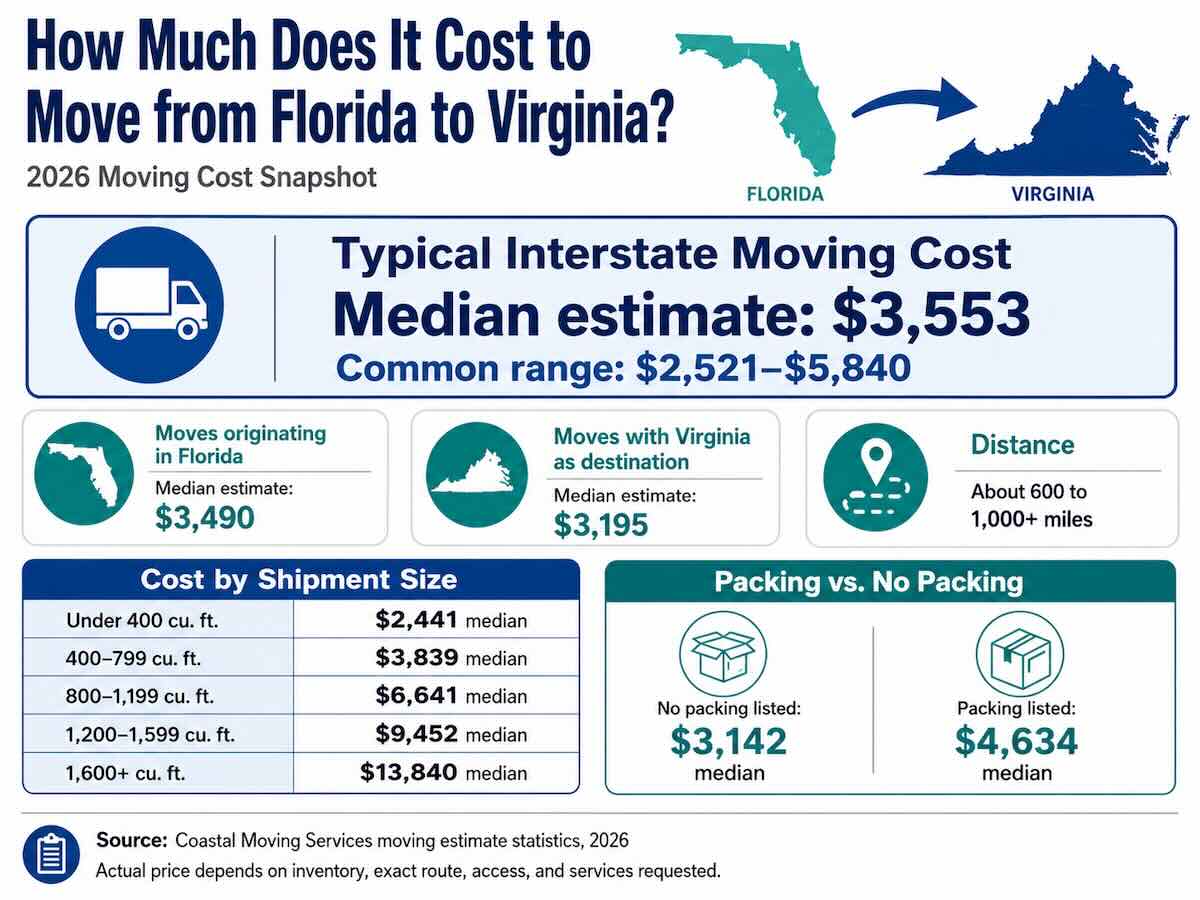
For the move itself, our 2026 estimate statistics provide a useful starting point. The median interstate moving estimate in our records is $3,553, with a common middle range of $2,521 to $5,840. Moves originating in Florida have a median estimate of $3,490, while moves with Virginia as the destination have a median of $3,195. These are broader planning figures rather than a Florida-to-Virginia route quote, because the amount of furniture being moved can change the price by thousands of dollars.
Once you arrive, the financial picture becomes more complicated. Florida does not impose a personal state income tax, while Virginia does. Housing can move in either direction depending on where you settle. Richmond and Roanoke can cost considerably less for housing than South Florida, while Arlington and Alexandria can be more expensive than many Florida cities. Virginia also allows localities to levy personal property taxes on vehicles, an expense that can surprise someone who has spent years living in Florida.
This guide brings those pieces together. It covers the cost to move from Florida to Virginia, the differences in housing and taxes, the Virginia cities worth comparing, the services available for the move, and the practical requirements that begin once the truck reaches your new home.
Key Points: Moving from Florida to Virginia in 2026
- Typical moving budget: Coastal Moving Services’ 2026 data shows a $3,553 median interstate moving estimate. Moves originating in Florida have a $3,490 median, while moves with Virginia as the destination have a $3,195 median.
- Shipment size changes the price considerably: Moves under 400 cubic feet have a median estimate of $2,441, compared with $6,641 for shipments between 800 and 1,199 cubic feet. Larger furnished homes can move well beyond the general interstate range.
- Florida-to-Virginia distance depends on the cities: North Florida to Richmond can be around 600 road miles, while moves from South Florida to Northern Virginia can exceed 1,000 miles. The actual pickup and delivery ZIP codes should be used when estimating the move.
- Virginia introduces a state income tax: Florida does not impose a personal state income tax, while Virginia currently uses graduated individual income-tax rates that reach 5.75%. This should be included when comparing your post-move household budget.
- Housing costs depend heavily on where you settle: Richmond and Roanoke can offer substantially lower housing costs than Miami or other expensive Florida markets, while Arlington and Alexandria can cost considerably more than Jacksonville, Orlando and many other Florida cities.
- Vehicle ownership can cost more in Virginia: Virginia localities can levy personal property taxes on vehicles, so the annual cost depends on the city or county where the vehicle is normally garaged.
- Professional moving services range from transportation-only to full packing: Coastal’s statistics show a $3,142 median among estimates without packing listed and $4,634 when packing is included, although larger shipments account for part of that difference.
- Virginia moving-truck rules are local: Arlington, Alexandria, Richmond and other Virginia localities use different parking and right-of-way procedures. Apartment and condominium buildings may also require freight elevator reservations, loading appointments and insurance documentation before delivery.
How Much Does It Cost to Move from Florida to Virginia?
For someone trying to establish a realistic Florida-to-Virginia moving budget, the $3,553 median interstate estimate in Coastal Moving Services’ 2026 statistics is a better starting point than a single advertised route price. The middle range for interstate estimates runs from $2,521 to $5,840, although larger furnished homes can move well beyond that range.
Two other figures make the estimate more relevant to this particular move. Among moves originating in Florida, our current median estimate is $3,490, with a common range of $2,447 to $5,628. Among shipments going to Virginia, the median is $3,195, with a common range of $2,306 to $5,114.
Coastal’s published statistics do not currently contain enough Florida-to-Virginia moves to establish a separate route median that we are comfortable presenting as representative. Instead of creating an artificial route average, we use the interstate, Florida-origin, Virginia-destination and shipment-size figures to establish the likely range. Your written estimate should then narrow that range using your actual inventory and addresses.
| Moving Cost Benchmark | Common Range | Median Estimate |
|---|---|---|
| Interstate moves | $2,521 to $5,840 | $3,553 |
| Moves originating in Florida | $2,447 to $5,628 | $3,490 |
| Moves with Virginia as destination | $2,306 to $5,114 | $3,195 |
Source: Coastal Moving Services Moving Cost Statistics 2026. These figures are planning references based on moving estimates and are not guaranteed prices for an individual shipment.
How Much Does Shipment Size Change the Price?
Shipment size is where the numbers begin to separate quickly. In our statistics, a move under 400 cubic feet has a median estimate of $2,441. Once the shipment reaches 800 to 1,199 cubic feet, the median rises to $6,641. At 1,600 cubic feet or more, the median is $13,840.
That difference explains why two people can move between the same states during the same month and receive very different prices. A lightly furnished one-bedroom apartment with 300 cubic feet of belongings bears little resemblance to a three-bedroom house containing 1,200 cubic feet of furniture, boxes, garage contents and outdoor items.
| Shipment Size | Common Estimate Range | Median Estimate |
|---|---|---|
| Under 400 cu. ft. | $2,048 to $2,862 | $2,441 |
| 400 to 799 cu. ft. | $2,886 to $4,917 | $3,839 |
| 800 to 1,199 cu. ft. | $5,216 to $8,041 | $6,641 |
| 1,200 to 1,599 cu. ft. | $7,561 to $11,362 | $9,452 |
| 1,600 cu. ft. and above | $10,860 to $16,967 | $13,840 |
This is also why bedroom-count estimates should be treated cautiously. A two-bedroom apartment occupied by one person may contain less furniture than a heavily furnished one-bedroom apartment with a storage unit. When you request quotes, a detailed inventory provides considerably more information than simply telling the company how many bedrooms you have.
How Much Does Packing Add to the Move?
Packing service is another area where our own estimates show a meaningful difference. Moves without packing listed have a median estimate of $3,142, compared with $4,634 when packing is included. The common range also widens from $2,349 to $5,048 without packing to $2,998 to $7,414 when packing appears in the estimate.
That difference should not be interpreted as a flat $1,492 packing fee. Shipments that require professional packing also tend to be larger, and packing costs vary according to the number of cartons, fragile items and amount of labor required. It does tell you that a household requesting packing should build a larger budget than someone who has every box sealed before the carrier arrives.
When comparing quotes, ask whether the packing price includes cartons, tape, wrapping paper, mattress protection and specialty containers. A lower packing-labor figure can become less attractive if most materials are billed separately.
How Far Is Florida from Virginia for a Move?
There is no meaningful single mileage figure for moving from Florida to Virginia. Florida stretches hundreds of miles from north to south, and Virginia destinations range from Hampton Roads on the coast to Richmond, Northern Virginia and communities farther west.
A move beginning in Jacksonville and ending in Richmond can be around 600 road miles, while a move from South Florida to Northern Virginia can exceed 1,000 miles. Orlando sits between those extremes. For many moves, Interstate 95 carries the shipment through Florida, Georgia, South Carolina, North Carolina and into Virginia, although the final route depends on the actual addresses and the carrier’s schedule.
Distance affects fuel, driving time and carrier scheduling, but it should be considered alongside shipment size. An additional 200 miles does not necessarily change the estimate as much as doubling the amount of furniture being transported.
How Long Does a Florida-to-Virginia Move Take?
The time required to drive between the two addresses and the delivery window on an interstate moving agreement are different things. A truck can physically cover many Florida-to-Virginia routes within one or two driving days, but professional household-goods deliveries may be scheduled across a wider window.
Carriers may coordinate several shipments along the same corridor, and commercial drivers must comply with federal hours-of-service requirements. Traffic, weather, pickup scheduling and access at the destination can also influence the final delivery date.
Ask the company to explain both the pickup window and delivery window before you sign. If your shipment will travel as part of a consolidated load, you should know that before moving day because it affects how you plan the first several days in Virginia.
Is Virginia More Expensive to Live in Than Florida?
There is no useful statewide yes-or-no answer. Housing costs vary so much within both states that your specific city pairing matters more than the Florida and Virginia averages.
The U.S. Bureau of Economic Analysis measures regional differences in prices through its Regional Price Parities, which compare the price level of goods, services and housing across states and metropolitan areas. Those figures show why city-level comparisons matter. Northern Virginia sits within the expensive Washington metropolitan economy, while Richmond, Roanoke and much of inland Virginia operate at very different price levels.
Housing data from the U.S. Census Bureau makes that variation easier to see. The figures below use the latest 2020-2024 American Community Survey medians. They describe existing households during that period rather than today’s asking rent for a vacant apartment, so they are best used to compare the relative position of each market.
| City | Median Gross Rent | Median Owner-Occupied Home Value |
|---|---|---|
| Miami, FL | $1,758 | $518,100 |
| Orlando, FL | $1,747 | $394,100 |
| Jacksonville, FL | $1,465 | $293,700 |
| Richmond, VA | $1,372 | $353,000 |
| Virginia Beach, VA | $1,714 | $382,500 |
| Arlington County, VA | $2,322 | $895,000 |
| Roanoke, VA | $996 | $190,500 |
These figures immediately show why a statement such as “Virginia is cheaper than Florida” is too broad. Someone moving from Miami to Richmond may find considerably more room in the housing budget. Someone leaving Jacksonville for Arlington is moving in the opposite direction and should expect housing to become a much larger expense.
What Does a Miami-to-Richmond Move Look Like Financially?
Miami and Richmond provide one of the clearest examples of why Virginia can feel less expensive despite its state income tax. The Census median value of an owner-occupied home in Miami is $518,100, compared with $353,000 in Richmond. Median gross rent also runs higher in Miami, at $1,758 compared with $1,372 in Richmond.
A household leaving Miami may therefore gain room in its housing budget after moving to Richmond. Virginia income tax will take part of that savings, and vehicle taxes may add another new expense, but the difference in housing can remain much larger than either tax change for some households.
What About Orlando to Virginia Beach?
This comparison is much closer. Orlando’s Census median gross rent is $1,747, while Virginia Beach is $1,714. Median owner-occupied home values are also fairly close, at $394,100 in Orlando and $382,500 in Virginia Beach.
For someone making this move, taxes and personal spending patterns may matter more than the broad housing comparison. Virginia Beach also sits in Hampton Roads, where the regional sales-tax rate differs from parts of the Commonwealth. A household should compare actual rent or mortgage options rather than assuming that crossing the state line will create a large housing saving.
What About Jacksonville to Arlington?
This move produces a very different calculation. Jacksonville’s Census median rent is $1,465 and its median owner-occupied home value is $293,700. Arlington County reports a median gross rent of $2,322 and a median owner-occupied housing value of $895,000.
For a household moving to Arlington for a Washington-area job, the increase in earnings may justify the higher housing cost, but the housing difference needs to be built into the decision before accepting a salary offer. Virginia income tax and Arlington’s vehicle personal property tax also become part of the household budget.
How Do Taxes Change When You Move from Florida to Virginia?
Taxes represent one of the clearest financial changes for a Florida resident. Florida does not impose a personal state income tax. Virginia does, which means wages and other taxable income may produce a state income-tax bill after you establish Virginia residency.
Virginia currently uses four individual income-tax rates. Taxable income up to $3,000 is taxed at 2%, the next portion up to $5,000 at 3%, income between $5,001 and $17,000 at 5%, and taxable income above $17,000 follows the state’s formula of $720 plus 5.75% of the amount over $17,000.
The important phrase here is taxable income. You should not multiply your salary by 5.75% and assume that figure represents your Virginia tax bill. Deductions, filing status and other adjustments affect Virginia taxable income. For tax year 2026, Virginia’s standard deduction remains $8,750 for single filers and $17,500 for married couples filing jointly.
If the move occurs during the year, part-year resident rules can also apply. Someone who earns income in Florida for part of the year and then becomes a Virginia resident should review the Virginia Department of Taxation’s part-year resident instructions or speak with a qualified tax professional about the specific move date and income involved.
How Do Sales Taxes Compare?
Florida’s general state sales tax is 6%, and many counties add a discretionary sales surtax. The final rate therefore depends on the Florida county where the taxable transaction occurs.
Virginia’s general combined retail sales and use tax is 5.3% in much of the state. Northern Virginia, Hampton Roads and the Central Virginia region have an additional regional component that brings the general rate to 6% in those areas. Certain products and transactions follow their own tax rules in both states.
For most households, the difference in ordinary sales tax is smaller than the difference created by state income tax, housing or vehicle property tax. It still deserves a place in the budget, especially if you are furnishing a new home after arriving.
Will You Pay Property Tax on Your Car in Virginia?
This is one of the expenses that Florida residents are most likely to overlook. Virginia allows counties, cities and towns to levy tangible personal property taxes on vehicles, and the amount depends on where the vehicle is normally garaged.
Rates and tax-relief programs vary by locality. Arlington County, for example, lists a 2026 vehicle personal property tax rate of 5%, or $5 for every $100 of assessed value, before applicable Personal Property Tax Relief is calculated for qualifying vehicles. Other Virginia cities and counties use different rates and assessment practices.
If you own one or more valuable vehicles, look up the destination locality’s vehicle-tax estimator before deciding that a lower Virginia home price automatically means a lower total cost of living. For some households, the annual vehicle bill is large enough to deserve its own line in the budget.
What About Real Estate Property Taxes?
Real estate taxes are local in Virginia, just as property-tax burdens in Florida vary by county and municipality. The home’s assessed value, local tax rate and available exemptions all matter.
Someone comparing a Florida home with a Virginia home should therefore compare the actual annual tax bill on properties within the same purchase-price range. Statewide averages provide context, but they cannot tell you what you will owe on a specific house in Richmond, Arlington or Virginia Beach.
Will Your Monthly Budget Be Higher or Lower in Virginia?
The answer usually depends on which expense dominates your household budget today. For homeowners and renters in expensive South Florida markets, housing savings can outweigh part of the new Virginia tax burden. For someone leaving Jacksonville or another lower-cost Florida market for Northern Virginia, the combination of higher housing costs and Virginia income tax can increase the amount required each month.
Before moving, take your current Florida budget and rebuild it line by line using the Virginia destination. Start with housing because it is often the largest difference. Add an estimate for Virginia income tax, check the local vehicle property tax, obtain new auto and homeowners or renters insurance quotes, and then compare utilities, commuting and childcare if those expenses apply to your household.
This exercise is more useful than asking whether one state is “cheaper.” A household can spend less overall in a state with income tax if its housing falls substantially. Another household can move to the same state and spend more because it chose a much more expensive metropolitan area.
Where in Virginia Should You Compare Before Moving?
Virginia offers several very different housing and employment markets. If you have flexibility about where to live, the destination can have a greater effect on your long-term finances than the price of the move itself.
Richmond
Richmond often makes sense for Florida residents who want a larger city without Northern Virginia housing prices. Census figures place median gross rent at $1,372 and the median value of owner-occupied housing at $353,000. The city also provides access to a broader Richmond metropolitan area where housing choices extend into Henrico, Chesterfield and Hanover counties.
For someone leaving Miami or Orlando, Richmond can create meaningful housing savings while still providing an urban job market, restaurants, universities and medical systems. The tradeoff is that Virginia income tax becomes part of the budget, and a car may also be subject to local personal property tax.
Arlington and Alexandria
Northern Virginia deserves its own calculation. Arlington’s median gross rent of $2,322 and median owner-occupied value of $895,000 place it far above Richmond and Virginia Beach. Alexandria’s Census median gross rent is also high at $2,089.
The attraction is access to Washington-area employment, Metro service and a dense job market that can support higher salaries. If you are moving to Virginia for a federal, defense, technology, consulting or professional-services position in the Washington region, compare the salary increase with housing, state income tax, vehicle tax and commuting before deciding how close to the District you need to live.
Virginia Beach and Hampton Roads
Virginia Beach can feel more familiar to someone leaving coastal Florida because water and beach access remain part of daily life, although the climate is more seasonal. Census data places median gross rent at $1,714 and the median owner-occupied home value at $382,500, which puts the housing market much closer to Orlando than to Arlington.
The broader Hampton Roads region also includes Norfolk, Chesapeake, Portsmouth, Hampton and Newport News, so a household working in the region has several different housing markets to compare.
Roanoke
Roanoke represents a much larger change from Florida. It is smaller, mountainous and considerably less expensive for housing than the major coastal metros discussed above. Census figures place median gross rent at $996 and the median value of owner-occupied housing at $190,500.
For remote workers or households whose employment does not require Richmond or Northern Virginia, that housing difference can substantially change the financial result of moving to Virginia.
What Moving Services Are Available from Florida to Virginia?
Once you know roughly how much you are moving and where you are going, the next decision is how much of the work you want handled professionally. The cheapest transportation method and the easiest moving method are rarely the same, so the right service depends on budget, household size, physical ability and schedule.
Full-Service Florida-to-Virginia Moving
Full-service interstate moving generally includes loading at the Florida origin, transportation and unloading in Virginia. Depending on the carrier and estimate, furniture protection and ordinary disassembly may also be included.
This option usually makes the most sense for furnished households, families with larger inventories and anyone who does not want to drive a loaded rental truck up the East Coast. The written estimate should explain exactly which services are included so that you can compare the complete price rather than a headline transportation figure.
Professional Packing
Packing can be added for the entire household or limited to particular rooms and fragile items. Coastal’s own moving statistics show a median estimate of $4,634 when packing is listed, compared with $3,142 among moves without packing listed, although shipment size also contributes to that difference.
If you are trying to control the budget, partial packing can be a useful compromise. You can prepare clothing, books and everyday household goods yourself while leaving artwork, mirrors, dishes or other fragile items to the professional crew.
Storage Between Florida and Virginia
Storage becomes relevant when the Florida property must be vacated before the Virginia home is available. This is common around home closings, lease transitions and new construction.
Ask where the shipment will be stored, whether storage is charged by day or month, and whether additional handling charges apply when the goods enter or leave storage. The estimate should also explain whether storage changes the expected delivery schedule.
Moving Containers
A portable moving container shifts the loading and unloading work to the customer while the container company handles transportation. This can reduce labor costs and provide flexibility when you need several days to load.
Before choosing a container, make sure both addresses allow one to remain on the property. Condominium associations, apartment communities and public streets may restrict container placement, and local permits may be required when the unit occupies public space.
Rental Trucks
A rental truck gives you control over the driving schedule and can reduce the amount paid to a professional moving company. The tradeoff is that you assume responsibility for packing, loading, driving, fuel, tolls, overnight stops when needed and unloading in Virginia.
For a small apartment, that may be a reasonable exchange. For a larger household, the physical work and long drive can change the value calculation considerably.
How Do You Choose the Best Movers from Florida to Virginia?
Because the shipment crosses a state line, Florida-to-Virginia household moves fall under federal interstate moving rules. The Federal Motor Carrier Safety Administration provides a public search that allows consumers to review the registration of interstate household-goods carriers and brokers.
Understand Whether You Are Working With a Carrier or Broker
A motor carrier performs the physical transportation of your household goods. A moving broker arranges transportation with an authorized carrier. Both operate within the interstate moving industry, but their roles are different and should be clear before you agree to the service.
Coastal Moving Services operates as an interstate household-goods broker. We arrange transportation with authorized motor carriers rather than presenting Coastal employees as the crew that will physically transport every shipment.
When a carrier is assigned, review the carrier’s name and federal information before pickup. FMCSA’s registered mover search allows you to look up the legal business name or U.S. DOT number.
Give Each Company the Same Inventory
A quote comparison only works when the companies are pricing the same move. Include furniture, estimated boxes, garage contents, storage units, patio furniture and anything else that will travel to Virginia.
If an estimator offers a video survey, open closets and storage areas rather than showing only the main rooms. The goal is to produce an inventory that resembles what will actually be loaded on moving day.
Read the Estimate Carefully
Interstate estimates may be binding or non-binding, and the distinction affects how the final charge is determined. FMCSA explains that a non-binding estimate is an approximation based on the estimated shipment and requested services, while a binding estimate applies to the goods and services described in that agreement.
If the inventory changes substantially before pickup, discuss the change before loading begins. Adding furniture and boxes after an estimate was prepared can lead to a revised price because the company is handling a larger shipment than the one originally described.
Check What Happens if Your Belongings Are Lost or Damaged
Interstate movers must offer liability options that include Full Value Protection and Released Value. These choices provide very different levels of protection, so read the valuation section before signing rather than deciding while the crew is standing at the door.
FMCSA’s Protect Your Move program explains estimates, valuation, complaints and the documents interstate movers and brokers are required to provide.
What Should You Arrange Before the Moving Truck Reaches Virginia?
Virginia does not use one statewide moving-truck parking permit. Street reservations and right-of-way rules are usually handled by the city or county, while private apartment and condominium properties set their own loading requirements.
This means the destination address should be checked before the carrier arrives. A legal parking arrangement in Richmond tells you nothing about the process in Arlington or Alexandria.
Moving to Arlington
Arlington County uses a Moving Van/Container Permit when a moving van or container requires qualifying use of the public right of way. The application is submitted through Permit Arlington, and the county instructs applicants to file at least five business days before the requested start date.
You can review the process and begin the application through the Arlington County Moving Van/Container Permit page. For right-of-way permit questions, Arlington lists 703-228-3344.
If you are moving into an Arlington high-rise, ask the building for the loading-dock address, freight-elevator reservation, maximum truck height and certificate-of-insurance instructions at the same time.
Moving to Alexandria
Alexandria allows temporary on-street spaces to be reserved for moving. The city currently requires applications by noon at least three full business days before the space is needed. Current city fees are $40 per metered space per day and $30 per non-metered space per day.
Applications and instructions are available through Alexandria’s Temporary Reserved Parking page. The Permit Center can be reached at 703-746-4200.
Old Town deserves particular attention because narrow streets, metered spaces and loading restrictions can affect where a larger interstate vehicle can stand.
Moving to Richmond
Richmond directs residents who need a moving permit or temporary residential parking arrangement to the city’s Parking Division. The current contact number for moving-permit questions is (804) 646-3684.
Parking conditions vary significantly between Downtown, Shockoe Bottom, the Fan and lower-density residential neighborhoods. Ask the building manager where the truck should load and check with the city when public curb space needs to be reserved.
What Should Apartment and Condo Residents Request?
Ask property management for the approved moving hours, freight-elevator reservation, loading-dock address, truck-size limits, move-in fees and insurance requirements. If a certificate of insurance is required, request the building’s written instructions and forward them directly to the assigned carrier.
That is safer than paraphrasing the requirements yourself because management may require a specific certificate-holder name, address, coverage amount or additional insured wording.
What Do You Need to Do After Moving to Virginia?
The administrative work continues after the household goods have been delivered. Virginia DMV currently gives new residents 60 days to obtain a Virginia driver’s license. A commercial driver’s license must be transferred within 30 days.
Vehicles generally need to be titled in Virginia within 30 days of the move, and registration should also be completed within that period. Virginia additionally requires an annual vehicle safety inspection.
Residents in Arlington, Fairfax, Loudoun, Prince William and Stafford counties, along with Alexandria, Fairfax City, Falls Church, Manassas and Manassas Park, may also need an emissions inspection before registration when the vehicle does not already have an acceptable current emissions certificate.
Virginia DMV maintains the full process on its New to Virginia page, including license documents, vehicle titling, insurance, registration and emissions requirements.
Some Virginia localities also require a local vehicle registration, sticker or decal. DMV advises new residents to check with the local Commissioner of the Revenue, Treasurer or finance office because those local requirements are handled outside the state DMV system.
When Should You Start Planning a Florida-to-Virginia Move?
Six to Eight Weeks Before Moving
Begin with the household inventory and the Virginia destination. At this stage, the goal is to understand both the moving budget and the cost of living after arrival. Compare housing in the actual Virginia city, estimate the effect of state income tax and check whether the locality taxes vehicles.
Request moving estimates using the same inventory and addresses. If you are moving during summer, around a holiday or near the end of the month, beginning earlier gives you more flexibility with pickup dates.
Three to Four Weeks Before Moving
Confirm the Virginia property and ask the landlord, condominium association or building manager for moving requirements. If the building uses a freight elevator or loading dock, reserve it before the most convenient windows disappear.
Continue reducing the inventory. At long-distance prices, moving furniture that you no longer want can cost more than disposing of or selling it in Florida and replacing it after the move.
One to Two Weeks Before Moving
Complete any city parking applications required at the Virginia destination. Arlington’s five-business-day minimum and Alexandria’s three-full-business-day deadline should be treated as minimums rather than ideal planning dates.
Review the moving estimate and inventory again. If you added a desk, outdoor furniture or another group of boxes after the original estimate, report the change before pickup.
During Moving Week
Keep identification, medication, work equipment, chargers, keys, important financial documents and several days of clothing outside the household shipment. If the carrier provides a delivery window of several days, you should be able to function without opening the moving truck.
Confirm the delivery address, building contact and telephone numbers before leaving Florida. If you are driving separately, keep the moving documents accessible rather than packing them into a box.
After Arriving in Virginia
Inspect delivered items as they come off the truck and follow the carrier’s procedures for documenting visible damage or missing items. Once the household is settled, begin the driver’s-license, vehicle-title, registration and local tax requirements that apply to your Virginia address.
Before you leave Florida, review our moving from Florida page for moving-company options in the market where your move begins.
Moving from Florida to Virginia FAQs
How much does it cost to move from FL to VA?
Coastal Moving Services’ 2026 statistics show a median interstate estimate of $3,553, with a common range of $2,521 to $5,840. Moves originating in Florida have a median estimate of $3,490, while moves going to Virginia have a median of $3,195. Your Florida-to-Virginia moving cost will depend primarily on shipment size, exact addresses, services and access conditions.
What is the moving cost from FL to VA for a small apartment?
Shipment size provides a useful guide. Moves under 400 cubic feet have a median estimate of $2,441 in Coastal’s statistics, with a common range of $2,048 to $2,862. Shipments between 400 and 799 cubic feet have a $3,839 median. A heavily furnished apartment can therefore cost considerably more than a lightly furnished apartment with the same bedroom count.
How much does it cost to move a larger home from Florida to Virginia?
In Coastal’s statistics, shipments between 800 and 1,199 cubic feet have a median estimate of $6,641. The median rises to $9,452 for 1,200 to 1,599 cubic feet and $13,840 for shipments of 1,600 cubic feet or more.
Is Virginia cheaper to live in than Florida?
It depends on the cities being compared. Richmond and Roanoke can provide substantially lower housing costs than Miami, while Arlington is considerably more expensive for housing than Jacksonville, Orlando or Miami. Virginia also has a personal state income tax and local vehicle property taxes that Florida residents do not currently pay in the same form.
Does Virginia have a state income tax?
Yes. Virginia uses graduated individual income-tax rates ranging from 2% to 5.75%. Florida does not impose a personal state income tax. Your Virginia tax is calculated from Virginia taxable income rather than simply applying 5.75% to your gross salary.
Will I have to pay tax on my car after moving to Virginia?
Possibly. Virginia localities can levy personal property tax on vehicles, and rates vary by city or county. Check the Commissioner of the Revenue or finance office for the Virginia locality where the vehicle will normally be garaged.
What are the best moving services from Florida to Virginia?
The best service depends on your inventory and how much work you want handled professionally. Full-service moving suits larger furnished households, packing service can reduce the work before pickup, and storage can bridge a gap between Florida move-out and Virginia delivery. Containers and rental trucks can reduce professional labor costs for customers who are comfortable doing more of the work themselves.
How long does a Florida-to-Virginia move take?
The physical drive can be completed much faster than a typical interstate delivery window. Professional carriers may coordinate several shipments, comply with federal driving-hour requirements and schedule multiple pickups and deliveries. Review the delivery window in writing before booking.
Is Florida to Virginia considered a long-distance move?
Yes. The shipment crosses state lines, which makes it an interstate household-goods move for federal regulatory purposes. The carrier performing the transportation should have appropriate FMCSA authority.
Do I need a moving-truck parking permit in Virginia?
There is no single statewide permit. Requirements depend on the locality. Arlington has a Moving Van/Container Permit process, Alexandria allows temporary reserved on-street parking, and Richmond directs residential moving-permit questions to its Parking Division. Private apartment and condominium buildings may have additional loading requirements.
How soon do I need a Virginia driver’s license after moving?
Virginia DMV currently gives most new residents 60 days to obtain a Virginia driver’s license. Vehicles generally need to be titled and registered within 30 days, and Virginia also requires a vehicle safety inspection.
Get a Florida-to-Virginia Moving Estimate
The most useful estimate begins with the actual Florida pickup address, Virginia destination and a realistic household inventory. Include furniture, estimated boxes, garage or storage contents, packing requests, stairs, elevators and any building restrictions that the carrier will need to handle.
Coastal Moving Services is an FMCSA-licensed household-goods broker that arranges interstate transportation with authorized motor carriers. Our Moving Cost Statistics 2026 page publishes the real estimate ranges used throughout this guide, including interstate prices, shipment-size medians, packing comparisons and state-level figures.
Calculate your Florida-to-Virginia moving estimate after you have your addresses, move date and approximate inventory ready.
How We Built the Costs in This Guide
Moving costs in this article come primarily from Coastal Moving Services’ own 2026 moving estimate statistics. The public statistics currently provide interstate medians, state-level medians, shipment-size ranges and packing comparisons. Florida-to-Virginia is not presented as a standalone route median because there are not enough published route records on the statistics page to justify presenting one as representative.
Cost-of-living comparisons use the latest U.S. Census Bureau 2020-2024 American Community Survey figures available through QuickFacts. These housing figures describe median rents and owner-occupied home values across existing households during that period. They should be used for market comparison rather than treated as current apartment listings or home asking prices.
Tax information comes from the Florida Department of Revenue and Virginia Department of Taxation. Vehicle and new-resident requirements come from Virginia DMV, while moving-company consumer protections and interstate registration information come from the Federal Motor Carrier Safety Administration.
Last reviewed: August 15, 2026
References
- Coastal Moving Services, Moving Cost Statistics 2026
- Federal Motor Carrier Safety Administration, Protect Your Move
- Federal Motor Carrier Safety Administration, Search for a Registered Mover
- Federal Motor Carrier Safety Administration, Movers vs. Brokers
- Federal Motor Carrier Safety Administration, Interstate Moving Estimates
- Florida Department of Revenue, Personal Income Tax
- Florida Department of Revenue, Sales and Use Tax
- Virginia Department of Taxation, Individual Income Tax Rates
- Virginia Department of Taxation, 2026 Tax Law Changes and Standard Deduction
- Virginia Department of Taxation, Property and Real Estate Tax Information
- U.S. Bureau of Economic Analysis, Regional Price Parities
- U.S. Census Bureau QuickFacts, Miami, Florida
- U.S. Census Bureau QuickFacts, Orlando, Florida
- U.S. Census Bureau QuickFacts, Jacksonville, Florida
- U.S. Census Bureau QuickFacts, Richmond, Virginia
- U.S. Census Bureau QuickFacts, Arlington County, Virginia
- U.S. Census Bureau QuickFacts, Virginia Beach, Virginia
- U.S. Census Bureau QuickFacts, Roanoke, Virginia
- Virginia Department of Motor Vehicles, New to Virginia
- Arlington County, Moving Van/Container Permit
- City of Alexandria, Temporary Reserved Parking
- City of Richmond, Parking Enterprise and Moving Permit Information