

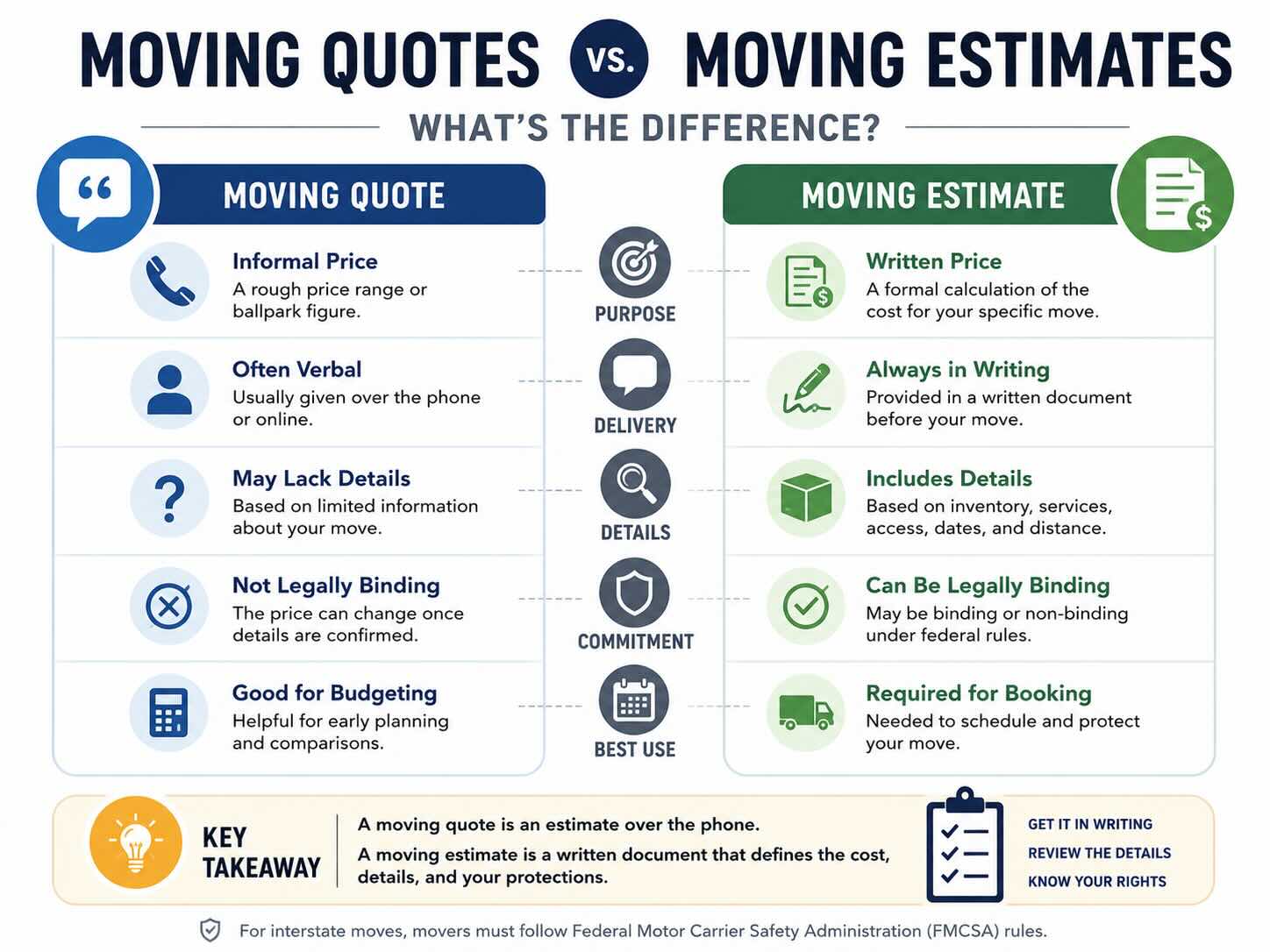
A moving quote is commonly used as an informal price indication, while a moving estimate is the written document that matters when pricing an interstate household-goods move. Under Federal Motor Carrier Safety Administration rules, an interstate mover must provide a written estimate of the charges for the move. FMCSA specifically warns that a mover’s “rate quote” is not an estimate.
The difference becomes important when you are comparing prices. A company might tell you over the phone that your move will cost “around $4,000,” but that number alone does not tell you what inventory was included, what services were priced, whether the estimate is binding or non-binding, or what could legitimately change the amount later.
A proper written estimate should identify the shipment and services being priced. For an interstate move, it should also tell you whether you are working with a binding estimate or a non-binding estimate. Those two estimate types have very different rules.
The safest way to compare moving prices is therefore not to ask only, “What is your quote?” Ask what the price is based on, whether you will receive it in writing, what inventory and services are included, and what type of estimate you are being given.
Moving Quote vs. Moving Estimate: The Short Answer
- Moving quote: commonly used to describe a preliminary or informal price indication. FMCSA states that a mover’s “rate quote” is not an interstate moving estimate.
- Written moving estimate: the formal estimate of the charges for your interstate move, based on the household goods and services being priced.
- Binding estimate: generally fixes what you must pay for the quantities and services included in that estimate, subject to rules for added goods, added services, and certain other circumstances.
- Non-binding estimate: predicts the cost but does not guarantee the final total. Final charges are determined under the mover’s tariff and the actual shipment and services.
- 110% rule: for the services and quantities covered by an original non-binding estimate, the mover generally cannot require more than 110% of that estimate at delivery.
- Verbal estimates are not enough: FMCSA tells consumers not to accept verbal estimates for interstate moves.
- Inventory matters: a $4,000 estimate based on 500 cubic feet is not comparable with a $5,000 estimate based on 800 cubic feet.
- Broker estimates have rules too: an interstate household-goods broker can provide an estimate, but it must be based on the tariff of the motor carrier that will transport the shipment.
Moving Quote vs. Moving Estimate: What Is the Difference?
In everyday conversation, there may be little difference. Consumers ask for “moving quotes,” moving companies advertise “free quotes,” and online calculators may generate an estimated moving price in seconds.
Once an interstate household-goods move reaches the actual booking and transportation process, however, the terminology matters.
| Feature | Moving Quote | Moving Estimate |
|---|---|---|
| What is it? | Usually a general or preliminary price indication | Written estimate based on the shipment and requested services |
| Is the term federally defined the same way? | FMCSA distinguishes a “rate quote” from an estimate | Yes. Interstate estimate requirements are governed by federal regulations |
| Can it be verbal? | A preliminary quote may be discussed verbally | Interstate estimates must be in writing |
| Does it establish what is included? | Not necessarily | Should describe the shipment and services being estimated |
| Can it be binding? | The word “quote” alone does not establish this | Yes. Estimates can be binding or non-binding |
| Should you book based on it alone? | No | Review the complete written estimate and related documents first |
This is why two companies can both advertise a “free moving quote” while ultimately giving you very different documents.
The phrase used in the advertisement matters less than what you receive before the interstate move is performed.
What Is a Moving Quote?
A moving quote is usually the first price you encounter while shopping for a mover.
You might receive one after filling out an online form, entering your origin and destination into a moving calculator, speaking with a representative, or providing a rough description of your home.
For example, you might say:
“I’m moving a two-bedroom apartment from Atlanta to Denver in October.”
A company might respond that moves of that type often cost somewhere around $3,500 to $5,000.
That information can be useful for budgeting. It tells you whether you are probably looking at a $1,500 move, a $4,000 move, or an $8,000 move.
But it leaves several unanswered questions:
- How much furniture is actually moving?
- How many boxes were assumed?
- Is packing included?
- Are there stairs at either property?
- Can the truck reach both addresses?
- Is storage required?
- Are specialty items included?
- What pickup dates were assumed?
- What tariff rates apply?
- Is the eventual estimate binding or non-binding?
Until those details are established, the number should be treated as a planning figure rather than the complete price documentation for the move.
Why Does FMCSA Say a Rate Quote Is Not an Estimate?
This is one of the most important distinctions for interstate moves.
FMCSA requires interstate movers to provide consumers with a written estimate of all charges, including transportation charges and applicable accessorial and advance charges.
The agency specifically states that a mover’s “rate quote” is not an estimate.
That distinction prevents a rough price mentioned during the sales process from being treated as a substitute for the formal estimating process.
The written estimate should be based on the household goods and services involved in the move. FMCSA also tells consumers to make sure the estimate is based on an actual or virtual inspection of the household goods.
That is why a price generated before anyone knows what you own should not carry the same weight as a written estimate prepared after the inventory has been reviewed.
What Is a Moving Estimate?
A moving estimate is a written calculation of what the mover expects the transportation and requested services to cost.
For interstate moves, the estimate is much more than a number at the bottom of a page.
It should reflect the household goods being transported and the services needed to perform the move. Depending on the shipment, those services might include:
- Long-distance transportation
- Packing
- Packing materials
- Storage-in-transit
- Stair carries
- Elevator service
- Long carries
- Shuttle service
- Special handling
- Other applicable accessorial services
FMCSA’s interstate rules recognize two major estimate types: binding and non-binding.
Understanding which one you have is much more useful than asking whether a salesperson calls the document a “quote.”
What Is a Binding Moving Estimate?
A binding estimate is an agreement made in advance that establishes the cost of the move based on the quantities and services shown on the estimate.
If nothing changes, the consumer generally does not have to pay more than the binding estimated amount at delivery for those included goods and services.
Suppose your written binding estimate is:
Binding estimate: $5,200
Inventory: 720 cubic feet of household goods
Services: transportation + standard furniture protection
Pickup: Chicago, IL
Destination: Tampa, FL
If the shipment and requested services remain as described, the binding estimate establishes the amount due for those services.
But “binding” does not mean that you can add unlimited belongings or additional services while keeping the same price.
If the estimate covers one sofa and you arrive on moving day with an additional sectional, 30 extra boxes, a garage full of tools, and two bicycles, the shipment being transported is no longer the shipment that was estimated.
Can a Binding Moving Estimate Change?
Yes, but there are rules governing how that happens.
FMCSA explains that when additional items or services are added, the mover and customer may agree to continue under the original binding estimate, negotiate a new binding estimate, or convert the arrangement to a non-binding estimate.
Additional circumstances can also affect services required to perform the move. Common examples include:
- Additional furniture
- More boxes than listed
- Professional packing added later
- An undisclosed staircase
- An elevator requiring additional labor
- Parking restrictions
- A long carry
- A destination that requires shuttle service
The important distinction is when the change is identified.
A mover should not simply load the original shipment and then decide afterward that the original binding price no longer applies because it underestimated the move.
If the goods or services have genuinely changed before loading, the paperwork should reflect that change.
What Is a Non-Binding Moving Estimate?
A non-binding estimate works differently.
It is the mover’s reasonable prediction of what the move will cost, but it does not guarantee the final charge.
FMCSA explains that final charges under a non-binding estimate are determined according to the actual shipment, services performed, and the mover’s applicable tariff.
For a weight-based interstate shipment, for example, the final charge may depend on the shipment’s actual weight rather than the weight originally estimated.
Imagine the mover estimates that your household goods weigh 5,000 pounds and provides a non-binding estimate of $4,000.
If the shipment actually weighs substantially more, the lawful final charge may exceed $4,000.
That does not mean the mover can demand any amount it wants at your front door.
What Is the 110% Rule for Moving Estimates?
The federal 110% rule is one of the most misunderstood consumer protections in interstate moving.
When a shipment moves under an original non-binding estimate, the mover generally cannot require you to pay more than 110% of that estimate at delivery for the quantities and services included in the original estimate.
If the original non-binding estimate was $4,000:
Original estimate: $4,000
110% = $4,400
That means $4,400 is generally the maximum the mover can require at delivery for the services and quantities shown on that original non-binding estimate.
It does not necessarily mean the final lawful bill can never exceed $4,400.
Additional services requested by the customer and certain permissible charges can be handled separately under federal rules. FMCSA also provides specific rules for impracticable operations at delivery, such as circumstances requiring services that could not reasonably be performed as originally expected.
The 110% rule is therefore primarily a protection against being forced to pay a dramatically inflated non-binding charge just to regain possession of the shipment.
Example: Quote vs. Binding Estimate vs. Non-Binding Estimate
Consider a two-bedroom interstate move from New York to Florida.
| Pricing Stage | Example | What It Means |
|---|---|---|
| Initial quote | “$3,000–$4,500” | Early planning range based on limited information |
| Binding estimate | $3,850 | Price established for the inventory and services listed |
| Non-binding estimate | $3,850 estimated | Final lawful charges depend on actual shipment/services and applicable tariff; 110% delivery-payment rule applies to the original estimated quantities and services |
The number can be identical while the legal and financial meaning is completely different.
That is why consumers should look past the dollar amount and identify the estimate type.
Why the Inventory Matters More Than the Headline Price
A moving estimate is only as useful as the shipment information underneath it.
Suppose two companies estimate the same interstate move:
| Estimate A | Estimate B | |
|---|---|---|
| Estimated price | $3,900 | $4,500 |
| Shipment | 500 cu ft | 750 cu ft |
| Boxes | 25 | 55 |
| Packing | Not included | Fragile packing included |
Estimate A looks $600 cheaper.
But the two companies are not pricing the same move.
If your actual inventory resembles Estimate B, choosing Estimate A because of the lower headline number does not create a $600 saving. It creates an inventory mismatch that will eventually need to be resolved.
This is one of the most useful habits when comparing moving estimates: compare the inventories before comparing the totals.
What Our Moving-Cost Data Shows About Estimate Accuracy
Coastal Moving Services maintains a Moving Cost Statistics reference built from thousands of moving jobs across 2,002 state-route combinations.
One of the clearest findings is how strongly shipment size is associated with price.
| Shipment Size | Middle Price Range | Middle Price |
|---|---|---|
| Under 400 cu ft | $2,048–$2,862 | $2,441 |
| 400–799 cu ft | $2,886–$4,917 | $3,839 |
| 800–1,199 cu ft | $5,216–$8,041 | $6,641 |
| 1,200–1,599 cu ft | $7,561–$11,362 | $9,452 |
| 1,600+ cu ft | $10,860–$16,967 | $13,840 |
This is why a moving company cannot produce a meaningful interstate estimate from the origin and destination alone.
The difference between a 350-cubic-foot shipment and a 1,300-cubic-foot shipment is not a minor detail. In our records, those shipment-size groups have dramatically different middle prices.
The same principle applies to weight-based estimates. The estimator needs a reasonable picture of how much household goods are actually being transported.
Packing Changes the Comparison Too
Our records also show that moves with packing listed had a middle price of approximately $4,634, compared with about $3,142 when no packing was listed.
The packed shipments were also larger, so the difference should not be interpreted as the isolated price of packing alone.
It does demonstrate why two moving estimates cannot be compared intelligently without checking the service level.
Is an Online Moving Quote a Real Estimate?
Usually, an instant online moving calculator is best treated as a planning tool.
A calculator can estimate a likely price range using inputs such as:
- Origin
- Destination
- Distance
- Home size
- Estimated shipment size
- Move date
- Service type
That can be extremely useful early in the process.
For example, someone deciding whether a Florida-to-California move is financially realistic does not need to complete a detailed inventory just to learn whether the likely cost is closer to $1,000 or $8,000.
But an online calculation does not know that you have a storage unit, 80 boxes of books, a piano, a fourth-floor apartment, or a destination street that cannot accommodate a tractor-trailer unless those details are specifically collected.
Use an online moving cost calculator to establish a budget. Use the subsequent inventory and written estimate to price the actual shipment.
Why Does a Moving Quote Sometimes Change After an Inventory Review?
Because the estimator now knows more about the move.
A preliminary quote might assume that a two-bedroom apartment contains a typical amount of furniture.
Then the inventory review finds:
- Three large bookcases
- Two sectional pieces
- 60 boxes
- A king mattress and adjustable base
- Two televisions
- Patio furniture
- Four bicycles
- A storage locker
The shipment is larger than the initial assumption.
A revised price at that stage is not inherently suspicious. In fact, correcting the inventory before the move is preferable to discovering the discrepancy after the truck arrives.
The question is why the price changed.
A price change supported by a documented inventory change is different from a company arbitrarily increasing a price without explaining what changed.
Why the Lowest Moving Estimate Is Not Always the Cheapest Move
Moving estimates are unusual because the lowest number can be the result of the least complete inventory.
Consider three estimates:
- Company A: $3,100 for 450 cubic feet
- Company B: $4,000 for 650 cubic feet
- Company C: $4,350 for 700 cubic feet
If your shipment is actually close to 700 cubic feet, Company A has not necessarily discovered a way to transport the same household for $1,250 less.
It may simply be pricing 250 fewer cubic feet.
This is why comparing moving companies purely by the estimated total can reward the least accurate inventory.
Before choosing the lowest estimate, compare:
- Inventory
- Estimated weight or volume
- Services
- Packing
- Pickup dates
- Delivery period
- Access assumptions
- Storage
- Estimate type
- Payment terms
Moving Estimate Red Flags to Watch For
A Verbal Price With No Written Estimate
FMCSA specifically tells interstate consumers not to accept verbal estimates.
A phone conversation can help build the inventory, but the resulting estimate should be provided in writing.
An Estimate With No Clear Inventory
If the price depends on how much you are moving, you should be able to see what the estimator believes you are moving.
Check furniture quantities, boxes, specialty items, and rooms.
A Price That Is Dramatically Lower Than Similar Estimates
A legitimate price difference can exist. But a major gap deserves investigation.
Find out whether the shipment size, packing, access, or other services differ.
Blank Documents
Do not sign documents containing important blank fields that can be completed later without your review.
FMCSA advises consumers against signing blank or incomplete estimates.
Missing Access Information
Stairs, elevators, long carries, loading restrictions, and shuttle requirements can affect the service required.
If an estimator never asks about either property, the estimate may be missing relevant information.
No Explanation of Binding vs. Non-Binding
You should know which type of estimate you are accepting before the move.
“This is your guaranteed quote” is not a substitute for reading what the document actually says.
You Cannot Tell Whether the Company Is a Broker or Carrier
That status should not be hidden.
A carrier physically transports household goods. A broker arranges transportation with a motor carrier.
Can a Moving Broker Give You an Estimate?
Yes.
This is particularly relevant to Coastal Moving Services because we operate as an interstate household-goods broker rather than the motor carrier that physically transports the shipment.
FMCSA permits brokers to provide binding or non-binding estimates on behalf of motor carriers, but those estimates must be based on the tariff of the mover that will actually transport the shipment.
Federal broker requirements also include:
- Registration with FMCSA
- Using FMCSA-registered interstate movers
- Maintaining written agreements with the movers the broker uses
- Providing consumers with a list of the movers used by the broker
- Providing required federal consumer information
- Clearly disclosing broker status
A broker arranges the transportation. The assigned motor carrier performs the physical pickup, transportation, and delivery.
Knowing this distinction helps you understand whose name should appear on different parts of the paperwork and which company is responsible for transporting the shipment.
What Should Happen Before You Accept a Moving Estimate?
1. Build the Inventory
Walk through the entire home rather than estimating from bedroom count alone.
Include closets, garages, attics, basements, storage units, balconies, and outdoor areas.
2. Explain Both Properties
Tell the estimator about stairs, elevators, parking, loading docks, gated entrances, narrow roads, long driveways, and truck restrictions.
3. Decide What Services You Need
Clarify whether you are self-packing, requesting partial packing, or having the mover pack the entire household.
Discuss storage and specialty items as well.
4. Review the Inventory
Do not assume the estimator captured everything correctly.
Read the list yourself.
5. Identify the Estimate Type
Determine whether the written estimate is binding or non-binding.
6. Check the Payment Terms
Understand deposits, pickup payments, delivery payments, and accepted payment methods before booking.
7. Verify the Company
Interstate movers and brokers can be checked through FMCSA’s Protect Your Move resources.
8. Keep the Documents
Save the estimate, inventory, order for service, bill of lading, payment receipts, and written changes.
Is the Moving Estimate the Same as the Bill of Lading?
No.
The estimate is part of the pricing process. The bill of lading is the transportation contract and receipt for the shipment.
FMCSA requires the bill of lading to contain important information about the move, including the carrier, payment terms, pickup and delivery periods, and the maximum amount the mover will demand at delivery based on the estimate when applicable.
The estimate can also become an attachment to the bill of lading.
Another document you may see is the order for service. It authorizes the mover to transport the household goods and records important service information.
| Document | Main Purpose |
|---|---|
| Moving estimate | Explains the estimated charges for the shipment and services |
| Order for service | Authorizes the mover to perform the requested transportation services |
| Bill of lading | Transportation contract and receipt for your household goods |
Do not treat these names as interchangeable just because they contain overlapping information.
What if the Moving Price Increases After Your Goods Are Loaded?
This is where the distinction between binding and non-binding estimates becomes especially important.
FMCSA states that if a household-goods mover increases the agreed price after the goods are loaded, the consumer generally is not required to pay more than 100% of a binding estimate or 110% of a non-binding estimate at delivery for the original estimated shipment and services.
There are separate rules for additional requested services and qualifying impracticable operations.
For qualifying impracticable operations performed at delivery, the amount collected at delivery is limited under federal rules, with remaining applicable charges billed later.
If you believe a carrier is refusing to deliver your shipment unless you pay an amount that violates federal requirements, FMCSA treats hostage-load situations seriously.
Do These Rules Apply to Local Moving Quotes?
Not necessarily.
The federal rules discussed throughout this guide apply to interstate household-goods transportation under FMCSA jurisdiction.
A move entirely within one state is generally governed by that state’s rules rather than the federal interstate estimating requirements described here.
That means terminology, required documents, hourly pricing rules, maximum rates, estimate requirements, and consumer protections can differ from state to state.
If you are moving locally, check the rules of the state agency that regulates household-goods movers where you live.
How to Compare Moving Quotes the Right Way
Once you have several prices in front of you, compare them in this order:
First: Compare the Shipment
Are all companies pricing approximately the same amount of household goods?
Second: Compare the Services
Does one estimate include packing, storage, or specialty handling that another excludes?
Third: Compare Access Assumptions
Did every estimator account for the same stairs, elevators, parking conditions, and truck access?
Fourth: Compare the Estimate Type
A binding $5,000 estimate and non-binding $4,700 estimate do not carry the same pricing structure simply because one number is $300 lower.
Fifth: Compare the Companies
Verify registration and determine whether you are dealing with a broker or the carrier that will physically transport the goods.
Then Compare the Price
Once everything else is reasonably aligned, the totals become much more meaningful.
Start With a Moving Cost Range, Then Build the Estimate
If you are still researching your move, our Moving Cost Calculator can help establish an initial planning range.
You can also compare real shipment-size and route pricing in our 2026 Moving Cost Statistics.
When you are ready for an actual interstate estimate, provide a complete inventory, route, move date, access information, and the services you expect to use. Those details are what turn a broad moving-price conversation into an estimate built around your actual shipment.
Coastal Moving Services is an interstate moving broker. We arrange household-goods transportation with authorized motor carriers. The assigned carrier performs the physical transportation.
Frequently Asked Questions About Moving Quotes and Estimates
Is a moving quote the same as an estimate?
Not necessarily. In ordinary conversation, companies and consumers often use the words interchangeably. For interstate household-goods moves, FMCSA specifically distinguishes a mover’s “rate quote” from the required written estimate. The written estimate is the document you should review when evaluating the actual proposed charges.
Are moving quotes legally binding?
The word “quote” by itself does not tell you whether the price is binding. Look at the written estimate. An interstate estimate should identify whether it is binding or non-binding.
What is a binding moving estimate?
A binding estimate establishes the cost for the quantities and services listed in the estimate. If you add household goods or request additional services, the estimate may need to be changed according to federal rules.
What is a non-binding moving estimate?
A non-binding estimate is a reasonable prediction rather than a guaranteed final price. Final charges are based on the actual shipment, services performed, and the mover’s applicable tariff.
Can a moving company charge more than its estimate?
It depends on the estimate type and whether the shipment or services changed. Binding and non-binding estimates follow different rules. For an original non-binding interstate estimate, FMCSA’s 110% rule generally limits what the mover can require at delivery for the quantities and services included in that estimate.
What does the 110% moving rule mean?
If your original non-binding interstate estimate is $5,000, the mover generally cannot require more than $5,500 at delivery for the quantities and services shown on that estimate. Additional requested services and qualifying charges may be handled separately under federal rules.
Can a binding moving estimate increase?
Yes, when the shipment or requested services change and the applicable federal procedures are followed. Adding furniture, boxes, packing, or other services can require a revised estimate. “Binding” does not mean you can materially increase the shipment while keeping the original price.
Should I accept a verbal moving estimate?
No for an interstate household-goods move. FMCSA tells consumers to get estimates in writing and specifically says verbal estimates are unacceptable.
Is an online moving calculator a quote?
It is best viewed as a planning estimate or cost range unless the company clearly states otherwise and completes the required estimating process. Online calculators are useful for budgeting but may not capture the exact inventory and access conditions of your move.
Why did my moving estimate increase after a video survey?
The video survey may have identified more household goods or additional services than the preliminary price assumed. Compare the original inventory with the revised inventory. A documented increase in shipment size can legitimately change the estimated price.
Why is one moving estimate much cheaper than the others?
Check whether the companies are estimating the same shipment. Compare weight or volume, inventory, box counts, packing, storage, access conditions, and specialty services. A lower estimate based on fewer belongings is not necessarily a lower price for the same move.
Can a moving broker provide an estimate?
Yes. FMCSA permits interstate household-goods brokers to provide estimates on behalf of motor carriers, but binding or non-binding estimates must be based on the tariff of the mover that will transport the shipment.
Is the moving estimate my moving contract?
No. The bill of lading is the transportation contract and receipt for the shipment. The estimate and order for service are separate documents, although the estimate can be attached to and incorporated into the bill of lading.
Should I get three moving quotes?
Comparing several companies can be useful, but the number of estimates matters less than their quality. Three estimates based on three different inventories will not give you a reliable price comparison. Make sure each company is pricing substantially the same shipment and services.
What should I check before accepting a moving estimate?
Check the inventory, shipment size or weight, included services, packing, pickup and delivery information, access assumptions, estimate type, payment terms, broker or carrier status, and company registration. Correct missing information before the move rather than waiting until pickup.
How We Prepared This Guide
This guide separates common moving-industry terminology from the federal requirements governing interstate household-goods estimates.
Federal rules and definitions are based on current Federal Motor Carrier Safety Administration consumer guidance and interstate household-goods regulations.
Cost examples are supported by Coastal Moving Services’ 2026 Moving Cost Statistics, which contains thousands of moving-job records across 2,002 state-route combinations. We use those records to illustrate why inventory and shipment size should be compared alongside the estimated total.
The cost statistics are historical examples, not guaranteed prices for future shipments. An individual estimate depends on the actual route, household goods, requested services, dates, access conditions, and the applicable carrier tariff.
References
- Federal Motor Carrier Safety Administration — What Is a Binding Move Estimate?
- FMCSA — Estimating Charges for Interstate Household-Goods Moves
- FMCSA — Pickup, Order for Service and Bill of Lading Requirements
- FMCSA — Protect Your Move Frequently Asked Questions
- FMCSA — Household-Goods Moving Glossary
- Coastal Moving Services — Moving Cost Statistics 2026
- Coastal Moving Services — Moving Cost Calculator