

Moving to Boston means preparing for two expenses at the same time: the cost of getting there and the considerably larger cost of living there once the boxes are unpacked. Boston remains one of the more expensive housing markets in the country, and the neighborhood you choose can change your monthly budget by well over $1,000 before transportation, parking or utilities enter the calculation.
For someone renting, the differences are particularly striking. Boston Planning Department data published in 2026 shows that 2025 one-bedroom asking rents ranged from about $2,000 in Hyde Park to more than $4,000 in the South Boston Waterfront. Allston, Brighton, East Boston and Dorchester sat closer to $2,350–$2,400, while Back Bay, the South End, West End and Downtown were above $3,000. That means choosing where to live can have a much larger effect on your first-year cost than saving a few hundred dollars on the moving truck.
Boston also requires more logistical planning than many newcomers expect. Parking space for a moving truck may need to be reserved in advance, older apartments can have narrow staircases and difficult furniture access, managed buildings may impose their own elevator and insurance requirements, and the enormous September 1 rental turnover puts unusual pressure on movers, trucks and curb space.
This guide approaches the move in that order. First, decide what Boston will cost you to live in. Then compare neighborhoods based on the life you actually expect to have there. Finally, plan the physical move around Boston’s parking, building and seasonal constraints.
Moving to Boston in 2026: Key Points
- Housing will probably matter more than the moving bill. The Census Bureau reports Boston’s median gross rent at $2,147 for 2020–2024, while newer Boston Planning Department asking-rent data shows one-bedroom rents ranging from about $2,000 to more than $4,000 depending on neighborhood.
- Neighborhood choice can change your budget dramatically. Hyde Park, Roslindale, West Roxbury, Allston, Brighton, East Boston and Dorchester generally offer lower one-bedroom asking rents than Back Bay, Downtown, the South End and the South Boston Waterfront.
- September 1 deserves special planning. Roughly two-thirds of Boston’s 165,000-plus apartment leases turn over around September 1, concentrating moving trucks, renters and parking demand into an unusually difficult period.
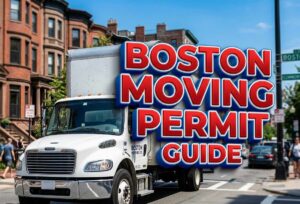
- Boston moving-truck parking should be arranged early. The City allows online moving-truck permit applications when the move is 15 days to eight weeks away. In-person applications can be made when the move is three days to eight weeks away.
- Massachusetts changed its rental broker-fee law. Since August 1, 2025, the person who hires the rental broker or salesperson is responsible for paying that person’s fee. A landlord cannot hire a broker and require the incoming tenant to pay that broker’s fee.
- Local moving rates vary by company. Massachusetts intrastate household-goods movers operate under tariffs regulated by the Department of Public Utilities, so compare the actual tariff, minimum hours and additional charges rather than relying on a single supposed Boston hourly rate.
How Much Does It Cost to Move to Boston?
There are really two answers to this question. The first is the one-time expense of moving your belongings. The second is the amount of money you need to establish a household in Boston. For many newcomers, the second number is substantially larger.
A renter may need money for the first month’s rent, a security deposit if one is required, moving expenses, utility setup, parking or transit, and the purchases that inevitably accompany a new apartment. Someone moving into a $3,000-per-month apartment can therefore spend several thousand dollars before paying the moving company.
The good news for renters arriving in 2026 is that Massachusetts changed one particularly painful part of the traditional Boston apartment search. Since August 1, 2025, the person who hires a rental broker is responsible for that broker’s fee. If the landlord hired the broker to market the apartment, the landlord cannot simply require the incoming tenant to pay the landlord’s broker. A renter who independently hires a broker to represent them can still be responsible for that broker’s fee.
That distinction matters in Boston because a broker fee historically could add the equivalent of another month’s rent to an already expensive move-in.
What Rent Looks Like Across Boston
There is no useful single answer to “What does an apartment cost in Boston?” because Boston’s neighborhoods occupy very different price tiers.
The Boston Planning Department’s 2026 economy report provides a particularly useful comparison because it examines one-bedroom asking rents across individual neighborhoods using 2025 rental data. At the lower end, Hyde Park averaged about $2,000, Mattapan $2,075, Roslindale $2,100 and West Roxbury $2,200. Allston, Brighton, East Boston and Dorchester clustered around $2,350–$2,400.
Move closer to several of the city’s most desirable central neighborhoods and the calculation changes quickly. South Boston was about $2,850, Mission Hill $2,900, Back Bay $3,300, the South End $3,350, West End $3,400 and Downtown $3,450. The South Boston Waterfront was the highest in the report at $4,033 for a one-bedroom.
| Neighborhood | 2025 One-Bedroom Asking Rent | What You Are Paying For |
|---|---|---|
| Hyde Park | About $2,000 | More residential surroundings and lower housing costs, with a longer trip into central Boston. |
| Roslindale | About $2,100 | Neighborhood feel, access to green space and comparatively moderate rent. |
| West Roxbury | About $2,200 | More space and a residential environment farther from the downtown core. |
| Allston / Brighton | About $2,350–$2,400 | Large rental inventory, younger population and access to universities and western Boston. |
| East Boston | About $2,350–$2,400 | Transit access to Downtown with rents below many central neighborhoods. |
| Fenway | About $2,800 | Central location near universities, hospitals, entertainment and Fenway Park. |
| South Boston | About $2,850 | Proximity to Downtown, neighborhood restaurants and access to the waterfront. |
| Back Bay | About $3,300 | Exceptional central location, historic architecture and walkability. |
| South End | About $3,350 | Historic streets, restaurants and proximity to central employment areas. |
| Downtown | About $3,450 | A highly central location that can substantially reduce some commutes. |
| South Boston Waterfront | About $4,033 | Newer housing, waterfront location and proximity to the Seaport employment district. |
About the numbers: These are neighborhood-level one-bedroom asking rents reported in the City of Boston Planning Department’s Boston’s Economy 2026 report using 2025 Rental Beast and MLS data. They are useful for comparing neighborhoods, not predicting the price of a particular apartment.
A difference of $1,000 in monthly rent becomes $12,000 over a year. That is why someone deciding between a $2,350 apartment in Allston and a $3,350 apartment in the South End should spend more time thinking about commute, neighborhood and housing tradeoffs than trying to shave $200 from the moving bill.
Best Boston Neighborhoods for Different Types of Moves
Boston is compact on a map, but living in one part of the city can feel very different from living in another. The right neighborhood depends less on which area receives the highest ranking and more on where you need to be several times each week.
A person working in Longwood Medical Area has a different transportation problem from someone commuting to the Financial District. A graduate student near Boston University has different priorities from a family that wants additional bedrooms, a car and more residential surroundings.
Start with the destinations you cannot change: your workplace, university, children’s school, hospital or other frequent commitments. Then compare neighborhoods that make those trips reasonable.
Back Bay: Best for Central Boston and Walkability
Back Bay is one of the easiest Boston neighborhoods to fall in love with during an apartment search. Commonwealth Avenue, Newbury Street, the Public Garden, the Charles River Esplanade and rows of historic brownstones create the version of Boston many newcomers imagined before arriving.
You pay heavily for that location. One-bedroom asking rents averaged about $3,300 in the 2025 data, placing Back Bay among Boston’s more expensive neighborhoods.
The housing stock also deserves inspection rather than assumption. A beautiful brownstone may have narrow stairs, no elevator, limited storage or a floor plan created long before modern furniture dimensions became standard. If you are bringing a king bed, oversized sectional or large dining table, measure the entrance and staircase before moving day.
South End: Central, Residential and Expensive
The South End works particularly well for someone who wants to remain close to Downtown while living on streets that feel more residential than the central business district. Restaurants, historic row houses and access to several employment areas keep demand high.
That demand appears in the rent. The Planning Department’s 2025 figure for a one-bedroom was about $3,350.
As in Back Bay, the apartment itself matters. Brownstone stairs, basement units, garden-level entrances and limited curb space can make two addresses on the same street very different moving jobs.
Allston and Brighton: More Apartment for the Budget
Allston and Brighton deserve serious consideration for renters who want to remain connected to the city without paying Back Bay prices. One-bedroom asking rents in the city’s 2025 data clustered around $2,350–$2,400, roughly $900 to $1,000 below several central neighborhoods.
The tradeoff is that your daily travel becomes more important. Someone regularly commuting east during busy periods may decide the rent saving is worth it; another person may eventually wish they had paid more to live closer to work.
These neighborhoods also sit near the center of Boston’s September moving phenomenon. Their large renter and student populations mean late August and September 1 require particularly careful planning.
East Boston: A Different Way to Stay Close to Downtown
East Boston offers an interesting compromise for someone who wants relatively quick access to central Boston without paying central Boston rents. Its one-bedroom asking rents were around the same general level as Allston and Brighton in the city’s 2025 data.
Because the neighborhood sits across Boston Harbor rather than immediately outside Downtown’s street grid, newcomers sometimes underestimate how close parts of East Boston are to the center of the city.
The neighborhood also has a different housing and streetscape character from Back Bay or the South End. Someone deciding between them should visit at the hours they would actually commute rather than judging the decision entirely from apartment listings.
Jamaica Plain: A Strong Middle Ground
Jamaica Plain is often attractive to people who want a neighborhood with restaurants, parks and more residential streets while maintaining access to central Boston. Housing ranges from apartments in older multi-unit buildings to larger homes, so the experience can vary substantially by address.
For movers, those older buildings deserve attention. A third-floor apartment in a traditional multi-family property can involve substantially more carrying than a modern elevator building even when both apartments have the same square footage.
South Boston: Close to Downtown Without Living Downtown
South Boston has become a popular choice for professionals who want relatively close access to Downtown while retaining a recognizable neighborhood environment. One-bedroom asking rent averaged about $2,850 in the city’s 2025 data, below Back Bay and the South End but above Allston, Brighton and several outer neighborhoods.
Parking can become part of the housing decision if you own a car. A beautiful apartment with no dedicated parking may feel considerably less convenient after several months of searching for street space.
Fenway: Excellent for Universities and Longwood Access
Fenway makes particular sense for students and employees connected to the universities, hospitals and research institutions in the surrounding area. The neighborhood also places restaurants, entertainment and Fenway Park close to home.
One-bedroom asking rents averaged about $2,800 in the 2025 neighborhood data. Smaller units are common: Boston Planning estimates show that about 65% of occupied Fenway housing units are studios or one-bedroom homes.
That smaller housing stock can work perfectly for one person moving without a car. It becomes a more difficult proposition for someone arriving with several rooms of furniture and expecting suburban storage space.
Roslindale, West Roxbury and Hyde Park: Look Here When Space Matters
People moving to Boston sometimes begin their search too close to Downtown. If you need more room, expect to own a car or simply prefer a more residential environment, the southwestern neighborhoods deserve attention.
The rent difference can be substantial. In the 2025 data, one-bedroom asking rents were about $2,000 in Hyde Park, $2,100 in Roslindale and $2,200 in West Roxbury.
The trade is distance. Before choosing an apartment primarily because it is several hundred dollars cheaper, test the commute you will make repeatedly. Saving $600 a month can be an excellent trade. Saving $600 while adding two exhausting hours to every workday may not be.
Which Boston Neighborhood Should You Choose?
| If Your Priority Is… | Start Looking At | Main Trade-Off |
|---|---|---|
| Central location and walkability | Back Bay, South End, Downtown | Some of Boston’s highest rents and limited parking |
| University access and younger rental market | Allston, Brighton, Fenway, Mission Hill | Heavy rental turnover and crowded September moving season |
| Lower rent without leaving Boston | Hyde Park, Roslindale, West Roxbury | Longer trip to central Boston |
| Downtown access at a lower rent | East Boston | Different commute geography and airport proximity in some areas |
| Residential feel with city access | Jamaica Plain, Roslindale | Commute depends heavily on the exact address |
| Newer apartment buildings | South Boston Waterfront / Seaport | The city’s highest one-bedroom asking rents in the 2025 neighborhood data |
The exact address matters almost as much as the neighborhood name. Two apartments described as being in the same part of Boston can produce different commutes depending on how far they sit from a transit stop, whether a transfer is required and how much walking is involved at either end.
Before signing a lease, make the commute at the time you would normally travel. That single test can tell you more about whether an apartment works than another hour spent comparing neighborhood rankings.
What Does a Local Boston Move Cost?
Boston local moving prices are commonly expressed as hourly rates, but there is no official citywide price for two movers, three movers or four movers. Massachusetts intrastate household-goods movers are regulated by the Department of Public Utilities, and individual movers operate under filed tariffs that specify their rates and charges.
Current tariffs demonstrate why a planning range is more useful than pretending every company charges the same amount. One Massachusetts mover’s 2026 tariff, for example, lists $185 per hour for two movers and a truck, $235 for three movers and a truck, and $285 for four movers and a truck, all with a four-hour minimum. Other licensed movers can have different approved tariffs, minimums and charges.
For planning purposes, a Boston household should expect the final cost to depend on the number of movers, number of billable hours, minimum charge, travel time and any services or charges permitted under the mover’s tariff.
| Move Size | Useful Planning Range | What Usually Pushes the Cost Higher |
|---|---|---|
| Studio / small 1-bedroom | About $600–$1,200 | Minimum hours, stairs, long carry, difficult parking |
| 1–2 bedroom apartment | About $900–$1,800 | Furniture volume, packing, elevators and building access |
| 2–3 bedroom household | About $1,400–$3,000 | Larger inventory, multiple floors and additional crew hours |
| Large household | $2,500–$5,000+ | Large inventory, packing, difficult access, storage and longer move duration |
Planning note: These are budgeting ranges rather than quotes or regulated citywide prices. Massachusetts movers have individual DPU tariffs. Your written estimate and the mover’s filed rates are more important than a generic Boston average.
A Boston apartment can also take longer to move than its square footage suggests. A small third-floor walk-up with a narrow staircase and a truck parked half a block away may require more labor than a larger apartment in an elevator building with a reserved loading area.
That is why an accurate estimate should include the floor, elevator availability, walking distance from curb to entrance, unusually large furniture and the approximate number of boxes rather than simply “two-bedroom apartment.”
For a deeper breakdown of Boston mover pricing, see our guide to how much movers cost in Boston.
Long-Distance Moving Costs to Boston
Moving to Boston from another state changes both the price and the regulatory framework. Interstate household-goods moves fall under federal FMCSA rules rather than Massachusetts intrastate moving regulation.
A nearby interstate move from New York, Connecticut or another New England state can cost considerably less than bringing a household from Florida, Texas or California. Household size remains crucial: transporting the contents of a lightly furnished one-bedroom apartment is a very different shipment from transporting a four-bedroom family home across the country.
| Example Move to Boston | Smaller Household | 2–3 Bedroom Household | Large Household |
|---|---|---|---|
| New York City | $1,200–$2,500 | $1,800–$4,500 | $3,500–$7,000+ |
| Washington, D.C. | $1,500–$3,200 | $2,500–$5,500 | $4,500–$8,500+ |
| Chicago | $2,500–$4,500 | $3,500–$7,500 | $6,500–$11,000+ |
| Florida / Texas | $2,800–$5,500 | $4,000–$8,500 | $7,500–$13,000+ |
| California / Pacific Northwest | $3,500–$6,500 | $5,000–$10,500 | $8,500–$15,000+ |
Planning ranges only: Actual interstate pricing depends on the shipment, route, services, estimate type, access conditions and carrier tariff. Use the written estimate for your particular shipment rather than treating a route average as a quote.
Federal rules require an interstate mover to provide a written estimate of transportation, accessorial and advance charges based on an actual or virtual inspection of the household goods. A binding estimate and a non-binding estimate also work differently.
A binding estimate establishes the amount due for the shipment and services described in the estimate, although adding goods or services can require a revised agreement. A non-binding estimate is not a guarantee of the final cost; final charges can be based on factors including actual shipment weight, services performed and the mover’s published tariff.
That is more precise than saying every long-distance move is simply “priced by weight and mileage.”
Boston Moving Truck Permits: Arrange the Curb Before the Truck Arrives
One of the easiest ways to make a Boston move unnecessarily expensive is to solve the parking problem after the moving crew arrives.
Boston allows residents to reserve street space for a moving truck through the Office of the Parking Clerk. For an online application, your moving date must be at least 15 days away and no more than eight weeks away. If the move is closer, an in-person application can be made when the date is at least three days away and no more than eight weeks away.
The distinction is worth remembering because “apply at least 15 days ahead” is only part of the rule. Fifteen days is the online eligibility threshold. The City also establishes an eight-week maximum window.
Once a permit is issued, follow the City’s instructions for posting the temporary signs. Reserving the curb does not help if the signs were never posted correctly and vehicles are occupying the space when the truck arrives.
Parking becomes particularly important in places such as Beacon Hill, Back Bay, the North End and the South End, where finding an alternative legal position close to the entrance can be difficult.
Your Boston Building Can Matter More Than Your Neighborhood
Neighborhood guides tend to describe Beacon Hill as difficult, Seaport as easy and Allston as a maze of walk-ups. Reality is more address-specific.
A Beacon Hill apartment with a workable rear entrance may be easier than expected. A new high-rise can become surprisingly complicated if the freight elevator is available for only a two-hour window. A triple-decker may have a staircase that accepts ordinary furniture but not the sectional sofa that fit perfectly in your previous suburban house.
Before moving day, ask the landlord, condominium association or building manager four questions: where the truck is allowed to load, whether the building restricts moving hours, whether an elevator must be reserved, and whether the moving company must provide proof of insurance.
A Certificate of Insurance, usually shortened to COI, is a building requirement rather than a universal City of Boston moving rule. Some managed buildings require one and others do not. If your building does, obtain its exact insurance instructions and send them to the mover rather than asking vaguely whether the company “does COIs.”
The same principle applies to elevators. Do not assume that because a building has an elevator you can use it whenever the truck arrives. Some properties reserve specific moving windows or require use of a service elevator.
What You Need to Know About Moving on September 1
September 1 in Boston deserves its reputation. Recent reporting estimates that roughly two-thirds of the city’s more than 165,000 apartment leases turn over around this date. Thousands of students arrive at the same time, moving trucks compete for curb space and discarded furniture accumulates along streets in heavily rented neighborhoods.
Locally, the phenomenon is so familiar that the piles of furniture left behind around Allston helped produce the nickname “Allston Christmas.”
The useful lesson is not that September 1 is literally guaranteed to be “the most expensive moving day in America.” That claim is much harder to establish. What can be established is that Boston experiences an extraordinary concentration of rental turnover around the date, and that concentration makes moving resources harder to secure.
If your lease requires a September 1 move, begin planning much earlier than you would for an ordinary autumn move. The moving company is only one reservation. You may also be competing for loading space, elevator windows, rental trucks and storage.
If your lease dates are flexible, even shifting the physical move away from the immediate late-August and September 1 rush can simplify the logistics. Ask the landlord whether there is any flexibility in possession dates before assuming the dates printed on the first draft of the lease are your only option.
Students and first-time Boston renters should also remember that September 1 affects neighborhoods differently. Allston, Brighton, Fenway and Mission Hill have particularly large renter and student populations, so the concentration is much more visible there than in parts of Boston with more owner-occupied housing.
Should You Bring a Car When Moving to Boston?
This is one of the decisions worth making before choosing the apartment.
If you expect to live in Back Bay, Downtown, Fenway or another transit-rich central neighborhood and rarely need to leave the urban core, a car can become an expense that spends most of its life parked. Insurance, registration, parking and the time spent finding a legal space all need to be weighed against how often you will actually drive.
Farther from central Boston, the calculation changes. A household in Hyde Park, West Roxbury or another more residential neighborhood may find a car considerably more useful, particularly when work, childcare, shopping or family commitments do not line up neatly with transit.
Street parking also should not be assumed simply because you saw an open space while touring the apartment. Boston’s resident parking program is neighborhood-specific. If you move from one Boston neighborhood to another, an existing resident permit does not automatically transfer to the new neighborhood. Your vehicle registration, insurance and residency documentation need to reflect the new address when applying.
For an apartment hunter, that means parking belongs on the same checklist as rent and laundry. Ask whether the apartment includes a space, whether nearby streets use resident parking restrictions and what a private space would cost if street parking becomes impractical.
Moving to Boston Also Means Planning for Winter
A newcomer arriving in July can choose an apartment without ever seeing the condition that will define several months of the year.
Older Boston housing varies enormously in insulation, window quality and heating systems. Before signing a lease, ask what type of heat the apartment uses and which utilities you are responsible for paying. Massachusetts consumer guidance specifically recommends estimating utility expenses when deciding whether an apartment is affordable.
That matters because two apartments with the same rent can produce different winter budgets.
Winter also changes moving-day logistics. Snow can reduce curb space, make stairs and sidewalks slippery and interfere with access that looked straightforward when the estimate was prepared. Resident parking permits do not override snow-emergency restrictions, so someone moving during winter should watch City parking announcements as the date approaches.
A winter move may offer more scheduling flexibility than late summer, but Boston weather makes flexibility valuable. Avoid constructing a closing, lease termination and moving schedule in which a weather delay leaves absolutely no margin between addresses.
Boston Moving Checklist
Six to Eight Weeks Before Moving
- Choose the neighborhood based on the commute you will actually make, not simply the neighborhood’s reputation.
- Calculate first-year housing costs using rent, expected utilities, parking and any legitimate fees associated with your tenancy.
- If a broker is involved, establish who hired the broker and therefore who is responsible for the fee under Massachusetts law.
- Compare written estimates from licensed movers using an accurate inventory.
- For a Massachusetts intrastate move, check whether the mover appears among the companies regulated by the Massachusetts DPU.
- For an interstate move, verify the mover or broker through FMCSA.
- Ask both buildings about loading locations, moving hours, elevators and insurance requirements.
Two to Four Weeks Before Moving
- Apply for Boston moving-truck parking once you are inside the City’s application window.
- If either address is in Cambridge, Somerville, Brookline or another municipality, check that city’s separate parking rules.
- Send any building insurance instructions to the moving company.
- Reserve elevators or loading docks where required.
- Measure large furniture against the narrowest doorway, staircase and landing at the new apartment.
- Begin packing items you will not need during the final weeks.
- Decide whether your car is coming with you and research parking at the new address.
During the Final Week
- Confirm that your curb reservation and temporary parking signs are handled according to City instructions.
- Confirm the moving company’s arrival window and crew information.
- Finish packing before an hourly crew arrives unless packing service is included in your estimate.
- Label boxes by destination room rather than only by contents.
- Keep identification, medication, valuables, keys, chargers and lease documents with you.
- Check the weather forecast and any City parking restrictions that could affect access.
On Moving Day
- Check the reserved curb space before the truck arrives.
- Walk through the apartment with the crew before loading begins.
- Point out fragile pieces and furniture that requires disassembly.
- Keep hallways and stairs clear so the crew is not working around loose boxes and packing materials.
- Before leaving the old apartment, check closets, cabinets, storage areas and appliances.
- At delivery, confirm that major furniture and boxes are accounted for before the crew departs.
How to Reduce the Cost of Moving to Boston
The largest saving may come from choosing the right apartment rather than the cheapest mover. Reducing rent by $300 per month saves $3,600 during the first year. Reducing it by $700 saves $8,400. Those numbers put a $200 difference between moving estimates into perspective.
That does not mean choosing the cheapest neighborhood. A lower rent can become a bad trade if it creates an expensive commute, requires a second car or puts you far from the places that brought you to Boston in the first place.
Compare the Total Housing Cost
Rent is the beginning of the comparison. Add heat and electricity, parking, transportation and any recurring building charges you will actually pay. If one apartment allows you to live comfortably without a car while another requires one, the more expensive apartment may not be more expensive overall.
Move Less Furniture Across the City
Boston’s older housing makes bulky low-value furniture particularly expensive to move. A bookcase that barely survives disassembly or an inexpensive sofa that may not fit the next staircase can consume a surprising amount of crew time.
Measure first. Then decide whether transporting the item makes economic sense.
Solve Access Problems Before Moving Day
A reserved curb, confirmed elevator window and accepted insurance certificate do not make the moving crew work faster. They prevent the crew from being unable to work at all.
On an hourly local move, that distinction matters. Time spent waiting for someone to unlock a loading dock or approve building paperwork is still time that can extend the job.
Give the Mover an Accurate Inventory
A useful estimate should describe the move the company will actually perform. Tell the estimator about basement storage, bicycles, exercise equipment, unusually large furniture and anything else that may not be obvious from the bedroom count.
“Two-bedroom apartment” could describe one couple with minimalist furniture or a family that has occupied the apartment for ten years. Those are not equivalent moving jobs.
Use September Flexibility if You Have It
If you can avoid the immediate September 1 turnover, doing so can improve availability and reduce logistical pressure. The point is not to promise an arbitrary percentage discount. It is to avoid competing with an unusually large portion of Boston’s rental population for the same movers, trucks and curb space.
Moving to Boston From Another State: Broker vs. Carrier
If you are moving to Boston from outside Massachusetts, know whether the company you book will physically transport the household goods or arrange transportation with another company.
An interstate household-goods carrier operates the vehicle that transports the shipment. A household-goods broker arranges transportation with a carrier. Both roles exist legitimately in interstate moving, but the company should be clear about which role it performs.
Coastal Moving Services operates as a moving broker. We arrange interstate household-goods transportation with licensed carriers rather than representing ourselves as the carrier operating the truck.
Consumers can check interstate movers and brokers through FMCSA before booking. For more information about arranging an interstate move, visit our long-distance moving service page.
Is Moving to Boston Worth It?
Boston makes the strongest case for someone whose career, education or family situation benefits directly from being here. The city concentrates universities, hospitals, research institutions, financial firms, technology companies and life-sciences employers within a relatively compact region. For someone entering one of those ecosystems, the housing premium may be attached to opportunities that are difficult to reproduce elsewhere.
The price is real. Boston’s housing market can force compromises between apartment size, neighborhood and commute that someone coming from a less expensive city has never needed to make. A $3,000 monthly housing budget does not automatically buy a large apartment, dedicated parking and a short commute.
That is why moving to Boston works better when the neighborhood decision begins with your daily life rather than with a generic list of the city’s “best” areas.
If your job requires you in Longwood four days each week, solve Longwood. If your classes are at Boston University, solve that trip. If you work remotely and only need to be Downtown twice per month, paying Back Bay rent for a five-minute commute may accomplish very little.
Boston rewards people who understand its geography before signing a lease. The neighborhood that initially appears farther away may connect directly to where you need to go, while an apartment that looks close on a map can involve an awkward daily trip.
Once you have solved that question, the physical move becomes much easier to plan: reserve the curb, understand the building, give the mover an accurate inventory and keep September 1 in mind.
long distance moves
as low as $1748
Long-distance moving all across the United States. Experienced and insured, residential and commercial.
4.9/5 AVERAGE RATING
Moving to Boston FAQs
How much money should I save before moving to Boston?
Start with the upfront housing expenses attached to your actual apartment rather than using a generic number. Depending on the lease, you may need first month’s rent, a security deposit and other lawful upfront payments in addition to the cost of moving. Since August 1, 2025, a landlord cannot require you to pay the fee of a rental broker the landlord hired. If you independently hire a broker to represent you, you can still be responsible for that broker’s fee.
How expensive is rent in Boston?
It varies dramatically by neighborhood. Boston Planning Department data for 2025 put one-bedroom asking rents at about $2,000 in Hyde Park, $2,100 in Roslindale, roughly $2,350–$2,400 in several neighborhoods including Allston, Brighton and East Boston, $3,300 in Back Bay, $3,450 Downtown and $4,033 in the South Boston Waterfront.
What are some more affordable neighborhoods in Boston?
Hyde Park, Roslindale and West Roxbury were among the lower-priced neighborhoods for one-bedroom asking rents in the city’s 2025 data. Allston, Brighton, East Boston and Dorchester occupied a middle range below neighborhoods such as Back Bay and the South End. Affordability should be considered alongside the commute because transportation can change the real cost of living farther from work.
What are good Boston neighborhoods for young professionals?
There is no single best choice. Back Bay and the South End offer central locations at higher rents. South Boston provides relatively close access to Downtown with a strong neighborhood environment. Fenway works well for people connected to nearby universities, hospitals and research institutions. Allston and Brighton can offer lower rents while keeping residents connected to western Boston and the university corridor.
Do I need a car in Boston?
Not necessarily. Someone living and working in transit-rich central Boston may find a car unnecessary, while a household in a more residential outer neighborhood may use one regularly. Decide based on the exact home-to-work trip and other weekly travel rather than assuming everyone in Boston either needs or does not need a car.
Do I need a permit for a moving truck in Boston?
If you want to reserve curb space for the moving truck, use the City of Boston moving-truck permit process. Online applications are available when the move is between 15 days and eight weeks away. In-person applications are available when the move is between three days and eight weeks away. Cambridge, Somerville and Brookline have their own municipal processes.
Why does everyone move in Boston on September 1?
Boston’s rental market has developed an unusually concentrated September 1 lease cycle, reinforced by the enormous student population arriving for the academic year. Recent reporting estimates that roughly two-thirds of the city’s 165,000-plus apartment leases turn over around September 1. That creates heavy demand for movers, rental trucks, elevators and curb space.
How much do local movers cost in Boston?
There is no universal Boston hourly rate. Massachusetts intrastate household-goods movers operate under tariffs regulated by the Department of Public Utilities. Current tariffs show that a multi-person crew with a truck can easily cost several hundred dollars per hour, often with minimum-hour requirements. A small Boston apartment move may cost roughly $600–$1,200, while larger household moves can reach several thousand dollars depending on crew hours, inventory and access.
Are interstate moves to Boston priced by weight?
Weight can be important, particularly under a non-binding interstate estimate, but saying every interstate move is simply priced by weight and mileage is too broad. FMCSA distinguishes binding and non-binding estimates, and final charges can depend on the estimate type, actual shipment, services performed and the mover’s tariff.
Does my Boston apartment require a Certificate of Insurance?
Possibly, but a COI is a building requirement rather than a universal Boston moving rule. Managed apartment buildings and condominium associations may require proof of the mover’s insurance before allowing access. Ask building management for its exact requirements before requesting the certificate from the mover.
What should I check before signing a Boston apartment lease?
Test the commute, determine which utilities you pay, understand parking, inspect the heating system, measure large furniture against the entrances and stairs, and ask about moving-day restrictions. If a broker is involved, establish who hired that broker and who is legally responsible for the fee.
Planning an Interstate Move to Boston?
Your origin, household inventory, destination building and requested services determine what the move will actually cost. Coastal Moving Services can review those details and arrange transportation with a licensed interstate carrier.
References
- City of Boston, Office of the Parking Clerk: Moving Truck Permit FAQs. Used for the official online and in-person moving-truck permit application windows and City permit procedures.
- City of Boston: Moving Guide. Used for municipal moving and parking guidance.
- City of Boston Planning Department Research Division: Boston’s Economy 2026 and Neighborhood Profiles 2025. Used for Boston neighborhood housing, rental and demographic comparisons.
- City of Boston Planning Department: Boston in Context 2025. Used for neighborhood housing-unit composition and Boston housing-stock comparisons.
- U.S. Census Bureau QuickFacts: Boston city, Massachusetts. Used for citywide housing and demographic context, including median gross rent.
- Massachusetts Executive Office of Housing and Livable Communities: Residential Rental Broker Fee FAQs. Used for the Massachusetts broker-fee law effective August 1, 2025.
- Mass.gov: Apartment Finder’s Fees, Broker’s Fees and Signing a Lease. Used for rental search, broker-fee and utility-cost guidance.
- Massachusetts Department of Public Utilities: Regulated Moving Companies. Used for Massachusetts intrastate household-goods mover regulation and tariff information.
- Federal Motor Carrier Safety Administration: What Is a Binding Move Estimate?. Used for interstate written-estimate requirements and the distinction between binding and non-binding estimates.
- Federal Motor Carrier Safety Administration: Movers vs. Brokers. Used for the distinction between interstate household-goods carriers and brokers.
- Boston.com: September 1 Boston Moving Guide. Used for contemporary reporting on Boston’s September 1 lease turnover and Moving Day conditions.
- City of Boston: Resident Parking Permit FAQs. Used for neighborhood-specific resident parking requirements when changing addresses within Boston.