


Moving a refrigerator is one of the most injury-prone and damage-prone tasks in any home move, and it is almost entirely preventable with the right equipment, the right sequence, and at least one other person. A modern full-size refrigerator weighs between 200 and 400 pounds, has a high center of gravity, and contains a compressor that can be permanently damaged if the appliance is tilted too far or laid flat without the proper waiting period before restarting. None of that is difficult to manage when you know what you are doing. All of it causes expensive problems when you do not.
This guide also a part of our extensive moving electronic appliances article covers every step of moving a refrigerator correctly, from the 24 hours of preparation before you touch it to the waiting period after it reaches its new location before you plug it back in. It also covers the equipment you need, the mistakes that damage compressors, what to do when you have no choice but to transport it on its side, and when calling a professional mover instead of doing it yourself is the right economic decision.
Essential Tips for Moving a Refrigerator Safely
- Never move a refrigerator alone. Modern full-size refrigerators weigh 200 to 400 pounds with a high center of gravity; moving one without a second person is a leading cause of back injury and property damage.
- Unplug at least 24 hours before moving. This allows the freezer to defrost and compressor oil to stabilize; moving before defrosting risks water damage to your flooring.
- Use an appliance dolly, not a standard furniture dolly. Appliance dollies feature taller, reinforced frames and security straps specifically designed for the height and weight profile of large appliances.
- Keep the refrigerator upright during transport. Laying it on its side risks oil migrating into the refrigerant lines, which can lead to mechanical failure upon restarting.
- Wait 24 hours to plug in if transported on its side. If you must lay it down, you need a full day for the oil to drain back into the reservoir; failure to wait is a common cause of compressor burnout.
- Wait 4 to 6 hours for upright moves. Even if moved upright, manufacturers like Whirlpool and GE recommend a waiting period to allow the refrigerant to settle.
- Measure the path and doorways in advance. Most structural damage occurs at tight corners; verify clearances for hallways and stairways before you begin the move.
- Properly disconnect the water supply line. Ensure the water is shut off and the line is fully detached to prevent high-pressure leaks and interior water damage.
Equipment You Need To Move A Refrigirator Before You Start
Attempting to move a refrigerator without the right equipment is what turns a straightforward task into a back injury, a scratched floor, or a damaged compressor. Every item on this list has a specific function that cannot be adequately substituted by improvising with what is on hand.
| Item | Purpose | Why You Cannot Skip It |
|---|---|---|
| Appliance dolly (hand truck) | Transports the refrigerator upright on two wheels with a reinforced frame | A standard furniture dolly sits too low and cannot stabilize a 300+ lb upright appliance; tipping risk is high |
| Appliance dolly straps (x2) | Secure the refrigerator body to the dolly frame during transit | An unsecured fridge on a dolly will shift when navigating corners and steps; 200–400 lbs of falling appliance causes serious injury |
| Moving blankets (x2 minimum) | Wrap the exterior to prevent scratches, dents, and paint transfer on walls during transit | Bare refrigerator surfaces scratch instantly on doorframes and wall corners; moving blankets also cushion against vibration damage in the truck |
| Stretch wrap / plastic wrap | Secures doors closed and holds moving blankets in place without adhesive damage to the exterior finish | Tape applied directly to refrigerator surfaces can pull off paint or leave adhesive residue; stretch wrap solves both problems |
| Floor protection (cardboard or hardboard panels) | Creates a protective path across hardwood, tile, and vinyl flooring from the kitchen to the exit | Refrigerator feet and dolly wheels can gouge hardwood and scratch tile; floor protection is faster and cheaper than floor repair |
| Furniture sliders | Placed under the front feet to allow the refrigerator to be slid away from the wall before the dolly is positioned | Dragging refrigerator feet directly across flooring without sliders causes scratches; sliders allow controlled repositioning without damage |
| Work gloves | Improve grip on the dolly handles and the refrigerator body | A 300-lb appliance slipping from sweaty hands is a hand injury waiting to happen; gloves solve grip failure |
| Cooler with ice packs | Stores perishable food during the 24-hour defrost period and transport time | Food left in an unplugged refrigerator during a move spoils; a cooler with ice maintains food safety for 24 to 48 hours |
| Tape measure | Measures the refrigerator dimensions and every doorway, hallway, and stairwell on the path | The most common cause of refrigerator damage during moves is discovering at a doorframe that the appliance does not fit; the tape measure is the cheapest insurance available |
| Bubble wrap and packing paper | Wraps glass shelves, crisper drawers, and removable interior components for separate transport | Glass shelves left inside a moving refrigerator shift and shatter during transport; wrapping and boxing them separately eliminates that risk entirely |
Appliance dollies are available for rent at Home Depot, Lowe’s, and U-Haul for $10–$25/day; purchasing one runs $80–$150 for a quality unit with straps.
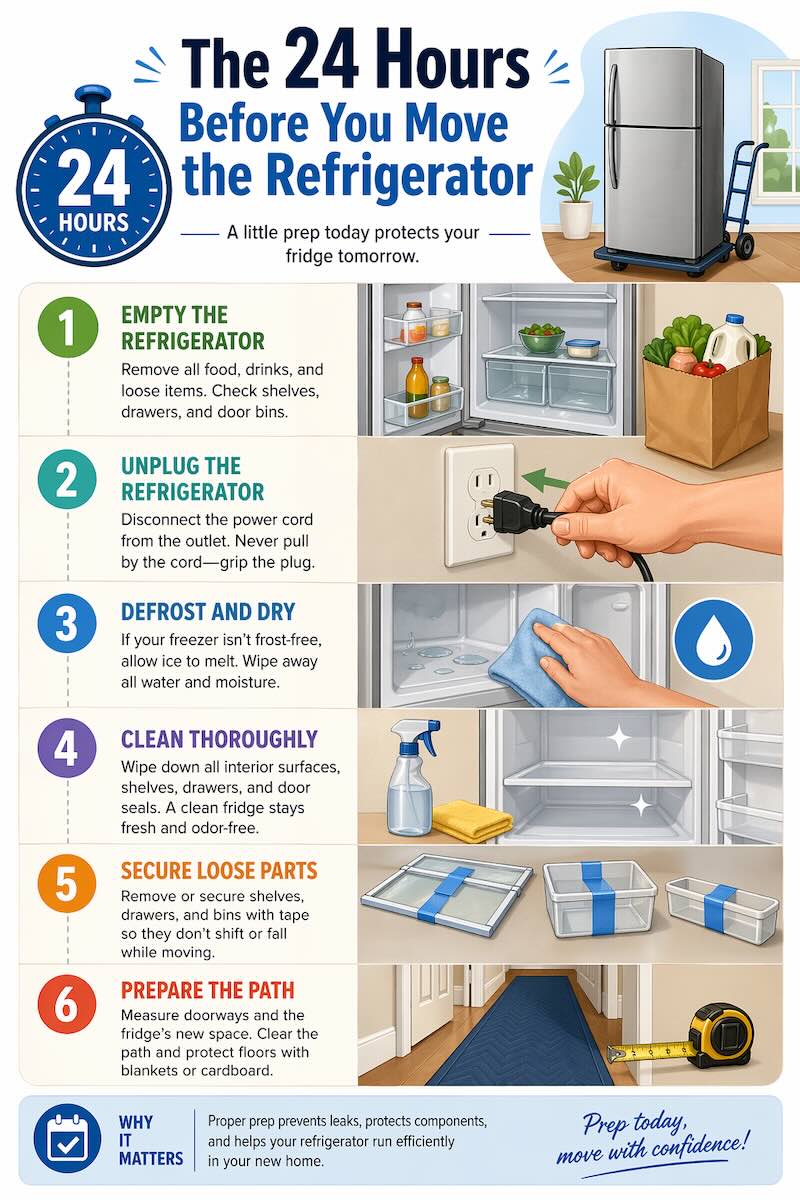
Preparation: The 24 Hours Before You Move the Refrigerator
What you do the day before moving the refrigerator determines most of whether the move goes smoothly. Skipping preparation steps creates problems that cannot be solved mid-move.
Step 1: Measure Everything on the Path
Measure the refrigerator’s height, width, and depth. Then measure every doorway, hallway, and stairwell opening along the route from the current location to the moving truck or new location. The critical number is the diagonal measurement: a refrigerator that is 70 inches tall and 32 inches deep has a diagonal of approximately 77 inches when tilted at 45 degrees on the dolly, which is what determines whether it clears a low doorframe or basement ceiling.
Most standard interior doorways are 80 inches tall and 32 to 36 inches wide. French doors and some older home doorframes can be narrower. If the refrigerator will not fit through a doorway in standard upright position, most manufacturer owner’s manuals include instructions for removing the doors from the refrigerator itself to reduce the width by 3 to 5 inches. This takes 15 minutes and a flathead screwdriver; it is significantly easier than discovering the problem with the loaded dolly wedged in the frame.
Step 2: Unplug and Begin Defrosting (24 Hours Ahead)
Unplug the refrigerator at least 24 hours before the planned move. Open both the refrigerator and freezer doors and place towels inside and on the floor beneath to absorb melting ice from the freezer compartment. A fully loaded freezer can produce several quarts of water as it defrosts; towels prevent that water from reaching the floor and creating a slip hazard or water damage to wood flooring.
Transfer all perishable food to a cooler with ice packs. Most ice packs maintain food safety temperatures below 40°F for 24 to 48 hours, which is sufficient for any same-day move. Non-perishables can be moved in boxes separately; moving them out of the refrigerator also reduces the weight of the appliance by 50 to 100 pounds on a well-stocked unit.
Step 3: Disconnect the Water Line (Ice Maker and Water Dispenser Models)
Any refrigerator with an ice maker, water dispenser, or plumbed water filter connection has a supply line running to the back of the unit that must be properly shut off and disconnected before the refrigerator is moved. The water supply valve is typically a saddle valve or dedicated shutoff on the cold water supply pipe behind or under the refrigerator. Turn the valve fully clockwise to close it, then disconnect the supply line from the back of the refrigerator and allow any residual water in the line to drain into a towel.
Tape the disconnected supply line to the back of the refrigerator for transport so it does not catch on the floor or doorframes. Leaving a pressurized water line connected to a refrigerator that is being maneuvered out of position is how water lines get pulled loose and soak floors, walls, and the interior of moving trucks.
Step 4: Remove and Pack Interior Shelves and Drawers
Remove all glass shelves, crisper drawers, door bins, and any other detachable interior components. Wrap each glass component individually in bubble wrap or packing paper, then pack them together in a clearly labeled box. Glass shelves left inside the refrigerator during transport do not stay in place; they shift with every bump, crack against each other, and can break the mounting brackets inside the unit in addition to shattering themselves.
Plastic door bins can often remain in place if they are secured with painter’s tape or stretch wrap so they cannot rattle or shift. If they are loose or not designed to lock into position, remove and box them with the glass shelves.
Step 5: Clean the Interior
Wipe down all interior surfaces with a mild cleaner before closing the unit for transport. Any food residue or liquid left inside during a multi-day move will develop mold and odors that are difficult to eliminate after the fact. For long-distance moves where the refrigerator may sit in a truck for several days, cleaning is not optional; it is the difference between a functional appliance at destination and one that requires professional deodorizing before it is usable.
Leave both doors slightly open during the 24-hour defrost period after unplugging. Close and secure them only when you are ready to begin physically moving the unit.
How to Move a Refrigerator: Step-by-Step on Moving Day
Step 1: Prepare the Floor Protection Path
Lay cardboard panels or hardboard sheets on every floor surface the refrigerator will travel across, from its current position to the exit. Overlap panels so there are no gaps where feet or wheels can catch on an edge. On hardwood floors, a double layer of cardboard provides meaningful scratch protection; on tile, a single layer is sufficient. Carpet does not require floor protection from scratching, but cardboard still helps the dolly roll smoothly.
Mark the floor protection path in advance so you know exactly where you are navigating before the weight is on the dolly. Redirecting a loaded appliance dolly mid-corridor because the floor protection did not extend far enough is when people lose control of the appliance.
Step 2: Secure the Doors and Wrap the Exterior
Close both the refrigerator and freezer doors fully. Run stretch wrap horizontally across both doors in two passes to hold them shut; they should not be able to swing open when the unit is tilted. Do not use packing tape directly on the exterior finish of the refrigerator; it pulls off paint and leaves adhesive residue on stainless steel and painted surfaces.
Wrap the entire exterior of the refrigerator in moving blankets, covering the corners and back panel. Secure the blankets with stretch wrap or moving bands so they stay in position during transport. The moving blankets serve two purposes: they protect the refrigerator’s exterior from doorframe and wall contact, and they protect your walls and doorframes from the refrigerator.
Step 3: Position the Appliance Dolly
With your helper positioned on the opposite side of the refrigerator, gently tilt the unit forward slightly. Slide the toe plate of the appliance dolly underneath the bottom of the refrigerator, centering it side-to-side so the weight is balanced on the dolly frame. Lower the refrigerator back down onto the dolly toe plate.
Secure the appliance dolly straps around the body of the refrigerator: one strap at the upper third and one at the lower third of the refrigerator body. Pull both straps snug so there is no play between the refrigerator and the dolly frame. The refrigerator should feel like one unit with the dolly when you grip the handles, not like an appliance sitting loosely on top of a cart.
Step 4: Tilt and Roll Toward the Exit
With one person gripping the dolly handles and leaning back to tilt the loaded dolly, and the second person steadying the front of the refrigerator and acting as a spotter and guide, tilt the dolly back to no more than a 45-degree angle. Going past 45 degrees shifts too much weight over the wheels and makes the dolly difficult to control; it also puts unnecessary stress on the refrigerator’s mounting points.
Roll slowly toward the exit, with the spotter walking ahead to guide through doorways, alert to obstacles, and call out any direction changes before they happen. The person on the dolly handles cannot see clearly past the wrapped refrigerator; the spotter’s eyes are what prevent the unit from catching on doorframes, furniture, or floor transitions.
Step 5: Navigate Doorways
At each doorway, pause before attempting to pass through. Confirm that the width is clear of the refrigerator plus dolly combination. If door handles will create a width problem, remove them if they detach, or shift the dolly angle to lead with the hinge side of the refrigerator rather than the handle side.
For tight doorframes, have the spotter grip the front corner of the refrigerator and walk it through the frame with controlled lateral guidance while the dolly handler follows the direction of that guidance. Do not push the refrigerator through a doorframe by force; if it does not fit, that is the time to check whether the refrigerator doors can be removed to reduce width, not a reason to apply more force.
Step 6: Navigate Stairs
Stairs require maximum care and slow, deliberate movement. On descending stairs, the person with the dolly handles controls the rate of descent from above; the spotter positions below the refrigerator with hands on the lower edge of the unit and helps control the descent rate one step at a time. Never release the dolly at the top of a staircase. Never attempt stairs with fewer than two people.
On ascending stairs, the process reverses: the spotter pushes from below while the person on the dolly handles pulls and controls the tilt angle. Take stairs one at a time, pausing between each step to confirm balance and grip before proceeding. This is the highest-risk part of any refrigerator move and should be treated accordingly; the option to call a professional mover becomes most sensible when the route includes a full flight of stairs.
Step 7: Load onto the Moving Truck
Position the truck ramp at its lowest practical angle. Walk backward up the ramp while pulling the dolly, with the spotter pushing from behind and controlling the angle. Attempting to push a loaded dolly up a ramp from behind while walking forward removes the ability to see and respond to the ramp edge; always pull from the top, not push from the bottom.
Once inside the truck, position the refrigerator upright against the truck wall with the back of the refrigerator toward the wall. Secure it to the truck wall with moving straps or ratchet straps through the truck’s E-track or D-ring anchor points. A refrigerator that is not strapped to the truck wall will shift and fall in transit; a 300-lb falling appliance in a moving truck destroys everything it falls on.
The refrigerator should be among the last items loaded and positioned to prevent other items from being stacked against it or on top of it during transit. Other heavy furniture can be placed in contact with the sides of the refrigerator to provide lateral stability, but nothing should be stacked on top of the appliance.
Upright vs. On Its Side: The Rule That Protects the Compressor When Moving The Refrigerator
The instruction to keep a refrigerator upright during transport exists because of how the compressor system works. The compressor contains oil that lubricates its internal components during operation, and that oil is designed to sit in a reservoir at the base of the compressor when the unit is upright. When a refrigerator is laid on its side, that oil migrates out of the reservoir and into the refrigerant lines.
If the refrigerator is plugged in before the oil drains back into the reservoir, the compressor runs without proper lubrication and can seize. Compressor replacement typically costs $200 to $400 for parts plus labor, often close to or exceeding the value of an older refrigerator.
If You Must Transport the Refrigerator on Its Side
The ideal is always to transport a refrigerator upright. When the truck height or loading configuration makes upright transport genuinely impossible, the following rules minimize the damage risk:
- Lay the refrigerator on its compressor side, which is typically the right side when facing the front of the unit. The compressor is located at the bottom rear; laying the refrigerator on the right side keeps the compressor oil closer to the reservoir. Check your owner’s manual or the manufacturer’s sticker on the back of the unit to confirm the correct side for your specific model.
- Never lay the refrigerator on its back. The compressor and condenser coils are on the back of the unit; laying it back-down crushes these components and causes damage that cannot be undone.
- Once returned to upright at the destination, wait at least 24 hours before plugging in. The standard recommendation from Whirlpool, GE, LG, Samsung, and most major manufacturers for a refrigerator transported on its side is to wait at least as long as it was transported on its side before restarting with a minimum of 24 hours regardless of transport duration.
- If you are unsure how long it was transported on its side, default to the 24-hour waiting period. The cost of waiting is patience. The cost of plugging in too early is a compressor replacement or a totaled refrigerator.
Arriving at the New Location: Installation and the Waiting Period
Unloading and Positioning
Reverse the loading process: use the dolly, walk the ramp backward in a controlled descent, and navigate through the new home’s doorways and hallways using the same measurement and spotter system used at origin. Position the refrigerator in its final location before removing the moving blankets and straps, not after; repositioning a 300-pound appliance after the blankets are off is harder and carries floor damage risk.
Level the refrigerator in its new position using the adjustable front feet that most models include. A refrigerator that is not level runs less efficiently, causes doors to swing open or closed on their own, and can develop compressor wear over time from running on an uneven surface. Adjust the front feet until a bubble level placed on top of the unit reads center in both directions.
Refrigerators need clearance for adequate airflow to the condenser coils. Most manufacturers specify 1 to 2 inches of clearance on the sides, 1 inch at the top, and 2 to 3 inches at the rear. Pushing a refrigerator directly against a wall with no rear clearance causes the condenser to overheat, increasing energy use and reducing the lifespan of the compressor.
Reconnecting the Water Line
If your refrigerator has an ice maker or water dispenser, reconnect the water supply line before returning the refrigerator to its final position, while there is still room to reach the back of the unit. Turn the water supply valve back on and check the connection for leaks by running a paper towel along the line and fitting; any moisture indicates a connection that needs to be tightened or replaced.
Allow the ice maker 24 to 48 hours after plugging in to produce the first batch of ice. Discard the first one or two batches; any particles loosened during transport or from the supply line may be present in the early ice production.
The Waiting Period Before Plugging In
For a refrigerator transported upright, wait a minimum of 4 to 6 hours before plugging it in. This allows the compressor oil and refrigerant to fully settle in the new position. Most major manufacturers recommend at least 4 hours; many recommend up to 24 hours for maximum compressor protection, particularly if the refrigerator was tilted significantly during any portion of the move.
For a refrigerator transported on its side, the minimum is 24 hours upright before plugging in. Set a timer and do not override it. The compressor oil migrates slowly back to its reservoir, and the cooling system needs to be fully stable before it is asked to work again.
Return the glass shelves, crisper drawers, and door bins to the refrigerator before or after the waiting period, as they will be accessible during the downtime. Once the waiting period is complete, plug the unit in, set the temperature to the desired setting, and allow 4 to 8 hours for the interior to reach proper operating temperature before loading it with perishable food.
Special Situations: What Changes the Standard Process
Moving a French Door or Bottom-Freezer Refrigerator
French door and bottom-freezer models are among the most common refrigerator styles sold in the last decade, and they have specific considerations beyond the standard top-freezer or side-by-side units. The double-door design means both French doors must be secured with stretch wrap before moving; they are lighter than a single door and more prone to swinging open suddenly when the unit is tilted. Bottom-freezer drawer designs need to be checked for a locking mechanism or taped shut, as the drawer can slide open under its own weight when the unit is tilted back on the dolly.
Moving a Counter-Depth or Built-In Refrigerator
Counter-depth and built-in refrigerators are integrated more closely into the cabinetry and may require panel removal to extract. Check whether the cabinetry side panels are screwed into the refrigerator or the cabinet framing before tilting the unit; pulling a refrigerator away from integrated cabinetry without removing attachment screws pulls the cabinetry with it. Built-in refrigerator models from Sub-Zero, Thermador, and similar premium brands are substantially heavier than standard residential units and are best handled by professional appliance movers who have specific experience with these products.
Moving a Refrigerator Up or Down Stairs
Stairs are the most common reason that a DIY refrigerator move becomes a professional mover call. More than one flight of stairs, a spiral staircase, or any staircase with a tight landing or turn at the bottom significantly increases the difficulty and injury risk. An appliance dolly with stair-climbing wheels (sometimes called a “stair climber dolly”) distributes the descent load across the stair nosings rather than requiring the handlers to bear the full weight at each step; renting one for $30 to $50 per day is worth the investment for any stair move.
Moving a Refrigerator in Cold Weather
Extreme cold makes plastic components on refrigerators brittle, particularly door gaskets and plastic door liners. In temperatures below 20°F, allow the refrigerator to acclimate to room temperature before attempting to move or manipulate the doors, and avoid tilting the unit sharply or impacting corners. Moving blankets provide some temperature insulation during brief transit in cold weather, but an extended period in a cold truck should be avoided for units with a significant amount of plastic construction.
When to Call a Professional Mover Instead of Moving It Yourself
Most refrigerators can be moved by two physically capable adults with the right equipment and this guide. Several situations make the case for professional movers clear enough that the cost difference is worth calculating before you decide.
- More than one flight of stairs at origin or destination: two flights of stairs with a 300-pound appliance creates genuine injury risk; a professional moving crew handles this daily with trained technique and equipment.
- A built-in, commercial, or premium refrigerator weighing over 400 pounds: commercial refrigeration expert Jim Van Vleet puts it directly: “Some equipment weighs between 500 and 2,000 pounds per appliance. My advice is: don’t attempt to move it yourself.”
- No second person available: a refrigerator move without a helper is not a modified version of this guide; it is a different and significantly more dangerous operation that should not be attempted.
- A long-distance move where the refrigerator will be on the truck for multiple days: professional movers include the refrigerator as part of a binding estimate and handle all positioning, strapping, and unloading, which eliminates the risk of improper securement over hundreds of miles.
- A tight access situation where the refrigerator is marginally too wide for a doorway: professional movers have experience removing refrigerator doors to reduce width and reassembling them at destination; this is a trained skill that takes minutes when you know what you are doing and can take hours and cause damage when you do not.
Professional movers typically charge $150 to $300 to move a single appliance locally, and refrigerator handling is included in the base rate for most full-service long-distance moves. Measured against the cost of a back injury, a damaged floor, or a compressor replacement, the case for professional handling in any of the above situations is straightforward.
Need Help Moving Your Refrigerator or Planning a Full Move?
Coastal Moving Services handles appliance moves, full home moves, and long-distance relocations to all 50 states with licensed, insured crews who know how to move refrigerators, washers, dryers, and heavy appliances without damaging your floors, your walls, or the appliances themselves. Binding estimates. No surprise charges at delivery. Call us at +1-334-659-1878 or get a free quote below.
Frequently Asked Questions: How to Move a Refrigerator
How long do you have to wait to plug in a refrigerator after moving it?
For a refrigerator transported upright, wait a minimum of 4 to 6 hours before plugging it in. Most major manufacturers including Whirlpool, GE, LG, and Samsung recommend at least 4 hours, with 24 hours being the safest interval when the refrigerator was significantly tilted at any point during the move. For a refrigerator transported on its side, the minimum waiting period before plugging in is 24 hours after returning the unit to upright. The reason for the wait is compressor oil: the oil migrates out of its reservoir when the unit is tilted or laid flat, and plugging in before it settles back can cause compressor seizure. Once plugged in, allow 4 to 8 hours for the interior to reach operating temperature before loading perishable food.
Can you transport a refrigerator on its side?
Yes, but it is not the preferred method and introduces compressor damage risk if the waiting period is not observed. If you must transport a refrigerator on its side, lay it on its compressor side, which is typically the right side when facing the front of the unit, and never on its back. Once returned to upright, wait a minimum of 24 hours before plugging in. Do not skip or shorten this waiting period. Most manufacturers state in their owner’s manuals that the warranty does not cover compressor damage resulting from improper transport, which means the risk is entirely on the mover.
How do you move a refrigerator without scratching the floor?
Three approaches work in combination. First, place cardboard or hardboard panels on every floor surface along the path before moving the refrigerator to create a protective pathway. Second, use furniture sliders under the front feet of the refrigerator to allow it to be slid away from the wall without dragging across the floor surface. Third, use an appliance dolly once the refrigerator is away from the wall, which lifts the feet entirely off the floor and rolls on wheels that cause no scratch damage. This three-step approach eliminates virtually all floor damage risk on hardwood, tile, and vinyl.
What happens if you don’t defrost a refrigerator before moving it?
Moving a refrigerator that has not been defrosted causes two specific problems. First, the melting ice from the freezer compartment produces several quarts of water as the refrigerator moves through its position changes, and that water runs out of the freezer drain and onto your floors. On hardwood floors, this causes water staining and warping. Second, ice that is still frozen in the freezer compartment shifts during transport and can crack plastic drawer components and door shelves inside the freezer. Unplugging 24 hours before the move and allowing the freezer to fully defrost with towels inside and on the floor beneath eliminates both problems.
Can one person move a refrigerator?
It is possible to slide a refrigerator short distances across a kitchen floor using furniture sliders, but a full move, including loading onto a dolly, navigating doorways, and loading into a truck, should never be attempted by one person. Modern full-size refrigerators weigh 200 to 400 pounds with a high center of gravity; tipping on a dolly without a spotter is a real physical risk. Beyond injury risk, an unsupported refrigerator that shifts on a dolly mid-maneuver will damage walls, doorframes, and floors in ways that are expensive to repair. Moving a refrigerator is a two-person minimum task, and three people make stair moves significantly safer.
Do you need a special dolly to move a refrigerator?
Yes. An appliance dolly, sometimes called an appliance hand truck, is specifically designed for moving upright heavy appliances. It is taller than a standard furniture dolly, has a reinforced vertical frame, and includes integrated straps to secure the appliance to the frame during transit. A standard furniture or utility dolly sits too low and cannot safely support the height and weight of a refrigerator; the center of gravity is too high to maintain stability when the appliance is tilted back for rolling. Appliance dollies are available for rental at Home Depot, Lowe’s, and U-Haul for $10 to $25 per day.
How do you move a refrigerator with water and ice maker connections?
Before moving any refrigerator with an ice maker, water dispenser, or in-door water filter connection, locate the water supply shutoff valve, typically a saddle valve on the cold water supply pipe behind or under the appliance. Turn the valve clockwise to close it completely, then disconnect the supply line from the refrigerator fitting and drain any residual water from the line into a towel. Tape the disconnected supply line to the back of the refrigerator for transport. At the new location, reconnect the supply line and turn the shutoff valve back on before pushing the refrigerator into its final position, then check for leaks at the connection. Allow 24 to 48 hours for the ice maker to produce the first cycle of ice, and discard the initial one or two batches.
References
- GE Appliances: Refrigerator Moving Instructions – Official Manufacturer Guidelines for 2026
- Whirlpool: How to Move a Refrigerator – 2026 Step-by-Step Maintenance and Safety Guide
- U-Haul: Professional Equipment for Moving a Fridge Safely – 2026 Logistics Guide
- The Home Depot: How to Move a Refrigerator – Updated April 2026 Tool and Supply List
- Elite Anywhere: How to Move a Refrigerator During Home Relocation – January 2026 Expert Advice
- Angi: Hiring Professional Appliance Movers – 2026 Cost and Safety Comparison