
Everything you need on moving day that is not on the truck belongs in one bag that stays in your car, and most people only discover what should have been in that bag after spending the first hour at the new address digging through boxes looking for toilet paper, a phone charger, or their lease. This guide covers every category of item that belongs in a moving day survival kit, organized by priority, with a complete checklist at the end.
Key Points: Moving Day Survival Kit
- The survival kit travels in your car, never on the moving truck. Once the truck is loaded, the contents are inaccessible until delivery and unloading are complete. Everything you need from the moment packing ends to the moment the new home is functional needs to be in a bag or box in your vehicle from the start of moving day through to the end of it.
- Pack the survival kit the night before moving day, not the morning of. Moving day mornings are chaotic by nature. A kit packed the night before means the essentials are confirmed, organized, and loaded before the first distraction of the day arrives. A kit assembled on moving day morning consistently ends up missing items that were overlooked under time pressure.
- Documents and medications are the highest-priority items in the kit. The lease or purchase agreement, photo ID, moving contract, insurance papers, and all prescription medications for every member of the household should be in the survival kit before any other category is considered. These are the items with the highest consequence if they end up inaccessible on the truck.
- The kit should cover a minimum of 24 to 48 hours of independent function. Truck delivery delays, access issues, and utility activation problems can leave a household without a functioning home for 24 hours or more after moving day. A kit stocked for 48 hours ensures the household can function through a delay without scrambling for supplies.
- Tools belong in the kit, not on the truck. A box cutter, screwdriver set, Allen keys, and scissors are needed repeatedly throughout moving day and the first day of unpacking. Putting them in the truck means retrieving them requires either waiting for the truck to arrive or digging through the load, neither of which is practical.
- Toilet paper and hand soap are the two single items most consistently reported missing on moving day. Our guide specifically call out toilet paper as the item households most reliably forget to keep accessible. Both go on the truck with the household goods and both are needed within the first 10 minutes of arriving at the new address.
Why Is It Called a Moving Day Survival Kit?
The term “survival kit” is used because moving day effectively strips away the basic functional infrastructure of your home. Once your belongings are packed and loaded, you lose access to the everyday tools and supplies required to maintain a standard level of comfort and efficiency.
This kit serves as a tactical resource to bridge the gap between your old residence and your new one. It prevents the frustration of digging through dozens of sealed boxes to find immediate necessities like chargers, basic tools, or personal care items. By keeping these essentials in a dedicated, accessible container, you ensure that the first 24 hours of your transition remain organized and manageable, even while the rest of your life is still in transit.
Documents and Valuables to Keep in the Survival Kit
Documents and valuables are the first category to pack into the survival kit and the last category to check before leaving the old address. Any document or valuable item placed on the moving truck is inaccessible during transit and is exposed to the same risk of loss or damage as every other item in the load. Every item in this category should travel in the family vehicle with a designated person responsible for it throughout the day.
- Photo ID for every adult in the household passport or driver’s license
- Lease agreement or mortgage closing documents for the new address
- Moving contract and binding estimate from the carrier, with the USDOT number and carrier contact information accessible
- Home insurance documents for the new address, with the policy number and emergency claims contact
- Vehicle registration and auto insurance cards if these are not already kept in the vehicle
- Medical insurance cards for every member of the household
- Birth certificates, Social Security cards, and passports if not already packed under ID above
- New address utility confirmation numbers with the activation dates for electricity, gas, water, and internet
- Cash with a reasonable amount in small bills for tipping the moving crew, paying for meals during the day, and handling any incidentals that require cash payment
- New home keys, garage codes, and building access fobs confirmed in hand before leaving the old address
- Jewelry, irreplaceable photographs, and any small high-value items that would be impossible to replace if lost in transit
Moishes’ 2025 moving day guide recommends keeping all documents in a dedicated waterproof folder or document pouch within the survival kit rather than loose in the bag, and labeling the folder clearly so it can be located immediately rather than searched for during the day.
Tools and Supplies for Moving Day
The tool category of the survival kit covers the physical supplies needed to function on moving day and through the first 24 hours of unpacking. Most of these items cost very little and collectively make an enormous difference to how smoothly the first day at the new address runs.
Essential Tools
- Box cutter or utility knife needed for opening boxes from the first minute of unloading; pack two if multiple people will be unpacking simultaneously
- Screwdriver set flat head and Phillips in at least two sizes for reassembling furniture, tightening cabinet hinges, and installing curtain rods on the first day
- Allen key set most flat-pack furniture including beds, wardrobes, and shelving units uses Allen bolts; a full metric and imperial set covers the majority of hardware combinations
- Scissors separate from the box cutter; useful for cutting tape, opening packaging, and tasks where a blade is not appropriate
- Cordless drill or electric screwdriver optional but significantly speeds up furniture reassembly on the first day; bring the charger and confirm the battery is charged the night before
- Hammer for picture hooks, furniture assembly pins, and any light assembly that requires it
- Measuring tape for confirming furniture placement before heavy items are moved to their final positions
- Flashlight with spare batteries or a charged headlamp essential if utilities are not active at arrival, if the move extends into evening, or if any area of the new home lacks functional lighting fixtures
- Extension cord and power strip outlets at the new address may not be positioned where they are needed; an extension cord and power strip allow devices to be charged and appliances to be used before furniture is arranged and cables are routed
Supplies and Packing Materials
- Packing tape and tape gun for resealing boxes that need to be repacked, reinforcing box bottoms that weaken during loading, and taping up anything that needs temporary securing during the move
- Permanent markers for labeling any boxes that were packed without labels in the final rush and for noting room assignments on boxes placed by the movers
- Duct tape for quick repairs, temporary fixes, and securing moving blankets and furniture pads that loosen during transit
- Zip bags in multiple sizes for organizing hardware removed from furniture, storing small items from opened boxes, and keeping cables sorted during the initial unpacking
- Trash bags, large and heavy-duty packing materials, cardboard, and moving debris accumulate rapidly during unloading; having bags immediately available rather than in a box keeps the new home navigable through the unloading process
- Paper towels and all-purpose cleaning spray for wiping down surfaces before items are placed, cleaning up spills during the move, and handling any dirt or debris in the new space before furniture is positioned
- Hand soap and hand sanitizer moving involves significant physical contact with dirty surfaces, packaging materials, and outdoor environments; hand washing supplies need to be accessible from the first moment at the new address
- Toilet paper – a minimum of one full roll per person for the first 24 hours. This is consistently the most reported missing item on moving day according to Penske’s moving day essentials guide and White and Company’s 2026 survival kit guide. Pack more than seems necessary.
Personal Care and First Aid Essentials
Moving day involves physical exertion, dust, irregular meals, and the kind of minor injuries that come from lifting, carrying, and working in spaces full of sharp box corners and heavy furniture. A personal care kit that covers the day’s basic hygiene needs and the most likely minor medical situations costs almost nothing to prepare and prevents the specific discomfort of needing any of these items and not being able to find them.
Personal Care Items
- Toothbrush and toothpaste for every member of the household
- Deodorant
- Face wash and moisturizer
- Wet wipes or facial wipes for quick clean-ups without shower access
- Shower gel or soap bar
- Shampoo and conditioner if a shower at the new address will be available that evening
- Towel for each person at least one bath towel and one hand towel per adult
- Shower curtain liner and rings if the new bathroom does not have one already installed
- Feminine hygiene products if applicable
- A change of clothing for each person moving clothes get dirty, wet, and sweaty; having clean clothes accessible for the evening means the first night at the new address is comfortable regardless of what else is still unpacked
- Pajamas or sleepwear for each person for the first night
First Aid Kit
Moving day produces a predictable set of minor injuries: blisters from tape and box edges, cuts from box cutters and sharp packaging, muscle soreness, headaches from dehydration and exertion, and the occasional bruised shin from a furniture corner. A small first aid kit in the survival bag covers all of them without requiring a pharmacy run on moving day.
- Adhesive bandages in multiple sizes
- Antiseptic wipes
- Pain reliever ibuprofen or acetaminophen
- Antihistamine for allergy reactions to dust and new environments
- Antacid tablets irregular meals and stress commonly produce digestive discomfort on moving day
- All prescription medications for every member of the household, with enough supply to cover at least three to five days
- Any over-the-counter medications used regularly including eye drops, nasal spray, or topical treatments
- Blister pads for hands and feet
- A reusable cold pack for minor muscle injuries from heavy lifting
Food, Snacks, and Hydration for Moving Day
Physical exertion combined with irregular meal timing and the mental load of managing a move makes dehydration and low blood sugar two of the most consistent causes of fatigue, irritability, and poor decision-making on moving day. Packing food and hydration supplies in the survival kit means they are accessible at any point during the day without requiring a stop or a delivery order at the moment when they are needed most.
What to Pack for Food and Drink
- Water a minimum of two liters per person for the day; more in summer or in hot climates where dehydration happens faster under physical exertion
- Electrolyte drinks or powder packets for heavy exertion days where water alone does not replace the minerals lost through extended physical work
- Protein bars or granola bars high calorie-to-volume ratio, no refrigeration required, no preparation needed
- Nuts, trail mix, or dried fruit sustained energy without the sugar spike and crash that comes from snacks based primarily on simple carbohydrates
- Fruit bananas, apples, or oranges hold up well without refrigeration for a full day and provide quick accessible energy during a break
- Crackers and peanut butter or hummus cups a more substantial snack option that does not require refrigeration or preparation
- Coffee or tea supplies for the morning and evening of moving day a travel mug, instant coffee or tea bags, and a small electric kettle or single-serve coffee maker that can be set up with the extension cord from the tools kit at any point during the day; Penske’s moving day essentials guide specifically lists a coffee pot as a moving day essential
- Disposable plates, cups, and utensils kitchen items are on the truck; having disposable options means the first meal at the new address does not require unpacking the kitchen first
- Paper towels as napkins already in the tools and supplies section but worth noting as doubling for the food category as well
The First Night Box: What to Set Up Before the Truck Leaves
The first night box is a dedicated box or bag separate from the survival kit that contains everything needed to make the new home functional and comfortable for the first night and morning, labeled OPEN FIRST in large text on all sides. Moishes’ 2025 moving guide identifies the first night box as a distinct preparation from the survival kit; the survival kit covers the day in transit, and the first night box covers the evening and morning after arrival. The first night box travels in the family car alongside the survival kit.
First Night Box Contents
- Bedding for every sleeping surface being used on the first night fitted sheet, flat sheet or duvet, and pillows; vacuum-sealed bags compress bulky bedding into a manageable size for the first night box
- Shower curtain and rings if not already in the personal care kit
- Bath mat
- Full set of towels per person if not already in the personal care kit
- Pajamas or sleepwear for each person
- Coffee maker and coffee supplies for morning a single-serve pod coffee maker is the most practical option since it requires only a power outlet and a cup to produce coffee within two minutes of arrival
- Breakfast items for the following morning cereal, oats, crackers, peanut butter, fruit, or any no-cook breakfast that requires no kitchen setup
- Phone chargers and a power strip phones will be low by end of moving day and need charging overnight; the power strip from the tools kit doubles here
- A lamp or portable light source if the bedroom or primary living area does not have functioning overhead lighting on arrival
- White noise machine or phone with white noise app for anyone who requires sound to sleep, since a new home has unfamiliar ambient noise that disrupts sleep on the first night
- Nightlight for any children in the household
Survival Kit Items for Children and Pets
Children and pets experience a moving day environment in ways that are fundamentally different from adults. For a child, moving day is a day of disruption, unfamiliarity, and limited autonomy. For a pet, it involves confinement, noise, and the complete removal of every territorial marker in their environment. A dedicated kit component for each addresses those specific needs rather than expecting children and pets to manage with the general household supplies.
For Children
- A small backpack assembled by or for the child containing their favorite snacks, a familiar comfort object, and two to three toys or activities that do not require setup — Howard Hanna’s moving survival kit guide specifically recommends having children assemble their own miniature kit to give them an active role in the moving day process
- Age-appropriate entertainment for the transit window — a loaded tablet with headphones, a favorite book, or a small activity set
- Diapers and wipes in sufficient supply for 48 hours if there are infants or toddlers in the household
- Formula, baby food, or any dietary-specific foods the child requires, in enough quantity for 48 hours
- A comfort object and familiar bedding item for the first night
- Any medications the child takes regularly, in the first aid kit section of the main survival bag
For Pets
- Pet food for 48 hours in a sealed container do not rely on the pet food being accessible in the main household boxes on the first day
- Water and food bowls packed in the survival bag rather than on the truck
- Leash, collar with updated address tags, and harness
- Any pet medications and the vet’s contact information
- A familiar blanket, toy, or comfort item with the scent of the old home to reduce anxiety in the new space
- Waste bags and a litter box with litter for cats, accessible from the moment of arrival rather than after unpacking
- Carrier or crate if the pet requires containment during any part of the move day
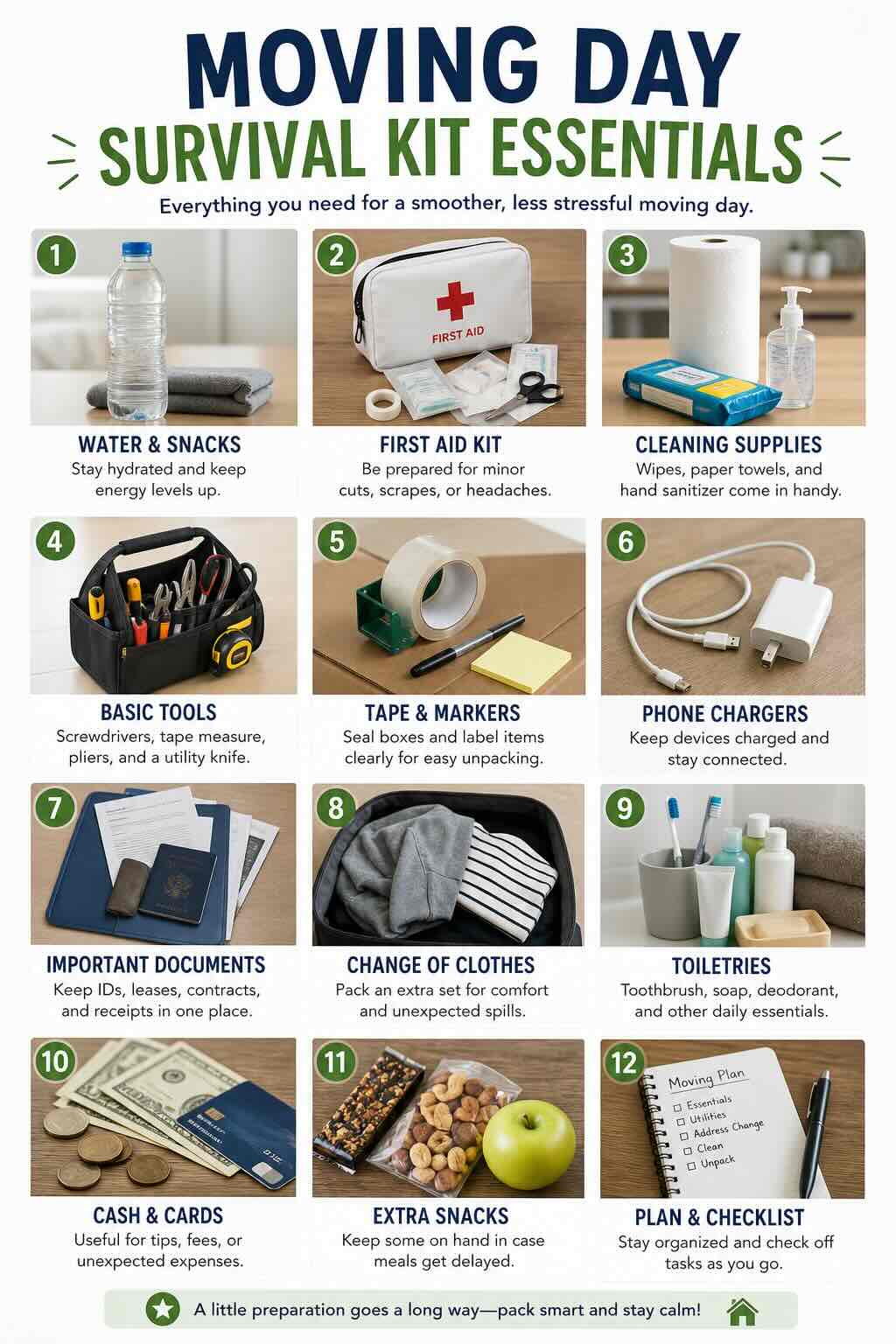
Moving Day Survival Kit: Complete Checklist
| Category | Items |
|---|---|
| Documents and valuables | Photo ID, lease or purchase agreement, moving contract, home insurance, medical insurance cards, birth certificates, passports, utility confirmation numbers, new home keys and access codes, cash, jewelry and irreplaceable valuables |
| Tools | Box cutter, screwdriver set, Allen key set, scissors, hammer, measuring tape, flashlight with batteries, extension cord, power strip |
| Supplies | Packing tape, permanent markers, duct tape, zip bags, trash bags, paper towels, all-purpose cleaner, hand soap, hand sanitizer, toilet paper (minimum one roll per person) |
| Personal care | Toothbrush and toothpaste, deodorant, face wash, wet wipes, shower gel, shampoo, towels, shower curtain liner, change of clothing per person, pajamas per person |
| First aid | Bandages, antiseptic wipes, pain reliever, antihistamine, antacid, all prescription medications (3 to 5 day supply), blister pads, cold pack |
| Food and hydration | Water (2 liters per person minimum), electrolyte packets, protein bars, nuts or trail mix, fruit, crackers and nut butter, coffee or tea supplies, travel mug, disposable plates and utensils |
| First night box (separate, labeled OPEN FIRST) | Bedding per sleeping surface, pillows, bath mat, full towel set per person, pajamas, coffee maker and coffee, breakfast foods, phone chargers, power strip, lamp or portable light |
| Children | Comfort object, snack backpack, entertainment for transit, diapers and wipes if applicable, formula or special foods if applicable, familiar bedding item, medications |
| Pets | 48-hour food supply, water and food bowls, leash and updated collar tags, medications, comfort object, litter box and litter if applicable, waste bags, carrier or crate |
Planning Your Move From Start to Finish
The survival kit is the last thing packed and the first thing needed, and it works best when the rest of the move is as organized as the kit itself. Our long-distance moving services page covers how we handle full-service moves including packing coordination, load sequencing, and delivery scheduling so households arrive at the new address with their survival kit, their first night box, and a truck that unloads in the right order. For households who want the full packing process handled professionally so moving day is purely about logistics rather than packing and wrapping, our packing services page details how we work through a home room by room with proper materials and labeling.
FAQ
What should be in a moving day survival kit?
A moving day survival kit should cover seven categories: documents and valuables including your ID, lease, moving contract, and keys; tools including a box cutter, screwdriver set, Allen keys, flashlight, and extension cord; supplies including packing tape, trash bags, toilet paper, hand soap, and cleaning supplies; personal care including toiletries, towels, and a change of clothing for each person; first aid including bandages, pain reliever, antihistamine, and all prescription medications; food and hydration including water, snacks, and coffee supplies; and a separate first night box containing bedding, pajamas, chargers, and breakfast items. All of it travels in the family car rather than on the moving truck.
What is an “open first” box for moving?
An open first box is a dedicated box or bag containing everything needed to make the new home functional for the first night and morning after the move, labeled OPEN FIRST on all sides so it is identified and opened before any other box during unloading. Standard open first box contents include bedding for every sleeping surface, towels, shower curtain, pajamas, phone chargers, a coffee maker with coffee, basic breakfast items, and a lamp or portable light if the new home’s lighting is not fully functional on arrival. It travels in the family car alongside the main survival bag and is the first item carried into the new home at the start of unloading.
What should you keep in your car on moving day?
Everything that needs to be accessible at any point between leaving the old address and being fully settled at the new one should travel in your car rather than on the truck. That includes the full moving day survival kit, the first night box, all documents and valuables, all medications, all children’s and pets’ immediate care items, all electronics small enough to travel safely in the car, and the new home keys and access codes. Tings App’s 2025 moving day kit guide recommends keeping the survival bag within arm’s reach throughout the day rather than in the trunk, so it can be accessed during a rest stop, during a break in loading, or at any point before the new home’s unloading is complete.
How do you pack a moving day survival bag?
Use one large duffel bag or backpack for the survival kit itself and a clearly labeled box for the first night items. Pack the documents folder first at the bottom where it will not shift or be damaged. Layer personal care and first aid items in a dedicated zip pouch. Place tools in a dedicated tool pouch or small tote bag within the main bag so they are accessible without unpacking everything around them. Pack food and hydration in a separate insulated bag if any items need temperature stability. Load the survival bag into the car the night before moving day so it is confirmed packed, confirmed in the vehicle, and not left behind in the chaos of the moving morning.
References
- White and Company: What to Pack as Part of a Moving Day Survival Kit – 2026 Edition
- Penske: Your Moving Day Essentials Checklist – Official 2026 Fleet Resource
- Really Moving: Your Essential Moving Day Survival Kit – Preparation and Logistics
- Continua Logistics: Creating a Moving Day Survival Kit – 2026 Equipment Standards