


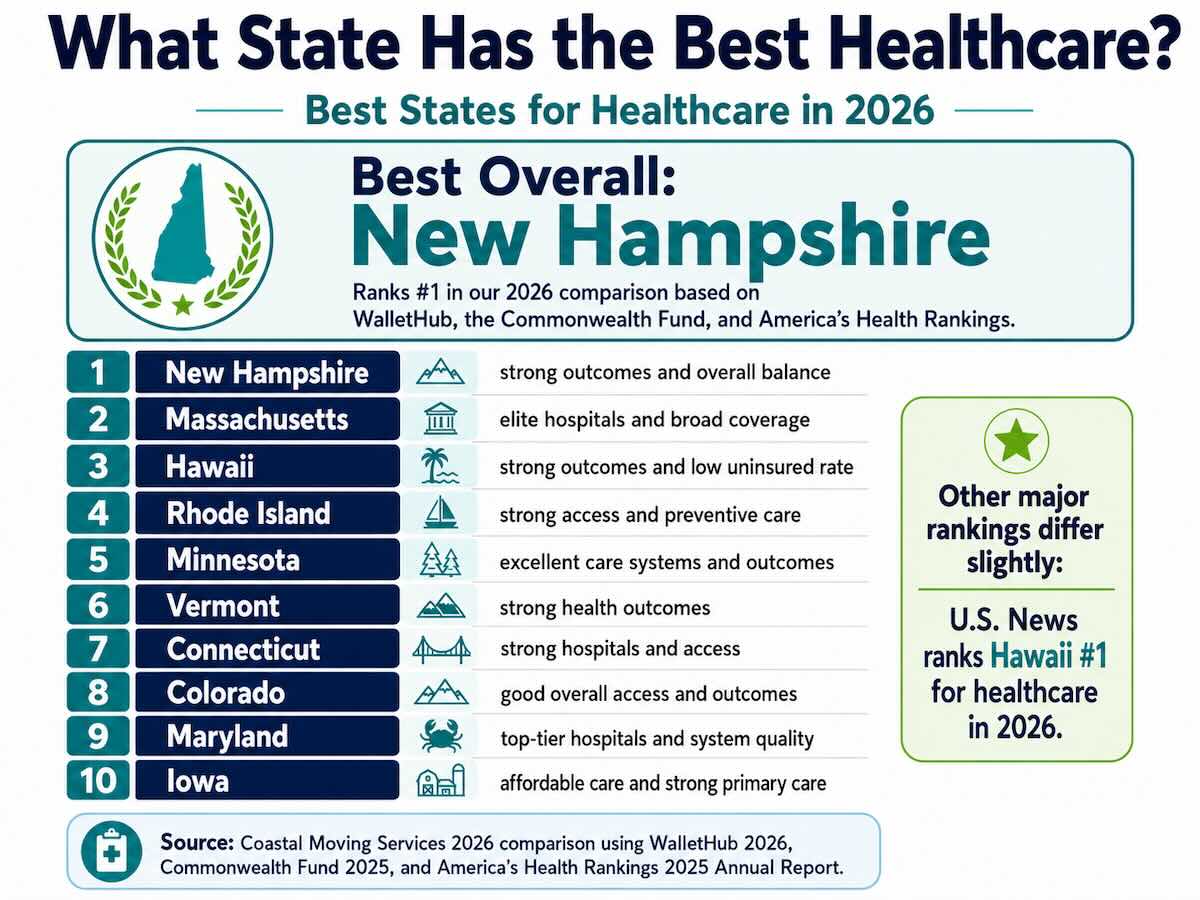
New Hampshire ranks as the best state for healthcare in our 2026 comparison, followed by Massachusetts, Hawaii, Rhode Island, and Minnesota. New Hampshire places first in WalletHub’s 2026 healthcare ranking and first in the latest America’s Health Rankings Annual Report, while the Commonwealth Fund ranks it third for overall health-system performance.
No single healthcare ranking tells the whole story. WalletHub gives substantial weight to cost, access, and outcomes. The Commonwealth Fund focuses on how well state health systems provide affordable access, prevention, treatment, and healthy outcomes. America’s Health Rankings takes a broader view that includes clinical care, health outcomes, behaviors, social conditions, and the physical environment. U.S. News uses another model and ranks Hawaii first for healthcare in its 2026 Best States report.
To answer searches such as “which state has the best healthcare” and “healthcare rankings by state” more consistently, we ranked all 50 states using the latest complete state rankings from WalletHub, the Commonwealth Fund, and America’s Health Rankings. The result is an editorial comparison designed to identify states that perform well across several different ways of measuring healthcare and health.
Key Points (2026)
- Best state for healthcare in our 2026 ranking: New Hampshire.
- Top five: New Hampshire, Massachusetts, Hawaii, Rhode Island, and Minnesota.
- WalletHub’s 2026 leader: New Hampshire, which ranks especially well for health outcomes.
- Commonwealth Fund leader: Massachusetts ranks first in its latest State Health System Performance Scorecard.
- U.S. News 2026 leader: Hawaii ranks first, followed by Massachusetts and Connecticut.
- Lowest-ranked states in our comparison: Mississippi, West Virginia, Arkansas, Texas, and Louisiana.
- Healthcare and health are different: insurance coverage, doctors, hospitals, and affordability measure the healthcare system, while life expectancy and chronic disease are health outcomes influenced by many factors outside medical care.
Healthcare Rankings by State: All 50 States
The table below is the Coastal Moving Services 2026 editorial healthcare ranking. We averaged each state’s position in three national studies: WalletHub’s 2026 Best & Worst States for Healthcare, the Commonwealth Fund’s 2025 State Scorecard on State Health System Performance, and the America’s Health Rankings 2025 Annual Report published in January 2026.
WalletHub and the Commonwealth Fund include Washington, D.C. in their published rankings. Because this article ranks the 50 states, we removed D.C. and recalculated those two sources as state-only positions before averaging them. A lower average source rank is better.
| 2026 Rank | State | WalletHub 2026* | Commonwealth Fund* | America’s Health Rankings | Average Source Rank |
|---|---|---|---|---|---|
| 1 | New Hampshire | 1 | 3 | 1 | 1.7 |
| 2 | Massachusetts | 6 | 1 | 2 | 3.0 |
| 3 | Hawaii | 5 | 2 | 9 | 5.3 |
| 4 | Rhode Island | 4 | 4 | 10 | 6.0 |
| 5 | Minnesota | 2 | 14 | 6 | 7.3 |
| 6 | Vermont | 16 | 7 | 3 | 8.7 |
| 7 | Connecticut | 15 | 10 | 4 | 9.7 |
| 8 | Colorado | 9 | 9 | 12 | 10.0 |
| 9 | Maryland | 17 | 6 | 8 | 10.3 |
| 10 | Iowa | 3 | 17 | 17 | 12.3 |
| 11 | Maine | 7 | 20 | 13 | 13.3 |
| 12 | Utah | 19 | 16 | 5 | 13.3 |
| 13 | Washington | 29 | 8 | 7 | 14.7 |
| 14 | Virginia | 22 | 13 | 14 | 16.3 |
| 15 | North Dakota | 14 | 21 | 15 | 16.7 |
| 16 | Pennsylvania | 13 | 12 | 26 | 17.0 |
| 17 | Nebraska | 10 | 23 | 20 | 17.7 |
| 18 | Idaho | 20 | 18 | 16 | 18.0 |
| 19 | Wisconsin | 8 | 25 | 21 | 18.0 |
| 20 | New Jersey | 30 | 15 | 11 | 18.7 |
| 21 | Oregon | 33 | 11 | 19 | 21.0 |
| 22 | South Dakota | 12 | 31 | 23 | 22.0 |
| 23 | California | 24 | 19 | 24 | 22.3 |
| 24 | New York | 39 | 5 | 25 | 23.0 |
| 25 | Kansas | 11 | 32 | 27 | 23.3 |
| 26 | Delaware | 31 | 24 | 18 | 24.3 |
| 27 | Michigan | 21 | 22 | 33 | 25.3 |
| 28 | Montana | 18 | 27 | 31 | 25.3 |
| 29 | Illinois | 27 | 26 | 28 | 27.0 |
| 30 | North Carolina | 38 | 28 | 22 | 29.3 |
| 31 | Ohio | 25 | 29 | 34 | 29.3 |
| 32 | Arizona | 32 | 33 | 32 | 32.3 |
| 33 | Indiana | 26 | 34 | 37 | 32.3 |
| 34 | South Carolina | 28 | 35 | 36 | 33.0 |
| 35 | Florida | 36 | 38 | 30 | 34.7 |
| 36 | Missouri | 23 | 42 | 39 | 34.7 |
| 37 | Wyoming | 37 | 39 | 29 | 35.0 |
| 38 | Kentucky | 34 | 36 | 43 | 37.7 |
| 39 | New Mexico | 43 | 30 | 41 | 38.0 |
| 40 | Alaska | 50 | 37 | 35 | 40.7 |
| 41 | Nevada | 35 | 45 | 42 | 40.7 |
| 42 | Tennessee | 41 | 43 | 44 | 42.7 |
| 43 | Georgia | 48 | 44 | 38 | 43.3 |
| 44 | Alabama | 45 | 41 | 47 | 44.3 |
| 45 | Oklahoma | 40 | 48 | 45 | 44.3 |
| 46 | Louisiana | 44 | 40 | 50 | 44.7 |
| 47 | Texas | 47 | 49 | 40 | 45.3 |
| 48 | Arkansas | 42 | 47 | 49 | 46.0 |
| 49 | West Virginia | 46 | 46 | 46 | 46.0 |
| 50 | Mississippi | 49 | 50 | 48 | 49.0 |
*WalletHub and Commonwealth Fund positions have been converted to state-only ranks by removing Washington, D.C. The original publications rank D.C. alongside the 50 states. Average source rank is the simple arithmetic mean of the three state-only rankings. It is an editorial comparison, not a clinical quality score.
How Did We Rank the States for Healthcare?
We did not copy one publisher’s list and present it as our own. The 2026 ranking combines three recent national assessments that approach the question differently.
| Source | Edition Used | What It Measures | Weight |
|---|---|---|---|
| WalletHub | 2026 | 44 metrics covering healthcare cost, access, and outcomes. | 33.3% |
| The Commonwealth Fund | 2025 State Scorecard | 50 indicators covering access and affordability, prevention and treatment, avoidable hospital use and cost, healthy lives, and equity. | 33.3% |
| America’s Health Rankings | 2025 Annual Report, published January 2026 | Overall ranking uses measures across social and economic factors, physical environment, behaviors, clinical care, and health outcomes. | 33.3% |
These sources are not interchangeable. WalletHub is the most directly focused on the consumer question of healthcare cost, access, and outcomes. The Commonwealth Fund looks closely at health-system performance. America’s Health Rankings includes broader conditions that affect health as well as medical care. Averaging their ranks rewards states that perform consistently rather than states that dominate only one narrow category.
We also reviewed the 2026 U.S. News Best States healthcare category as an outside comparison. U.S. News ranks Hawaii first, Massachusetts second, and Connecticut third. Because our core table is built from three sources with complete comparable state-level rankings, U.S. News is used as a cross-check instead of a fourth component.
Which State Has the Best Healthcare?
New Hampshire ranks first in our 2026 healthcare comparison. It is #1 in WalletHub’s healthcare ranking, #1 in America’s Health Rankings, and #3 in the Commonwealth Fund’s state health-system scorecard. That consistency gives it the best average source position of any state.
There is no universal winner across every study. Massachusetts ranks first with the Commonwealth Fund and second in both our composite and America’s Health Rankings. Hawaii ranks first in the 2026 U.S. News healthcare category, second with the Commonwealth Fund, fifth with WalletHub, and third in our combined ranking.
| Ranking | #1 State | What the Ranking Emphasizes |
|---|---|---|
| Coastal 2026 Composite | New Hampshire | Consistency across three national rankings |
| WalletHub 2026 | New Hampshire | Cost, access, and outcomes |
| Commonwealth Fund | Massachusetts | Health-system performance |
| America’s Health Rankings | New Hampshire | Health outcomes and their drivers |
| U.S. News 2026 | Hawaii | Healthcare access, quality, and public health |
Why Do the Top 10 States Rank So Well?
1. New Hampshire
New Hampshire is the most consistent performer in the current data. WalletHub ranks it first overall for healthcare and first for outcomes, while America’s Health Rankings also places it first. The Commonwealth Fund puts the state third. That combination suggests strong performance extends beyond one measure such as hospital quality or insurance cost.
2. Massachusetts
Massachusetts ranks first in the Commonwealth Fund Scorecard, second in America’s Health Rankings, and second in U.S. News’ 2026 healthcare category. WalletHub places it sixth because its model gives healthcare costs a larger role. For someone focused heavily on access and health-system performance, Massachusetts can reasonably be considered a contender for the top position.
3. Hawaii
Hawaii is U.S. News’ #1 healthcare state for 2026 and ranks second with the Commonwealth Fund. WalletHub places it fifth. America’s Health Rankings puts Hawaii ninth, which brings it to third in our composite. The state’s strong outcomes and coverage performance are balanced by the practical challenges of providing specialty care across an island chain.
4. Rhode Island
Rhode Island performs unusually consistently for a small state. It ranks fourth with both WalletHub and the Commonwealth Fund and tenth in America’s Health Rankings. Its result is driven by broad performance rather than a single exceptionally high source rank.
5. Minnesota
Minnesota ranks second with WalletHub and sixth in America’s Health Rankings. The Commonwealth Fund places it lower at 14th among states, which keeps it below the New England leaders in our composite while still placing it comfortably in the top five.
6. Vermont
Vermont demonstrates why combining rankings changes the order. America’s Health Rankings places Vermont third and the Commonwealth Fund ranks it seventh among states, but WalletHub places it 16th. It remains one of the strongest overall performers after those differences are averaged.
7. Connecticut
Connecticut ranks fourth in America’s Health Rankings and tenth among states in the Commonwealth Fund scorecard. U.S. News places Connecticut third in its 2026 healthcare category. WalletHub’s 15th-place result pulls the state slightly lower in our overall list.
8. Colorado
Colorado is one of the most consistent states across all three sources, ranking ninth with WalletHub, ninth in the Commonwealth Fund state-only comparison, and 12th in America’s Health Rankings. There is relatively little disagreement about its overall position.
9. Maryland
Maryland ranks sixth among states with the Commonwealth Fund and eighth in America’s Health Rankings. WalletHub places it 17th. It still makes the top 10 because its health-system and broader health performance remain strong across the other two sources.
10. Iowa
Iowa enters the top 10 largely because of its strong WalletHub result. WalletHub ranks Iowa third overall and first for healthcare cost in its 2026 analysis. The Commonwealth Fund and America’s Health Rankings both place Iowa 17th among states, producing a composite rank of tenth.
Which States Are Best for Healthcare Cost, Access, and Outcomes?
An overall healthcare rank can hide major tradeoffs. WalletHub’s 2026 analysis illustrates this clearly: Iowa ranks first for healthcare cost, North Dakota ranks first for access, and New Hampshire ranks first for outcomes. A person choosing a state because of one particular healthcare need may therefore reach a different conclusion from someone looking only at the overall ranking.
The Commonwealth Fund reaches similar conclusions about the importance of separating dimensions. Its scorecard evaluates access and affordability separately from prevention and treatment, potentially avoidable hospital use and cost, healthy lives, and equity. A state can perform very well in one area while remaining average or weak in another.
This matters especially when comparing expensive Northeastern states with lower-cost states elsewhere. Massachusetts can deliver excellent access and system performance while still facing high healthcare and living expenses. Conversely, lower medical prices do not automatically mean residents have enough physicians, hospitals, insurance coverage, or good health outcomes.
Which States Rank Lowest for Healthcare in 2026?
Mississippi ranks 50th in our combined comparison, followed by West Virginia, Arkansas, Texas, and Louisiana. These states appear near the bottom across multiple sources, although the exact order changes substantially depending on the methodology.
WalletHub’s published 2026 ranking, which includes Washington, D.C., places Alaska last, followed by Mississippi, Georgia, Texas, and West Virginia. The Commonwealth Fund instead places Mississippi last, followed by Texas, Oklahoma, Arkansas, and West Virginia. America’s Health Rankings puts Louisiana last, followed by Arkansas, Mississippi, Alabama, and West Virginia.
That disagreement is important. Alaska’s high healthcare costs cause it to fall sharply in WalletHub, while broader health rankings do not place it nearly as low. Texas performs especially poorly on healthcare access. America’s Health Rankings, which includes social, environmental, and behavioral measures, produces another ordering again.
| Rank | State | Why It Falls in the Bottom 10 |
|---|---|---|
| 41 | Nevada | Lower Commonwealth Fund and America’s Health Rankings positions |
| 42 | Tennessee | Bottom-tier results across all three sources |
| 43 | Georgia | WalletHub places Georgia near the bottom, particularly for access |
| 44 | Alabama | Low overall health and health-system rankings |
| 45 | Oklahoma | Commonwealth Fund ranks Oklahoma near the bottom |
| 46 | Louisiana | Last in America’s Health Rankings and low in the other sources |
| 47 | Texas | Very low access rankings pull down overall performance |
| 48 | Arkansas | Bottom-five results in Commonwealth and America’s Health Rankings |
| 49 | West Virginia | Ranks 46th among states in all three source rankings |
| 50 | Mississippi | Near the bottom in every source used in the composite |
How Does Medicaid Expansion Affect State Healthcare Access?
Insurance policy is one reason healthcare access differs between states. According to KFF’s May 2026 tracking, 41 states including Washington, D.C. have adopted the Affordable Care Act Medicaid expansion, while 10 states have not. The Commonwealth Fund also identifies coverage policy as an important contributor to differences in insurance and healthcare access between states.
The 10 states that had not adopted the full ACA expansion as of May 2026 were Alabama, Florida, Georgia, Kansas, Mississippi, South Carolina, Tennessee, Texas, Wisconsin, and Wyoming. Georgia and Wisconsin have expanded eligibility through other approaches, so their coverage situation differs from some of the other non-expansion states.
South Dakota should not appear on a current list of non-expansion states. It implemented Medicaid expansion in July 2023. North Carolina followed in December 2023.
What Should You Check Before Moving for Better Healthcare?
State rankings are useful for narrowing a search, but healthcare is delivered locally. A top-ranked state can still have rural communities with limited specialist access, while a major medical center in a lower-ranked state can provide excellent care for a particular condition.
If You Need Ongoing Specialty Care
Start with the specialists and health systems you actually need. Check whether they are accepting new patients, whether they participate in your insurance network, and how far you would need to travel for routine appointments, imaging, infusions, surgery, or emergency care. A statewide rank cannot answer those questions.
If You Are Planning to Have Children
Look beyond the state’s overall position and check obstetric services in the specific county. HRSA reports that more than half of rural U.S. counties lack hospital obstetric services. Hospital labor-and-delivery availability, neonatal care, maternal-fetal medicine, and travel time can matter more than the statewide rank for a household planning a pregnancy.
If You Are Retiring
Medicare is federal, but the local healthcare experience still varies. Compare the physicians and hospitals available near the community you are considering, Medicare Advantage and Medigap options where relevant, prescription coverage, and the distance to higher-level specialty care.
Healthcare should also be considered alongside housing, taxes, transportation, and proximity to family. Our Best States for Retirement comparison looks at the broader decision.
If You Are Moving to a Rural Area
Access can change dramatically outside major metropolitan areas. HRSA reports that 152 rural hospitals closed between 2010 and 2025, including 52 Critical Access Hospitals. Before choosing a rural destination, check the nearest emergency department, trauma center, primary-care practice, pharmacy, hospital, and the specialists you expect to use.
What Is the Difference Between a Healthy State and a State With Good Healthcare?
A healthy population does not automatically prove that its medical system is better. Smoking, exercise, income, education, housing, environmental conditions, age, and many other factors affect life expectancy and disease rates.
America’s Health Rankings intentionally measures those broader drivers. Its overall state ranking uses measures across social and economic factors, physical environment, behaviors, clinical care, and health outcomes. WalletHub is more directly focused on healthcare cost, access, and outcomes. The Commonwealth Fund concentrates on health-system performance.
That is why we show the individual source ranks in the main table. A reader who cares most about medical access can give more attention to access-focused measures, while someone comparing overall population health may place more weight on the America’s Health Rankings result.
Planning a Move to Another State?
If healthcare is one factor in your decision, build the destination first and then work out the practical cost of getting there. Shipment size, distance, packing, access conditions, and the time of year can all affect an interstate moving estimate.
Use our moving cost calculator to create a planning range, or review our long-distance moving guide before requesting estimates.
Coastal Moving Services is a moving broker that arranges interstate household-goods transportation with authorized motor carriers. The assigned carrier performs the physical transportation.
Frequently Asked Questions
Which state has the best healthcare in 2026?
New Hampshire ranks first in the Coastal Moving Services 2026 healthcare comparison. It ranks first in WalletHub’s 2026 healthcare study, first in America’s Health Rankings, and third among states in the Commonwealth Fund’s latest State Scorecard. U.S. News uses a different methodology and ranks Hawaii first for healthcare in 2026.
What state has the best healthcare?
New Hampshire is the strongest overall answer when several current rankings are combined. Massachusetts and Hawaii are close behind. Massachusetts leads the Commonwealth Fund’s health-system ranking, while Hawaii is first in the 2026 U.S. News healthcare category.
What are the states with the best healthcare?
Our top 10 for 2026 are New Hampshire, Massachusetts, Hawaii, Rhode Island, Minnesota, Vermont, Connecticut, Colorado, Maryland, and Iowa. These states perform most consistently across the three national rankings used in our comparison.
What are the worst states for healthcare?
The bottom five in our composite are Mississippi, West Virginia, Arkansas, Texas, and Louisiana. The exact order changes between national studies because cost, insurance access, treatment quality, population health, and other measures receive different weights.
Which state has the best healthcare access?
Access depends on the methodology. WalletHub ranks North Dakota first for healthcare access in its 2026 study. The Commonwealth Fund measures access and affordability through a wider set of insurance and care-access indicators, producing a different ordering.
Which state has the best healthcare outcomes?
WalletHub ranks New Hampshire first for healthcare outcomes in its 2026 analysis. New Hampshire also ranks first overall in America’s Health Rankings, which incorporates health outcomes along with the conditions that influence them.
Which state has the most affordable healthcare?
Iowa ranks first in WalletHub’s healthcare cost dimension for 2026. Cost alone should not determine the choice, because a lower-cost state can still have weaker access, provider shortages, or poorer outcomes.
Why do healthcare rankings by state disagree?
Each ranking measures healthcare differently. WalletHub evaluates cost, access, and outcomes. The Commonwealth Fund focuses on health-system performance, affordability, treatment, avoidable hospital use, healthy lives, and equity. America’s Health Rankings includes broader health drivers such as behavior, socioeconomic conditions, environment, clinical care, and outcomes. U.S. News uses healthcare access, quality, and public health.
Does a high state healthcare ranking mean every city has good healthcare?
No. Healthcare access can vary substantially inside a state. Large metropolitan areas may have several hospital systems and specialists, while rural communities in the same state may have fewer physicians, longer emergency travel times, and limited specialty or obstetric care.
Should healthcare rankings determine where I move?
They are best used as a screening tool. After identifying promising states, check the specific hospitals, physicians, specialists, insurance networks, pharmacies, emergency services, and travel times in the community you are considering.
References
- WalletHub: Best & Worst States for Healthcare, 2026
- The Commonwealth Fund: 2025 Scorecard on State Health System Performance
- America’s Health Rankings: 2025 Annual Report State Rankings, published January 2026
- U.S. News & World Report: Best States for Healthcare, 2026
- KFF: Status of State Medicaid Expansion Decisions, May 2026
- Health Resources and Services Administration: Rural Hospital Programs and Closure Data
- Health Resources and Services Administration: Rural Maternity and Obstetrics Management Strategies
- Centers for Medicare & Medicaid Services: National Health Expenditure Data
Last reviewed: August 15, 2026
Healthcare rankings describe state-level patterns and should not be used as a substitute for checking the specific healthcare providers, insurance networks, facilities, and services available in the community where you plan to live.