


The city’s combination of pre-war walk-up buildings, freight elevators with strict reservation windows, co-op board requirements, borough-to-borough tolls, and the most stringent COI requirements of any city in the country creates a layer of administrative and logistical complexity that does not exist anywhere else. Every piece of it has a direct cost impact since local moves are billed by the hour while the clock runs regardless of whether the crew is carrying boxes or waiting in the lobby.
Most New York City residents end up paying somewhere between $900 and $3,800 for a typical local move, though that range moves dramatically based on home size, which borough and neighborhood you are moving between, what time of year and month you schedule, and whether you have handled the COI, elevator reservation, and building deposit before the crew arrives. This guide walks through everything that actually determines what you will pay for movers in New York City in 2026, covering hourly rates by crew size, how apartment type translates into real move duration, why July 31 and August 31 are as chaotic as any moving day in the country, what NYC-specific requirements add time and cost, and the practical steps that genuinely reduce your final bill without cutting corners on the documentation your building legally requires.
Key Points (2026)
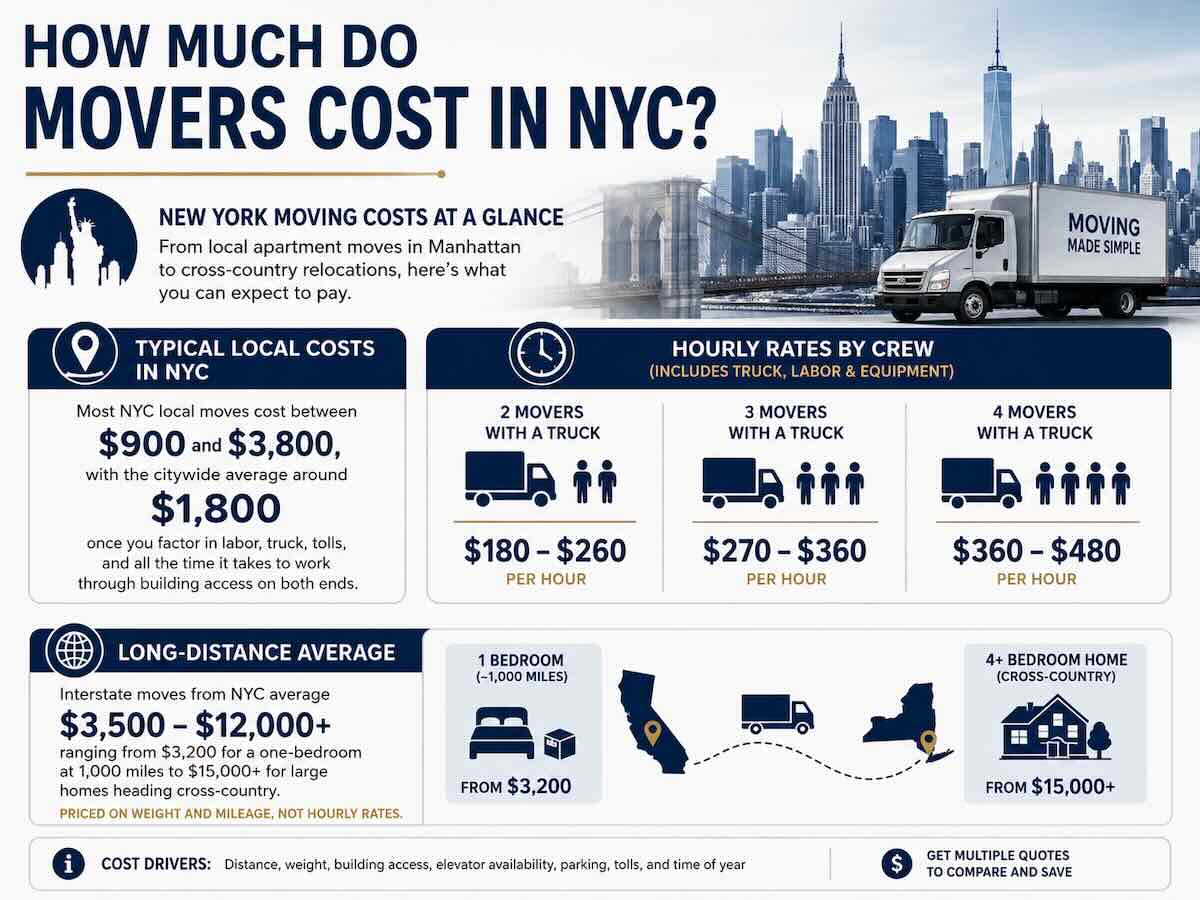
- Typical local costs: Most NYC local moves cost between $900 and $3,800, with the citywide average around $1,800 once you factor in labor, truck, tolls, and all the time it takes to work through building access on both ends.
- Hourly rates by crew: Two movers with a truck run $180–$260 per hour, three movers cost $270–$360 per hour, and four-person crews run $360–$480 per hour, higher per hour but significantly fewer total hours for larger moves.
- Long-distance average: Interstate moves from NYC average $3,500–$12,000+, ranging from $3,200 for a one-bedroom at 1,000 miles to $15,000+ for large homes heading cross-country, priced on weight and mileage rather than hourly rates.
- COI is non-negotiable: Nearly every NYC building, including co-ops, condos, rentals, and doorman buildings, requires your moving company to provide a Certificate of Insurance naming the building as additionally insured for at least $1 million liability. This takes 1–5 business days to arrange and must be submitted to building management in advance. Movers without a valid COI will be turned away at the door.
- Congestion pricing adds real cost: Commercial trucks over 5 tons entering Manhattan south of 60th Street are charged $21.60 per trip under NYC’s congestion pricing program. Most reputable companies now pass this through as a line item on Manhattan move invoices.
- Timing swings prices 25–40%: July 31 and August 31 lease-end dates create the most compressed demand of the year. Off-peak mid-month weekday moves in November through March can cost 30–40% less than peak-season weekend month-end moves for identical service.
Hourly Rates: What NYC Movers Charge by Crew Size
Almost every local New York City move is priced by the hour, with rates that bundle together labor, the truck, fuel, and standard equipment like dollies and furniture blankets. New York runs roughly 20–30% above the national average because of higher operating costs, commercial insurance requirements, borough tolls, and the logistical overhead of moving in the most densely built urban environment in the country.
Two movers with a standard truck, the entry-level configuration for studios, light one-bedroom apartments, and moves where you have already handled all packing and disassembly, charge between $180 and $260 per hour depending on the company’s licensing tier, insurance coverage, and current demand. The lower end of that range represents newer operators or companies that may not carry the COI documentation your building requires, while fully licensed, DOT-registered operations with proper insurance typically fall in the $210–$260 range. Adding a third mover brings you into the $270–$360 per hour bracket, which for two-bedroom apartments often delivers better total value because that third person cuts move time by 30–40%, enabling a continuous loading relay rather than two people making individual back-and-forth trips on a walk-up staircase.
Four-person crews at $360–$480 per hour represent the optimal setup for three-bedroom or larger apartments and homes, and while the per-hour figure looks steep, they routinely complete a move in roughly half the time a two-person crew would need. A job that might take two movers ten hours could wrap in five hours with four people working in sequence, leaving your total bill in a comparable or lower range while delivering a much shorter day.
| Crew Configuration | Hourly Rate | Efficiency / Best For | Time Advantage |
|---|---|---|---|
| 1 Mover + Van | $110–$160/hr | Dorm rooms or single-item deliveries. | Baseline Rate |
| 2 Movers + Truck | $180–$260/hr | Studios or 1-bedroom apartments. | Standard Velocity |
| 3 Movers + Truck | $270–$360/hr | The Sweet Spot: 2-bed apartments and co-ops. | 35% Faster |
| 4 Movers + Truck | $360–$480/hr | Large 3+ bedroom homes and townhouses. | 55% Faster |
Note: Pricing based on 2026 data from MoveAdvisor, Roadway Moving, Piece of Cake Moving, and Forbes Home. Rates include truck, fuel, and standard equipment. Manhattan moves below 60th Street may include a $21.60 congestion pricing surcharge for commercial trucks.
Local Move Costs by Apartment and Home Size in NYC
Apartment size is the most reliable starting predictor of what your NYC move will cost, but two units with the same number of bedrooms can produce dramatically different final bills depending on whether you are in a doorman high-rise with a dedicated freight elevator or a fifth-floor walk-up in a pre-war building with a staircase barely wide enough for a box spring. Getting an actual written estimate based on your specific inventory, origin address, and destination address is the only way to get a number you can rely on.
Studios are the fastest and most affordable moves in NYC, typically wrapping in two to three hours for $600–$1,200 with a two-person crew, though walk-up floors and long carries push toward the higher end of that range.
One-bedrooms usually run between $900 and $1,800 for three to five hours, with the higher end reflecting pre-war walk-up buildings, larger furniture collections, or cross-borough moves involving tolls and longer drive time.
Two-bedrooms hit $1,500–$2,800 with a three-person crew working five to seven hours, while three-bedroom apartments and townhouses, particularly those spread across multiple floors in Brooklyn brownstones or Upper West Side pre-war buildings, require seven to ten hours and typically land between $2,400 and $4,200. Four-bedroom homes start at $3,500 and routinely reach $5,800 or more when families have filled every room plus storage.
| Home Size / Inventory | Recommended Crew | Est. Duration | Estimated Cost |
|---|---|---|---|
| Studio / Efficiency | 2 Movers | 2–3 Hours | $600 – $1,200 |
| 1-Bedroom Apt | 2 Movers | 3–5 Hours | $900 – $1,800 |
| 2-Bedroom Apt / Co-op | 3 Movers | 5–7 Hours | $1,500 – $2,800 |
| 3-Bedroom Apt / Townhouse | 3–4 Movers | 7–10 Hours | $2,400 – $4,200 |
| 4-Bedroom Home | 4+ Movers | 9–12 Hours | $3,500 – $5,800 |
| 5+ Bedroom / Estate | 5–6 Movers | 12–16+ Hours | $5,200 – $9,000+ |
Logistics Note: Duration estimates include loading, transit (under 45 mins within a borough), and unloading. Cross-borough moves add 20–60 minutes of drive time plus applicable tolls. Walk-up buildings: Add approximately $75–$175 per flight above the first for both origin and destination addresses.
Long-Distance Moving Costs from New York City
Once you cross state lines, pricing shifts from hourly billing to a combination of shipment weight and mileage, and NYC’s status as a dense urban loading environment adds complexity and time that suburban moves do not face. NYC long-distance moves average in the $3,500–$12,000 range overall, with significant variation by home size and destination. Shorter moves of under 250 miles to destinations like Boston, Philadelphia, Washington DC, or Connecticut run $1,500–$6,000 depending on home size, while mid-range moves of 500–1,000 miles toward Chicago, Florida, or the Carolinas push into $2,200–$10,500 territory.
Cross-country relocations exceeding 2,000 miles easily reach $7,000–$15,000+ for larger households, with fully loaded three- and four-bedroom homes sometimes exceeding those ranges when total shipment weight passes 12,000 pounds. Building access complications including COI documentation, freight elevator scheduling, and tight loading dock windows can also add several hundred dollars in labor time to NYC interstate moves that would not apply to a suburban origin.
| Route Distance | 1-Bedroom Apt | 2–3 Bedroom Home | 4–5 Bedroom Home |
|---|---|---|---|
| Under 100 Miles | $700 – $1,500 | $1,200 – $3,200 | $2,200 – $5,500 |
| 250 Miles (Regional — Philly, Boston, DC) | $1,500 – $2,500 | $2,000 – $4,500 | $3,000 – $6,500 |
| 500 Miles (Mid-Haul) | $2,200 – $3,600 | $3,000 – $6,200 | $5,500 – $10,000 |
| 1,000 Miles (Long-Haul) | $3,200 – $6,100 | $4,100 – $8,500 | $6,200 – $10,500 |
| 1,500+ Miles (Major Move) | $3,800 – $6,500 | $5,500 – $9,500 | $7,500 – $13,500 |
| 2,500+ Miles (Coast-to-Coast) | $4,500 – $7,000 | $6,500 – $12,000 | $9,000 – $15,000+ |
Logistics Strategy: Long-distance rates are calculated by weight and mileage. Efficiency Tip: Decluttering before an interstate move from NYC can drop you into a lower weight bracket and save $1,500–$3,000 on cross-country routes.
NYC-Specific Factors That Add to Your Moving Cost
New York City moves come with a set of requirements and logistical realities that have no equivalent in other cities, and each one directly impacts total billable time or adds mandatory out-of-pocket costs. All of these apply to the majority of NYC moves, and failing to account for any one of them before moving day typically results in delays, fines, or a crew that physically cannot begin working.
Walk-up buildings are one of the most common cost drivers in NYC, where pre-war buildings across Manhattan, Brooklyn, and Queens were constructed decades before elevator installation was standard. Each flight of stairs above the first typically adds $75–$175 to the final bill as a stair fee, and many companies charge this separately rather than rolling it into the hourly rate. When you are moving out of a fourth-floor walk-up on the origin side and into a third-floor walk-up on the destination side, that stair surcharge alone can add $450–$1,000 to what initially looked like a straightforward hourly-rate estimate.
Congestion pricing, which went into full effect in January 2025, charges commercial trucks over 5 tons $21.60 per toll point entering Manhattan south of 60th Street. Most reputable moving companies now list this as a separate line item on Manhattan move invoices, and a move with multiple trips or cross-Manhattan routing can accumulate $40–$80 in congestion pricing costs that will not appear in an initial quote unless you ask specifically.
Long-carry fees are particularly common in Manhattan, where moving trucks physically cannot park closer than 75–150 feet from many building entrances due to fire hydrant zones, loading dock restrictions, and street width limitations. Companies typically charge $50–$200 for carries exceeding 75 feet, and in densely built neighborhoods like SoHo, Tribeca, or Midtown East, long carries are the norm rather than the exception.
Moving out of Queens means dealing with strict building rules on your way out, finding parking for a massive truck on tight neighborhood blocks, and ensuring your crew has a Certificate of Insurance (COI) ready for your building management. To avoid last-minute delays or hidden fees as you clear out, you need a team that knows how to navigate local loading zones and building restrictions. Before you head to your new destination, check out Coastal Moving Services Queens to save a deal in a seamless moving out of the borough.
Logistics & Efficiency: Operational Cost Drivers
| Complicating Factor | Labor Time Added | Est. Financial Impact |
|---|---|---|
| Walk-Up Stairs (per flight) | 15–30 min / flight | $75 – $175 per flight fee |
| COI Not Submitted (Crew Turned Away) | 60–180 min delay or full cancel | Full Hourly Rate + potential reschedule fee |
| Long Carry (>75 ft) | 30–60 min | $50 – $200 flat surcharge |
| Congestion Pricing (Manhattan below 60th) | No time impact | $21.60 per toll crossing |
| Borough-to-Borough Tolls | 15–30 min transit | $10 – $40 in toll charges |
| Freight Elevator Wait / Window | 20–60 min | $80 – $250 labor cost |
| Building Move-In / Move-Out Deposit | No time impact | $200 – $1,500 (refundable) |
| Specialty Items (Piano / Safe / Artwork) | 30–90 min | $200 – $600 flat fee |
Efficiency Strategy: Submitting the COI and reserving the freight elevator 2–3 weeks in advance can eliminate the two most common sources of move-day delay in NYC, potentially saving 1–3 hours of billable time.
COI, Permits, and Building Requirements: What NYC Actually Requires
New York City does not have a single citywide moving permit the way Boston or Philadelphia do. Instead, it has a building-by-building requirement system that is every bit as consequential and significantly harder to navigate without advance preparation. Getting these elements in order requires the same planning discipline as any other part of the move, and skipping any one of them is how otherwise well-prepared moves turn into expensive lobby delays.
The Certificate of Insurance (COI) is the most critical document in any NYC move and the one that catches the most people off guard. Nearly every co-op, condo, doorman rental building, and managed residential property in the city requires your moving company to provide a COI naming the building and often the management company as additionally insured for a minimum of $1 million in general liability and often $1 million in workers’ compensation. Most reputable NYC movers can generate a COI within one to five business days, but the request must come from you and must be submitted to building management in advance, before moving day. Buildings that do not receive a valid COI before your scheduled move will refuse to allow the crew in the building. Verify COI capability with your moving company when you book, not the day before.
Freight elevator reservations apply in virtually every NYC building that has an elevator at all. Most buildings designate a single freight elevator for move-related activity and restrict its use to weekdays from approximately 9 AM to 5 PM. Reservations must be made through your building’s superintendent or management office, typically requiring two to four weeks of lead time during peak summer months. Moves attempted outside the reservation window, including evenings, weekends, or without an advance booking, will be refused or severely delayed.
Building move-in and move-out deposits, common in co-ops and condos, run from $200 to $1,500 and are held against potential damage to hallways, elevators, and common areas. These are typically refundable within 30 days after management inspects the space, but they must be paid before or on moving day, so budgeting for them in advance prevents last-minute scrambles.
For street parking, NYC offers temporary No Standing sign permits through local NYPD precincts or via NYC.gov, though the process varies by precinct and availability is not guaranteed. Many NYC movers use established double-parking practices during the move window, which the city tolerates within limits, but on high-density streets in SoHo, Midtown, or Williamsburg, securing even a temporary reserved space in advance is worth the effort.
When You Move in NYC Determines How Much You Pay
New York City’s moving market runs on a lease cycle driven by one of the most competitive rental markets in the country, and the pricing dynamics that result are among the most dramatic of any major American city. The three most expensive dates to move in NYC are July 31, August 31, and October 1, which are the most common lease expiration dates and together create a rolling surge of demand that fills every reputable moving company weeks in advance and pushes rates 25 – 40% above baseline for any nearby date.
Summer from June through September represents peak season, with rates running 20 – 30% above baseline and quality crews booked solid on weekends often four to eight weeks out. Late July and late August are the most competitive windows, when the combination of summer leases ending and families moving before school starts compresses maximum demand into a small number of available days. Fall from October through November offers genuine value, with rates dropping 15 – 25% from summer highs, pleasant moving weather, and companies that are actively competing for your booking rather than turning away calls. Winter from December through February delivers the lowest rates of the year, down 30 – 40% from summer peaks, with conditions for negotiating crew configurations and total pricing that simply do not exist during the summer window. Spring from March through May offers a reasonable mid-range window with strong availability and manageable rates across the board.
Logistics Strategy: 2026 NYC Moving Price & Demand Calendar
| Timing Factor | Price Impact | Operational Strategy |
|---|---|---|
| July 31 / Aug 31 / Oct 1 (Lease Surge Days) | +35–50% (Extreme Peak) | NYC’s highest-demand dates. Book 8 weeks out if unavoidable; freight elevator windows fill first. |
| Summer (June–Sept) | +20–30% (Peak) | Highest overall demand. Book 6–8 weeks out to secure a COI-capable, licensed crew. |
| Winter (Dec–Feb) | –30–40% (Low) | Highest savings. Plan for potential weather delays and shorter daylight hours for larger moves. |
| Mid-Month (4th–26th) | Best Value | Avoids lease-expiration congestion. Gives maximum leverage on freight elevator availability. |
| Month-End (Last 5 Days) | +15–25% Premium | High lease-turnover demand; freight elevator slots and reputable crews book out weeks early. |
| Tue–Thu (Mid-Week) | Lower Hourly Rates | Avoids weekend surcharges. Freight elevator slots easier to secure; buildings more responsive. |
Efficiency Insight: Shifting a NYC move from a late-July weekend to a mid-November Tuesday can reduce the total bill by over 50% for identical service, purely through timing.
NYC Move Planning Checklist
4 – 6 Weeks Out
- Get written quotes from at least three licensed, DOT-registered NYC movers with verified COI capability and confirm they can generate a COI for your specific building before booking
- Verify active NYDOT registration for intrastate moves or FMCSA number for interstate moves
- Check Google, Yelp, and MoveBuddha reviews for patterns around COI handling, stair carries, and on-time arrival
- Confirm your move date in writing with a deposit receipt, especially critical near July 31, August 31, or October 1
- Begin decluttering, because every item eliminated is one fewer stair carry, and in a NYC walk-up that savings is real and immediate
- Contact your building management to confirm COI requirements, freight elevator availability, and move-in deposit amount
2 – 3 Weeks Out
- Request the COI from your moving company, providing building name, address, management company name, and any specific language required. Allow 1–5 business days and submit to building management immediately upon receipt
- Reserve the freight elevator at your origin building and your destination building through the building super or management office
- Pay any required move-in or move-out deposits to building management
- Notify your landlord of move-out date and request return of key deposit and any required move-out inspection scheduling
- Begin packing non-essential rooms, labeling every box with room name and general contents
- Schedule utility disconnections at your current address and connections at the new address; submit USPS address change
1 Week Out
- Confirm the COI has been received and accepted by both buildings’ management offices in writing. Follow up directly rather than assuming receipt
- Confirm freight elevator reservation times with both buildings and communicate the exact window to your moving company
- Confirm crew size, arrival time, and parking approach with your mover, and ask specifically whether they will need double-parking access or a reserved spot
- Disassemble large furniture yourself to save 1–2 hours of billable time; bag and label all hardware and tape directly to each piece
- Defrost and dry the refrigerator if moving appliances; disconnect washer hoses; disconnect and bag all electronics cables
- Pack an essentials bag with documents, medications, valuables, and move-day necessities. Keep this with you, not on the truck
Moving Day
- Be at your origin address before the crew arrives. Any delay in building access falls on your billable clock, not theirs
- Do a walkthrough with the crew leader at the start, documenting any pre-existing damage to walls, floors, and furniture with photos
- Have everything packed, staged near the door, and ready before movers arrive. Unpacked rooms on arrival are billed at your full hourly rate
- Point out narrow staircase turns, low ceilings, and tight doorways before the crew begins carrying rather than mid-carry
- Monitor freight elevator usage and communicate with the building super immediately if the elevator is occupied or unavailable. Having the super’s direct number on your phone before moving day makes this much easier
- Review the final invoice carefully before signing and question any stair fees, long-carry charges, or congestion pricing surcharges not discussed in your original written estimate
Strategies That Actually Reduce Your NYC Moving Bill
Some cost-reduction approaches for NYC moves deliver genuine savings, and others create administrative problems that cost more than they saved, so it is worth being specific about which are which in a city where paperwork failures shut down moves entirely.
Decluttering before you move is the most straightforward cost lever available, because reducing your volume directly reduces total stair-carry time, and in a walk-up building every item eliminated is one fewer trip up and down that staircase. Most NYC apartments accumulate more than residents realize over years of compressed living, and a systematic pre-move review of closets, under-bed storage, and kitchen cabinets regularly identifies 20–30% of inventory that can be donated, sold, or discarded before moving day.
Booking a mid-month weekday move during the November through March off-season combines lower seasonal demand, lower day-of-week rates, and freight elevator availability into a single decision that can reduce total cost by 35–50% compared to a late-July Saturday. On a $2,500 NYC move that difference is $875–$1,250 in pure savings for adjusting your calendar.
Packing yourself completely before the crew arrives eliminates $400–$1,000 in professional packing labor and, more importantly in NYC, eliminates the risk of paying your hourly rate while movers wait for you to finish boxing up the kitchen. In a city where the clock runs regardless, arriving unprepared to a move is an expensive mistake with no recovery options.
FAQ
How much do movers cost in New York City?
Most NYC local moves cost between $900 and $3,800, with the citywide average around $1,800. Hourly rates run $180–$260 for two movers, $270–$360 for three movers, and $360–$480 for four-person crews. Total costs are determined by hours worked, stair counts, long-carry distances, tolls, and building access conditions at both addresses.
Do I need a Certificate of Insurance (COI) to move in NYC?
Yes, in practice. Nearly every co-op, condo, doorman rental building, and managed property in New York City requires your moving company to provide a COI naming the building as additionally insured for at least $1 million in general liability. Request this from your mover when you book, submit it to both buildings’ management offices in advance, and confirm receipt in writing. Movers without a valid COI will be turned away at the door.
What is congestion pricing and how does it affect moving costs?
NYC’s congestion pricing program charges commercial trucks over 5 tons $21.60 per toll crossing into Manhattan south of 60th Street. Most reputable moving companies pass this through as a separate line item on Manhattan move invoices. A move involving multiple crossings can accumulate $40–$80 in congestion pricing charges that may not appear in your initial quote, so ask about this specifically when getting estimates for any Manhattan move.
When is the cheapest time to move in NYC?
Mid-week moves (Tuesday–Thursday) during mid-month in the November through March off-season deliver the lowest rates, potentially 35–50% below peak late-July pricing. October and November offer the best balance of reduced rates and manageable weather. The single most expensive dates to move are July 31, August 31, and October 1, when NYC lease expirations cluster across the city simultaneously.
How much do long-distance moves from NYC cost?
Long-distance moves from NYC average $3,500–$12,000, ranging from approximately $3,200 for smaller apartments at 1,000 miles to $15,000+ for large homes relocating cross-country. Pricing is based on shipment weight and mileage rather than hourly rates, and building access complexity in NYC can add labor time to the loading stage compared to suburban moves.
What hidden fees should I watch for on a NYC move?
Stair fees ($75–$175 per flight above the first), long-carry charges ($50–$200 when the truck cannot park within 75 feet of your entrance), congestion pricing surcharges ($21.60 per Manhattan crossing), borough-to-borough tolls ($10–$40), travel time to and from the company’s facility, minimum hour requirements of 2–3 hours, building move-in/move-out deposits ($200–$1,500), and packing services not clearly excluded from your initial estimate are the most common unexpected charges on NYC move invoices.
Is hiring movers worth it in NYC versus renting a truck?
For studio apartments or light one-bedrooms moving within the same building or block with reliable help available, DIY is viable. For any move involving walk-up stairs, a COI requirement, freight elevator coordination, or cross-borough routing, professional movers deliver efficiency, documentation, and liability coverage that justify the cost. Driving a rental truck yourself in Manhattan also requires a commercial license for vehicles over a certain weight class, so verify this before booking.
References
- MoveAdvisor: How Much Do Movers Cost in New York City in 2026?
- Roadway Moving: Average Moving Costs in NYC – 2026 Update
- Piece of Cake Moving: Average Moving Cost NYC – 2026 Guide
- Extra Space Storage: How Much Do Movers Cost in New York City in 2026?
- Forbes Home: Average Moving Costs NYC – Hourly Rate Breakdown
- Stack Moves: How Much Does It Cost to Hire Movers in NYC?
- FlatRate Moving: NYC Moving Company – Pricing and Services