


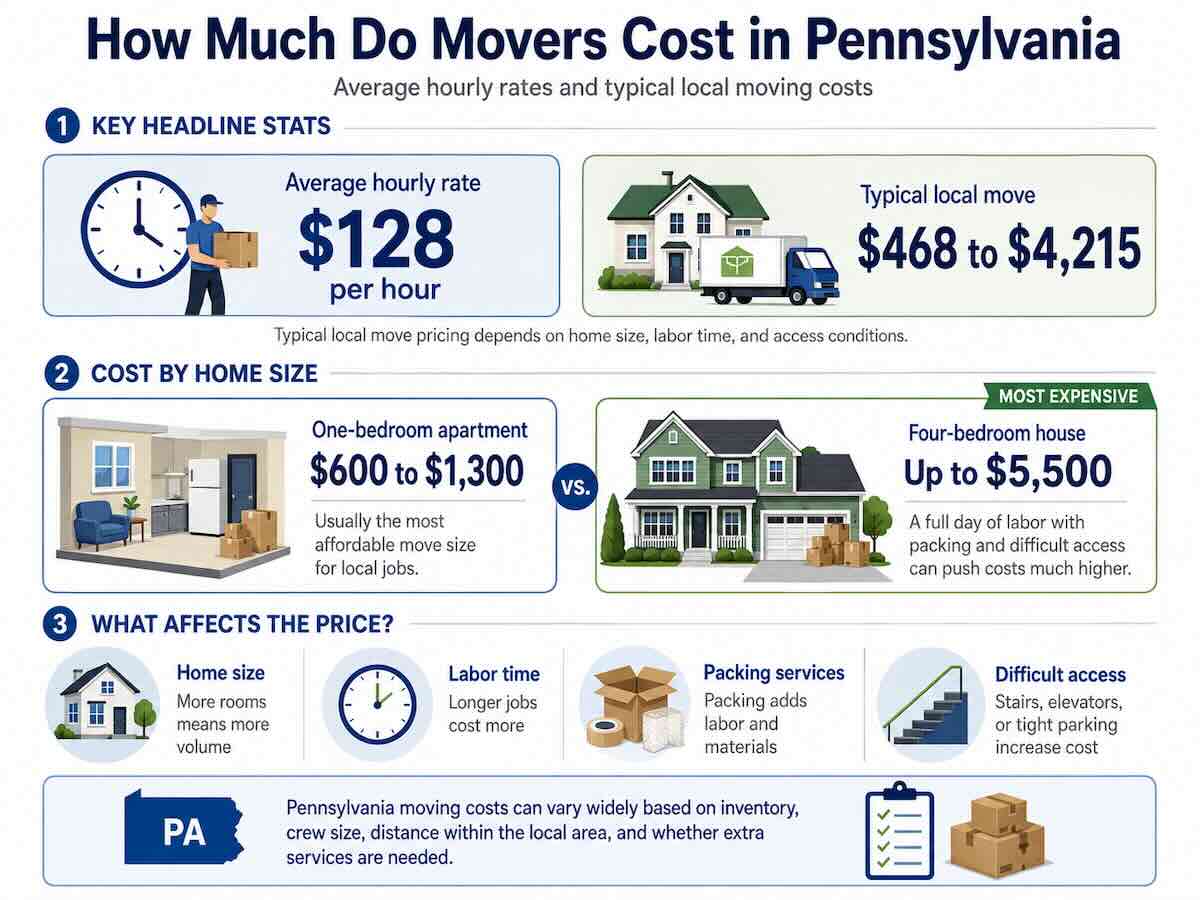
Coastal Moving Services’ completed-move records give us several Pennsylvania examples to work from instead of relying on a single statewide average. Same-city Philadelphia moves in those records had a median price of $1,997, with a common recorded range of $1,670 to $2,303 and a median shipment of 439 cubic feet. Pittsburgh local examples had a $1,903 median, a common range of $1,801 to $2,815, and a 487-cubic-foot median shipment.
For a longer move inside the state, Pittsburgh-to-Philadelphia examples had a median price of $2,120, with recorded prices from $1,728 to $3,629 and a median shipment of 488 cubic feet. On interstate moves, Coastal’s records show a $3,214 median for shipments arriving in Pennsylvania, while the broader interstate group had a $3,553 median and a common recorded range of $2,521 to $5,840.
The numbers make more sense when the move itself stays visible beside the price. A 450-cubic-foot apartment shipment in Philadelphia is not comparable with a large family home leaving Pennsylvania for Florida, even if both customers simply ask, “How much do movers cost?” we tried to explain each situation so you can compare your move with the closest useful median prices.
Pennsylvania Moving Cost: Key Points
- Moves of 40 miles or less are priced by the hour under Pennsylvania tariff rules. Moves over 40 miles within the state are priced by weight and mileage.
- Philadelphia local examples in Coastal’s completed-move records had a $1,997 median and a common recorded range of $1,670 to $2,303.
- Pittsburgh local examples had a $1,903 median and a common recorded range of $1,801 to $2,815.
- Pittsburgh-to-Philadelphia moves had a $2,120 median in Coastal’s records, with a 488-cubic-foot median shipment.
- Moves arriving in Pennsylvania had a $3,214 median and a common recorded range of $2,304 to $5,100.
- Shipment size matters much more than bedroom count on longer moves. Inventory, packing, access, storage, and the route all change the amount being priced.
How Much Do Movers Cost in Pennsylvania?
There is no single Pennsylvania rate that applies to every move because the state uses two different pricing structures for in-state household moves, and interstate moves fall under a different system again. A local move across town can be billed by crew time, while a move from Pittsburgh to Philadelphia is based on weight and mileage even though both addresses are still in Pennsylvania.
Coastal’s completed-move records are useful because they let us look at real moves that fit those different situations.
| Pennsylvania Move Example | Common Recorded Range | Median Price | Median Shipment |
|---|---|---|---|
| Philadelphia local moves | $1,670 to $2,303 | $1,997 | 439 cu ft |
| Pittsburgh local moves | $1,801 to $2,815 | $1,903 | 487 cu ft |
| Pittsburgh to Philadelphia | $1,728 to $3,629 | $2,120 | 488 cu ft |
Source: Coastal Moving Services Moving Cost Statistics 2026, based on completed moves recorded through Coastal.
The Philadelphia and Pittsburgh figures show how close the medians can be even when the cities themselves are very different. The useful comparison is not that one city is universally cheaper than the other. The recorded shipments were also similar in size, at 439 cubic feet in Philadelphia and 487 cubic feet in Pittsburgh, which gives those local examples some real context.
The Pittsburgh-to-Philadelphia route is a different type of move. At roughly 300 miles between the two cities, it crosses Pennsylvania’s 40-mile threshold by a wide margin, so an intrastate mover prices it on weight and mileage rather than simply keeping an hourly clock running from one city to the other.
Why the 40-Mile Rule Matters in Pennsylvania
Pennsylvania’s pricing rules make the distance of an in-state move especially important. The Pennsylvania Public Utility Commission requires a household-goods estimate to use the mover’s hourly tariff when the move is 40 miles or less. When the distance is more than 40 miles, the estimate is based on weight and mileage.
That means a move from one Philadelphia neighborhood to another is built differently from a move between Philadelphia and Lancaster. The second move stays entirely inside Pennsylvania, but the distance pushes it into the weight-and-mileage system.
For moves above 40 miles, Pennsylvania regulations also require the shipment to be weighed by a public weighmaster, with limited circumstances allowing a constructive weight when a public scale is not available near the origin. That makes the amount of household goods especially important. A basement, garage, storage unit, large book collection, or heavy furniture can change the price even when the route remains exactly the same.
The state also has a rule for situations where the actual charges come in substantially above the written estimate. If the charges exceed the estimate by more than 10%, the mover must release the shipment at delivery, upon request, when the customer pays the estimated amount plus 10% or $25, whichever is greater. The remaining tariff charges are then deferred for 15 days. The rule does not erase the remaining balance, but it does prevent a large overrun from becoming an all-or-nothing payment demand at the door.
What Do Local Moves Cost in Philadelphia and Pittsburgh?
Coastal’s broader completed-move study includes same-city moves in both Philadelphia and Pittsburgh. These are recorded completed moves rather than advertised hourly rates, so they show what the entire move cost in those examples after the shipment, labor, and conditions of the job were taken into account.
Philadelphia
Philadelphia local moves in Coastal’s records had a $1,997 median, with the middle portion of recorded prices running from $1,670 to $2,303. The median shipment was 439 cubic feet.
A shipment around that size could represent an apartment or a relatively compact household, but the work involved can still change considerably from one address to another. A rowhome with stairs and no convenient place for the truck to stand can take longer to load than the same amount of furniture coming out of a building with a reserved loading area and an elevator.
Parking deserves attention before moving day because every extra trip between the home and the truck adds crew time on an hourly move. If you are planning a move in the city, the Philadelphia moving services page has more location-specific planning information.
Pittsburgh
Pittsburgh local moves in Coastal’s records had a $1,903 median and a common recorded range of $1,801 to $2,815. The median shipment was 487 cubic feet, slightly larger than the Philadelphia group.
In Pittsburgh, the distance from the truck to the door, outdoor steps, narrow streets, and steep driveways can add work even when the move itself covers only a few miles. Those conditions should be described when the estimate is prepared so the crew size and expected time are based on the actual property rather than just the number of rooms.
How Much Do Long-Distance Movers Cost to or From Pennsylvania?
Once a move leaves Pennsylvania, the strongest pricing comparison is usually the shipment size and the route together. Coastal’s completed-move records show a median price of $3,553 for interstate moves overall, with a common recorded range of $2,521 to $5,840. The median shipment in that group was 432 cubic feet.
Moves with Pennsylvania as the destination had a $3,214 median and a common recorded range of $2,304 to $5,100. That group combines shipments arriving from many different states, so the figures are most useful as a Pennsylvania destination reference rather than a quote for one specific route.
| Move Group | Common Recorded Range | Median Price | Median Shipment |
|---|---|---|---|
| Moves to another state | $2,521 to $5,840 | $3,553 | 432 cu ft |
| Moves arriving in Pennsylvania | $2,304 to $5,100 | $3,214 | Varied by route |
Coastal’s state-route table also includes Pennsylvania-to-Florida moves with a $2,928 median recorded price. That number is route-specific, but it should still be read alongside the inventory. A small shipment from Pennsylvania to Florida and a packed four-bedroom house on the same route are not using the same amount of truck space and should not be expected to price alike.
The broader shipment-size records make that difference easier to see. Across more than 4,000 completed moves, shipments under 400 cubic feet had a $2,441 median. The median rose to $6,641 for 800 to 1,199 cubic feet, $9,452 for 1,200 to 1,599 cubic feet, and $13,840 above 1,600 cubic feet.
For an interstate move from Pennsylvania, start by estimating what is actually leaving the home. Then compare a similar route. That produces a much more realistic planning number than choosing a price simply because another customer had the same number of bedrooms.
What Changes the Cost of a Pennsylvania Move?
How Much You Are Moving
Inventory matters on every move, but it matters in different ways depending on the distance. On a local hourly move, a larger household generally means more loading and unloading time. On a move over 40 miles within Pennsylvania, or on an interstate move, the amount of household goods also affects the weight or shipment size being transported.
Garages, basements, storage units, patios, and packed closets are where estimates often drift away from the real move. A three-bedroom home with lightly furnished rooms may be smaller than a two-bedroom home with a full basement, home office, garage, and 60 boxes.
Stairs, Elevators, and the Walk to the Truck
Anything that slows the path between the home and the truck changes the labor involved. A reserved freight elevator and loading dock can keep a move moving steadily. A third-floor walk-up, a long hallway, or a truck parked far from the entrance means the crew covers that distance again and again while carrying furniture and boxes.
For local moves, where the price is tied directly to time, access conditions can show up quickly in the total. Give the estimator the floor number, elevator situation, parking distance, and any loading restrictions at both addresses.
Packing
Professional packing adds labor and materials, and it often accompanies larger shipments. In Coastal’s completed-move records, customer-packed moves had a $3,142 median and a median shipment of 456 cubic feet. Moves with packing included had a $4,634 median and a 625-cubic-foot median shipment.
The difference between those prices cannot be assigned to packing alone because the packed group also moved more household goods. When you compare estimates, check both the amount being moved and what packing service is included.
Heavy and Difficult Items
Pianos, safes, pool tables, large artwork, exercise equipment, oversized mirrors, and other difficult pieces can change the crew, equipment, or handling needed for the move. Mention them during the estimate rather than on moving day. A quote built without the piano in the living room is not really pricing the move you plan to make.
Move Date and Storage
Availability can tighten during summer, weekends, and the end of the month. Storage can also add cost when the origin and destination dates do not line up. If you know the new home will not be ready, include the expected storage period when you request the estimate so the service is part of the plan from the beginning.
How to Get a More Accurate Pennsylvania Moving Estimate
A useful estimate starts with the same details the crew will encounter on moving day. Before requesting one, build a simple room-by-room inventory and count the boxes as realistically as you can. Include the garage, basement, patio, attic, shed, and storage unit instead of treating them as extras to mention later.
For an in-state move, know whether the distance is below or above 40 miles because that changes how Pennsylvania requires the move to be priced. For an interstate move, have the destination, shipment size, moving date, access conditions, packing needs, and any storage gap ready.
If the inventory changes after the estimate, update it before pickup. Ten extra boxes may not transform the move, but adding a bedroom set, sectional, garage contents, and a storage unit can. The written estimate is most useful when it still describes what is actually going onto the truck.
You can compare the figures in this article with Coastal’s full Moving Cost Statistics study or start with the Moving Cost Calculator.
Estimate Your Pennsylvania Move
If you are moving out of Pennsylvania or planning another interstate move, the most useful next step is to match your route with the amount of furniture and boxes you are actually taking.
Use the Moving Cost Calculator, visit our Pennsylvania moving services page, or call 888-316-8329 with your origin, destination, moving date, and rough inventory.
Coastal Moving Services arranges interstate household-goods transportation with registered motor carriers.
Pennsylvania Moving Cost FAQs
How much do movers cost in Pennsylvania?
The price depends on the kind of move. In Coastal’s completed-move records, local Philadelphia moves had a $1,997 median and local Pittsburgh moves had a $1,903 median. Pittsburgh-to-Philadelphia moves had a $2,120 median. For interstate moves overall, the median was $3,553, while moves arriving in Pennsylvania had a $3,214 median.
Do Pennsylvania movers charge by the hour?
For in-state household moves of 40 miles or less, Pennsylvania requires the estimate to be based on the mover’s hourly tariff. Once the move goes beyond 40 miles, the estimate is based on weight and mileage.
How much did local Philadelphia moves cost in Coastal’s records?
Philadelphia local examples had a common recorded range of $1,670 to $2,303 and a $1,997 median. The median shipment was 439 cubic feet.
How much did local Pittsburgh moves cost?
Pittsburgh local examples in Coastal’s completed-move records had a common range of $1,801 to $2,815 and a $1,903 median. The median shipment was 487 cubic feet.
How much does it cost to move from Pittsburgh to Philadelphia?
Coastal’s completed-move examples for Pittsburgh to Philadelphia ranged from $1,728 to $3,629, with a $2,120 median and a 488-cubic-foot median shipment. Because the route is well over 40 miles, Pennsylvania intrastate pricing is based on weight and mileage rather than an hourly local rate.
How much do long-distance movers cost to Pennsylvania?
Moves arriving in Pennsylvania in Coastal’s records had a $3,214 median and a common recorded range of $2,304 to $5,100. The exact price for an individual move still depends heavily on the origin, shipment size, packing, access, storage, and move date.
What happens if a Pennsylvania moving bill is more than 10% above the estimate?
For a Pennsylvania-regulated household move, if actual charges exceed the estimate by more than 10%, the mover must release the shipment at delivery, upon request, when the customer pays the estimate plus 10% or $25, whichever is greater. The remaining tariff charges are deferred for 15 days. The rule limits what can be required at delivery; it does not automatically cancel the remaining balance.
Why can two Pennsylvania moves with the same number of bedrooms cost different amounts?
Bedroom count does not tell the mover how much is actually going onto the truck. Box count, furniture, garage and basement contents, stairs, elevators, parking, packing, storage, and the distance of the move can all be different even when both homes have the same number of bedrooms.
How can I lower the cost of my Pennsylvania move?
Reduce the inventory before the estimate, finish self-packing before the crew arrives, arrange close truck access when possible, disclose stairs and difficult items in advance, and compare written estimates that include the same inventory and services.
Where the Prices in This Guide Come From
Coastal’s price figures come from the 2026 Moving Cost Statistics study, which analyzes more than 4,000 completed moves. The Pennsylvania examples used here include same-city moves in Philadelphia and Pittsburgh, the Pittsburgh-to-Philadelphia route, Pennsylvania destination records, and Pennsylvania-to-Florida state-route records.
The local city examples are shown with shipment volume because the size of the move matters when comparing one completed move with another. Broader interstate figures are used only where the article needs context beyond the Pennsylvania-specific records.
Pennsylvania in-state pricing rules are based on current Pennsylvania Public Utility Commission guidance and 52 Pa. Code Chapter 31.
Sources
- Coastal Moving Services – Moving Cost Statistics 2026
- Pennsylvania Public Utility Commission – Household Goods Movers
- 52 Pa. Code Chapter 31 – Transportation of Household Goods in Use
Last reviewed: August 28, 2026