
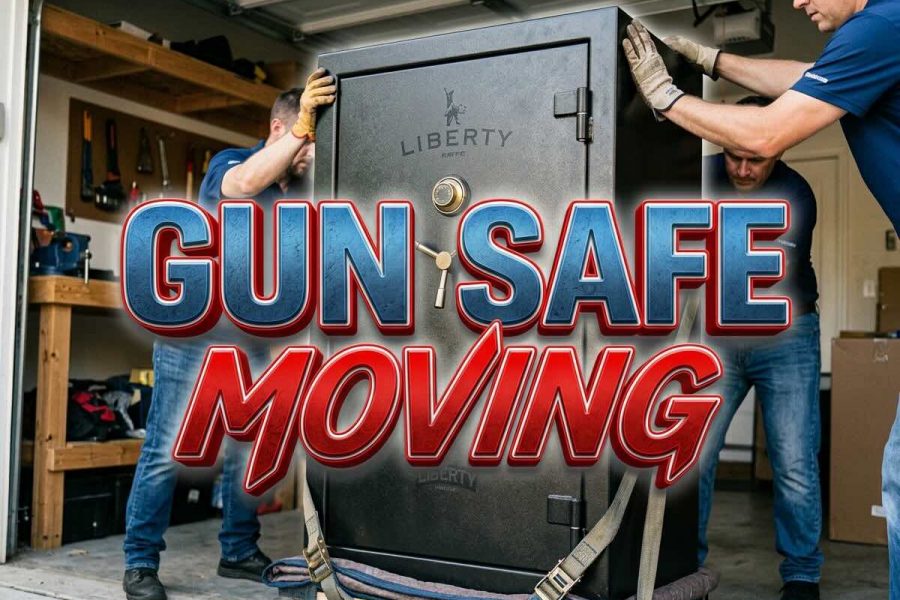
Key Points: Gun Safe Moving in 2026
- Weight Factors: Gun safe weights range from 200 to 3,100 pounds. Weight is the primary factor in determining if a DIY move is safe.
- Professional Threshold: Safes over 500–600 pounds require specialized movers to avoid injury or property damage.
- Moving Costs: Local professional moves range from $175 to $1,000, influenced by stairs, weight, and site complexity.
- Legal Compliance: Remove all firearms and ammo before transport. Per 18 U.S.C. § 926A, interstate transport requires firearms to be unloaded and locked separately.
- Equipment Needs: Use specialized safe movers with hydraulic equipment and stair-climbing dollies rather than standard movers.
- Structural Integrity: Residential floors are often rated for 40–50 lbs/sq ft; heavy safes can exceed concentrated load limits.
- Security Anchoring: Always bolt the safe to the floor at the new destination to prevent tipping or theft by prying.
Gun Safe Weight Categories and What They Mean for Moving Planning
Understanding where a specific safe falls in the weight spectrum is the first and most consequential step in planning any gun safe move. Weight determines the equipment required, the number of people needed, whether stairs are manageable or require professional intervention, and whether standard moving company liability insurance covers the item or requires a specialty safe mover.
| Safe Category | Empty Weight | Typical Steel Gauge | Recommended Move Method |
|---|---|---|---|
| Handgun / Small Safe | 15 – 200 lbs | 14 – 16 gauge | DIY with 1 – 2 people; standard appliance dolly |
| Entry-Level Rifle Safe | 200 – 600 lbs | 12 – 14 gauge | DIY with 3+ strong helpers and rated equipment, OR professional movers strongly recommended |
| Mid-Range Safe | 600 – 1,000 lbs | 10 – 12 gauge | Professional safe movers required; stair-climbing dolly and hydraulic equipment necessary |
| High-End / Fire-Rated Safe | 1,000 – 1,600 lbs | 7 – 10 gauge + fireboard | Specialist safe movers only; may require door removal and floor reinforcement assessment |
| Commercial / Vault Grade | 2,000 – 5,000+ lbs | Under 7 gauge + concrete | Commercial safe moving company with rigging equipment; structural floor assessment required |
Sources: Liberty Safe Weight Guide (2026); Gujrat Steel Safe Weight Analysis (2026). Empty weight only; loaded weight with firearms and contents adds substantially to all figures.
What makes gun safe weight particularly hazardous compared to other heavy objects is its distribution. A refrigerator weighing 400 pounds distributes that weight across a broad base with a relatively low center of gravity. A gun safe at the same weight concentrates mass high in the structure, particularly in the door assembly, creating a tip-forward tendency on any incline. At 10 degrees of tilt, a 500-pound safe generates more than 85 pounds of rotational force trying to pull it forward, which is enough to overwhelm two people holding ratchet straps if they have not anticipated the geometry of the incline.
DIY Gun Safe Moving vs. Hiring Professional Safe Movers: When Each Applies
The decision between DIY and professional safe moving is not primarily about cost preference. It is about weight threshold, site complexity (particularly stairs), and the honest assessment of whether available help and equipment meet the physical demands of the specific move. Several factors must align simultaneously for DIY gun safe moving to be genuinely safe rather than merely possible.
DIY gun safe moving is appropriate when the safe weighs under 400 to 500 pounds empty, the route from current position to the moving truck is on a single level with no more than two or three exterior steps, the move involves no internal staircases, appropriate weight-rated equipment is available or rentable, and at least three physically capable adults are available for the full duration of the move. When all five conditions are met, DIY is a legitimate option that saves the $200 to $800 professional service cost for a local move.
Professional safe movers become necessary rather than optional when the safe weighs over 500 to 600 pounds, when internal staircases are involved at any weight above 300 pounds, when the destination is a basement or upper floor, when the route involves tight corners or narrow doorways that require the safe to be tilted, or when the customer does not have access to proper equipment. A general moving company that handles household goods is not the same as a specialist safe mover. General movers often refuse gun safes over specific weight thresholds, and those that do accept them may not carry the stair-climbing dollies, hydraulic lifts, and specialized strapping systems that the job requires. Confirming that any hired crew has direct experience with gun safes specifically is worth doing before the booking is finalized.
The property damage risk is as significant as the personal injury risk. A 600-pound safe dropped on hardwood flooring, a stair riser, or a doorframe threshold creates damage that typically costs $500 to $3,000 to repair. Professional safe movers carry specific liability insurance for this type of incident that general moving company policies do not always cover for specialty items.
Equipment Required to Move a Gun Safe Without Professional Movers
Attempting a DIY gun safe move without the correct equipment at the correct weight rating is the single largest source of injuries and property damage in residential safe moves. Consumer-grade furniture dollies rated for 400 pounds are not appropriate for a 450-pound safe because the equipment rating should always exceed the item weight by a meaningful safety margin, and consumer ratings frequently reflect optimal flat-surface conditions rather than the actual loads generated during stair navigation or ramp loading.
- Heavy-duty appliance dolly (600 to 1,500 lb rated):
A standard furniture dolly does not provide the upright frame, toe plate, and built-in strap slots that safe moving requires. The dolly must be rated well above the safe’s actual weight, with a frame capable of holding the safe vertical on inclines. Rental from Home Depot, U-Haul, or a local equipment rental company typically costs $30 to $60 per day. - Industrial-grade ratchet straps (two minimum):
The safe must be strapped to the dolly at two points, one high and one low on the frame, to prevent tipping at either end. Standard moving straps are not adequate; 1.5-inch to 2-inch ratchet straps rated for the safe’s weight are the correct tool. The straps must never contact the safe’s handle, dial, or locking hardware. - Moving blankets and stretch wrap:
The entire safe should be wrapped in moving blankets before loading onto the dolly. Blankets prevent finish damage to the safe and protect doorframes, walls, and floor transitions from impact damage if the safe contacts them in transit. Stretch wrap holds the blankets in position without adhesive contact with the safe’s surface. - Floor protection materials:
Masonite panels (compressed hardboard sheets) laid along the route protect hardwood, tile, and laminate floors from the concentrated point loads of dolly wheels under high weight. A 300-pound safe on standard dolly wheels can generate 75 or more pounds per square inch of floor pressure at the wheel contact points, which is sufficient to dent or crack most residential flooring materials. - Liftgate truck or rated loading ramp:
Loading a gun safe into a moving truck without a liftgate or a heavy-duty ramp at the correct angle creates a severe tipping risk at the point of transition onto the truck bed. U-Haul and Penske both offer trucks with liftgates; requesting a liftgate-equipped vehicle rather than a standard ramp is worth the small additional rental cost for any safe over 200 pounds. - Steel-toed boots and work gloves for all helpers:
These are not optional safety precautions. A dropped safe lands on whatever is below it at the moment of release, and a foot under a corner of a 400-pound safe produces injuries that require surgery to address. Gloves with grip material on the palm surface provide control on the safe’s steel body in ways that bare hands cannot maintain under sustained load.
How to Move a Gun Safe: Step-by-Step Process for DIY Moves
The following process assumes a safe weighing under 500 pounds, a single-level route with no internal staircases, and a minimum of three physically capable helpers. Each step must be completed before the next begins; skipping any preparation step in an attempt to save time introduces compounding risk to subsequent steps.
Preparation Before Any Lifting Begins
Measure the safe’s full dimensions including handle depth, since an assembled safe with its external handle is wider from front to back than the specification sheet’s listed depth. Measure every doorway, hallway, and corner on the planned route with a tape measure and add a minimum of six inches on each dimension for dolly width and clearance. A tight measurement is not a go-ahead to proceed; it is a flag to identify an alternate route or plan for door removal before the move begins.
Remove everything from inside the safe completely. Loaded safes shift weight unpredictably during movement, increasing the tip-forward tendency on the dolly. The contents themselves, firearms, ammunition, documents, jewelry, and accessories, need to be removed and transported separately regardless of convenience. Remove the guns and ammunition from the safe, lock them in an appropriate case or container, and keep them accessible only to authorized individuals throughout the move process.
Secure the safe door shut with heavy-duty tape in addition to locking the mechanism. The safe door is the heaviest component of the overall assembly, and an unexpected door swing during movement shifts the center of gravity rapidly enough to pull the safe off the dolly before anyone holding it can react.
Loading the Safe onto the Dolly
Two people should tilt the safe back slowly while a third positions the dolly toe plate completely under the safe’s base. The safe tilts back onto the dolly rather than the dolly sliding under a stationary safe, because pushing a flat metal plate under a 400-pound object on a finished floor causes floor damage and creates an uncontrolled situation if the safe moves unexpectedly. Once the toe plate is fully under the base, apply both ratchet straps before releasing the safe to the dolly’s balance point.
Moving Through the Route
Move in controlled steps of six to twelve inches at a time, with the dolly operator at the rear controlling direction and speed, one person in front guiding around obstacles and through doorways, and additional helpers stabilizing the sides. Communication between all helpers should be explicit and verbal before every directional change, incline, or doorframe clearance. No part of the move should happen faster than complete situational awareness allows; rushing is the most consistent cause of dropped safes and injuries in residential safe moves.
For doorframes and tight corners, approach at a slight angle rather than straight-on, confirming clearance on both the entry and exit side of the frame before committing the safe’s weight to the turn. A safe wedged at a 30-degree angle across a doorframe is difficult to extract without damage to the frame and may require door removal to resolve.
Loading into the Moving Truck
A liftgate is the safest loading method for any safe over 200 pounds. Position the dolly at the center of the liftgate platform, verify that all helpers have secure footing on the ground and that no one is standing in the path of the safe if it tips, and raise the liftgate platform slowly. If a ramp is the only available option, position the safe directly behind the center of the ramp, keep the dolly angle tilted slightly back toward the loaders rather than forward toward the truck bed, and move up the ramp in increments with full stops to check stability between each one. Once on the truck bed, strap the safe to the truck’s anchor points using two ratchet straps; the safe’s weight alone does not prevent it from sliding or tipping during transport and should never be relied upon as a substitute for active restraint.
Moving a Gun Safe Up or Down Stairs: Why This Changes Everything
Stairs represent the most significant escalation in difficulty and risk in any gun safe move. On a flat surface, gravity works against the mover only in terms of inertia and rolling resistance. On stairs, gravity actively works to pull the safe forward and down, and the force required to control that tendency increases with every pound of safe weight and every degree of stair angle. A 500-pound safe on a standard 35-degree residential staircase generates approximately 285 pounds of gravitational force trying to pull it down the stairs at any given moment, a force that three average adults cannot reliably oppose in addition to managing the dolly, the straps, and the clearance on both sides.
Professional safe movers who handle stair moves routinely use stair-climbing dollies, which are power-assisted or manually operated devices specifically engineered for this application. A stair-climbing dolly uses motorized tracks or articulated legs to maintain three-point contact with stair risers at all times, preventing the uncontrolled rotation that causes conventional dollies to slip on stair edges. The equipment costs $800 to $3,000 to purchase, which is why rental is rarely available and ownership is concentrated among specialized moving companies.
For any safe over 300 pounds that needs to navigate a staircase, professional safe movers are the appropriate choice regardless of the customer’s general physical capability or moving experience. The physics of stair movement at that weight create a failure mode that skilled and experienced non-specialists cannot reliably prevent with improvised techniques and consumer equipment.
If stairs are unavoidable in a DIY move for a lighter safe, the specific preparation required includes: verifying that the staircase framing can support the concentrated load of the safe at a mid-stair point (an issue particularly relevant for older homes with undersized stair carriages), having a minimum of four people for any staircase move with two controlling the dolly from the uphill side and two providing resistance from the downhill side, moving in increments of one stair at a time with a full stop and stability check between each step, and having a contingency plan for controlled lowering to the floor if control is lost at any point.
How Much Does Professional Gun Safe Moving Cost in 2026?
Professional gun safe moving costs depend on four primary variables: the safe’s weight, the floor level it occupies at origin and destination, the number of staircases involved, and the geographic market. The range across these variables is significant, and understanding which factors apply to a specific move produces a more accurate cost expectation than applying the average to every situation.
| Move Scenario | Typical Cost Range (2026) | Notes |
|---|---|---|
| Local, single level, under 500 lbs | $175 – $400 | Base rate for most residential safe moves; includes blanket wrap and dolly movement |
| Local, stairs involved, under 600 lbs | $350 – $650 | Staircase surcharge applies per flight; basement and second-floor placements in this range |
| Local, stairs, 600 – 1,000 lbs | $500 – $1,000 | Requires stair-climbing dolly and 3+ specialized crew; high complexity rate applies |
| Local, 1,000+ lbs | $800 – $1,500+ | May require door removal, hydraulic equipment, structural assessment; highly site-dependent |
| Long-distance, any weight | Varies widely; call for quote | Long-haul safe transport typically included as part of the overall household goods move; weight surcharges apply |
Sources: Liberty Safe Delivery Cost Guide; MyProMovers 2025 Market Data; Moving Help Marketplace average safe moving cost $295; Key-En-Lock Safe Moving Estimator; Reliable Movers LLC. Costs vary by market and site conditions.
A commonly cited rough pricing benchmark among safe movers is approximately $1.00 per pound for local moves, which produces reasonable estimates across the weight range for standard site conditions. Additional charges typically apply for each flight of stairs ($50 to $150 per flight), narrow turns and tight corridors, door and railing removal required to create clearance, and bolting the safe to the floor or wall at the destination.
When selecting a professional safe mover, the distinction between a general moving company that accepts safes and a specialist safe mover that focuses on this type of work is meaningful at higher weights. Specialist companies own stair-climbing dollies, hydraulic lifts, and have crew members who handle safes regularly enough to have developed reliable technique. A general moving company handling its first 800-pound safe of the year does not have the same risk profile as a company whose crew does six per week.
Floor Load Capacity: Can Your Floor Handle a Gun Safe?
Floor load capacity is one of the most frequently overlooked considerations in residential gun safe placement and is the source of floor damage that occurs not during the move but after the safe is in position. Residential floors in standard US construction are typically designed to handle 40 pounds per square foot of live load, a standard set by the International Residential Code that applies to most homes built in the past several decades. A 600-pound safe with a footprint of 24 by 18 inches occupies three square feet of floor space, producing an average of 200 pounds per square foot, which is five times the standard residential live load rating.
In practice, residential floors do not fail under gun safes as routinely as this comparison suggests, because the structural members (joists, beams, and subflooring) often have capacity beyond the code minimum and because the load is distributed by the subfloor across multiple joists. However, there are real conditions where floor assessment before safe placement matters: older homes (pre-1970) with undersized joists or deteriorated structural members, finished basement installations where the slab conditions are unknown, second-floor placements particularly in older construction, and any placement that coincides with the midspan of floor joists rather than near a bearing wall.
Placing a gun safe perpendicular to floor joists rather than parallel to them distributes the weight across multiple joists rather than concentrating it on one or two. Placing the safe near a bearing wall rather than at mid-span further reduces the effective load on any individual joist. For safes over 1,000 pounds or any placement situation with structural uncertainty, a structural engineer’s assessment costs $200 to $500 and provides concrete guidance rather than estimated tolerance.
Legal Requirements for Transporting Firearms Removed From the Safe During a Move
When moving a gun safe, all firearms inside it must be removed and transported separately. How those removed firearms are transported is governed by federal law and, in some cases, more restrictive state laws at the destination.
The federal framework is the Firearm Owners Protection Act (FOPA) of 1986, codified at 18 U.S.C. § 926A. Under FOPA’s safe passage provision, a person may transport any legally owned firearm across state lines, including through states where that firearm might otherwise be restricted, provided the firearm is unloaded, stored in a locked container, and the container is not the vehicle’s glove compartment or center console. Ammunition must also be stored in a locked container separate from the firearms. This provision protects a lawful gun owner traveling from their origin state to their destination state from arrest under the destination state’s laws as long as the transport conditions are met continuously throughout the trip.
Several states impose additional requirements that apply when establishing residency rather than simply passing through. California requires registration of certain firearms within 60 days of establishing residency. Hawaii requires all firearms to be registered within three days of arrival in the state, a timeline that requires advance planning rather than post-arrival attention. New York requires a permit for handgun possession that must be addressed before the move rather than after arrival. Massachusetts, New Jersey, and Connecticut each maintain registration, permit, or identification card requirements for newly arrived residents.
The practical application for most interstate residential moves is straightforward: remove all firearms and ammunition from the safe before the moving crew arrives. Transport firearms in locked hard-sided cases in a personal vehicle, with ammunition in a separate locked container. Do not transport ammunition on the moving truck regardless of the general mover’s willingness to load it; ammunition is a prohibited item under standard carrier non-allowable lists and is a DOT Class 1 explosive regardless of how it is packaged.
For customers moving to a state with restrictive firearm laws, confirming the specific registration, permit, and compliance requirements for the destination state before the move date rather than after arrival protects against inadvertent violations during the transition period.
Anchoring and Securing the Gun Safe at the New Location
The security value of a gun safe depends substantially on whether it is anchored to a fixed structural element at the destination. An unanchored safe of any weight can be tipped forward by one or two determined individuals to access the underside, where many manufacturers locate the pre-drilled anchor bolt holes, and the exposed hinge side. Tipping and prying attacks on the door hinge side represent one of the most common methods used against residential gun safes, and an anchored safe resists this approach entirely while an unanchored one does not.
Most quality gun safes include pre-drilled anchor holes in the floor plate of the safe body and sometimes in the back panel for wall anchoring. The correct hardware for floor anchoring is typically a 3/8-inch to 1/2-inch diameter lag bolt or concrete anchor, depending on whether the anchor substrate is wood framing, concrete slab, or subfloor. Concrete floors require a masonry anchor such as a Tapcon or a wedge anchor rather than a wood lag bolt, and the depth of concrete below any flooring surface needs to be sufficient to provide meaningful anchor strength, typically a minimum of 2.5 inches of solid concrete engagement.
The appropriate time to anchor the safe is immediately after it reaches its final position at the destination. Professional safe movers typically offer floor anchoring as an add-on service at the time of delivery, and having this done by the crew that placed the safe is significantly easier than attempting it independently after they have left. Having the correct anchor hardware available before the safe arrives requires knowing the floor substrate type at the destination location in advance.
How to Find and Vet Professional Gun Safe Movers
Not every moving company that claims to handle gun safes has the specialized equipment, trained crew, and appropriate insurance for the work. The following criteria distinguish a competent specialist from a general mover accepting a job outside their typical capability.
Equipment specifics:
A company equipped for gun safe moving owns stair-climbing dollies, wide-base appliance dollies rated above the safe’s weight, Masonite floor protection panels, hydraulic lift assistance for heavy safes, and furniture strapping for securing the safe in the truck. A company that cannot describe specific equipment by name when asked is not routinely handling this type of work.
- Insurance for specialty items:
Confirm that the company’s liability insurance covers high-value specialty items including safes. Standard moving company liability covers household goods at released value rates ($0.60 per pound under basic coverage); a safe worth $3,000 weighing 600 pounds receives a maximum $360 payout under that coverage. A specialist safe mover should carry specific property damage coverage for the items they move. - Site assessment before quoting:
Reputable safe movers ask for photos of the safe, its current location, the route to the exit, any stairs involved, and the destination placement area before providing a quote. A company that quotes a flat rate without asking about site conditions is either underquoting to win the business or building in unexpected surcharge flexibility for moving day. - Reviews specific to safe moving:
General moving company reviews do not reflect safe moving capability. Searching for reviews that specifically mention safe moves, gun safes, or heavy safes provides a more relevant signal than overall company ratings. - USDOT registration for interstate moves:
Any company moving a safe (or any household goods) across state lines must hold a valid USDOT number and be registered with the FMCSA. Verification takes two minutes at the FMCSA Protect Your Move portal (protectyourmove.gov) and confirms that the company is operating legally before any deposit is paid.
For customers who are already booked with a general moving company for a full household move, confirming the company’s weight limit for safes before moving day is essential. Many general movers accept gun safes up to 400 to 600 pounds and decline heavier ones; knowing this in advance allows time to arrange a specialist for the safe specifically while the general crew handles the rest of the household.
Moving a Gun Safe Long Distance or Across State Lines
Long-distance gun safe moves involve the same physical challenges as local moves plus the additional considerations of securing the safe for multi-day transit, managing firearms in accordance with each state’s laws along the route, and confirming that the receiving destination’s floor and placement conditions have been assessed in advance rather than on arrival.
Most full-service long-distance movers include gun safes in their household goods inventory when they fall within weight limits that the carrier accepts. The safe is treated as a heavy specialty item with additional preparation requirements: it must be wrapped, strapped to the truck wall anchor points, and positioned away from other household goods to prevent contact and shifting during transport. The weight it adds to the shipment contributes to weight-based pricing calculations on full-service long-distance moves.
For safes that exceed what the household’s general moving company will accept, specialty safe movers who operate long-distance transport represent the alternative. Companies like U-Haul’s specialty freight service, independent safe movers with interstate authority, and nationwide specialty moving companies that focus on heavy items all operate in this space. The cost for long-distance safe transport varies significantly by distance and weight and warrants direct quotes from at least two to three providers for any move over 500 miles.
The firearms removed from the safe for transport should be in the customer’s personal vehicle throughout the long-distance drive. For customers flying rather than driving to the new location, TSA regulations govern airline firearms transport: firearms must be declared at check-in, transported in a locked hard-sided container in checked baggage, and be completely unloaded. Ammunition may be transported in the same checked bag as unloaded firearms within quantity limits. Flying customers who cannot transport firearms personally have the option of shipping them through a federally licensed firearms dealer (FFL) to an FFL dealer at the destination, a process that must be arranged in advance of the move.
Frequently Asked Questions About Moving Gun Safes
Do regular moving companies move gun safes?
Many general moving companies accept gun safes up to certain weight thresholds, typically 400 to 600 pounds, when they are on a single level without stair involvement. Above that threshold, or when stairs are involved, most general movers either decline or lack the specialized equipment to do the job safely. Always confirm the company’s specific safe weight limit and equipment capability before booking a general mover for a job that includes a heavy safe.
Can a gun safe be moved without emptying it?
No safe should be moved with contents inside, regardless of how convenient that might seem. Loaded safe contents shift weight during movement and increase tipping risk on the dolly. The firearms and ammunition inside represent a specific additional risk if the safe tips and the door is forced open by the impact. Professional movers decline loaded safes universally, and the physical safety case for always emptying the safe before moving it is unambiguous.
How do I move a gun safe across carpet without a dolly?
On carpet surfaces, a safe can be slid short distances using furniture sliders placed under its corners or using thick moving blankets as a low-friction surface. This approach is appropriate only for repositioning within the same room and only for safes under 300 to 400 pounds with at least two people managing the movement. It is not an appropriate substitute for a dolly for any meaningful relocation distance, and it risks carpet fiber damage, subfloor damage from concentrated weight sliding, and back injuries from sustained pushing loads.
What is the best dolly for moving a gun safe?
A heavy-duty appliance dolly with a steel frame, integrated strap slots, and a weight rating of at least 150 percent of the safe’s actual weight is the appropriate tool for most residential gun safe moves. The Milwaukee Hand Truck, Magliner GMK series, and Harper Series 700 are frequently cited by professional safe movers for their structural integrity and wheel quality. For stair involvement, a dedicated stair-climbing dolly or power stair climber is required rather than a conventional appliance dolly regardless of the conventional dolly’s weight rating.
Does homeowner’s insurance cover a gun safe during a move?
Standard homeowner’s insurance policies cover household contents during a move under the “personal property in transit” provision, but coverage limits, deductibles, and specific exclusions vary significantly between policies. Most homeowner’s policies exclude or severely limit coverage for guns and firearms specifically, and the safe itself may be covered at actual cash value rather than replacement cost depending on the policy’s property coverage structure. Reviewing the specific moving transit coverage and firearms coverage provisions with the insurance carrier before the move date rather than after a loss is the appropriate preparation.
How do you anchor a gun safe to a concrete floor?
Anchoring to a concrete floor requires masonry anchors rather than wood screws. The most common approach is a wedge anchor or sleeve anchor in 3/8-inch to 1/2-inch diameter, driven into a pilot hole drilled with a hammer drill and masonry bit at the exact diameter specified by the anchor manufacturer. The anchor depth should provide a minimum of 2 to 2.5 inches of embedment in solid concrete below any flooring surface. Most quality safes include pre-drilled holes in the safe’s floor plate with manufacturer documentation specifying anchor size and installation depth. If the safe’s floor plate holes do not align well with joist locations on a wood-subfloor installation, a concrete anchor is still available if the slab is accessible, or lag bolts can be directed into joists when the floor plate holes permit.
Moving and Have a Gun Safe That Needs to Come With You?
Coastal Moving Services handles residential moves of all sizes with licensed, insured crews experienced in specialty items including heavy safes. We can assess your safe’s weight and site conditions during the quote process so there are no surprises on moving day. Call us at +1-334-659-1878 or request a free quote for fully itemized pricing based on your specific move.
References
- ATF: Federal Regulations for the Interstate Transport and Shipment of Firearms (2026 Guide)
- FMCSA: Your Rights and Responsibilities – 2026 Federal Consumer Protection for Household Goods
- Liberty Safe: 2026 Gun Safe Weight Guide – Calculating Floor Load and Equipment Needs
- Liberty Safe: Professional Safe Moving Costs – 2026 National Average Estimates
- U-Haul: Specialized Equipment and Logistics for Moving Heavy Safes in 2026
- ATF: SAFETY AND SECURITY FOR FIREARM OWNERS