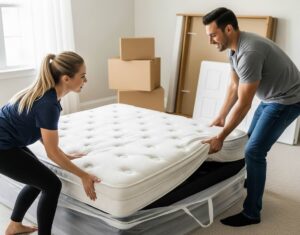


Storing a mattress sounds simple until you pull it out of storage six months later warped, moldy, or permanently dented. The damage is almost always preventable. Most of it comes from three things: storing it on its side when you should not, skipping the bag, or putting it somewhere with temperature swings and moisture. Get those three things right and a stored mattress comes out in the same condition it went in.
This guide covers how to clean and prep a mattress before storage, how each mattress type needs to be stored differently, what storage location actually does to a mattress over time, and how to store one when you are working with a small space or a self-storage unit.
Key Points: How to Store a Mattress
- Always store a mattress flat unless it is a foam-only mattress and the storage period is short; spring, memory foam, and natural-fill mattresses stored on their side for more than a few days risk permanent damage to the internal structure.
- Clean and dry the mattress completely before wrapping it; moisture sealed inside a mattress storage bag becomes mold within weeks.
- Use a breathable mattress storage bag, not airtight thick plastic; airtight wrapping traps moisture and encourages bacterial growth.
- Climate-controlled storage is the right choice for memory foam and latex mattresses; temperature extremes in attics, garages, and non-climate-controlled units cause lasting structural damage to both materials.
- Do not put anything on top of a stored mattress; even moderate weight over weeks creates permanent dents and compression spots that do not recover.
- Air the mattress out every few months during long-term storage; open the mattress storage bag, let it breathe for a few hours, reseal.
- Latex mattresses can be rolled only for under 30 days; longer than that and the material develops permanent indentations.
How to Prep a Mattress for Storage
Whatever is on or in the mattress when you seal it up is still there when you open it. Dust mites, stains, sweat, and moisture sealed inside a bag for several months turn a usable mattress into something you do not want to sleep on. Ten to fifteen minutes of prep before storage prevents that.
Clean It Before You Wrap It
Vacuum both sides thoroughly using an upholstery attachment. This pulls out dust, dead skin cells, and anything living in the fabric that would otherwise sit sealed inside the bag for the duration of storage. After vacuuming, spot-treat any visible stains with an upholstery cleaner or a mixture of baking soda and cold water, blot dry, and let the area air completely. Do not move to the next step until every damp spot is fully dry. Sealing a damp mattress is how mold starts.
Sprinkling baking soda over both sides and letting it sit for a few hours before vacuuming it off pulls residual odors and absorbs surface moisture. This step is optional for a mattress going into short-term storage and worth doing for anything going in for more than a few weeks.
Wrap It in a Breathable Mattress Storage Bag
A purpose-made mattress storage bag is the right wrapping material for storage. These are designed to block dust and pests while still allowing some airflow, which reduces the bacterial growth that occurs inside fully airtight plastic wraps. Thick airtight plastic sheeting, the kind often used for moving, is not ideal for storage because it traps any remaining moisture inside with nowhere to go.
Mattress bags are sold by size at U-Haul, Home Depot, and most storage facilities, typically for $5 to $15. Once the mattress is inside, seal the open end with duct tape and check that there are no tears or open seams before moving it. Many mattress bags include built-in handles, which makes moving the bagged mattress significantly easier than gripping the fabric itself.
For long-term storage, plan to open the bag and air the mattress out for a few hours every two to three months before resealing. This is the single most neglected step in long-term mattress storage and the most effective way to prevent the stale, musty smell that builds up inside sealed bags over time.
Flat vs. On Its Side: Why Positioning Matters More Than You Think
This is where most storage mistakes happen. Storing a mattress on its side looks like a logical space-saving move and it works fine for some mattress types for short periods. For others, it causes permanent damage that does not show up until you put the mattress back on a bed and sleep on it.
The core issue is that a mattress stored vertically on its side has its internal components, coils, foam layers, and natural fillings, hanging under gravity in a direction they were never designed to support. Over days that is fine. Over weeks, the materials start to shift, sag, and settle into positions they cannot fully recover from.
Which Mattresses Can Be Stored on Their Side (and for How Long)
Innerspring / coil mattresses:
Storing these on their side briefly, a day or two during a move, is generally fine. Storing them on their side for weeks or months causes the coils to shift position and the padding layers to settle unevenly. The damage shows up as a mattress that feels different on different sides or develops a consistent sag. Always store flat for anything beyond a short transit period.
Memory foam mattresses:
Always store flat. Memory foam is dense and heavy and does not tolerate being stored on its side for any extended period without the material compressing unevenly on the bottom edge. That compression is permanent. If space is truly limited, a brief side-storage is technically possible for some foam mattresses, but flat is the only safe option for anything beyond a few days.
Natural fill mattresses (wool, cotton, pillow-top):
Store flat, no exceptions. Natural fillings shift and compress when stored vertically, and unlike foam, they cannot recover because the loose fill materials redistribute permanently under gravity.
Foam-only mattresses (no springs, no natural fill):
Storing on the side for short periods is generally acceptable because the foam material does not have loose components to shift. Still, flat storage is always preferable when space allows.
Latex mattresses:
These can be rolled and stored boxed for up to 30 days, which is how they are shipped from manufacturers. Beyond 30 days rolled, the latex develops permanent indentations and the mattress may not fully unroll or expand when you take it out. For storage longer than 30 days, store flat like any other mattress. Adding silica gel packets inside the bag helps absorb moisture that can damage latex over time.
Where to Store a Mattress: What the Location Actually Does to It
The storage location determines whether the mattress comes out in usable condition or not. Temperature, humidity, and light exposure all affect mattress materials over time, and some common storage spots are genuinely bad choices regardless of how well the mattress is wrapped.
Why Attics, Basements, and Garages Are Problematic
These three locations are where most people instinctively try to store a mattress because they have the floor space. They are also the three worst options for mattress longevity.
Attics reach temperatures well above 100 degrees Fahrenheit during summer months. At those temperatures, foam layers soften and deform, adhesive bonding between foam layers can break down, and any residual moisture in the mattress or the bag environment accelerates bacterial and mold growth significantly faster than it would in a temperature-stable room.
Basements run cool and damp. Humidity is the enemy of any mattress in storage, and most basements run at relative humidity levels that create condensation inside mattress storage bags, especially when there are temperature swings between seasons. A mattress that smells fine going in can come out of a basement storage situation smelling permanently of mildew.
Garages have the worst of both problems: temperature extremes from summer heat to winter cold, and humidity that fluctuates with weather and season. They also commonly have pest activity that a mattress storage bag may not fully prevent over a long storage period.
What a Climate-Controlled Storage Unit Provides
A climate-controlled self-storage unit maintains a consistent temperature, typically between 55 and 80 degrees Fahrenheit year-round, and manages humidity to levels that prevent the moisture damage that ruins mattresses in garages and basements. For memory foam and latex mattresses in particular, climate-controlled storage is the right choice rather than a nice-to-have.
The cost difference between a climate-controlled and non-climate-controlled storage unit is typically $20 to $40 per month depending on the market and unit size. For a mattress worth several hundred to several thousand dollars, that premium is a reasonable protection cost for storage periods of more than a few weeks.
If a climate-controlled unit is not available or not in the budget, the best indoor alternative is a dry room inside a home such as a spare bedroom or an interior closet. The key requirement is stable temperature and low humidity; if the room does not have both, the mattress is at risk regardless of how well it is wrapped.
Self-Storage Unit Sizes for Mattresses
Choosing the right unit size determines whether you can store the mattress flat, which is the right position, or whether you are forced to stand it on its side because the unit is too narrow.
| Mattress Size | Unit for Side Storage | Unit for Flat Storage (Recommended) | Notes |
|---|---|---|---|
| Twin | 5×5 | 5×10 | 5×10 gives room to lay flat with space around it for airflow |
| Full | 5×5 | 5×10 | Full mattress fits flat in a 5×10 with some room to spare |
| Queen | 5×5 or 5×10 | 5×10 | A queen fits flat in a 5×10; tighter than a full but workable |
| King / Cal King | 5×10 | 10×10 | King mattresses are 76 inches wide; a 10×10 is required to lay flat comfortably |
| Multiple mattresses or additional furniture | 10×10 | 10×20 or 10×30 | Upsizing allows all mattresses to lay flat and leaves room for other stored items |
Source: Extra Space Storage unit sizing guide 2026.
Once the mattress is in the unit, place it on a wooden pallet or cardboard rather than directly on the concrete floor. Concrete is cold and draws moisture; keeping the mattress an inch or two off the floor allows airflow underneath and reduces condensation risk on the bottom surface. Leave at least one square foot of space on each side of the mattress rather than pressing it against the unit walls, for the same airflow reason.
Do not stack anything on top of the stored mattress. One medium-weight box sitting on a mattress for three months leaves a dent. Several boxes leave several dents. Both are permanent.
How to Store a Mattress When Space Is Tight
If a storage unit is not an option and you are working with limited home space, a few approaches keep the mattress protected without requiring a dedicated room.
Under the bed:
- If you have a bed with enough clearance, sliding a smaller mattress underneath it flat works well for short-term storage. A twin under a queen, or a queen under a king. The mattress stays flat, stays inside the house in stable temperature conditions, and is protected by the bag from dust. Make sure the clearance is enough that the mattress is not being compressed by the bed frame above it.
Against an interior wall:
For foam-only mattresses stored short-term, leaning against an interior wall is acceptable when flat storage is not available. Keep it against an interior wall rather than an exterior wall to avoid the temperature differential that creates moisture on the cold side of the mattress. Do not use this method for spring, memory foam, or natural-fill mattresses for more than a day or two.
Wall-mounted brackets for thin foam mattresses:
Some people install wall brackets or hooks to hold thinner foam or roll-up mattresses vertically when not in use. This works specifically for foam or roll-up style mattresses designed to flex. Do not do this with a spring mattress; the internal structure will bend and not recover.
A Murphy bed cabinet:
For a mattress that will be used regularly but needs to be out of the way when not in use, a Murphy bed frame keeps it flat inside a cabinet against the wall. This is a furniture solution rather than a storage solution, but it is worth knowing about if the storage situation is ongoing rather than temporary.
Storing a Mattress Long Term: What Changes After a Few Weeks
Storing a mattress for a week during a move is straightforward. Storing one for six months or two years requires a few additional steps that most people skip because they seem unnecessary in the short-term.
The biggest long-term risk is moisture accumulation inside the bag. Even a perfectly clean, completely dry mattress will develop a musty smell inside a sealed bag after a few months if no moisture management is in place. Opening the bag every two to three months, letting the mattress air out for a few hours in a dry room, and resealing it eliminates this problem consistently.
For latex mattresses in long-term storage, add a few silica gel packets inside the mattress storage bag before sealing. Silica absorbs residual moisture from the air inside the bag and significantly reduces the risk of the moisture damage that latex is particularly susceptible to.
If you stored a mattress in a non-climate-controlled location and it is coming out of storage, inspect it before putting it back on a bed. Look at the surface for any dark spots that could indicate mold, press both sides firmly to check for uneven compression spots, and smell it before deciding it is ready to use. A mattress that spent a winter in a damp garage may look fine and still carry mold inside the foam or fabric layers.
Quick Reference: How to Store Each Mattress Type
| Mattress Type | Store Flat? | Climate-Controlled? | Special Notes |
|---|---|---|---|
| Innerspring / Coil | Always | Recommended | Coils and padding shift permanently when stored on the side for more than a day or two |
| Memory Foam | Always | Required for long-term | Extreme heat softens and deforms memory foam permanently; cold makes it stiff and brittle |
| Latex | Always (over 30 days) | Required for long-term | Can be rolled for under 30 days only; add silica packets inside the bag for moisture control |
| Foam-only (no springs) | Preferred; side OK short-term | Recommended | No internal components to shift; most forgiving of the mattress types for brief side storage |
| Natural Fill (wool, cotton, pillow-top) | Always | Required | Loose fill materials redistribute under gravity and cannot recover once shifted; most sensitive type |
Sources: Extra Space Storage 2026; Sleep Foundation 2024; Ecosa 2025; Memory Foam Warehouse.
How to Store a Mattress Topper
A mattress topper needs slightly different handling than the mattress itself because of how it is shaped. Rolling is the right method, not folding. Folding creates permanent crease lines in the topper material that do not fully recover, especially in foam or latex toppers. Roll it from one end to the other, reasonably firm but not so tight that you are compressing the material significantly.
Once rolled, place it in a breathable bag or a vacuum-sealed bag if you need to reduce volume. Store it in a cool, dry place out of direct sunlight. Do not store heavy items on top of a rolled topper for extended periods; even in a rolled shape, sustained compression from something sitting on top of it causes deformation over time.
For memory foam toppers, the same temperature rules apply as for memory foam mattresses: avoid the attic in summer and the unheated garage in winter. Foam that has been subjected to extreme cold can crack or crumble at the edges when you unroll it.
Frequently Asked Questions About Storing a Mattress
Can you store a mattress on its side?
It depends on the type. Foam-only mattresses can be stored on their side for short periods without damage. Spring, memory foam, natural fill, and pillow-top mattresses should always be stored flat. Side storage on those types shifts the internal components, coils, or fill materials under gravity in a way that causes permanent unevenness in the sleeping surface. If you are storing for more than a day or two, flat is the only reliable option for most mattresses.
How long can you store a mattress?
A mattress stored correctly in a climate-controlled space, clean, wrapped in a breathable bag, laid flat, and aired out every few months can be stored for several years without meaningful degradation. The same mattress stored in a damp basement or a hot attic in a sealed plastic bag can develop permanent problems within a few months. The time limit is less about duration and more about whether the storage conditions are right.
Can you store a mattress in a garage?
For short periods of a few days during a move, yes. For anything beyond that, a garage is a poor storage environment because of temperature swings, humidity, and pest risk. If it is the only option and the storage period is more than a couple of weeks, get a quality mattress bag sealed tightly, place the mattress flat on a pallet off the concrete floor, and check it regularly for moisture. Consider it a compromise situation rather than a recommended one.
Can a mattress get bed bugs in storage?
Yes. An unprotected mattress in a storage unit can pick up bed bugs from neighboring units, from the facility itself, or from other items stored in the same unit. A properly sealed mattress bag that has no tears or open seams significantly reduces that risk. Inspect the mattress bag for any signs of damage when opening it after storage, and inspect the mattress itself before putting it back on a bed frame.
Do you need a special bag to store a mattress?
You need a bag designed for mattresses specifically, not general moving wrap or stretch film. Mattress bags are sized to fit the mattress without excess material that bunches and creates pressure points, and they are made from materials that allow enough airflow to prevent the bacterial and mold growth that occurs inside fully airtight wraps. They cost $5 to $15 at most hardware stores, moving supply retailers, and storage facilities. It is a small cost for meaningful protection on an item that costs several hundred to several thousand dollars to replace.
Can you store a mattress outside?
No. Even fully bagged, outdoor storage exposes a mattress to UV degradation of the bag material, temperature extremes, humidity, and pest access. A mattress left outside for any extended period will not be in usable condition when you retrieve it. If you have no indoor storage option, a climate-controlled storage unit is the right solution rather than outdoor covered storage.
Moving and Need Your Mattress Transported Safely?
Coastal Moving Services handles mattresses and full household moves with licensed, insured crews for local and long-distance relocations. We supply mattress bags and blanket wrap as part of the standard service. Call us at +1-334-659-1878 or get a free quote below.
References
- Extra Space Storage: How to Store a Mattress – Tips and Best Practices (Updated March 2026)
- Sleep Foundation: How to Store a Mattress – 2026 Comprehensive Safety and Hygiene Guide
- Sleepline: Proper Mattress Storage Techniques for 2026 – Avoiding Structural Damage
- Saatva: 2026 Guide to Moving and Storing Luxury Mattresses – Flat vs. Upright Protocols
- Casper: 2026 Mattress Maintenance and Storage – Protecting Memory Foam Integrity