

Moving with a baby requires a different plan than moving as an adult household, and every parent who has done it will say the same thing: the physical work was manageable, but keeping a baby safe, rested, and regulated through the process while also executing a full household relocation was the hardest part. This guide covers the complete process from eight weeks out to post-move settling, written specifically for parents of infants and young babies rather than for households that can treat a moving day as a straightforward long distance moving event.
Why Moving With a Baby Is a Different Kind of Challenge
A standard moving guide assumes two adults with uninterrupted packing hours, flexible sleep, and the physical capacity to push through a 12-hour moving day. A household with a baby has none of those assumptions available. Feeding windows, nap schedules, and nighttime wakings structure every hour of a baby household’s day regardless of what else is happening, and a move that disrupts those structures simultaneously with every other relocation demand produces a level of compounded stress that parents consistently report as more difficult than they anticipated.
Babies under 12 months use routine and sensory familiarity as their primary source of security. When a move changes the sounds, smells, visual environment, and daily rhythm of a baby’s world all at once, behavioral and sleep disruptions are a predictable outcome rather than a parenting failure. According to Bright Horizons, the transition period for babies adjusting to a new home environment commonly runs two to four weeks, and parents who plan for that adjustment window rather than expecting a fast return to normal manage the post-move period significantly more successfully than those who do not.
The practical implication is that a household moving with a baby needs to plan specifically for two parallel operations: the logistical process of executing the move itself, and the caregiving process of maintaining the baby’s routine, safety, and emotional stability throughout it. This guide treats both as equally important rather than treating the baby as a complication to work around.
Key Points: Moving With a Baby
- Pack the nursery last and set it up first. The baby’s room should be the final room packed at the old home and the first room fully assembled at the new one. Familiar bedding, a running white noise machine, and recognizable comfort objects in a properly assembled crib give a baby the sensory continuity to sleep in a new space on the first night.
- Arrange dedicated childcare for moving day. A trusted adult whose only responsibility is the baby for the entire loading and transit window is the single most impactful moving day decision a parent can make. It allows both adults to manage the move fully and ensures the baby’s needs are met without either job being compromised.
- Transfer medical records and identify a new pediatrician before the move date. Requesting a complete records transfer and confirming the new doctor before moving day means the baby has continuous medical coverage from the first day at the new address, rather than leaving parents scrambling for care during the most disruptive week of the household’s recent life.
- Maintain the baby’s feeding and sleep routine as consistently as possible throughout the move. Feed at the same times, start naps at the same times, and run the full bedtime sequence at the same time regardless of how much is still unpacked. Routine is how babies under 12 months regulate their sense of security, and preserving it through environmental change reduces adjustment difficulty significantly.
- Baby-proof the new home before the first box arrives. Outlet covers, cabinet locks, corner protectors, and safety gates installed before move-in day prevent a mobile baby from accessing hazards while both adults are occupied with the active demands of an ongoing move.
- Pack a three-day baby essentials bag that stays in the family vehicle throughout the entire move. Diapers, wipes, feeding supplies, medications, a thermometer, comfort objects, and changes of clothing for three days. This bag never goes on the moving truck and remains accessible at every point from the old address to the new one.
- Do not begin packing earlier than two weeks before the move unless an item is in deep storage. North American Van Lines specifically advises against early packing in baby households due to the safety risk that stacked boxes present to mobile infants and the routine disruption that a visually dismantled home produces. Items the baby never accesses can be packed four weeks out without household impact.
Moving With a Baby: Complete Timeline Checklist
The following checklist is organized by phase rather than a single moving week because a household with a baby cannot compress preparation into a short window the way a childless household can. Starting specific tasks at the right phase prevents the safety and routine risks that early preparation creates while ensuring nothing critical is left undone by moving day.
Eight to Six Weeks Before the Move
- Schedule a pediatrician appointment to confirm vaccinations are current and all prescriptions are renewed or filled for the coming months
- Request a transfer of your baby’s complete medical and immunization records
- Research and identify a new pediatrician at the destination before you arrive; ask your current pediatrician for referrals if moving to a new city
- Research childcare options at the destination, including daycare waitlists if applicable, since popular programs often have waiting lists of several months
- Book your moving company and confirm the crew size; tell the moving company explicitly that a baby will be in the household so they can plan accordingly
- Begin collecting packing supplies but do not begin packing living areas yet
- Pack items in deep storage that the baby never accesses: seasonal items, stored documents, garage contents
- Order baby-proofing supplies for the new home so they are available before the first visit or move-in day
Four to Two Weeks Before the Move
- Confirm childcare arrangements for moving day; a family member, close friend, or hired sitter whose only job is the baby for the full day
- Confirm your baby’s new pediatrician has received or is in the process of receiving the transferred records
- Begin packing non-essential rooms and storage areas while keeping all baby areas fully intact and functional
- Research child-friendly rest stops and family-rated hotels along the route if the move involves a multi-day road trip
- Pack a labeled “nursery setup” box containing everything needed to assemble the crib, set up the changing table, and put the nursery in functional order within one hour of arrival; mark it “FIRST IN” on the label
- Confirm with your new landlord or building management that elevator or freight access is booked for moving day if applicable
- Wash and organize the baby’s clothing into the three-day essentials bag so it is ready to remove from the household before the packing crew arrives
One Week Before the Move
- Pack all rooms except the baby’s room, the master bedroom, and the kitchen; leave the nursery fully intact until the night before or morning of moving day
- Confirm moving day logistics with the moving company including start time, access instructions, and the plan for how the nursery items will be loaded last and delivered first
- Fill the three-day baby essentials bag completely: diapers for three full days, wipes, formula or pumping supplies and storage bags, bottles, all current medications, thermometer, nail clippers, two comfort objects, three changes of clothing per day, sleep sack or swaddle, white noise machine or phone with white noise app
- Identify where the baby will nap and sleep on moving day and the first night, and confirm that arrangement is set
- Notify your current utility providers of the move date and confirm utilities are active at the new address from day one, including heat or air conditioning depending on the season
Moving Day
- Hand off the baby to the designated caregiver at the start of the moving crew’s arrival, not mid-morning after things are already chaotic
- Keep the baby’s essentials bag in the family vehicle from this point forward; confirm it is not on the truck
- Load the nursery items last so they come off the truck first at the destination
- At the new home, set up the nursery completely before doing anything else: crib assembled with familiar bedding, white noise machine running, familiar comfort objects in place
- Run the full nap and bedtime routine at the normal time regardless of what else is unfinished in the house
- Feed the baby at normal feeding times; do not shift feeding windows to accommodate the move schedule
- Keep a consistent caregiver with the baby throughout the day so the baby is not passed between multiple unfamiliar faces during an already disorienting transition
First Week After the Move
- Maintain the full sleep and feeding routine without exception for at least the first two weeks, accepting that other unpacking tasks will wait
- Confirm the new pediatrician appointment is scheduled within the first two weeks of arrival
- Complete baby-proofing of all accessible rooms before the baby is set down to explore the new space independently
- Walk each room from floor level to identify hazards the baby will reach before you notice them from adult height
- Register with local emergency services and confirm the nearest urgent care and emergency room locations before the first medical need arises
- Give the baby extra physical contact and one-on-one time during the first week; increased clinginess, fussiness, and night waking are normal adjustment responses and typically resolve within two to four weeks according to Bright Horizons
How to Pack a Baby Household Without Disrupting the Baby

Packing a baby household requires a sequencing strategy that most general packing guides do not address. The goal is to dismantle as little of the baby’s functional environment as possible until the last responsible moment, while still completing the full packing job before the moving crew arrives. North American Van Lines recommends starting packing as late as possible when a baby is present, citing both the safety risk to mobile babies and the behavioral impact of a visually disrupted environment on infants who rely on spatial familiarity for security.
What to Pack First in a Baby Household
- Deep storage items the baby never accesses: seasonal clothing, stored files, garage and basement contents, holiday decorations
- Guest rooms and infrequently used spaces that have no role in the baby’s daily routine
- Books, decor, and non-essential items from adult spaces that will not be missed in the weeks before the move
- Second sets of kitchen items, excess linen, and anything that has a duplicate in daily use
What to Pack Last in a Baby Household
- The nursery in its entirety; pack it the morning of the move or the evening before at the earliest
- The baby’s daily feeding and changing supplies; these transfer directly to the essentials bag, not to a packing box
- The white noise machine, sleep sack, comfort objects, and any item the baby needs to complete the sleep routine; these go in the essentials bag
- The play area and any developmental toys the baby actively uses; pack these 24 to 48 hours before the move at the most
Labeling the Nursery Setup Box
Pack one clearly labeled box containing everything needed to assemble the crib and put the nursery in a functional sleep-ready state within 60 minutes of arriving at the new home. The box should contain: crib assembly hardware and tools, the familiar fitted crib sheet, the sleep sack or swaddle, the white noise machine with its power cord, two comfort objects, and a night light if the baby uses one. Label this box in large text on all sides as “NURSERY FIRST IN” and tell the moving crew it is the first box they unload at the destination. Treating nursery setup as a logistics priority rather than an afterthought is the single packing decision that has the largest direct impact on the baby’s first night in the new home.
Maintaining Your Baby’s Routine Through the Move
Routine is how babies under 12 months experience security. A baby does not understand that boxes are temporary, that a new room will soon smell familiar, or that the adults are stressed for reasons unrelated to anything the baby did. What a baby understands is the predictable sequence of events that signals safety: fed at this time, nap starts with this song, bedtime means this bath and this story read in this order. Preserving that sequence through a move is more important to a baby’s behavioral and sleep stability than any physical feature of the new environment.
Pediatricians specifically recommends maintaining consistent feeding and sleeping schedules during a long-distance move with a baby, noting that routine consistency helps babies feel secure and adapt better to new surroundings than environmental familiarity alone. The practical application of this is that the bedtime routine runs at the normal time on moving day even if only the nursery has been set up and the rest of the house is in boxes. A baby who goes to bed at 7:30 every night should go to bed at 7:30 on moving day, in a crib with familiar bedding, with the same songs and the same sequence, in a room that smells like the familiar sleep sack and sounds like the familiar white noise. The environment is new; the routine is not.
“Arthur was 3 months old when we moved. The night before, I packed his changing bag as if we were going out, with clothes, bottles, and nappies. Then I packed a separate weekend bag with more clothes, nappies, a sleeping bag, muslins, formula, the steriliser, bedding, and a couple of teddies. Having those two bags meant I never had to dig through a box for anything he needed in the first 48 hours.” Parent shared via MadeForMums
Transferring Your Baby’s Pediatrician Before the Move
Transferring the baby’s pediatrician is the task that parents most consistently defer and most consistently regret deferring. According to PODS’ guide on moving with a baby, a records transfer requires the current physician to receive a signed request, compile the baby’s complete history including immunization records, and send those records to the new provider, a process that takes time and is best initiated at least four to six weeks before the move date rather than in the final week when every other moving task is competing for attention.
The practical steps are straightforward. Schedule an appointment with the current pediatrician as soon as the move date is confirmed. Confirm that all vaccinations are current and that any ongoing prescriptions including eczema creams, reflux medications, or allergy treatments are renewed for enough supply to cover the first month at the new address. Sign the medical records transfer authorization at that appointment. Ask the pediatrician for referrals at the destination; many physicians have professional networks and can provide specific names rather than leaving parents to search independently. If a referral is not available, local parenting groups on Nextdoor or Facebook, recommendations from the new home’s realtor, and reviews on platforms like Zocdoc are consistently reliable sources according to Angi’s guide on moving with an infant.
Military families should complete a PCM transfer through Tricare at the same time as the move process begins. According to Military By Owner’s guide on moving with a baby, there is a meaningful probability that a baby will get sick during the transition due to schedule changes, travel, and exposure to new environments, and having a confirmed PCM before that happens rather than after is the difference between a manageable sick-baby situation and a stressful one.
Baby-Proofing the New Home Before Move-In Day
A new home presents the same hazards as any home but with one additional risk: the baby does not know where the stairs are, which cabinets have cleaning supplies, or where the sharp furniture corners are positioned. Installing baby-proofing hardware before the baby enters the new space for the first time is significantly easier and safer than doing it reactively after move-in while unpacking is still in progress. Order all supplies two to three weeks before the move so they are available for a pre-move-in installation visit or at minimum for installation on the morning of move-in before the baby is brought inside.
Baby-Proofing Checklist for a New Home
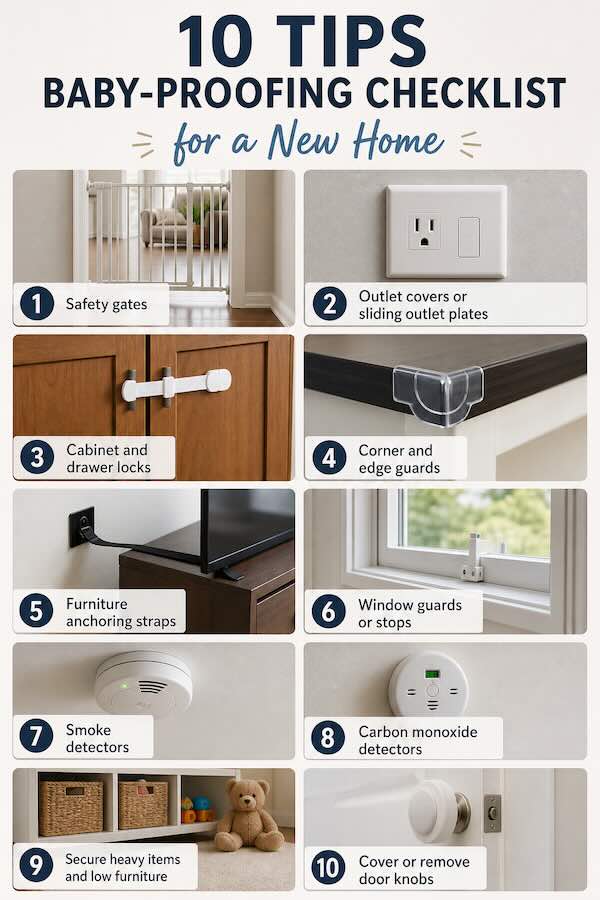
- Safety gates: Install at the top and bottom of every staircase and in any doorway to a room the baby should not access unsupervised; safety gates at the top of stairs must be hardware-mounted rather than pressure-mounted for adequate security
- Outlet covers or sliding outlet plates: Cover every accessible electrical outlet in all rooms the baby will enter; sliding plate covers are more durable and harder for older babies to remove than plug-in plastic covers
- Cabinet and drawer locks: Secure all cabinets and drawers containing cleaning products, medications, sharp tools, or breakable items; magnetic locks are the most secure option and do not interfere with normal adult use once the key magnet is available
- Corner and edge guards: Apply to all sharp furniture corners at the baby’s head height; coffee tables, hearths, and low shelving units are the most common injury sources
- Furniture anchoring straps: Anchor all tall furniture including bookshelves, dressers, and televisions to wall studs; tip-over injuries from furniture pulled down by a climbing baby are among the most serious household injuries for children under three
- Window guards or stops: Install window stops that prevent windows from opening more than four inches in any room above the ground floor
- Smoke and carbon monoxide detectors: Confirm they are installed on every level, test them on move-in day, and replace batteries regardless of the displayed status on any detector already in the home
“When my baby started crawling, I suddenly noticed how many things in a home are not baby-friendly. Moving into a new place only made it feel more overwhelming, where do you even start? I ordered everything online before we moved in and had my partner install the gates and locks while the movers were unloading. By the time our daughter was inside for the first time, the main hazards were already handled.” Parent shared via ProactiveBaby
What to Pack in the Baby Essentials Bag
The baby essentials bag is a dedicated bag that contains everything the baby needs for a minimum of three days and that stays in the family vehicle throughout the entire move. It never goes on the moving truck, never gets mixed into the household boxes, and is accessible from the moment the moving crew arrives at the old home until the baby is settled in a fully functional nursery at the new one. The three-day supply window covers the worst-case scenario of a delayed truck delivery and ensures that no critical baby supply requires digging through boxes during the most chaotic period of the move.
| Category | What to Include |
|---|---|
| Diapering | Three full days of diapers (approximately 24 to 30 for a newborn, 18 to 21 for a 6-month-old), wipes in a resealable pack, diaper cream, plastic bags for disposal |
| Feeding | Formula for three days plus extra as buffer, all bottles and nipples cleaned and packed, breast pump and storage bags if nursing, burp cloths (minimum six), any thickener or supplement used for reflux |
| Clothing | Three full changes of clothing per day minimum, one warmer layer for temperature changes during transit, one full set of pajamas per night |
| Sleep | Familiar sleep sack or swaddle, white noise machine with power cord, two comfort objects such as a lovey or familiar stuffed animal, night light if used |
| Health and safety | All current medications with full supply for the three-day window, thermometer, infant pain reliever such as acetaminophen or ibuprofen appropriate for age, nail clippers, nasal aspirator, saline drops |
| Comfort and activity | Two to three familiar toys appropriate for the baby’s developmental stage, pacifier if used with a minimum of two extras, baby carrier or infant wrap for hands-free caregiving during the move |
| Documents | Copy of immunization records, new pediatrician’s name and contact information, insurance card, emergency contacts list |
Common Mistakes Parents Make When Moving With a Baby
The following mistakes come up consistently in parent accounts of moves with infants. Each one is avoidable with specific preparation rather than general caution.
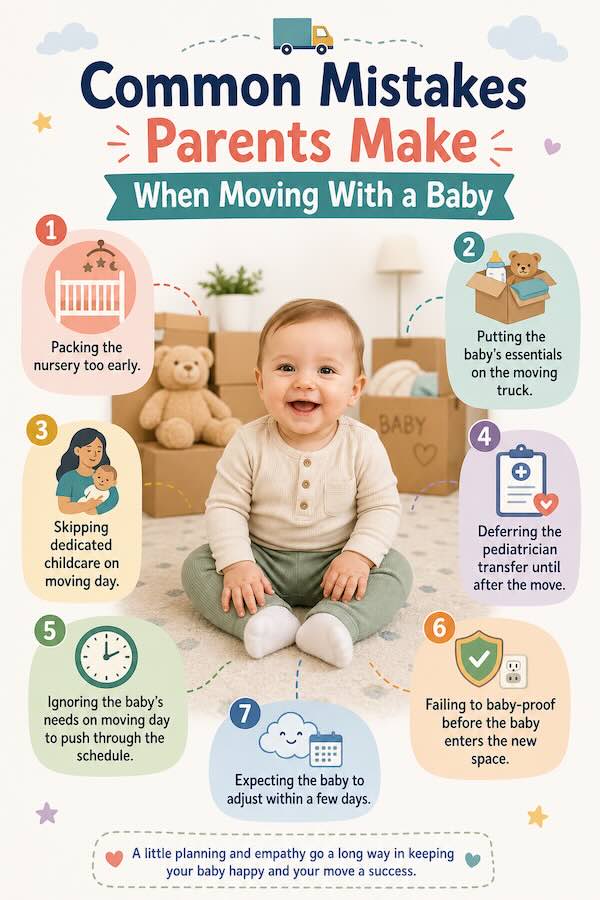
- Packing the nursery too early. Parents who begin packing the nursery more than 24 to 48 hours before the move create a visually and functionally disrupted sleep environment for the baby during the final nights at the old home, which are already likely to be disrupted by the household stress. Pack the nursery last, not first.
- Putting the baby’s essentials on the moving truck. Once those items are loaded, they are inaccessible for the duration of the transit. The three-day essentials bag must physically travel in the family car, separated from all truck cargo before loading begins.
- Skipping dedicated childcare on moving day. Parents who attempt to manage the moving crew and the baby simultaneously consistently report that both were managed poorly. A dedicated adult caregiver for the baby on moving day is not a luxury; it is the operational foundation that allows the move itself to be executed properly.
- Deferring the pediatrician transfer until after the move. Parents who plan to handle this after settling in routinely discover that their baby’s first illness at the new address arrives before a new doctor has been identified. The records transfer takes time and requires initiation before the move, not after.
- Ignoring the baby’s needs on moving day to push through the schedule. A baby who misses a nap, is fed late, or is passed between multiple unfamiliar adults all day will not settle easily that night. The move schedule should accommodate the baby’s needs, not the reverse. Building nap and feeding windows into the moving day plan before the crew arrives is a scheduling decision, not a parenting choice made under pressure.
- Failing to baby-proof before the baby enters the new space. A crawling or cruising baby brought into an unproofed new home during an active move-in will access hazards while both adults are occupied with furniture and boxes. Baby-proofing must be done before the baby’s first entry, not after the move is complete.
- Expecting the baby to adjust within a few days. Pediatricians cites a normal adjustment window of two to four weeks for babies adapting to a new home environment. Parents who expect a return to pre-move sleep and behavior within a week set themselves up for unnecessary stress. Planning for a two-week settling period and treating disruptions within that window as normal rather than problematic changes the experience significantly.
Products That Make Moving With a Baby Easier
The following products are consistently referenced in parent accounts and family moving guides as the items that made the most practical difference during a move with an infant. Each is useful beyond the move itself, which makes any purchase decision straightforward.
| Product | Why It Helps on a Move |
|---|---|
| Portable white noise machine (Hatch Rest, LectroFan, Dohm) | Creates an identical auditory sleep environment in the new space from the first nap, significantly reducing sleep disruption during the transition period |
| Baby carrier or infant wrap (Ergobaby, Solly Baby, LILLEbaby) | Keeps the baby contained, calm, and physically close to a caregiver during moving day without requiring a set-down surface; leaves both of the caregiver’s hands free for lighter moving tasks |
| Pack-and-play or portable crib (Graco Pack ‘n Play, 4moms Breeze) | Provides a safe, familiar sleep surface for the baby on moving day and the first nights at the new home before the crib is fully assembled and the nursery is set up |
| Formula dispenser or formula-to-go packs | Pre-measured formula eliminates the need to measure scoops in a moving environment where surfaces are unavailable and kitchen organization has not been established |
| Baby-proofing starter kit (Safety 1st, Munchkin, BabyDan) | Bundled kits containing outlet covers, cabinet locks, corner guards, and door pinch guards for a consistent installation before move-in day without building a separate shopping list |
| Hardware-mounted safety gate (Munchkin Pressure Gate is pressure-only; use Regalo or KidCo for hardware-mounted at stair tops) | Stair-top gates require hardware mounting to a wall stud for structural safety; a pressure gate is not sufficient at the top of a staircase regardless of its pressure rating |
| Insulated bottle bag | Keeps prepared bottles at temperature during transit and moving day without requiring refrigerator access, which may not be available at either address during the move window |
What Parents Say: Real Experiences Moving With an Infant
The following accounts are shared from parent communities and family moving resources. They reflect the practical reality of moving with a baby more accurately than any checklist can in isolation.
“The best thing we did was have my mother take the baby to her house for the entire moving day. We moved faster than we expected, everything got done properly, and when she brought him back that evening the nursery was set up and the house was functional. I wish someone had told us to do that from the start instead of assuming we could manage it ourselves.”
“We moved when our daughter was 8 months old. The first two nights were terrible. The third night was fine. By the end of the first week she was sleeping normally again. We kept the exact same bedtime routine every single night even when half the house was still in boxes, and I think that is the main reason she settled as quickly as she did.” Parent shared via Coastal Moving Services Comments
“The thing nobody tells you is that you will be exhausted in a different way than you expect. Not from the physical move but from managing a baby in an unfamiliar space while also trying to figure out where everything is and where nothing is. Give yourself two weeks to feel normal. It comes.” Parent shared via StairHoppers community
Planning Your Family Move
Moving with a baby is a plan that needs to account for two households: the adult logistics of boxes, trucks, and addresses, and the baby’s requirement for safety, routine, and a functional nursery from the first night. Our long-distance moving services page covers how we approach family moves and what full-service packing and coordination looks like for a household with an infant. For families who need professional packing so that nursery items, baby gear, and fragile household contents are protected for a long-distance or cross-country move, our packing services page details how we handle those items and how partial packing options let families focus on the baby while we handle the boxing.
FAQ
What is the hardest part of moving with a baby?
The hardest part of moving with a baby reported consistently by parents is managing the baby’s sleep and routine disruption during the post-move adjustment period rather than the move day itself. Babies under 12 months process environmental change through behavioral and sleep responses that can last two to four weeks according to Bright Horizons’ guidance on family transitions. Parents who plan for a two-week settling period, maintain the full sleep and feeding routine from the first night, and set up the nursery before anything else in the new home significantly reduce the duration and intensity of that adjustment period compared to parents who deprioritize routine maintenance in favor of faster unpacking.
How do you move a baby long distance?
Long-distance moves with a baby require planning for both the transit portion and the settling portion of the relocation. For a road trip, research child-friendly rest stops and family-rated hotels along the route before the move date, bring the three-day essentials bag in the passenger cabin rather than in a trunk or roof storage, and plan driving windows around the baby’s sleep schedule so the longest driving stretches coincide with nap or nighttime sleep. For moves requiring air travel, confirm the airline’s infant-in-lap or infant-fare policies, bring all feeding supplies as carry-on items regardless of checked bag restrictions, and request a bassinet seat bulkhead position when booking if the flight is more than three hours. Allied Van Lines recommends consulting the pediatrician before any long-distance move with a baby to confirm the baby is healthy enough for travel and to obtain any medications needed for the transition.
When should you not move with a baby?
Pediatricians generally advise against scheduling a move during the newborn period before six weeks old, during an active illness, or immediately before or after a scheduled vaccination appointment that may produce a fever or fussiness reaction. While no move timing is ideal, families with scheduling flexibility consistently report better outcomes from moves planned at three to six months or nine to twelve months rather than during the four-month sleep regression window, which typically runs from 14 to 19 weeks and produces the most significant sleep disruption of the first year independent of any environmental change. That said, move timing is rarely fully within a family’s control, and a well-prepared move at any age produces better outcomes than an unprepared one at an ideal age.
How do you baby-proof a new home before moving in?
The most efficient approach is to order all baby-proofing supplies two to three weeks before the move date and complete installation on a pre-move visit to the new home or on the morning of move-in before the baby enters the space. Start by walking each room from floor level to identify hazards at the baby’s accessible height. Install hardware-mounted safety gates at the top and bottom of all staircases, outlet covers or sliding plates on every accessible electrical outlet, magnetic cabinet locks on all cabinets with hazardous contents, corner and edge guards on sharp furniture corners at the baby’s head height, and furniture anchoring straps on all tall or heavy items. Confirm smoke and carbon monoxide detectors are functional and replace all batteries on the day of move-in regardless of the displayed status on any existing detectors in the home.
How long does it take for a baby to adjust to a new home?
Most babies adjust to a new home environment within two to four weeks according to Bright Horizons’ guidance on children and relocation transitions. The adjustment period typically involves some combination of increased fussiness, night waking beyond the baby’s established baseline, shorter naps, feeding changes, and increased clinginess toward primary caregivers. These responses are normal reactions to environmental change rather than signs of a persistent problem. Maintaining the feeding and sleep routine without deviation from the first night at the new address, providing increased physical contact and one-on-one time during the first two weeks, and ensuring the nursery is fully set up with familiar sensory cues from the first night all shorten the adjustment period relative to households where routine maintenance is deprioritized during the settling process.
References
- North American Van Lines: How to Move with a Baby – Tips for a Stress-Free Relocation (2026)
- Allied Van Lines: Moving Long Distance With a Baby – The Complete 2026 Family Guide
- Bright Horizons: Tips for Moving with a Baby – Expert Child Development Advice for 2026
- U-Pack: Complete Guide to Moving with a Baby – 2026 Logistics and Packing Checklist
- Fox Moving and Storage: How to Move with Newborns and Toddlers – A Practical Guide for 2026
- Angi: 10 Tips to Make Moving With a Baby Manageable – 2026 Service and Cost Comparison
- PODS: Moving With a Baby? Essential 2026 Preparation and Storage Strategies
- ProactiveBaby: Baby-Proofing Your New Home – 2026 Essential Moving Day Checklist