

There is no single city that can honestly be called the most moved-to city in America without first defining how “most moved to” is being measured. In the latest 2026 relocation data, The Villages, Florida has the strongest inbound-to-outbound move-search ratio, Ocala ranks first among U-Haul growth cities, Dallas-Fort Worth leads U-Haul’s metro ranking, Charlotte added more residents than any other incorporated U.S. city in the latest Census estimates, and Orlando leads Redfin’s current list of metros attracting relocating home-searchers.
Those results are not contradictions. They describe different layers of American migration. Census population estimates tell us where the number of residents is actually increasing, but total population growth includes births, deaths, domestic migration, and international migration. U-Haul records the balance of one-way moving customers arriving and departing. MoveBuddha captures where people are searching for moves relative to where people are searching to leave. Redfin measures where home shoppers are looking when they search outside their current metropolitan area.
Reading those sources together gives a much better picture than forcing all of them into one artificial ranking. The strongest migration destinations in 2026 include retirement communities in Florida, large employment centers in Texas and North Carolina, smaller Sun Belt cities that continue to absorb domestic migration, and a handful of western and Mountain West markets where outdoor access and smaller-city living remain important draws.
This guide looks at all of those patterns, explains why particular cities keep attracting movers, and points out the practical tradeoffs that migration rankings can hide. A city can be gaining residents while becoming harder to afford. It can have a strong move-in ratio while offering a relatively narrow job market. It can lead a home-search ranking without those searches ever turning into completed moves. Understanding those differences matters if you are using migration data to decide where you might actually live.
Key Points: Top Cities People Are Moving to in 2026
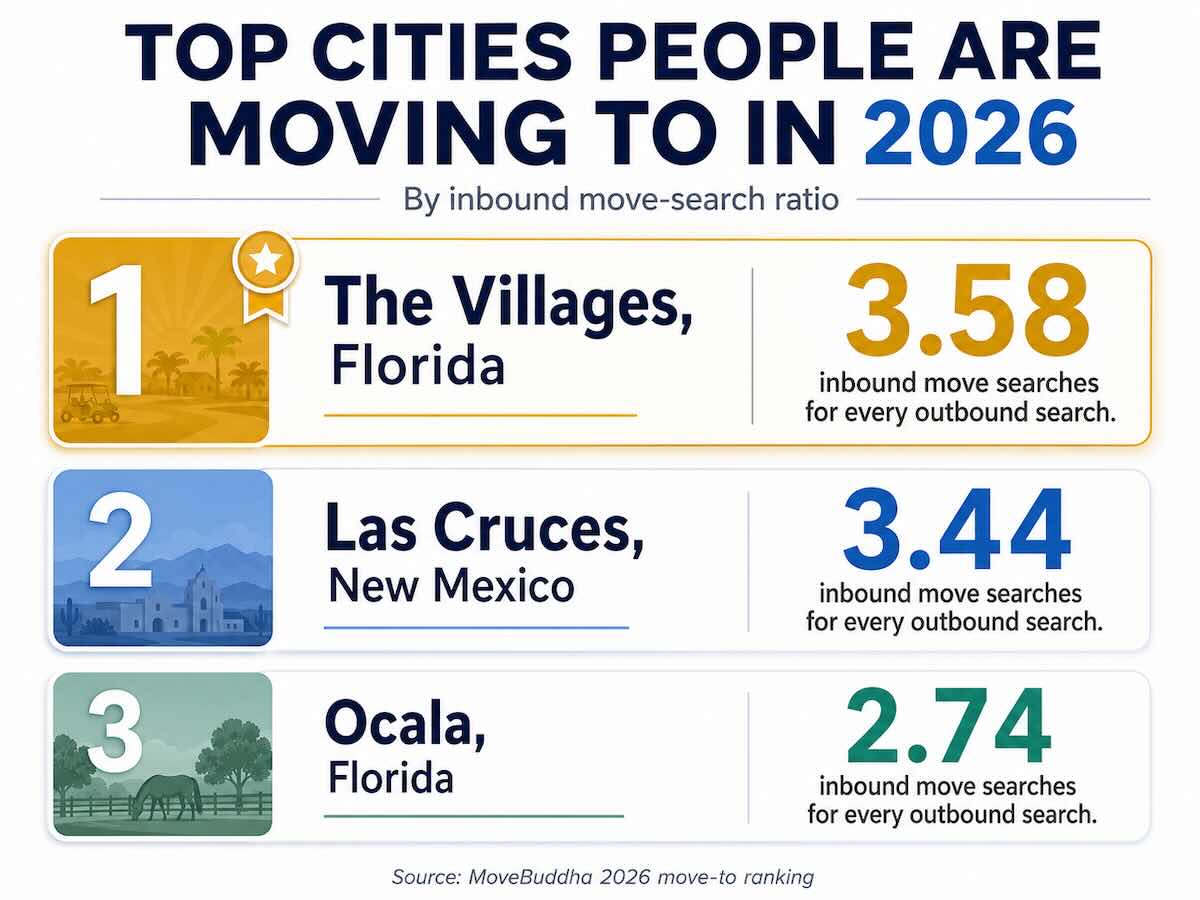
- The Villages, Florida leads MoveBuddha’s 2026 move-to ranking with 3.58 inbound move searches for every outbound search. Las Cruces, New Mexico is second at 3.44, followed by Ocala, Florida at 2.74.
- Charlotte, North Carolina had the largest numeric population gain of any U.S. city between July 2024 and July 2025, adding 20,731 residents according to the Census Bureau’s Vintage 2025 estimates.
- Dallas-Fort Worth-Arlington remains U-Haul’s #1 growth metro, repeating its 2024 result based on the net gain of one-way moving customers during 2025.
- Ocala, Florida remains U-Haul’s #1 growth city proper. Florida accounts for eight of U-Haul’s top 10 growth cities, showing how heavily city-level mover activity continues to favor the state.
- Orlando leads Redfin’s early-2026 relocation-search data, with a net inflow of 6,900 relocating home-searchers from January through March, followed by Sarasota, Miami, and Cape Coral.
- Smaller and midsized cities are an important part of the 2026 story. Census data show many outer-ring communities growing faster than the central cities of their own metropolitan areas, particularly around Charlotte and Dallas-Fort Worth.
- Retirement migration remains one of the clearest forces in city-level relocation. The Villages, Ocala, Punta Gorda, St. Augustine, Vero Beach, and Myrtle Beach all rank near the top of current inbound-move lists.
- Large employment metros still matter. Dallas-Fort Worth, Charlotte, Phoenix, Raleigh, Orlando, Houston, and Nashville continue to combine population or mover growth with deep regional job markets.
How Is a “Most Moved-To City” Actually Measured?
Migration coverage often becomes confusing because population growth, domestic migration, moving-company transactions, and online search behavior are discussed as if they are the same statistic. They are not.
A city can gain population without having the highest domestic migration. It can also lose domestic residents while continuing to grow because international migration and natural population increase offset those departures. Similarly, a smaller city can dominate an inbound-to-outbound ratio even though the total number of people moving there is far below the volume handled by a metro such as Dallas, Houston, or Orlando.
| What You Want to Know | Current Leader | Source | What the Number Actually Measures |
|---|---|---|---|
| Where is inbound move interest strongest relative to departures? | The Villages, FL | MoveBuddha 2026 | Move searches into the city divided by move searches out |
| Which city gained the most U-Haul customers? | Ocala, FL | U-Haul 2025 | Net gain of one-way truck, trailer, and U-Box customers |
| Which large metro gained the most U-Haul customers? | Dallas-Fort Worth, TX | U-Haul 2025 | One-way U-Haul arrivals minus departures within the metro |
| Which incorporated city added the most residents? | Charlotte, NC | U.S. Census Bureau | Total population increase between July 2024 and July 2025 |
| Where are relocating home shoppers looking? | Orlando, FL | Redfin Q1 2026 | Net inflow of Redfin home-search interest from other metros |
The distinction is especially important when comparing large and small places. Dallas-Fort Worth can absorb enormous moving volume because it is a metropolitan area with millions of residents and a huge labor market. The Villages can produce a much higher inbound ratio because far more MoveBuddha users are researching moves into the community than out of it. Both are meaningful, but they describe different migration dynamics.
Top 10 Cities People Are Moving to by Inbound Move Ratio
MoveBuddha’s 2026 data provides one of the clearest looks at destination preference. Rather than asking which city gained the most total residents, the company’s in-to-out ratio compares how many users search for moves into a city with how many search for moves out.
A ratio of 3.58 does not mean the Census counted exactly 3.58 new residents arriving for every person who left. It means MoveBuddha recorded 3.58 inbound move searches for every outbound search within its own dataset. That makes the measure particularly useful for spotting smaller communities with unusually strong relocation interest.
| Rank | City | State | In-to-Out Ratio | Main Relocation Pattern |
|---|---|---|---|---|
| 1 | The Villages | Florida | 3.58 | Retirement and active-adult migration |
| 2 | Las Cruces | New Mexico | 3.44 | Lower-cost Southwest destination |
| 3 | Ocala | Florida | 2.74 | Retirement, healthcare, central Florida access |
| 4 | Punta Gorda | Florida | 2.66 | Smaller coastal retirement market |
| 5 | St. Augustine | Florida | 2.65 | Historic coastal lifestyle and Northeast migration |
| 6 | Vero Beach | Florida | 2.62 | Retirement and smaller Atlantic-coast living |
| 7 | Myrtle Beach | South Carolina | 2.60 | Retirement, coastal access, lower-cost beach market |
| 8 | Kissimmee | Florida | 2.38 | Orlando-area growth |
| 9 | Leander | Texas | 2.32 | Austin suburban expansion |
| 10 | Bozeman | Montana | 2.31 | Mountain West lifestyle migration |
Source: MoveBuddha 2026 Moving Trends. In-to-out ratio represents MoveBuddha move searches into a city relative to searches out.
Which Cities Are Actually Adding the Most Residents?
The Census Bureau’s Vintage 2025 estimates provide the most important reality check on commercial migration rankings because they measure the population living in each incorporated place rather than the activity of one moving platform.
Charlotte, North Carolina added 20,731 residents between July 2024 and July 2025, more than any other city in the country. Fort Worth followed with an increase of 19,512. San Antonio added 14,359, while rapidly expanding suburban cities such as Celina and Fulshear show that a significant share of current growth is occurring around the edges of major metropolitan areas rather than solely inside their historic urban cores.
| Rank | City | State | Population Increase |
|---|---|---|---|
| 1 | Charlotte | North Carolina | +20,731 |
| 2 | Fort Worth | Texas | +19,512 |
| 3 | San Antonio | Texas | +14,359 |
| 4 | Celina | Texas | +12,710 |
| 5 | Seattle | Washington | +11,572 |
| 6 | Houston | Texas | +11,515 |
| 7 | Fulshear | Texas | +11,196 |
| 8 | Nashville-Davidson | Tennessee | +9,244 |
| 9 | Port St. Lucie | Florida | +9,131 |
| 10 | McKinney | Texas | +8,504 |
That table should not be labeled “inbound moves.” Total population change reflects the combined effects of domestic migration, international migration, births, and deaths. It nevertheless tells us something migration-platform data cannot: whether a city is actually becoming larger.
The 2025 estimates also show that the country’s biggest cities are no longer automatically capturing the strongest growth. Census found that many midsized communities around large metropolitan areas grew faster than the central city itself. Charlotte is a good example. Although Charlotte had the largest numeric gain in the nation, several smaller communities around the Charlotte metro grew faster by percentage, including Fort Mill across the state line in South Carolina.
That suburban and exurban growth pattern is one of the central migration stories of 2026. Movers are not simply choosing “Dallas” or “Charlotte.” Many are choosing the expanding ring of communities around those employment centers, trading direct access to downtown for newer housing, more space, or a different school and neighborhood environment.
Where Are U-Haul Customers Moving?
U-Haul provides another layer of evidence because its Growth Index is based on actual one-way equipment transactions rather than online destination searches. The index includes customers using trucks, trailers, and U-Box containers and compares arrivals with departures.
At the metropolitan level, Dallas-Fort Worth-Arlington ranks first for the second consecutive year. Houston and Austin take the next two positions, giving Texas the entire top three. Charlotte ranks fourth, followed by Phoenix, Nashville, Charleston, Raleigh, Atlanta, and Brownsville-McAllen.
| Rank | U-Haul Growth Metro |
|---|---|
| 1 | Dallas-Fort Worth-Arlington, TX |
| 2 | Houston, TX |
| 3 | Austin, TX |
| 4 | Charlotte, NC |
| 5 | Phoenix, AZ |
| 6 | Nashville, TN |
| 7 | Charleston, SC |
| 8 | Raleigh, NC |
| 9 | Atlanta, GA |
| 10 | Brownsville-McAllen, TX |
The city-proper ranking is even more concentrated geographically. Ocala remains #1, followed by North Port, Myrtle Beach, Kissimmee, and Clermont. Eight of the top 10 U-Haul growth cities are in Florida.
That difference between the metro and city lists is revealing. Texas dominates large employment-driven metropolitan migration. Florida dominates the smaller city and retirement-oriented end of the market.
Where Are Relocating Homebuyers Looking in 2026?
Redfin measures a different stage of relocation: the research phase. Its migration data looks at users searching for homes outside their current metropolitan area. These are not completed moves, but they provide a useful indicator of where people considering relocation are directing their attention.
For January through March 2026, Florida dominates the ranking. Orlando had the largest net inflow of relocating searchers at 6,900, followed by Sarasota at 6,800, Miami at 6,600, and Cape Coral at 6,500. Las Vegas ranks fifth, while Tampa, Phoenix, Sacramento, Tucson, and Myrtle Beach complete the top 10.
| Rank | Metro | Net Inflow of Relocating Searchers |
|---|---|---|
| 1 | Orlando, FL | +6,900 |
| 2 | Sarasota, FL | +6,800 |
| 3 | Miami, FL | +6,600 |
| 4 | Cape Coral, FL | +6,500 |
| 5 | Las Vegas, NV | +5,600 |
| 6 | Tampa, FL | +4,800 |
| 7 | Phoenix, AZ | +4,500 |
| 8 | Sacramento, CA | +4,400 |
| 9 | Tucson, AZ | +4,200 |
| 10 | Myrtle Beach, SC | +3,800 |
The Florida concentration does not necessarily mean everyone searching will move. It does show that the state remains a powerful destination during the home-shopping stage, even as some broader Census measures show Florida’s domestic-migration advantage narrowing from the extraordinary levels seen earlier in the decade.
Detailed Profiles: Why People Are Moving to These Cities in 2026
The Villages, Florida: Retirement Migration at a Scale Few Places Can Match
The Villages is the clearest example of why city-level migration cannot be understood through job-market data alone. MoveBuddha records 3.58 inbound move searches for every outbound search, making it the strongest move-to ratio in its current 2026 city data. The community’s appeal is overwhelmingly tied to the life stage of its residents rather than to the conventional economic logic that drives migration into Charlotte, Dallas, or Raleigh.
The Villages is designed around active-adult living. Golf, recreation centers, community clubs, healthcare access, and a built environment oriented toward older residents create a relocation product that is much more specific than a typical city. People moving there are often making a deliberate retirement decision rather than following an employer. That matters because retirement migration is less tied to the local wage structure. A household arriving with Social Security, retirement savings, investment income, or a pension does not need the destination to offer the same kind of employment base that a younger household requires.
The strength of that model has implications beyond The Villages itself. It helps explain why Florida places so many smaller cities near the top of migration-platform rankings. The state offers multiple markets designed around different versions of retirement: inland communities where housing and golf are central, Gulf Coast destinations built around boating and beaches, and Atlantic communities that retain access to larger employment centers.
The tradeoff is that a place optimized for one stage of life will not fit every mover. Someone relocating for a technology, finance, or manufacturing career may find a large metro far more practical. Families with school-age children will have different priorities. The Villages is therefore an excellent example of a city that can be #1 on a migration ratio without being a universal recommendation.
Las Cruces, New Mexico: The Unexpected Southwest Migration Story
Las Cruces is arguably the biggest surprise in the current MoveBuddha ranking. With 3.44 inbound searches for every outbound search, it sits only slightly behind The Villages and well ahead of many better-known Sun Belt destinations.
The city’s attraction is different from the retirement-heavy Florida markets. Las Cruces offers a smaller metropolitan environment in southern New Mexico, close to the Texas border and connected economically to the broader El Paso-Las Cruces corridor. New Mexico State University gives the city a stable institutional anchor, while healthcare, education, government, food service, administrative support, and other local service sectors form a large share of the employment base.
Bureau of Labor Statistics data illustrates both the opportunity and the limitation. The Las Cruces metropolitan area’s average hourly wage was below the national average in the latest occupational data. Healthcare practitioner positions, management, and other professional occupations pay substantially more, but the overall labor market is not comparable in scale or wage depth to Dallas, Charlotte, or Phoenix.
That means Las Cruces makes the most sense for movers whose income does not depend on accessing a huge local corporate market: retirees, remote workers, university-connected households, healthcare professionals, people with government or education employment, and residents who value a smaller urban footprint.
The city’s strong inbound ratio should therefore be read as evidence of destination preference, not proof that Las Cruces has suddenly become one of America’s largest employment magnets. Its appeal comes partly from offering a different proposition from the increasingly expensive major metros of the West: smaller scale, desert and mountain access, and a cost structure that can be easier to manage than many large western cities.
Ocala, Florida: Where Retirement Migration Meets a Real Regional Economy
Ocala stands out because it performs strongly across more than one migration dataset. It ranks third in MoveBuddha’s current 2026 inbound-search data at 2.74 and remains U-Haul’s #1 growth city proper. That overlap makes its migration story harder to dismiss as a platform-specific anomaly.
Its central Florida location matters. Ocala offers access to the state’s larger transportation network without the same urban scale as Orlando or Tampa. It also serves as the economic and healthcare center of Marion County, and its equestrian industry gives the area a distinctive identity beyond retirement housing.
The labor market is still a major consideration. BLS occupational data show an average hourly wage below the national average. Office and administrative support, sales, transportation and material moving, and food service account for large shares of local employment. Healthcare occupations pay considerably more, reflecting the demand created by an expanding and aging regional population.
That profile explains why Ocala can be attractive to retirees and households bringing income with them while being a more complicated choice for workers who need a high-paying local professional market. Someone selling a home in a more expensive state may view Ocala’s housing and lifestyle differently from someone entering the local workforce at local wage levels.
Growth also creates pressure. More residents mean more demand on roads, medical services, housing, and utilities. The qualities that make a smaller Florida city appealing can change as the population expands. Movers considering Ocala should therefore look beyond the national ranking and compare specific neighborhoods, commute patterns, flood and insurance considerations, and access to the services they expect to use regularly.
Myrtle Beach, South Carolina: Coastal Migration Without a Major-Metro Job Market
Myrtle Beach remains one of the most consistent relocation destinations in the country even after falling from the very top of MoveBuddha’s earlier 2026 rankings. It is currently seventh in MoveBuddha’s city list with a 2.60 ratio, third among U-Haul growth cities, and tenth in Redfin’s early-2026 relocation-search data.
That three-source overlap is important. Myrtle Beach is not appearing on just one proprietary list. People are researching moves there, U-Haul customers are arriving, and relocating home shoppers continue to consider the area.
The Grand Strand’s appeal is easy to understand: Atlantic beaches, golf, a large tourism and entertainment infrastructure, warm weather, and housing choices that can compare favorably with many established coastal markets farther north or in parts of Florida. Retirement migration is central, but it is no longer the entire story. Remote workers and households seeking a smaller coastal environment have widened the area’s appeal.
The economic tradeoff is equally important. BLS data show that the Myrtle Beach metropolitan area’s average hourly wage is considerably below the national average. Tourism-related and service occupations represent a major part of the labor market, even though healthcare, management, computer, and other skilled occupations offer much higher wages.
That creates a structural divide between people arriving with retirement income, remote salaries, home equity, or professional careers and people earning within the local service economy. Migration can raise demand for housing without raising every resident’s income at the same rate.
Infrastructure is another concern. A region built for seasonal tourism is becoming more of a year-round residential market. Roads, healthcare capacity, storm preparation, insurance costs, and development patterns become increasingly important as permanent population expands. Myrtle Beach’s ranking is real, but the strongest reasons to move there are lifestyle-driven rather than evidence that the city has suddenly developed the labor-market depth of Charlotte or Dallas.
Dallas-Fort Worth, Texas: The Scale Story
Dallas-Fort Worth is almost the opposite of The Villages or Myrtle Beach. Its migration appeal is not primarily retirement or lifestyle driven. It is a massive metropolitan labor market that continues to absorb households through employment, corporate activity, housing development, logistics, and sheer economic scale.
U-Haul ranks Dallas-Fort Worth first among U.S. growth metros for the second consecutive year. BLS data show more than 4.3 million nonfarm jobs in the metro in mid-2026. Trade, transportation and utilities alone account for close to 900,000 jobs, while professional and business services approach 800,000. Financial activities, education and health services, manufacturing, construction, hospitality, and government add further depth.
That diversification is one reason Dallas-Fort Worth remains durable as a migration destination. A household can move there for finance, logistics, healthcare, construction, professional services, aviation, manufacturing, technology, or corporate operations. That reduces dependence on any one employer or industry.
The metro also illustrates the shift from central-city growth to regional growth. Fort Worth added 19,512 residents in the latest Census city estimates, second nationally. Celina was the fastest-growing U.S. city with at least 20,000 residents by percentage, and McKinney also ranked among the country’s biggest numeric gainers. Much of the DFW migration story is therefore happening across a wide suburban and exurban geography rather than inside a single downtown core.
That geography is also the tradeoff. Dallas-Fort Worth is spread out. Housing that appears affordable relative to New York, Los Angeles, or San Francisco can come with longer drives, toll roads, multiple-car households, and commuting costs that do not appear in a simple home-price comparison. Summer heat, property taxes, insurance, and fast-rising infrastructure demand also belong in the equation.
Dallas is not #1 because it offers one perfect lifestyle. It remains a top migration metro because it offers a large number of people a workable combination of employment opportunity, housing supply, suburban choice, and economic scale.
Charlotte, North Carolina: The Strongest Current Census Growth Story
Charlotte has one of the strongest claims to being America’s most important current growth city because its momentum is visible in both official population data and mover activity. The Census Bureau estimates that Charlotte added 20,731 residents from July 2024 to July 2025, the largest numeric increase of any incorporated city in the country. U-Haul also ranks the broader Charlotte metro fourth among its growth metros.
The city’s economic structure helps explain why the growth has endured. Charlotte is a major financial center, but it is no longer simply a banking city. BLS data show a metro labor market of more than 1.4 million nonfarm jobs. Professional and business services, trade and transportation, healthcare and education, financial activities, construction, manufacturing, leisure and hospitality, and government all contribute substantial employment.
Business and financial occupations are particularly concentrated. The latest BLS occupational data show Charlotte with a larger share of employment in business and financial operations than the national average. That matters for migration because it gives professional households a reason to move for local employment rather than relying entirely on remote work.
Charlotte’s growth is also regional. Census specifically notes that several midsized places around the Charlotte metro are growing faster by percentage than Charlotte itself. Fort Mill, South Carolina is one example. That reflects the way households increasingly evaluate the entire metro rather than the municipal boundary: Charlotte jobs can support moves to Union County, Cabarrus County, northern Mecklenburg, Fort Mill, Rock Hill, and other surrounding areas.
The downside is the pressure created by rapid growth. Construction is expanding quickly, but roads, schools, housing supply, and commute patterns have to absorb thousands of new residents every year. Housing that once looked inexpensive compared with Northeast origin markets has appreciated significantly during the past decade.
Charlotte therefore offers a stronger case than many fashionable relocation cities because the growth is backed by both population numbers and employment depth. The tradeoff is that each new wave of migration makes the affordability and traffic advantages that originally attracted people somewhat less dramatic.
Orlando, Florida: Where Home-Search Demand Meets a Diversifying Economy
Orlando ranks first in Redfin’s early-2026 relocation-search data, with a net inflow of about 6,900 users looking to move into the metro from elsewhere. The number should not be interpreted as 6,900 completed moves, but it does show unusually strong interest among people actively searching for housing.
Orlando is often reduced to tourism, but its labor market is broader than that description suggests. Leisure and hospitality remains enormous, with more than 300,000 jobs in BLS’s June 2026 data. Professional and business services employ more than 280,000 people, while education and health services exceed 200,000. Trade, transportation, construction, manufacturing, financial services, and government add additional employment layers.
Healthcare and education employment have recently been among the stronger-growing parts of the metro’s labor market, while professional services also expanded. That matters because migration into Orlando is no longer supported solely by hospitality jobs.
Geography also makes Orlando different from many older metros. People saying they are “moving to Orlando” may be looking across a broad central Florida area that includes Kissimmee, Winter Garden, Clermont, Lake Nona, Sanford, and numerous master-planned suburban communities. Kissimmee itself ranks eighth in MoveBuddha’s current inbound ratio and appears near the top of U-Haul’s city ranking.
The tradeoffs are substantial. Housing growth, traffic, heat, insurance, and the cost of maintaining a car-dependent lifestyle can reduce the apparent financial advantage. Tourism also creates a labor market with a large share of service employment, meaning metropolitan growth does not guarantee high wages for every worker.
Orlando makes the most sense for movers who evaluate the entire employment and housing ecosystem rather than treating the theme-park corridor as representative of the region.
Phoenix, Arizona: A Mature Sun Belt Migration Market
Phoenix remains one of the country’s most persistent migration destinations even though it no longer feels like a new discovery. It ranks fifth among U-Haul growth metros and seventh in Redfin’s early-2026 relocation-search data.
The attraction combines a large labor market with the availability of extensive suburban development. Phoenix-Mesa-Chandler has grown across technology, healthcare, construction, logistics, manufacturing, professional services, and other industries. The metro is large enough that movers are not choosing one urban lifestyle; Scottsdale, Mesa, Chandler, Gilbert, Peoria, Goodyear, and central Phoenix provide very different housing and community environments.
That breadth is one reason Phoenix has endured through multiple migration cycles. Retirees form part of the demand, but the city is not dependent on retirement. Working-age households can access a regional economy with millions of residents and a wide occupational base.
The tradeoff is that the factors supporting Phoenix’s expansion also create pressure. Extreme summer heat affects daily routines and utility use. Water policy is a legitimate long-term issue in parts of the Southwest. Housing appreciation reduced some of the dramatic affordability advantage Phoenix offered a decade ago, and the physical size of the metro makes commuting and car ownership important considerations.
Phoenix is therefore best understood as a mature Sun Belt growth market rather than a cheap alternative waiting to be discovered. The question for a new mover is not whether people are going there—they clearly are—but whether the specific part of the metro, commute, housing cost, and climate fit the household’s priorities.
Raleigh, North Carolina: Growth Built Around Education and Professional Employment
Raleigh remains one of the strongest employment-oriented relocation destinations in the Southeast. It ranks eighth among U-Haul growth metros, and the city itself crossed the 500,000-resident mark in the latest Census estimates.
The larger Raleigh-Cary economy supports close to 790,000 nonfarm jobs in current BLS data, while unemployment remained relatively low in mid-2026. The Research Triangle’s concentration of universities, technology, biotechnology, pharmaceuticals, healthcare, research, and professional services gives the region a more specialized knowledge-economy profile than many fast-growing Southern metros.
That employment base matters because it makes Raleigh’s migration less dependent on one demographic. Young professionals, families, university-connected workers, healthcare employees, technology workers, and retirees all have reasons to consider the area.
Growth also spreads well beyond Raleigh’s municipal boundary. Cary, Apex, Morrisville, Holly Springs, Wake Forest, and communities farther into Wake and Johnston counties form part of the same relocation market. For families, the destination is often “the Triangle” rather than Raleigh alone.
The tradeoff is familiar: success has raised housing costs and pushed development farther from the core. A household choosing a distant suburb to get more space may give back some of that advantage through longer driving times and increased dependence on major highways.
Raleigh’s case remains strong because the migration story is supported by a real employment ecosystem. It is not simply a lifestyle trend or a retirement boom.
Bozeman, Montana: Lifestyle Migration With a Smaller Economic Base
Bozeman enters MoveBuddha’s top 10 with a 2.31 inbound-to-outbound search ratio, making it one of the clearest Mountain West destinations in the current data.
The reasons people consider Bozeman are very different from Dallas or Charlotte. Outdoor recreation, mountain access, Montana State University, a smaller-city environment, and the ability to combine professional or remote work with an outdoor lifestyle form much of the appeal.
That same popularity creates the central contradiction of the Bozeman migration story. A place can attract people partly because it feels smaller and closer to nature, then become more expensive and congested as more people try to access those qualities. Housing supply is much smaller than in a large Sun Belt metro, so new demand can have an outsized effect.
Bozeman therefore makes the most sense for households whose income and housing budget are already secure. Someone arriving with a remote professional salary may experience the market very differently from someone trying to enter through a local service-sector job.
The city’s ranking is valuable precisely because it shows migration is not solely about taxes and cheap housing. Some households are willing to pay more for access to a particular landscape, recreation pattern, and community scale.
Leander, Texas: The Growth Is Moving Beyond Austin
Leander ranks ninth in MoveBuddha’s current inbound-interest list at 2.32. Its presence is another example of the suburbanization of migration around major employment centers.
People are not necessarily choosing Leander because they want to leave the Austin economy. Many are choosing it because they want continued access to that economy while living farther from Austin’s expensive core.
This pattern appears repeatedly across the current Census data. Dallas-Fort Worth’s smaller communities are outgrowing the central cities by percentage, and Charlotte’s outer communities show a similar pattern. Rapidly growing metropolitan areas increasingly function as networks of employment centers, suburbs, exurbs, and satellite cities rather than one central destination.
The potential benefit is access to newer housing and suburban environments while remaining connected to a major labor market. The obvious tradeoff is transportation. As more households move outward, road capacity and commute times become part of the cost of housing.
Migration Trends Shaping Where Americans Are Moving in 2026
Florida’s migration story is becoming more specialized
Florida still dominates city-level relocation interest, but the pattern is more nuanced than the simple “everyone is moving to Florida” story of a few years ago.
Seven of MoveBuddha’s current top 10 cities are in Florida. Eight of U-Haul’s top 10 growth cities are in the state. Redfin’s four strongest relocation-search metros are Orlando, Sarasota, Miami, and Cape Coral.
But those cities represent very different mover types. The Villages is overwhelmingly retirement-oriented. Ocala mixes retirement with healthcare and regional employment. Orlando is a large diversified metro. Miami attracts high-income, international, professional, and lifestyle migration while simultaneously experiencing affordability pressure. Sarasota and Cape Coral appeal heavily to retirees and lifestyle movers.
Florida is therefore better understood as several migration markets operating at once rather than one uniform trend.
The outer edges of major metros are gaining importance
Census describes a national pattern in which large central cities slowed while many midsized communities around them continued to grow quickly. This is particularly visible in Texas and North Carolina.
Celina near Dallas was the fastest-growing U.S. city with at least 20,000 residents. Fort Mill outside Charlotte grew faster by percentage than Charlotte itself. Fulshear outside Houston appears among the largest numeric gainers.
This suggests that migration is increasingly metropolitan rather than municipal. Someone may work in Charlotte but live in Fort Mill. Someone may identify with Dallas-Fort Worth but buy in Celina or McKinney. Search data built around city names can miss this regional decision-making process.
Retirement migration is still powerful enough to reshape entire communities
The Villages, Ocala, Punta Gorda, Vero Beach, St. Augustine, and Myrtle Beach all illustrate the scale of retirement and later-life relocation.
Retirees have more geographic flexibility than workers tied to an office or local employer. They may place more weight on climate, healthcare, recreation, proximity to other retirees, taxes, and housing type. That produces migration patterns that have little relationship to local job creation.
This also explains why some of the country’s strongest inbound ratios appear in cities with below-average local wages. The arriving population does not always depend on those wages.
Jobs still determine which migration markets are durable for working-age households
Dallas-Fort Worth, Charlotte, Raleigh, Phoenix, Orlando, Nashville, Houston, and Atlanta remain important because their growth is supported by broad metropolitan economies.
A strong relocation market can survive changes in remote-work policy or retirement demand more easily when residents have multiple local employment options. A metro dominated by one employer or one industry presents more risk to a household planning a permanent move.
If employment is the primary reason for your move, compare these migration figures with our States Ranked by Job Market Growth analysis before choosing a destination.
Affordability remains important, but “cheaper” is increasingly relative
Many fast-growing destinations became popular because they offered more attainable housing than the expensive coastal markets their new residents were leaving. Repeated migration can erode that advantage.
A Charlotte suburb can still look affordable to someone selling a home in New York or Northern California while feeling expensive to a household earning local wages. The same is true in Phoenix, Boise, parts of Florida, and many Mountain West communities.
For that reason, migration popularity should never be treated as proof of affordability. Compare destination prices separately using our States Ranked by Housing Affordability study.
The Midwest story is real, but it is not a simple reversal
Some Midwestern metros are performing better than the “everyone is leaving the Midwest” narrative suggests. Indianapolis continues to offer a large diversified economy and comparatively lower housing costs than many Sun Belt metros. Minneapolis ranked inside U-Haul’s growth-metro list.
But different datasets still produce mixed signals. Home-search migration can show outflow in a metro that looks positive in one-way moving transactions. Rather than declaring the Midwest uniformly inbound, the more defensible conclusion is that selected Midwestern metros are becoming more competitive as Sun Belt housing costs rise.
We explore that shift separately in our Why People Are Moving to the Midwest guide.
What Migration Rankings Don’t Tell You About a City
Seeing a city near the top of a migration list can create the impression that thousands of households independently reached the conclusion that it is objectively one of the best places to live. Migration rarely works that cleanly.
Rapid population growth can make housing more expensive
New residents create housing demand. In places where construction cannot keep pace, that demand can push prices and rents higher. A city can therefore attract movers because it is affordable and gradually become less affordable because it succeeded in attracting them.
A large inbound ratio may come from a relatively small base
The Villages or Las Cruces can post an exceptional inbound ratio without receiving the same total number of movers as Dallas-Fort Worth. Ratios are excellent for identifying momentum but poor for comparing absolute scale.
State taxes are only one part of the financial equation
Moving to a state without an individual income tax can reduce one category of taxation, but property taxes, insurance, sales taxes, housing costs, transportation, utilities, and wages still determine whether the household actually comes out ahead.
Local wages matter
Myrtle Beach and Ocala demonstrate why this is important. Both attract significant inbound migration, but BLS wage data show average local pay below the national average. A retiree arriving with outside income faces a different financial reality from someone moving there to enter the local labor market.
Climate advantages create climate costs
Warm-weather destinations are popular partly because residents can avoid northern winters. The tradeoff can be extreme heat, hurricanes, flood risk, higher cooling demand, or insurance pressure depending on the city.
The neighborhood matters more than the state or metro ranking
Dallas-Fort Worth contains dozens of municipalities and vastly different commuting patterns. The Charlotte metro crosses a state border. Orlando includes communities with very different housing and employment profiles. Phoenix stretches across an enormous developed area.
The migration ranking should therefore help you decide where to research next, not where to sign a lease or buy a home without further investigation.
Which Growing Cities Are Worth Comparing for Different Types of Movers?
The matches below are editorial starting points based on the migration patterns, labor-market structure, and lifestyle factors discussed above. They are not a separate statistical ranking.
| Your Priority | Cities to Compare | Why They Belong on the Shortlist |
|---|---|---|
| Large professional job market | Dallas-Fort Worth / Charlotte | Deep employment bases, strong migration momentum, multiple suburban housing markets |
| Technology, research, or life sciences | Raleigh / Charlotte | Professional employment, universities, healthcare, technology and research ecosystems |
| Retirement community | The Villages / Ocala | Some of the strongest inbound ratios in current moving data |
| Coastal retirement or lifestyle | Myrtle Beach / St. Augustine | Consistent relocation interest with beach access and established retiree demand |
| Large Florida employment market | Orlando | High Redfin relocation interest and a much broader economy than tourism alone |
| Southwest smaller-city lifestyle | Las Cruces | Very strong inbound interest without large-metro scale |
| Mountain West lifestyle | Bozeman | Outdoor access and strong destination interest, with housing-cost tradeoffs |
| Big Sun Belt metro | Phoenix / Dallas-Fort Worth | Large economies and broad housing geographies rather than niche migration markets |
What About the Cities People Are Leaving?
Outbound migration is the other half of the story, but it should not take over an article about destination cities.
MoveBuddha’s current search data places Bakersfield, California among the strongest outbound markets, while several other California and high-cost urban markets also show weak inbound-to-outbound ratios. The broader pattern is familiar: high housing costs, long commutes, tax considerations, and the ability to access more space elsewhere continue to push some households toward the Sun Belt, Mountain West, and lower-cost regional metros.
At the same time, “people are leaving” does not always mean a city is shrinking. Census data show that international migration and natural population change can offset domestic departures. A large metro can lose residents to other states while still adding population overall.
That distinction is why this article does not use outbound searches as a proxy for population decline.
How to Decide Whether One of These Cities Is Right for Your Move
A migration ranking can tell you where other households are looking. It cannot tell you whether their priorities match yours.
1. Start with employment if your income depends on the destination
Check the actual employers, industries, wages, and job openings in your field. Dallas-Fort Worth, Charlotte, Raleigh, Phoenix, and Orlando offer much deeper labor markets than retirement-oriented communities such as The Villages.
2. Compare housing using your expected local income
Do not compare a destination home price only with the price of the home you are leaving. Compare it with what you will earn after the move, plus property taxes, insurance, utilities, transportation, and maintenance.
3. Test the commute before choosing a suburb
Fast-growing metropolitan areas often push new housing farther from employment centers. Drive the route at the time you would actually commute rather than relying only on mileage.
4. Check healthcare before retirement moves
A city marketed heavily to retirees should be evaluated for primary care, hospital access, specialists, rehabilitation, emergency care, and the insurance networks you expect to use.
5. Research climate risk at the neighborhood level
Flood exposure, wildfire, extreme heat, hurricane risk, and insurance availability vary within the same metro. State-level climate descriptions are not enough.
6. Visit when the destination is least flattering
Florida in August, Phoenix during extreme summer heat, Myrtle Beach during peak tourist season, and northern Mountain West cities in winter reveal more about day-to-day living than a pleasant spring weekend.
Planning a Move to One of 2026’s Top Destination Cities?
Once you have narrowed the destination, the migration ranking stops being the important number. The next question is what your specific interstate move may cost.
Distance, shipment size, packing, stairs, elevators, parking restrictions, long carries, storage needs, and the time of year can all affect the estimate. Use our moving cost calculator to build a planning range based on your actual route and move details.
Coastal Moving Services is a moving broker that arranges interstate household-goods transportation with authorized motor carriers. The assigned carrier performs the physical transportation.
Frequently Asked Questions About Cities People Are Moving to in 2026
What is the #1 city people are moving to in 2026?
There is no single answer because the available datasets measure different things. The Villages, Florida ranks first in MoveBuddha’s current 2026 inbound-search ratio at 3.58 searches in for every search out. Ocala, Florida ranks first among U-Haul growth cities. Charlotte, North Carolina added the most residents in the latest Census city estimates, while Dallas-Fort Worth is U-Haul’s #1 growth metro.
What are the top 10 cities people are moving to?
By MoveBuddha’s current 2026 inbound-to-outbound search ratio, the top 10 are The Villages, Las Cruces, Ocala, Punta Gorda, St. Augustine, Vero Beach, Myrtle Beach, Kissimmee, Leander, and Bozeman. This ranking measures move-search interest, not total population growth.
Which city gained the most population?
Charlotte, North Carolina added 20,731 residents between July 2024 and July 2025, the largest numeric increase of any incorporated U.S. city in Census Vintage 2025 estimates. Fort Worth ranked second with 19,512 additional residents.
Which metro is attracting the most movers?
U-Haul ranks Dallas-Fort Worth-Arlington first among its growth metros based on the net gain of one-way customers during 2025. Houston ranks second and Austin third.
Which Florida cities are people moving to?
Florida dominates several current city-level migration datasets. MoveBuddha’s top 10 includes The Villages, Ocala, Punta Gorda, St. Augustine, Vero Beach, and Kissimmee. U-Haul also places eight Florida cities in its top 10 growth-city ranking. Redfin’s current relocation-search data is led by Orlando, Sarasota, Miami, and Cape Coral.
Why are so many retirees moving to Florida and South Carolina?
Retirement removes the need to live near an employer, allowing households to prioritize climate, recreation, healthcare, housing type, taxes, family proximity, and community amenities. The Villages, Ocala, Myrtle Beach, Punta Gorda, Vero Beach, and St. Augustine all benefit from some version of that pattern.
Why are people moving to Charlotte?
Charlotte combines rapid population growth with a large employment market. Finance remains important, but professional services, healthcare, trade and transportation, construction, manufacturing, and other industries give the metro a broader economic base. Growth also extends into surrounding North Carolina and South Carolina communities.
Why are people moving to Dallas-Fort Worth?
Dallas-Fort Worth offers one of the country’s largest and most diversified metropolitan labor markets. U-Haul ranks it first among growth metros, while Census data show Fort Worth and multiple DFW suburbs among the nation’s largest or fastest-growing cities. The main tradeoffs are metro sprawl, commuting, summer heat, property taxes, and rapidly rising infrastructure demand.
Is Myrtle Beach still one of the most moved-to cities?
Yes. Myrtle Beach currently ranks seventh in MoveBuddha’s inbound-search data, third among U-Haul growth cities, and tenth in Redfin’s early-2026 relocation-search list. Its appeal is heavily connected to coastal lifestyle and retirement migration rather than the kind of large professional job market found in Charlotte or Dallas.
Are people still moving to Phoenix?
Yes. Phoenix ranks fifth among U-Haul’s growth metros and seventh in Redfin’s early-2026 relocation-search data. Its large regional economy and extensive suburban development continue to attract movers, although housing costs, extreme heat, commuting, and water concerns should be part of the decision.
Are people moving back to the Midwest?
Some Midwestern metros are competing more effectively for movers than they were during the peak Sun Belt migration years, particularly as housing costs rose in many Southern and Western destinations. However, the evidence is mixed by dataset, so it is more accurate to describe selected Midwest metros as becoming more competitive rather than declaring a nationwide reversal.
Does a high migration ranking mean a city is affordable?
No. Strong migration can actually push housing costs higher. The correct comparison is the total household budget after the move, including housing, wages, taxes, insurance, utilities, transportation, childcare if relevant, and healthcare.
How much does it cost to move to another state?
Interstate moving costs vary widely based on the origin and destination, shipment size, services, access conditions, and timing. A detailed route-specific estimate based on a complete inventory is more useful than applying one national average to every move.
Methodology
This guide uses multiple data sources because no single dataset fully captures U.S. city migration.
- U.S. Census Bureau Vintage 2025 Population Estimates: used for official city population change and national growth patterns. These estimates measure total population, not completed household moves.
- MoveBuddha 2026 Moving Trends: used for city inbound-to-outbound move-search ratios. This is proprietary platform search data and is labeled as such throughout the article.
- U-Haul Growth Index: used for city and metropolitan migration patterns among one-way U-Haul truck, trailer, and U-Box customers.
- Redfin Migration Data: used to show where users searching outside their existing metropolitan area are looking for homes. Search activity is not treated as proof of a completed move.
- U.S. Bureau of Labor Statistics: used to evaluate the size, industry mix, employment conditions, and wage structure of major destination metros rather than relying on relocation-company descriptions of local economies.
We do not combine these sources into one composite score. Each answers a different question, and preserving those differences gives a more accurate picture of where Americans are moving and why.
References
- U.S. Census Bureau — Vintage 2025 City and Town Population Estimates
- U.S. Census Bureau — 2025 Metropolitan, Micropolitan, and County Population Estimates
- U.S. Census Bureau — County Domestic Migration Trends From 2011 to 2025
- MoveBuddha — Moving Trends in 2026
- U-Haul — Top U.S. Growth Metros and Cities of 2025
- Redfin — U.S. Housing Market Migration and Relocation Data
- U.S. Bureau of Labor Statistics — Charlotte-Concord-Gastonia Economy at a Glance
- U.S. Bureau of Labor Statistics — Dallas-Fort Worth-Arlington Economy at a Glance
- U.S. Bureau of Labor Statistics — Orlando-Kissimmee-Sanford Economy at a Glance
- U.S. Bureau of Labor Statistics — Occupational Employment and Wages in Ocala
- U.S. Bureau of Labor Statistics — Occupational Employment and Wages in Myrtle Beach
- U.S. Bureau of Labor Statistics — Occupational Employment and Wages in Las Cruces
- U.S. Bureau of Labor Statistics — Raleigh-Cary Economy at a Glance
Last reviewed: August 15, 2026
Migration rankings should be treated as a starting point for destination research. City-level housing, employment, healthcare, transportation, insurance, climate risk, and neighborhood conditions can differ substantially from the statewide or metropolitan trend.