


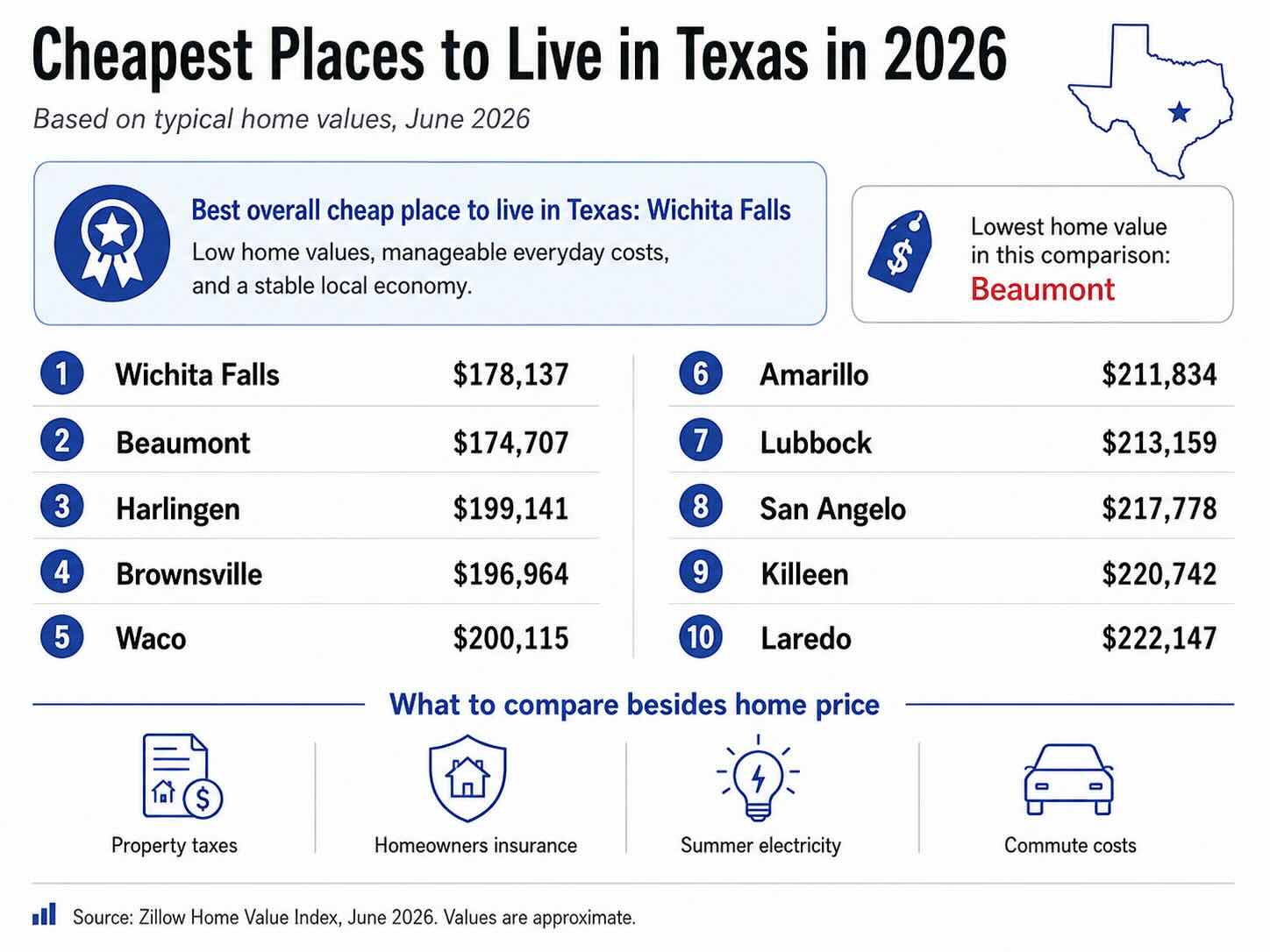
Cheap housing alone does not make a city affordable, however. Texas has no individual state income tax, but homeowners need to account for property taxes, homeowners insurance, summer electricity use, commuting costs, and, along the Gulf Coast, wind and flood exposure. Those recurring expenses are why this ranking does not simply sort Texas cities from the lowest home value to the highest.
This guide compares 15 of the most affordable places to live in Texas using current 2026 housing data, rent trends where available, access to jobs and services, and the expenses that can make an inexpensive house considerably more expensive to own.
Affordable Places to Live in Texas: 2026 Key Points
- Best cheap city overall: Wichita Falls combines a typical home value around $178,000 with relatively low everyday housing costs and a stable military and healthcare employment base.
- Lowest home value among our finalists: Beaumont, at roughly $175,000, although Gulf Coast weather and insurance exposure need to be considered.
- Best for renters: Harlingen, where Zillow’s rental measure was around $1,135 per month in mid-2026.
- Best inexpensive Central Texas option: Waco, with a typical home value around $200,000 and access to the I-35 corridor.
- Best affordable large-city option: El Paso, with typical home values around $238,000 and a much larger employment and services base than most cities in this ranking.
- Best major-city alternative to Austin: San Antonio, where typical home values are around $251,000 compared with roughly $508,000 in Austin.
- Texas statewide comparison: Zillow’s typical Texas home value was approximately $303,000 as of June 30, 2026.
- Major ownership expense: Texas homeowners insurance averaged $3,506 annually in preliminary 2025 state data, before accounting for differences by county, property, coverage level, and coastal wind exposure.
- Tax advantage: Texas does not impose an individual state income tax, but local property taxes remain an important part of the household budget.
How We Ranked the Affordable Places to Live in Texas
There is no single government statistic called the “cheapest city.” Home prices tell you what it costs to buy, rent tells you what it costs to enter a market without purchasing, and neither one tells you what property taxes, insurance, transportation, utilities, or local wages will do to your monthly budget.
For this 2026 ranking, current housing cost receives the greatest weight. We used Zillow’s Home Value Index as a consistent measure of typical home values across cities and reviewed current rental trends where comparable data was available. We then considered recurring ownership costs, employment access, city size, transportation needs, and weather-related insurance exposure.
The order therefore differs slightly from a simple cheapest-home-value list. Beaumont’s housing is marginally cheaper than Wichita Falls, for example, but Beaumont’s Gulf Coast location adds hurricane, flooding, and insurance considerations. Harlingen ranks strongly because both buying and renting can be inexpensive, while Brownsville’s current rental market is less inexpensive than its home values might suggest.
Housing data changes every month, so the figures below should be used as current planning numbers rather than permanent price guarantees.
15 Cheapest Places to Live in Texas in 2026
| Rank | City | Typical Home Value | 1-Year Change | Best For | Main Tradeoff |
|---|---|---|---|---|---|
| 1 | Wichita Falls | $178,137 | +1.0% | Buyers, military, retirees | Smaller job market |
| 2 | Beaumont | $174,707 | +2.8% | Lowest purchase price | Storm and insurance exposure |
| 3 | Harlingen | $199,141 | -1.8% | Renters, retirees | Smaller professional job market |
| 4 | Brownsville | $196,964 | +2.2% | South Texas, border trade | Higher insurance and current rents |
| 5 | Waco | $200,115 | -2.1% | Central Texas access | Rapid neighborhood price differences |
| 6 | Amarillo | $211,834 | +3.2% | Renters, healthcare, logistics | Remote location and severe weather |
| 7 | Lubbock | $213,159 | +1.7% | Students, healthcare, education | Distance from major metros |
| 8 | San Angelo | $217,778 | -1.4% | Military, retirees | Limited industry breadth |
| 9 | Killeen | $220,742 | -1.0% | Military families, renters | Fort Cavazos traffic |
| 10 | Laredo | $222,147 | +2.7% | Logistics, international trade | Specialized economy |
| 11 | Corpus Christi | $226,792 | -0.3% | Coastal lifestyle, port jobs | Wind and hurricane costs |
| 12 | McAllen | $231,417 | +0.5% | Healthcare, trade, families | Lower local wages in some sectors |
| 13 | Longview | $236,068 | +1.2% | Renters, East Texas living | Smaller career market |
| 14 | El Paso | $237,834 | +1.7% | Large-city amenities | Geographic isolation |
| 15 | Baytown | $247,381 | -1.1% | Houston-area workers | Industrial and flood exposure |
Housing data: Zillow Home Value Index, primarily through June 30, 2026. Zillow’s ZHVI measures typical home values and should not be confused with the median sale price for a particular month.
The Most Affordable Texas Cities Explained
1. Wichita Falls – Best Cheap Place to Live in Texas Overall
Wichita Falls is our top overall choice because a typical home was worth only about $178,000 in mid-2026, roughly $125,000 below the Texas statewide figure. The city also avoids the separate coastal wind exposure that complicates affordability in Beaumont, Corpus Christi, and the Rio Grande Valley. Sheppard Air Force Base and healthcare provide important employment anchors, while daily driving distances are manageable compared with the enormous footprints of Dallas, Houston, and San Antonio.
The compromise is opportunity. Wichita Falls does not offer the job diversity, entertainment, restaurant market, or air connections of the major Texas metros. It makes the most financial sense for military households, healthcare employees, remote workers, retirees, and buyers whose income is not dependent on a large corporate job market.
2. Beaumont – Cheapest Home Values Among the Cities We Ranked
Beaumont has the lowest typical home value in this ranking at roughly $175,000. Zillow’s rental measure was also around $1,285 in July 2026, giving the city genuine appeal to both buyers and renters. Energy, petrochemical operations, healthcare, transportation, and port-related employment give Beaumont a stronger economic base than many similarly priced small cities.
The reason Beaumont does not take the number-one position is recurring risk. Jefferson County sits in the Texas coastal catastrophe area, and homeowners need to investigate flood zones, wind coverage, deductibles, and actual insurance quotes for a specific address. A $175,000 house stops looking exceptionally cheap if the insurance and flood-related costs are substantially higher than they would be farther inland.
3. Harlingen – One of the Cheapest Texas Cities for Renters
Harlingen combines home values around $199,000 with some of the lowest current asking rents among the cities we reviewed. Zillow reported average rent near $1,135 in June 2026, well below the national figure on the same measure. That creates an unusually low barrier to entering the market, particularly for retirees, healthcare workers, and households moving to the Rio Grande Valley without immediately purchasing a home.
Harlingen is also close enough to Brownsville, McAllen, South Padre Island, and the wider Rio Grande Valley that residents are not confined to one small-city economy. The tradeoff is that professional salaries can also be lower, while South Texas heat, storm risk, and insurance need to be included in the comparison.
4. Brownsville – Cheap Homes With a Changing South Texas Economy
Brownsville’s typical home value was approximately $197,000 in June 2026, making it one of the few substantial Texas cities still below $200,000 on Zillow’s index. The Port of Brownsville, cross-border commerce, healthcare, education, and aerospace investment around the Boca Chica area have broadened a local economy historically dominated by trade and services.
Brownsville is especially appealing to buyers who value South Texas culture and Gulf Coast access, but renting is not as cheap as the home-value number might imply. Zillow’s average rental measure was around $1,569 in June 2026. Homeowners also need to price insurance carefully because Cameron County is part of the coastal windstorm area.
5. Waco – Cheap Central Texas Housing Without Giving Up I-35 Access
Waco is one of the most interesting additions to the revised list. A typical home was worth about $200,000 in June 2026, down roughly 2.1% from a year earlier, while average rent was around $1,369. Baylor University, healthcare, manufacturing, tourism, and Waco’s position on I-35 give it an employment and transportation advantage over similarly priced cities much farther west.
Waco can work for households that want access to both Dallas-Fort Worth and Central Texas without paying Austin-area prices. Housing costs vary sharply by neighborhood and suburb, however, so a citywide figure should be treated as a starting point rather than an expectation for every part of the market.
6. Amarillo – Low Housing Costs With a Regional Economic Base
Amarillo’s typical home value was around $212,000 in June 2026, while Zillow reported average rent near $1,277 in July. Healthcare, agriculture, food production, energy, transportation, and federal employment support an economy that serves much of the Texas Panhandle rather than functioning purely as a small local market.
For buyers who want a house, yard, relatively short commute, and access to outdoor recreation such as Palo Duro Canyon, Amarillo offers a great deal for the money. Its distance from the rest of Texas is the obvious compromise. Severe thunderstorms, hail, high winds, winter weather, and wildfire conditions can also affect insurance and maintenance costs.
7. Lubbock – Affordable College-City Living
Lubbock combines a typical home value around $213,000 with the economic stabilizing effect of Texas Tech University, healthcare, agriculture, research, and regional services. Average rent was about $1,380 in July 2026. For younger residents, healthcare professionals, university employees, and families who want more educational and cultural infrastructure than many low-cost Texas cities provide, that combination is difficult to ignore.
The tradeoff is geography. Lubbock is hours from the state’s largest metros, and its climate is dry, windy, and prone to blowing dust. Buyers who can work within the regional economy, however, can obtain substantially more house than they could in Austin or Dallas.
8. San Angelo – Affordable West Texas Without a College-Town Premium
San Angelo’s typical home value was roughly $218,000 in June 2026 and had fallen modestly over the previous year. Rent was around $1,332 in July. Goodfellow Air Force Base, healthcare, education, agriculture, energy-related activity, and regional services give the city a stable economic foundation.
San Angelo tends to suit buyers who prefer a smaller city and are comfortable trading career breadth for housing affordability, short commutes, and space. It is a more difficult fit for households that expect to change employers frequently within specialized corporate, technology, finance, or professional fields.
9. Killeen – Affordable Central Texas for Military Families
Killeen remains one of Texas’ clearest examples of an inexpensive housing market built around a major employment institution. Typical home values were around $221,000 in June 2026 and Zillow’s average rent was approximately $1,258 in July. Fort Cavazos drives an enormous military, civilian, contracting, housing, and service economy across Killeen, Harker Heights, and Copperas Cove.
The city also provides much cheaper entry into Central Texas than Austin and many I-35 suburbs. The downside is that Fort Cavazos traffic and military rotation patterns heavily influence the housing and rental markets. Buyers should compare neighborhoods carefully rather than assuming every inexpensive listing represents the same long-term value.
10. Laredo – Low Housing Costs in a Major Trade Economy
Laredo had a typical home value around $222,000 and average rent near $1,305 in mid-2026. Its affordability is especially notable because the city is not economically isolated in the same way as many inexpensive small markets. International trade, warehousing, trucking, customs services, logistics, retail, healthcare, and government employment support one of the country’s most important land-border trade corridors.
That specialization is also a limitation. Laredo makes considerably more sense for households connected to logistics, transportation, trade, healthcare, education, or government than for professionals who need a diverse technology, finance, or corporate headquarters market.
11. Corpus Christi – One of the Cheapest Coastal Cities in Texas
Corpus Christi’s typical home value was about $227,000 in June 2026, while average rent was around $1,415. Few cities at this price level combine a substantial population, Gulf Coast access, port employment, healthcare, energy, manufacturing, military activity, and established urban services.
The home price is only the beginning of the ownership calculation. Corpus Christi is in a coastal windstorm area, and some properties face meaningful hurricane, flood, and storm-surge exposure. Buyers comparing Corpus Christi with an inland city such as San Angelo should obtain insurance and flood information for the actual property before deciding which location is cheaper month to month.
12. McAllen – Affordable Rio Grande Valley City With More Services
McAllen’s typical home value was approximately $231,000 in June 2026. It costs more than Harlingen or Brownsville, but residents get one of the Rio Grande Valley’s largest concentrations of healthcare, retail, professional services, international commerce, restaurants, and entertainment.
That makes McAllen particularly relevant to people who want South Texas affordability but are reluctant to sacrifice urban conveniences. As with the rest of the Valley, home prices need to be considered alongside local wages, summer electricity use, transportation, and insurance rather than compared with Austin or Dallas on purchase price alone.
13. Longview – Strong Value for Renters in East Texas
Longview’s typical home value was around $236,000 in June 2026, which is higher than several West Texas markets, but its rental market is a major reason it remains on this list. Zillow reported average rent around $1,177 in July 2026, one of the lowest figures among the cities reviewed.
Healthcare, manufacturing, energy-related businesses, transportation, and regional services provide the employment base. Longview makes particular sense for households with work in East Texas or remote employment. Someone whose career depends on a large corporate labor market may find the Dallas-Fort Worth area more practical despite the higher housing cost.
14. El Paso – Best Cheap Large-City Experience in Texas
El Paso stands apart from most of this list because it delivers large-city infrastructure at a typical home value of only about $238,000. Fort Bliss, healthcare, government, education, logistics, manufacturing, and international trade create a substantially broader economy than buyers normally find at this price level.
The Franklin Mountains, extensive city services, universities, airport access, and cross-border culture also make El Paso more than a low-cost housing market. Its major disadvantage is location. El Paso is hundreds of miles from Texas’ other major metros, so moving there is a much bigger geographic commitment than choosing Killeen, Waco, or Baytown.
15. Baytown – Affordable Entry Into the Houston Employment Region
Baytown’s typical home value was about $247,000 in June 2026, down roughly 1.1% from a year earlier. That is no longer the $199,000 market described in the previous version of this guide, but it remains cheaper than Texas overall and gives residents direct access to the Houston Ship Channel’s petrochemical, port, manufacturing, logistics, and industrial employment base.
For people who already work east of Houston, Baytown can provide far better value than paying for a more central Houston neighborhood. Flood exposure, industrial proximity, property taxes, commute patterns, and insurance vary considerably from one part of the area to another, so the cheapest listing is not automatically the cheapest home to own.
What Is the Cheapest Major City in Texas?
San Antonio deserves its own category. It does not quite make our 15-city ranking because several smaller markets have lower housing costs, but it may be the best answer for someone who really means, “Where can I live cheaply in Texas without giving up a major-city job market?”
| Market | Typical Home Value | 1-Year Change |
|---|---|---|
| Austin | $507,622 | -5.0% |
| Dallas | $311,326 | -2.7% |
| Houston | $265,010 | -2.6% |
| San Antonio | $250,888 | -2.1% |
San Antonio’s typical home value is roughly half Austin’s. That difference is large enough to change the entire household budget, particularly for buyers who still want major hospitals, universities, military employment, corporate employers, restaurants, entertainment, an international airport, and a large selection of neighborhoods.
Cheapest Places to Rent in Texas
Buying and renting produce different rankings. A city can have extremely cheap homes but a surprisingly tight rental market, particularly when available rental inventory is limited or heavily influenced by military, university, or seasonal demand.
Among the markets reviewed, Harlingen was particularly inexpensive for renters at around $1,135 per month on Zillow’s rental measure in June 2026. Longview followed at roughly $1,177 in July, Killeen at $1,258, Amarillo at $1,277, and Beaumont at $1,285. These figures describe the overall asking-rent market rather than the rent for a particular bedroom count, so apartment shoppers should still compare individual listings.
Abilene illustrates why current rental figures should not be blindly copied into a ranking. Zillow’s 2026 rental measure rose sharply there, even though home values remained around $222,000. That makes Abilene potentially attractive to buyers while making its current rental market harder to characterize as one of Texas’ cheapest.
Popular Texas Places That Are No Longer Cheap
Some places repeatedly appear in older “affordable Texas” articles even though their housing markets no longer support that label.
| Place | Typical Home Value, June 2026 | Why It Does Not Belong on a Cheapest List |
|---|---|---|
| Fredericksburg | $525,994 | Hill Country and tourism premium |
| Boerne | $560,541 | High-demand San Antonio and Hill Country market |
| Wimberley | $607,573 | Premium Hill Country lifestyle market |
| New Braunfels | $351,340 | Above the Texas statewide typical home value |
These may be excellent places to live, but “desirable,” “less expensive than Austin,” and “cheap” are three different claims. A statewide cheapest-places ranking should not blur them together.
Which Affordable Texas City Fits Your Situation?
| If Your Priority Is… | Start With | Why |
|---|---|---|
| Lowest overall housing cost | Wichita Falls, Beaumont | Home values below $180,000 |
| Low rent | Harlingen, Longview, Killeen | Some of the lowest current rent measures reviewed |
| Large-city amenities | El Paso, San Antonio | Broader jobs, healthcare, education and entertainment |
| Central Texas | Waco, Killeen | Lower prices without leaving the I-35 region entirely |
| Military household | Killeen, Wichita Falls, El Paso, San Angelo | Major military installations and established support communities |
| Gulf Coast access | Corpus Christi, Brownsville | Coastal lifestyle at relatively low home values |
| Houston-region employment | Baytown | Lower housing cost near the eastern Houston industrial corridor |
Texas Homebuyer Assistance Can Change the Affordability Calculation
Buyers who have enough income for a monthly mortgage but are struggling with the initial down payment or closing costs should also check current state programs rather than assuming inexpensive Texas housing still requires a large amount of cash up front.
The Texas Department of Housing and Community Affairs operates My First Texas Home for qualifying first-time buyers and My Choice Texas Home for buyers who do not necessarily need to be purchasing their first home. Program details, income limits, purchase-price limits, rates, assistance structures, and lender requirements can change, so eligibility should be checked directly with TDHCA or an approved lender rather than relying on a dollar amount copied from an older article.
Texas State Affordable Housing Corporation also provides mortgage and down-payment-assistance options for qualifying buyers. Some assistance is structured as grants while other products may use forgivable or repayable second liens, which makes reading the specific program terms important before comparing offers.
Planning the Move to an Affordable Texas City
Housing savings can easily be diluted by a poorly planned interstate move, particularly when a household is moving several hundred or several thousand miles to reach Texas. Compare the cost of the house and the move as two separate decisions.
If you are moving from another state, provide movers with an accurate inventory, both addresses, stairs or elevator details, parking conditions, specialty items, and your preferred dates before comparing written estimates. Long-distance pricing can change substantially with shipment size, distance, packing, storage, access, and timing.
Coastal Moving Services is a moving broker that can help coordinate long-distance moves to Texas through a licensed carrier network. If you have narrowed your search to Wichita Falls, San Antonio, El Paso, Waco, Houston-area communities, or another Texas market, you can request an estimate based on your actual inventory and route rather than using a generic statewide moving price.
FAQ About the Cheapest Places to Live in Texas
What is the cheapest place to live in Texas in 2026?
Wichita Falls is our best overall choice for the cheapest place to live in Texas because typical home values are around $178,000 and it avoids some of the recurring coastal insurance exposure found in other very inexpensive markets. Beaumont has an even lower typical home value at roughly $175,000, so buyers focused strictly on purchase price should compare both.
What Texas city has the cheapest houses?
Among the substantial Texas cities reviewed for this guide, Beaumont had the lowest Zillow typical home value in June 2026 at approximately $174,700. Wichita Falls followed at approximately $178,100. Individual neighborhoods and smaller rural towns can be cheaper, but they may provide much less access to employment, healthcare, shopping, and other services.
Where is the cheapest place to rent in Texas?
Harlingen was one of the least expensive rental markets in our review, with Zillow’s average rent measure around $1,135 in June 2026. Longview, Killeen, Amarillo, and Beaumont also had relatively low asking-rent measures. Rental inventories change quickly, so current apartment listings should be checked before choosing a city based on rent alone.
Is San Antonio still affordable in 2026?
Yes, especially compared with Austin. San Antonio’s typical home value was about $251,000 in mid-2026 versus roughly $508,000 in Austin. San Antonio costs more than Wichita Falls, Waco, Lubbock, or Killeen, but it provides a far larger job market and much broader city services.
Is Texas still an affordable state?
Texas remains relatively affordable in many regions, but the answer depends heavily on location. The statewide typical home value was about $303,000 in June 2026, while places such as Wichita Falls and Beaumont remained below $180,000. Austin was above $500,000, showing why a single statewide figure can hide enormous differences.
Does Texas have a state income tax?
No. Texas does not impose an individual state income tax. That can improve take-home pay compared with states that levy personal income taxes, although households should compare the full tax picture because Texas relies heavily on local property and sales taxes.
Are Texas property taxes high?
Property taxes can be substantial, but there is no single statewide property-tax rate. Local taxing units set rates and property values vary. The school-district residence homestead exemption is now $140,000 for qualifying primary residences, and additional exemptions may apply depending on the homeowner and taxing unit.
Why isn’t Fredericksburg on the cheapest places list?
Because it is no longer cheap by Texas standards. Zillow’s typical Fredericksburg home value was approximately $526,000 in June 2026. Boerne was around $561,000 and Wimberley around $608,000. They can be attractive Hill Country communities, but current housing costs do not support describing them as some of the cheapest places to live in Texas.
Where can I buy a home under $200,000 in Texas?
Sub-$200,000 homes remain common enough to investigate in markets such as Wichita Falls, Beaumont, Harlingen, and Brownsville, although the citywide typical value does not mean every house will be available below that price. Waco is also close to the $200,000 level, and lower-priced neighborhoods exist within several more expensive Texas cities.
What is the cheapest Texas city near a major metro?
Baytown is one of the strongest options for buyers who need access to the Houston employment region without paying for many higher-cost Houston neighborhoods. Its typical home value was roughly $247,000 in June 2026. Buyers should compare commute time, flood exposure, property taxes, and insurance before deciding whether the lower purchase price produces a lower total monthly cost.
References
- Zillow – Texas Housing Market and Home Value Index
- Zillow – Wichita Falls Housing Market
- Zillow – Beaumont Housing Market
- Zillow – Harlingen Housing Market
- Zillow – Brownsville Housing Market
- Zillow – Waco Housing Market
- Zillow – Amarillo Housing Market
- Zillow – Lubbock Housing Market
- Zillow – San Angelo Housing Market
- Zillow – Killeen Housing Market
- Zillow – Laredo Housing Market
- Zillow – Corpus Christi Housing Market
- Zillow – McAllen Housing Market
- Zillow – Longview Housing Market
- Zillow – El Paso Housing Market
- Zillow – Baytown Housing Market
- Zillow – San Antonio Housing Market
- Zillow – Austin Housing Market
- Zillow – Dallas Housing Market
- Zillow – Houston Housing Market
- Texas Department of Insurance – Texas Homeowners Insurance Market Overview
- Texas Comptroller – Property Tax Exemptions
- U.S. Census Bureau – Texas QuickFacts
- Texas Department of Housing and Community Affairs – Homebuyer Programs
- Public Utility Commission of Texas – Power to Choose