

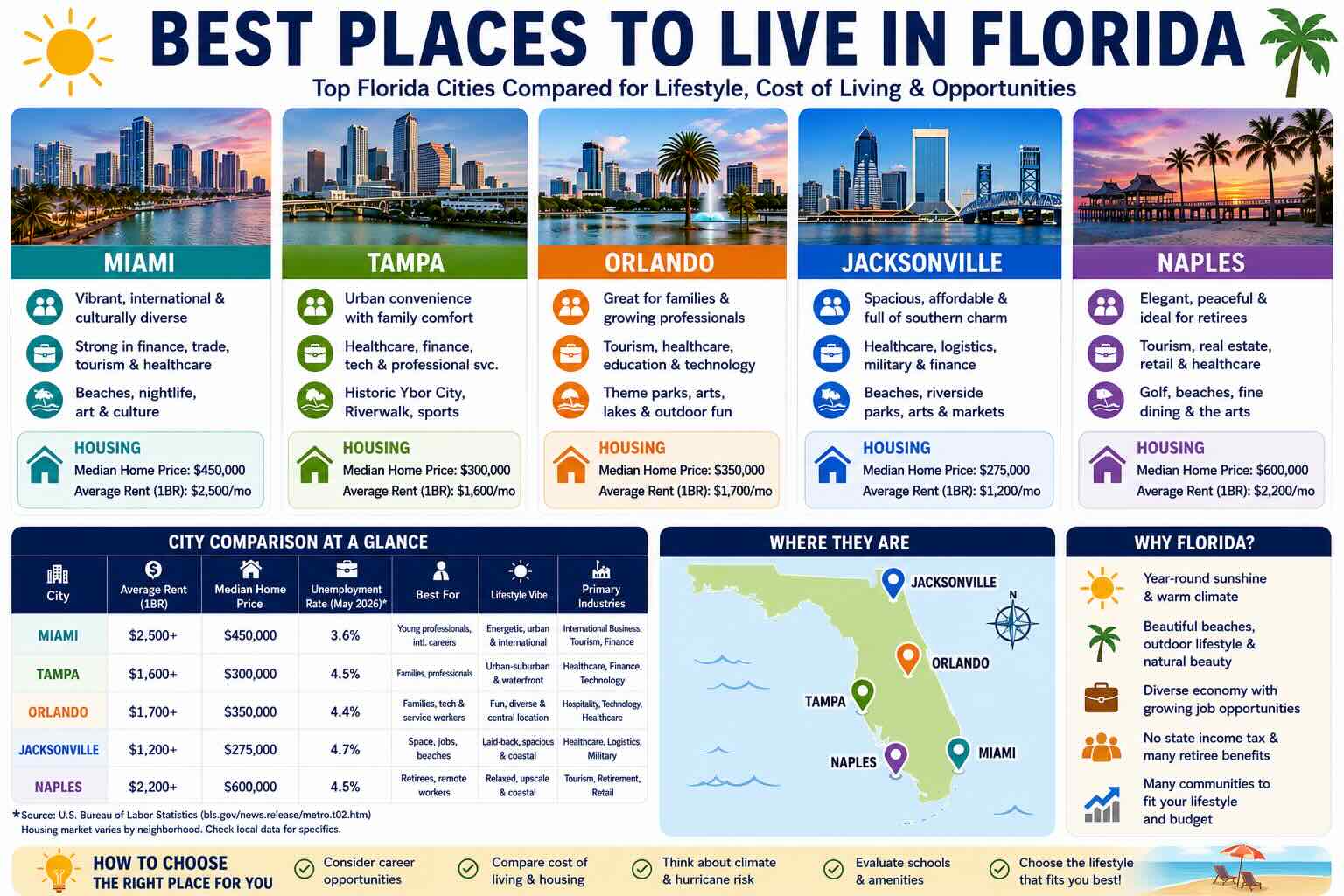
Finding the best places to live in Florida depends heavily on what you want from the move. Miami offers a major international employment market and an energetic urban lifestyle. Tampa combines a large metropolitan economy with Gulf Coast access. Orlando continues to grow far beyond its tourism roots, Jacksonville offers an unusually broad choice of urban, suburban, and coastal communities, and Naples appeals to people prioritizing Gulf Coast living, retirement, recreation, and a quieter pace.
But choosing where to live in Florida requires more than ranking cities from first to fifth. Housing costs, employment, insurance, hurricane and flood exposure, commute patterns, schools, healthcare, beaches, and the pace of everyday life can change substantially depending on where in the state you live. Even two neighborhoods within the same Florida metro can offer very different experiences.
This guide compares Florida destinations according to the decisions people actually make before moving: where to live for jobs, families, retirement, affordability, coastal access, culture, and lifestyle. We also look closely at Miami, Tampa, Orlando, Jacksonville, and Naples so you can understand what living in each city involves beyond a simple ranking.
If your research leads you to consider a move to the Sunshine State, getting an estimate for long distance moving can help you account for relocation expenses alongside housing and other living costs.
Best Places to Live in Florida at a Glance
There is no single Florida city that wins every category. Miami makes more sense for someone prioritizing a large international metro, cultural variety, nightlife, and career opportunities than for someone whose main goal is lower housing costs. Naples offers almost the opposite experience, with a smaller Gulf Coast community built around beaches, golf, recreation, retirement, and a more relaxed pace.
Tampa and Orlando occupy a useful middle ground for many households. Both support large employment markets and extensive suburban communities, but Tampa provides Gulf Coast access while Orlando offers a central location and an economy that has expanded well beyond its famous theme parks. Jacksonville is different again, combining a major regional economy with one of the largest municipal footprints in the country and access to Atlantic beaches.
| Florida City | Best Suited For | Lifestyle | Major Consideration |
|---|---|---|---|
| Miami | Culture, international business, nightlife | Dense, energetic, international and coastal | Housing costs, traffic, insurance and hurricane exposure |
| Tampa | Jobs, families, Gulf Coast metro living | Urban-suburban mix with waterfront access | Growth, traffic and coastal storm exposure |
| Orlando | Families, growing careers, entertainment | Large inland metro with extensive suburbs | Tourism traffic, heat and distance from the coast |
| Jacksonville | Space, jobs, beaches and Northeast Florida | Spread-out mix of urban, suburban and coastal areas | Car dependence and long cross-city distances |
| Naples | Retirement, beaches, golf and quieter living | Smaller, affluent and recreation-oriented | Higher housing costs and a smaller employment market |
Miami: A Vibrant Melting Pot of Culture and Opportunity

Miami is Florida’s most international major city, combining Caribbean and Latin American influences with finance, tourism, trade, healthcare, hospitality, real estate, entertainment, and professional services. The city’s identity extends well beyond its beaches. Food, music, language, architecture, art, and neighborhood life all reflect generations of immigration and Miami’s position as a gateway between the United States, Latin America, and the Caribbean.
That diversity creates an unusually broad lifestyle choice. Someone living in a Brickell high-rise experiences Miami differently from a household in Coconut Grove, a resident of Little Havana, or someone living farther inland in Miami-Dade County. Housing type, density, parking, commute times, access to transit, flood exposure, and proximity to the water can change dramatically over relatively short distances.
Who Is Miami Best For?
Miami makes the strongest case for people who want Florida without giving up the scale, employment diversity, restaurants, nightlife, arts, and international connections of a major metropolitan area. The broader Miami-Fort Lauderdale-West Palm Beach labor market remains one of the largest in the state.
It is particularly attractive to people working in international business, finance, hospitality, healthcare, real estate, professional services, aviation, logistics, and industries connected to tourism and trade. The tradeoff is that households need to budget for a comparatively expensive housing environment and investigate insurance and property-specific storm risks carefully.
What Is Everyday Life in Miami Actually Like?
Miami should be understood as a collection of communities rather than one continuous South Beach lifestyle. Brickell provides dense high-rise living close to offices, restaurants, and transit. Coconut Grove feels greener and more residential. Little Havana provides a strong neighborhood culture close to the urban core, while Miami Beach is a separate municipality across Biscayne Bay with its own housing and transportation considerations.
This distinction matters when choosing where to live. A short distance on a map does not always translate into a short commute, particularly during busy periods. A condominium can also introduce association rules, parking arrangements, elevator reservations, loading restrictions, and monthly fees that do not apply to a detached house.
What Should You Consider Before Moving to Miami?
Housing cost is only one part of the Miami budget. Buyers should investigate homeowners or condominium insurance, flood exposure, association fees where applicable, property taxes, parking, commuting, and the condition and age of the specific building.
Renters should compare neighborhoods according to the places they actually expect to travel each week rather than choosing solely on advertised distance from downtown or the beach. Miami’s traffic makes the location of work, school, childcare, and everyday errands especially important.
Tampa: Where Urban Convenience Meets Family Comfort
Tampa has grown into a large and increasingly diverse metropolitan area that combines an urban core, historic neighborhoods, extensive suburbs, major employment centers, waterfront development, professional sports, and access to the wider Tampa Bay region. It is a particularly useful alternative for people who want a major Florida metro but do not want Miami’s density or South Florida lifestyle.
Ybor City preserves a distinctive part of Tampa’s Cuban, Spanish, and immigrant history, while the Tampa Riverwalk connects downtown attractions and waterfront spaces. The broader region expands well beyond Tampa city limits into communities throughout Hillsborough, Pinellas, and neighboring counties.
Who Is Tampa Best For?
Tampa is a strong candidate for families and professionals who want access to a substantial employment market while retaining a broad selection of suburban housing. Healthcare, financial services, professional and business services, education, construction, tourism, and technology-related businesses all contribute to the regional economy.
The Tampa-St. Petersburg-Clearwater metropolitan area had a labor force of roughly 1.7 million people in May 2026, illustrating that Tampa is no longer simply a smaller alternative to Florida’s better-known metros.
Is Tampa a Good Place to Live for Families?
The size of the Tampa Bay region gives families many different residential environments to compare, from neighborhoods closer to downtown to large suburban communities. That choice is useful, but it also means a citywide description of Tampa can be misleading.
Families should investigate individual school assignments, childcare, commute times, parks, healthcare access, flood zones, housing costs, and insurance before narrowing the decision to a specific neighborhood. A household commuting into Tampa from a suburban community may have a very different daily routine from one living close to the urban core.
How Close Is Tampa to Florida’s Gulf Beaches?
Tampa is a waterfront city on Tampa Bay, but many of the famous Gulf of Mexico beaches associated with the Tampa Bay region are across the bay in Pinellas County. Clearwater Beach and St. Pete Beach, for example, should not be treated as downtown Tampa beaches.
If beach access is central to your decision, compare the actual drive from the neighborhood you are considering rather than assuming every Tampa address provides immediate Gulf access.
What Are the Tradeoffs of Living in Tampa?
Rapid regional growth has increased pressure on roads and housing in parts of the metro. The same waterfront geography that makes Tampa attractive also makes flood zones, storm surge, wind exposure, and property insurance important parts of the housing decision.
Tampa therefore works best when buyers compare specific properties and neighborhoods rather than relying on the city’s overall reputation for relative affordability.
Orlando: More Than Just Theme Parks
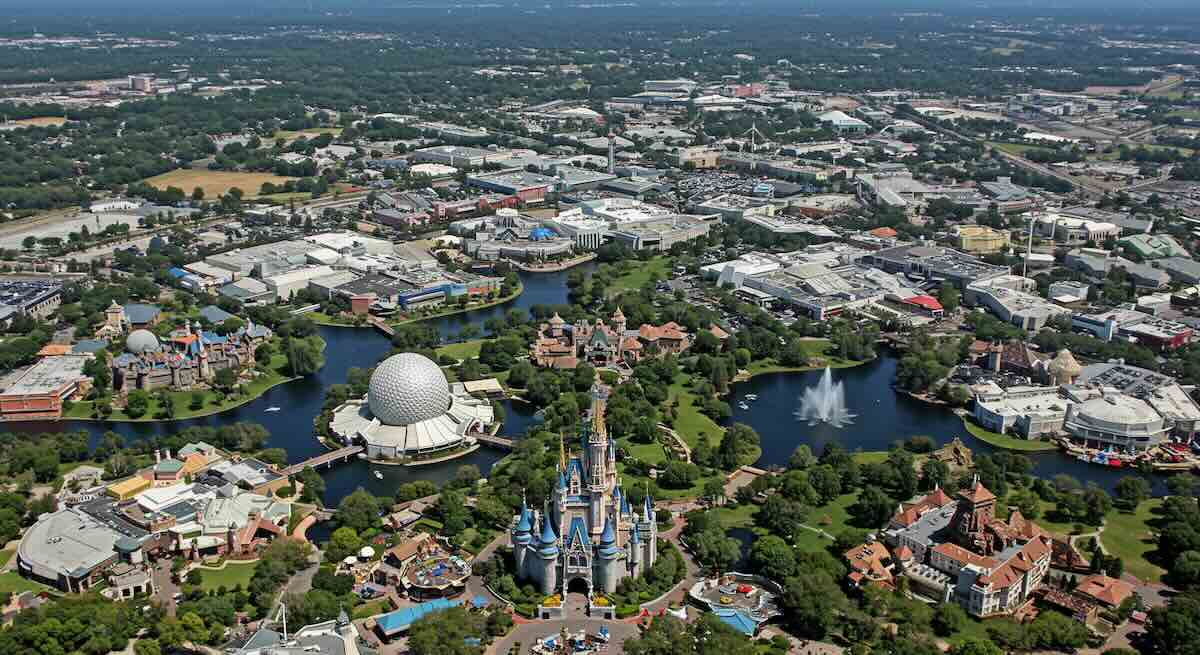
Orlando’s global identity is inseparable from Walt Disney World, Universal and the enormous tourism economy surrounding them, but treating Orlando as nothing more than a theme-park city gives prospective residents an incomplete picture of Central Florida.
The metro supports healthcare, education, professional services, construction, technology, simulation and training, aerospace-related activity, conventions, hospitality, and a growing network of suburban employment centers. The Orlando-Kissimmee-Sanford metropolitan labor force exceeded 1.5 million people in May 2026.
Is Orlando a Good Place to Live for Jobs?
Orlando can make sense for workers whose careers connect to the region’s large service economy, healthcare systems, education, professional services, technology, simulation, training, hospitality, and continued population growth.
Where the job is located matters. Downtown Orlando, Lake Nona, the tourism corridor, Winter Park, and suburban employment areas can create very different commute patterns. Choosing housing before understanding the location of work can leave residents crossing a large portion of the metro every day.
Who Should Consider Orlando?
Orlando deserves consideration from families and professionals who want a large Central Florida metro without needing to live directly on the coast. Residents have access to major entertainment, Orlando International Airport, universities, healthcare systems, professional sports, parks, lakes, and suburban communities that feel far removed from the busiest tourist districts.
Its central location can also be useful for households that regularly travel to different parts of Florida rather than orienting their lifestyle entirely around one coast.
What Is Living in Orlando Like Away From the Theme Parks?
Many residents can go about normal daily life without spending much time in the major tourist districts. Downtown Orlando, Winter Park, College Park, Lake Nona and the numerous surrounding communities each offer different housing and neighborhood environments.
The important distinction for newcomers is between Orlando city and the much larger Orlando metropolitan area. A property marketed as part of the Orlando lifestyle may actually sit in a separate municipality or suburban community, affecting taxes, schools, commute patterns, housing type, and access to amenities.
What Are Orlando’s Main Drawbacks?
Summer heat and humidity are significant, traffic can become difficult on major corridors, and the tourism economy produces unusual travel patterns around some parts of the metro. Orlando is inland but still experiences tropical weather and hurricane impacts, so inland location should not be interpreted as eliminating storm preparation.
Jacksonville: Spacious, Affordable, and Full of Southern Charm
Jacksonville gives Florida residents something difficult to find in Miami or Naples: an enormous geographic footprint containing downtown districts, established residential neighborhoods, suburban development, riverfront communities, and Atlantic beaches within the same consolidated city.
The U.S. Census Bureau estimated Jacksonville’s population at 1,017,689 in July 2025, up 7.2% from its 2020 estimates base. Jacksonville therefore should not be thought of as a small town with big-city amenities. It is a major Florida city with an unusually spread-out urban form.
Who Is Jacksonville Best For?
Jacksonville is particularly worth comparing for households that want Northeast Florida, Atlantic access, more residential space, and a large regional employment center without Miami’s density. Healthcare, financial services, logistics, transportation, military activity, construction, and the port all contribute to the area’s economy.
The Jacksonville metropolitan labor force included more than 840,000 people in May 2026. The scale of the city also gives residents a much wider range of housing environments than a simple citywide description suggests.
Where Should You Live in Jacksonville?
Neighborhood choice changes the Jacksonville experience considerably. Riverside and Avondale offer older architecture and established neighborhood character. San Marco sits close to downtown across the St. Johns River. Jacksonville Beach and neighboring beach communities provide a completely different coastal lifestyle, while newer suburban areas offer larger subdivisions and more conventional suburban housing.
That variety is one of Jacksonville’s biggest strengths, but the city’s size makes location important. Two homes with Jacksonville addresses can be separated by a substantial drive.
Is Jacksonville More Affordable Than South Florida?
Jacksonville can provide more attainable housing options than Miami or Naples, particularly for buyers who prioritize space. But “affordable” should not be interpreted as a single citywide price point.
Waterfront location, beach proximity, neighborhood, housing age, insurance, flood exposure, property taxes, commute length, and maintenance all affect the true monthly cost. Comparing total housing costs is more useful than comparing one median home-price figure.
What Are the Drawbacks of Jacksonville?
The city’s enormous footprint makes a car necessary for many households. Living far from work can turn an apparently affordable property into a demanding commute. New residents should map work, schools, healthcare, groceries, beaches, and the places they expect to visit regularly before choosing a neighborhood.
Naples: Elegance and Tranquility on Florida’s Gulf Coast

Naples offers a substantially different version of Florida from Miami, Tampa, Orlando, or Jacksonville. The community is closely associated with Gulf Coast beaches, golf, boating, restaurants, shopping, arts, retirement, and a slower pace than the state’s largest metropolitan centers.
That lifestyle comes with a significant housing-cost tradeoff. Naples and surrounding Collier County contain high-value coastal and luxury housing, making the area a better fit for households whose budgets can absorb the premium associated with Southwest Florida.
Is Naples One of the Best Places to Retire in Florida?
Naples has many of the qualities retirees commonly prioritize: warm winters, beaches, golf, outdoor recreation, dining, cultural activities, and a large population of older residents. It can be particularly appealing to people who want a smaller community rather than spending retirement in one of Florida’s largest urban regions.
Retirement decisions, however, should go beyond lifestyle. Access to healthcare, proximity to family, insurance, hurricane preparation, housing type, transportation, taxes, association costs, and long-term housing affordability all deserve consideration.
What Is Everyday Life in Naples Like?
Naples generally moves at a different pace from Miami or Orlando. Beach trips, golf, boating, restaurants, galleries, shopping, and outdoor recreation play a larger role in the area’s identity than nightlife or big-city entertainment.
Seasonality is important. Southwest Florida receives large numbers of seasonal residents and visitors during the cooler months, changing traffic, restaurant demand, and the overall pace of the community.
What Are the Tradeoffs of Living in Naples?
The largest is cost. Buyers who fall in love with the Naples lifestyle still need to evaluate the complete ownership cost, particularly for coastal or condominium properties. Insurance, flood exposure, association fees, assessments, maintenance, and hurricane resilience can materially change the budget.
The employment market is also smaller than Miami, Tampa, Orlando, or Jacksonville. Naples may therefore make considerably more sense for retirees, remote workers, established professionals, or households whose careers align with the local economy than for someone seeking the widest possible selection of employers.
Best Places to Live in Florida by Lifestyle
The best Florida city changes depending on why you are moving. A retiree prioritizing healthcare access and Gulf Coast recreation is making a different decision from a young professional comparing employment markets or a family trying to balance housing, schools, commute times, and neighborhood space.
Instead of producing another arbitrary ranking, the categories below show where each destination becomes particularly worth investigating.
Best Places to Live in Florida for Families
Tampa and Orlando are strong starting points for families who want access to large employment markets while retaining a wide choice of suburban communities. Jacksonville deserves consideration for households prioritizing space and a broad selection of residential environments.
The city name alone is too broad for evaluating family life. School assignments, commute times, childcare, parks, healthcare, housing stock, flood exposure, and neighborhood traffic can change substantially within the same metro. Families should narrow their search to specific communities before making a final comparison.
Best Places to Live in Florida for Young Professionals
Miami offers the strongest combination among these five cities for people prioritizing international business, finance, hospitality, nightlife, culture, and a dense urban environment. Tampa provides another large employment market with a different pace and Gulf Coast setting.
Orlando should not be dismissed as a tourism-only economy. Its large labor market makes it relevant to professionals working in healthcare, education, professional services, technology, simulation, hospitality, and industries connected to Central Florida’s growth.
Best Places to Live in Florida for Retirees
Naples stands out among the five cities in this guide for retirees who have the budget for Southwest Florida’s housing market and want beaches, golf, dining, recreation, and a smaller coastal community.
But Florida retirement decisions should extend beyond sunshine and recreation. Healthcare access, homeowners insurance, flood exposure, hurricane preparation, property taxes, condominium assessments where applicable, transportation, and proximity to family can matter more over the long term than a city’s position on a retirement ranking.
Best Places to Live in Florida for Jobs
Miami, Tampa, Orlando, and Jacksonville all operate as major employment centers, but their economies and labor markets are different enough that the best choice depends on your occupation.
Miami has strong connections to international business, finance, trade, tourism, healthcare, hospitality and professional services. Tampa supports major healthcare, financial and professional-service employment. Orlando combines its enormous visitor economy with healthcare, education, professional services, technology and simulation-related industries. Jacksonville has important healthcare, finance, logistics, military and transportation activity.
Current labor-market data reinforces why one statewide employment figure cannot answer the question. In May 2026, the unemployment rate was 3.6% for Miami-Fort Lauderdale-West Palm Beach, 4.5% for Tampa-St. Petersburg-Clearwater, 4.4% for Orlando-Kissimmee-Sanford, 4.7% for Jacksonville, and 4.5% for Naples-Marco Island.
Best Places to Live in Florida Near the Beach
Miami and Naples provide the most obvious beach-oriented lifestyles among these five destinations, but they appeal to very different residents. Miami combines beaches with a large metropolitan environment, while Naples combines Gulf beaches with a smaller and generally quieter community.
Jacksonville provides another option through the Atlantic beaches, allowing residents to remain connected to a major Northeast Florida employment market while living near the coast.
Tampa requires a little more geographic understanding. Tampa itself sits on Tampa Bay, while many of the region’s best-known Gulf beaches are across the bay in Pinellas County. Someone choosing Tampa specifically for beach access should compare actual driving times rather than assuming every Tampa neighborhood sits directly beside a Gulf beach.
Best Affordable Places to Live in Florida
Affordability requires more than comparing median home prices. A cheaper purchase price can be offset by insurance premiums, flood exposure, property taxes, condominium or HOA fees, commuting costs, utilities, and maintenance.
Within this five-city comparison, Jacksonville can offer a lower-cost alternative to Miami and Naples, while Orlando and Tampa contain a broad range of housing markets depending on neighborhood and suburb. Rather than treating any Florida city as universally cheap, compare the total monthly housing cost of the specific property you are considering.
Best Places to Live in Florida Without the Miami Lifestyle
People attracted to Florida but not to Miami’s density and pace have several fundamentally different alternatives. Tampa provides another large coastal metro on the Gulf side of the state. Orlando offers a major inland economy. Jacksonville combines a large employment market with a much more spread-out urban form. Naples provides a smaller and quieter Gulf Coast environment for households that can accommodate its housing costs.
This is why a statewide ranking can only take the decision so far. Florida’s major metros differ substantially in urban form, climate experience, employment, housing, transportation, and everyday lifestyle.
How To Choose The Best Places to Live in Florida
Choosing where to live in Florida should start with the part of your life that is hardest to compromise on. For some households that is employment. For others it is housing affordability, schools, proximity to family, healthcare, beach access, nightlife, retirement amenities, or simply wanting more space.
Compare the Total Cost of Housing
Do not compare Florida cities using home prices or rent alone. Homeowners should investigate property taxes, homeowners insurance, wind coverage, flood insurance where applicable, HOA or condominium fees, maintenance, utilities, and expected commuting costs.
Condo buyers should also understand the financial condition of the association, recurring fees, special assessments, reserve funding, building insurance responsibilities, and the age and condition of the property before treating the purchase price as the complete cost of ownership.
Look at the Job Market That Matches Your Career
A large employment market is not automatically the right employment market. Miami, Tampa, Orlando, Jacksonville, and Naples have different industry concentrations.
If employment is driving the move, compare actual openings, salaries, employer locations, career progression, and commute patterns in your field rather than relying on a general citywide jobs ranking.
Research the Neighborhood, Not Just the City
Citywide statistics hide enormous differences. Living in downtown Miami is different from living in a lower-density part of Miami-Dade County. Jacksonville’s size means neighborhoods can be separated by long drives. Many households considered part of the Orlando or Tampa lifestyle live outside the central city’s municipal boundaries.
Once you have narrowed your search to one or two metros, neighborhood-level research becomes more useful than another statewide ranking.
Understand Flood and Hurricane Exposure
Hurricane season affects Florida as a whole, but individual property exposure varies considerably. Coastal location, elevation, flood zone, building type, roof condition, construction standards, drainage, and insurance availability all matter.
A home several miles inland can have a very different risk profile from waterfront property within the same metropolitan area. Check the actual property rather than assuming an entire city is either protected from or uniformly exposed to flooding and hurricane damage.
Test the Commute Before Choosing a Neighborhood
Florida metros can be geographically large and car-dependent. A home that appears close to an employment center on a map may produce a difficult commute during the hours you actually need to travel.
Before signing a lease or purchasing a home, test likely travel times during morning and evening traffic. Include trips to work, schools, healthcare, groceries, recreation, airports, and other places you expect to visit regularly.
Visit During the Season That Concerns You Most
A January visit does not show what August feels like. If heat and humidity concern you, experience Florida during summer. If seasonal tourism concerns you, visit during peak season. If you are considering Naples or another market with a large seasonal population, seeing the area during winter can provide a more realistic picture of traffic and everyday demand.
Florida City Comparison: Which Destination Fits Your Priorities?
The table below compares the five destinations without relying on housing figures that can become obsolete within months. Housing costs should always be checked using current data for the specific neighborhood and property type you are considering.
| City | Best Fit | Housing Market | Employment Strengths | Lifestyle | Main Tradeoff |
|---|---|---|---|---|---|
| Miami | Young professionals, culture, international careers | Higher-cost with major condo and neighborhood variation | Finance, trade, tourism, healthcare, professional services | International, urban, nightlife and beaches | Housing, traffic and insurance |
| Tampa | Families, professionals, Gulf Coast metro living | Broad range across the Tampa Bay region | Healthcare, finance, professional services, technology | Urban-suburban with waterfront recreation | Growth, traffic and coastal exposure |
| Orlando | Families, professionals and Central Florida | Large suburban market with substantial local variation | Tourism, healthcare, education, technology, professional services | Entertainment, suburbs, central location | Traffic, heat and tourism corridors |
| Jacksonville | Space, Northeast Florida, jobs and beaches | Generally more attainable than Miami or Naples | Healthcare, finance, logistics, military, transportation | Urban, suburban, riverfront and Atlantic coast | Distance and car dependence |
| Naples | Retirees, Gulf beaches, golf and quieter living | Higher-cost, particularly near the coast | Healthcare, tourism, services, real estate | Relaxed, coastal and recreation-oriented | Housing cost and smaller employment market |
Before Moving to Florida: What Changes the Cost of the Move?
Choosing the destination is only one part of budgeting for a Florida move. The cost of getting there depends primarily on where you are moving from, the size of the household, the amount being transported, packing requirements, access at both homes, storage needs, timing, and the type of moving service you choose.
A move into a Miami high-rise can involve elevator reservations, loading restrictions, parking arrangements, and building documentation. A move into a Jacksonville or Orlando single-family home may have easier access but involve a larger household shipment. Those differences can affect labor and planning even when two moves cover a similar interstate distance.
If you are still comparing destinations, use our moving cost calculator to estimate the transportation side of the decision before comparing it with housing and other living costs.
Final Thoughts
The best place to live in Florida depends on which version of Florida you actually want. Miami makes sense for someone who values a large international city, culture, nightlife, and a diverse employment market. Tampa offers a Gulf Coast metropolitan alternative with a broad economy and a mix of urban and suburban living. Orlando combines a major Central Florida employment base with extensive suburban choices. Jacksonville provides space, Atlantic access, and a major Northeast Florida economy. Naples offers a smaller Gulf Coast environment that can be especially attractive for retirement and recreation.
The next step is not choosing whichever city ranks first on a generic list. Narrow Florida to the two or three metros that fit your career, housing budget, preferred pace, and climate tolerance. From there, compare individual neighborhoods, actual housing costs, commute times, insurance considerations, schools where relevant, and the properties available within your budget.
The best Florida destination is ultimately the one whose tradeoffs make sense for the life you expect to live there.