
Moving to an emerging city is a calculated arbitrage play. By securing high-value employment in markets where housing costs are 60-70% lower than coastal medians, households are building equity and retirement savings 30-50% faster than their counterparts in established metros.
These cities aren’t the “underdogs” anymore. They’re competing directly with the big guys on everything from job quality to nightlife. But moving to a place like Austin for a semiconductor job or Charlotte for fintech isn’t a guaranteed win. To really come out ahead, you need to look under the hood, understanding the tax breaks, finding the right housing corridors, and knowing exactly where the industry growth is actually happening.
This guide breaks down the logistics and financial mechanics of relocating to 2026’s top growth destinations.
Key Points (2026)
- Emerging cities dominate wealth building: Workers in Raleigh, Nashville, Austin, and Charlotte build wealth 30-50% faster than coastal equivalents when accounting for housing costs, taxes, and living expenses.
- Top emerging destinations: Raleigh, NC (tech hub with 20% population growth) and Charlotte, NC (finance and fintech leader) lead growth rankings, while Huntsville, AL and Greenville, SC emerge as fresh-start cities with strong job markets and lower costs.
- Cost-adjusted income advantage: A household earning $95,000 in Raleigh has equivalent purchasing power to a $165,000-$175,000 household in San Francisco, with real income gains accelerating through lower housing, taxes, and living expenses.
- Infrastructure investment accelerating: Over 2,100 locally-led federal infrastructure projects now fund emerging cities, with major transit expansions in Austin (Project Connect) and light rail growth in Charlotte and Raleigh.
- Job market diversity matters: Best-performing emerging cities (Scottsdale, Columbia, Portland) offer employment across multiple sectors rather than single-industry dependence, reducing recession risk and enabling career transitions.
Why Emerging Cities Now: The Wealth-Building Case
For decades, career-focused professionals accepted lower real incomes in established metros like San Francisco, New York, and Boston because those cities offered opportunities unavailable elsewhere. That calculus has shifted fundamentally. Emerging cities now compete directly on job quality, compensation, and lifestyle while delivering substantially better financial outcomes through lower housing costs and taxes.
Workers in emerging Sun Belt metros build wealth 30-50% faster than coastal counterparts. Consider the comparative mathematics for a senior software engineer:
| Expense/Income Metric | San Francisco | Raleigh, NC |
|---|---|---|
| Nominal Salary | $185,000 | $145,000 |
| Monthly Housing (PITI) | $8,670 | $2,430 |
| State Income Tax | 9.3% | 4.75% |
The $6,240 monthly housing cost difference alone requires $104,000 in additional gross income just to match Raleigh’s purchasing power. After factoring in taxes and childcare, the Raleigh engineer ends up $25,000-$35,000 ahead in real, spendable income.
This shift enables career acceleration for early-stage professionals. Instead of spending decades earning coastal salaries while housing costs consume 40-50% of gross income, workers in emerging cities can aggressively save and invest. For families, the gap widens further: a household earning $95,000 in Raleigh achieves purchasing power equivalent to $165,000-$175,000 in San Francisco, a nominal income gap of $70,000-$80,000 that evaporates entirely through cost adjustment.
This reality explains current migration patterns. Remote work expansion, which eliminated coastal premium arguments around career opportunity, coincided with a talent exodus to Sun Belt metros. Employers have been forced to adapt, but salaries continue to lag behind the massive real purchasing power gains found in these lower-cost regions.
Top Emerging Cities: Where to Move Now (2026)
Defining “emerging cities” requires balancing growth rate, economic strength, job market diversity, and quality of life. The following cities lead across multiple metrics and attract the broadest range of professionals and families.
| City and State | Key Industries | Growth (2010-2024) | Median Home Price | Why It Stands Out |
|---|---|---|---|---|
| Raleigh, North Carolina | Technology, research, healthcare, government | +20% | $442,333 | Research Triangle Park ecosystem; diverse employers reduce recession risk; excellent schools attract families; lower grocery costs (8% below national). |
| Charlotte, North Carolina | Finance, fintech, banking, healthcare, logistics | +19% | $420,500 | Bank of America and Truist headquarters; fintech boom attracts younger workers; light rail expansion underway; lowest housing costs among top-tier metros. |
| Nashville, Tennessee | Healthcare, entertainment, publishing, music technology | +18% | $465,000 | Vibrant culture without coastal price tag; hospital systems provide career stability; music industry draws creative professionals; no state income tax. |
| Austin, Texas | Technology (SaaS), software, semiconductors, music, creative | +22% | $589,000 | 18K+ new jobs annually; “Silicon Hills” SaaS dominance; no state income tax; Project Connect transit overhaul approved; fastest growing of major metros. |
| Greenville, South Carolina | Advanced manufacturing, automotive, engineering, textiles | Growing | ~$350,000 | Emerging fresh-start city for manufacturing professionals; more compact than Charlotte/Raleigh; growing food and arts scene; skills retraining available through local colleges. |
| Huntsville, Alabama | Aerospace, defense, STEM, technology, research | Rapid | ~$380,000 | Fastest-growing job market in emerging segment; aerospace and defense contract stability; excellent schools; housing affordability; limited cultural downsides. |
| Portland, Maine | Healthcare, education, tourism, small business | Moderate | ~$520,000 | Ranked No. 3 best city for jobs; 23rd-lowest violent crime; highest employer-based retirement plan access; vibrant food and arts scene; outdoor recreation. |
Source: World Population Review Fastest-Growing Cities (January 2026); WalletHub Best Cities for Jobs (January 2026); Zillow and RentCafe median prices (2024 data); Bureau of Labor Statistics employment data.
Cost of Living: Where Emerging Cities Win
Emerging cities compete on affordability. While housing costs rise in all metros due to population growth, they remain substantially lower than established high-cost regions. This gap compounds dramatically over decades when calculating wealth accumulation.
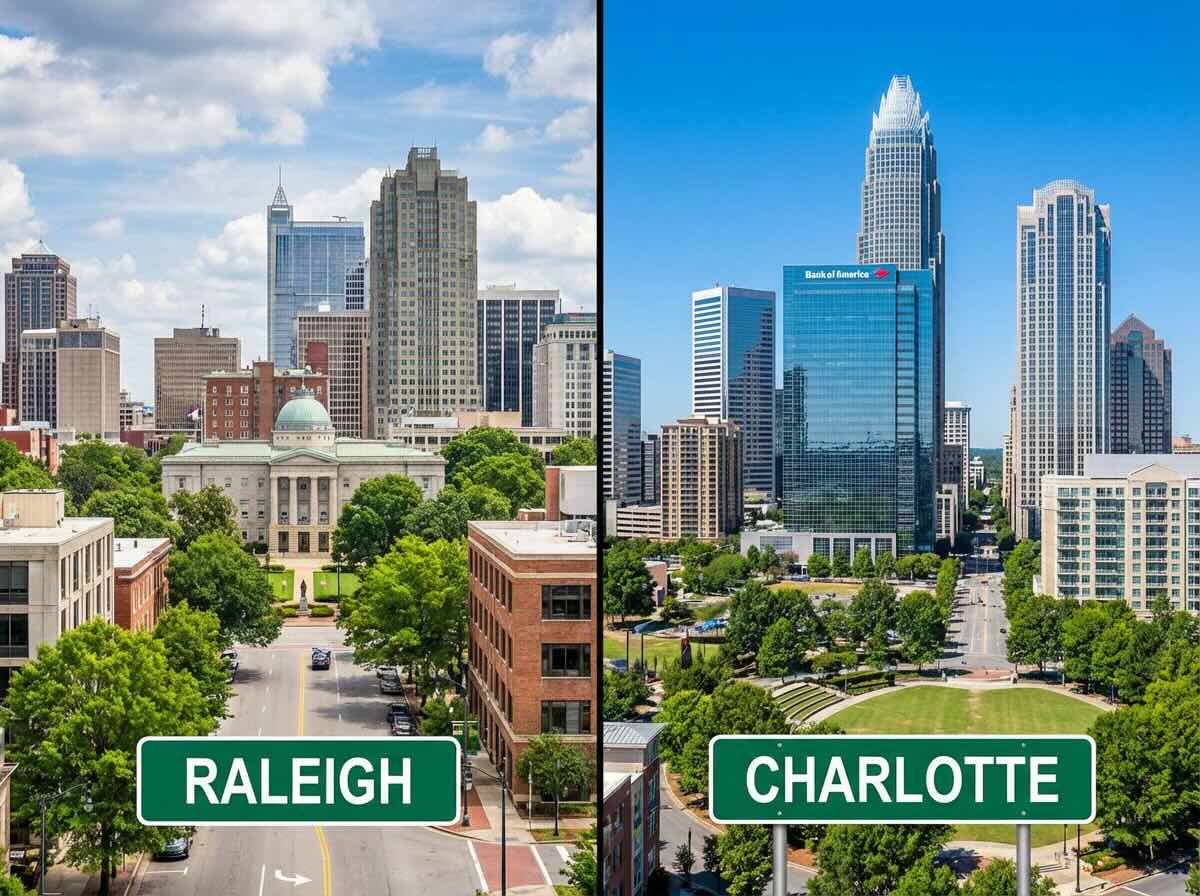
The North Carolina Advantage: Both Raleigh and Charlotte offer particularly strong cost-of-living propositions. North Carolina’s cost of living runs 4% below the national average, with housing 14% lower than national median and utilities 1% lower. Raleigh median home prices of $442,333 remain affordable for dual-income households earning $120K-$150K combined, while Charlotte’s $420,500 median (the lowest among top-tier emerging metros) creates entry points for first-time homebuyers at earlier career stages. Read more about Moving to North Carolina With Family to get a better understanding what this special state offers.
Compare this to San Francisco’s median of $1,350,000 or New York suburb medians of $800,000-$1.5 million. The Raleigh or Charlotte buyer with 20% down at current 6.8% mortgage rates pays roughly $2,200-$2,500 monthly for principal, interest, taxes, and insurance. The San Francisco equivalent pays $8,100-$9,000 monthly for identical circumstances. That $5,600-$6,500 monthly gap requires approximately $75,000-$85,000 in additional annual gross income just to match coastal housing costs.
Tax Structure Advantage: Texas (Austin), Tennessee (Nashville), and Florida (Tampa, Fort Myers) offer no state income tax, a significant long-term advantage for higher earners. North Carolina’s 4.75% state income tax remains among the nation’s lowest. By contrast, California imposes 9.3-13.3%, and New York assesses 6.85-10.9% state income tax. Over a 30-year career, this tax difference can represent $200,000-$400,000+ in additional take-home pay, depending on earnings trajectory.
Secondary Cost Factors: Beyond housing and taxes, emerging cities offer lower childcare ($600-$900/month vs. $1,300-$1,800 coastal), cheaper groceries (8% below national average in Raleigh), lower utility bills (averaging $162/month vs. $220+ in major metros), and reduced transportation costs through lower fuel prices and reduced parking fees.
Job Markets in Emerging Cities: Diversity and Growth
Emerging cities compete for talent by offering job diversity rather than single-sector dominance. This matters because single-industry dependence creates recession vulnerability. When tech crashed in 2001 and 2022, San Francisco and Seattle experienced employment catastrophes. Diversified metros recover faster because workers can transition between industries without relocation.
Top Performers by Employment Quality: WalletHub’s 2026 ranking identifies Scottsdale, Arizona as No. 1 for jobs, citing the lowest unemployment in the nation and median household income of $101,000. Columbia, Maryland ranks second with promising employment growth and affordable rent alongside strong job security. Portland, Maine ranks third with significant job availability in healthcare, education, and small business sectors.
For tech professionals specifically, Raleigh’s Research Triangle Park ecosystem creates exceptional opportunities. The RTP region employs 60,000+ workers across 300+ companies including IBM, Cisco, Qualcomm, and hundreds of startups. Unlike Silicon Valley’s venture-capital-dependent ecosystem vulnerable to funding cycles, RTP offers established corporate presence alongside startup opportunity, providing career stability with upside potential.
Nashville’s healthcare ecosystem provides comparable stability. Employer networks including Vanderbilt Health Systems, HCA Healthcare, and hundreds of providers create recession-resistant employment across nursing, medical technology, research, and administrative roles. The city’s music industry adds creative employment in recording, production, and technology.
Read More About State-Level Growth
Specific city growth is often fueled by state-level economic policy. See which states are leading the nation in total employment opportunities for 2026.
Charlotte’s finance dominance, anchored by Bank of America and Truist headquarters, creates banking, accounting, risk management, compliance, and fintech opportunities for professionals at all experience levels. Additionally, the city’s logistics corridor (supported by Charlotte Douglas International Airport and I-85 freight corridors) generates supply-chain management positions that weather economic cycles.
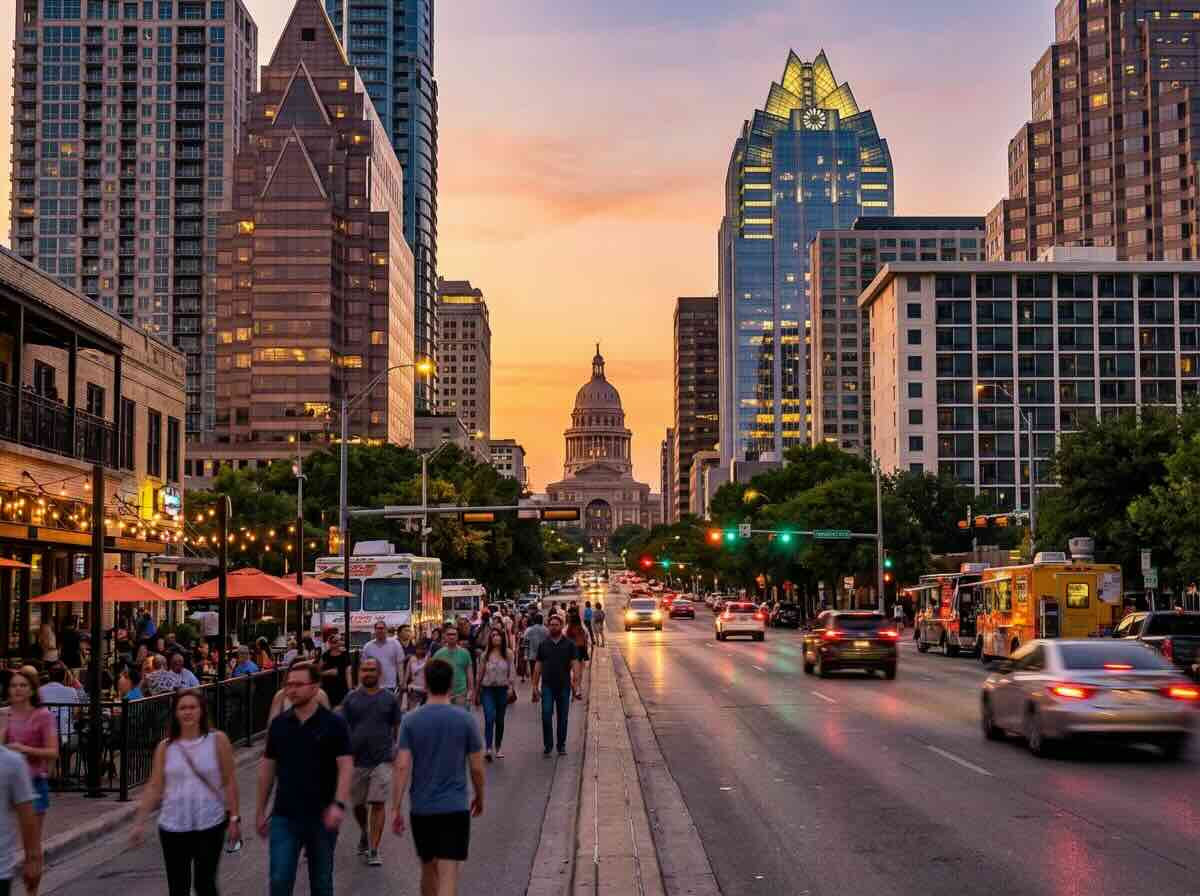
Austin’s job market grew by 18,000+ positions in 2024 alone, with SaaS companies and semiconductor manufacturers (Samsung invested $40 billion in Central Texas) driving sustained hiring. While tech-heavy, Austin benefits from energy sector opportunities (clean energy companies) and healthcare expansion as the city attracts skilled workers and families.
Huntsville, Alabama represents an emerging outlier: aerospace and defense contract employment provides federal budget-backed stability unavailable elsewhere. Companies including Northrop Grumman, NASA Marshall Space Flight Center, and dozens of defense contractors ensure employment security despite broader economic swings.
Infrastructure Investment: Why Timing Matters Now
Moving to emerging cities now positions residents to benefit from infrastructure investment cycles. Over 2,100 locally-led federal infrastructure projects started nationwide following the Infrastructure Investment and Jobs Act (IIJA), with substantial funding flowing to mid-size and smaller metros historically excluded from federal grant programs.
Austin’s Project Connect represents the largest transit initiative in the city’s history. Voter-approved in 2020 with $7.1 billion commitment, Project Connect will expand light rail coverage across east, west, and south corridors, fundamentally reducing car dependence and increasing walkability. Neighborhoods along planned routes will experience property value appreciation and transit-oriented development creating jobs in construction, retail, and service sectors.
Charlotte’s light rail expansion continues growing the existing 9.5-mile system. Phase 2 extends to outer suburbs, reducing commute times and opening development opportunities in previously car-dependent areas.
Raleigh-Durham’s regional coordination includes Jordan Lake Transit and planned commuter rail expansion, improving connections between Raleigh, Durham, and Chapel Hill. These projects increase housing supply by enabling development in currently underdeveloped areas near future transit hubs.
Gilbert, Arizona exemplifies infrastructure-driven growth. Recent capital improvement bonds funded Ocotillo Road widening and Northern Parkway extensions, with median earnings surging 32% and roadway miles expanding 26%. This infrastructure investment attracts employers and workers by reducing congestion and improving business access.
Timing matters because early arrivals benefit from improved infrastructure at lower prices than future residents will pay. A home in a neighborhood that receives transit access may appreciate 15-25% within three years as walkability increases and demand rises. Moving before infrastructure completion captures this appreciation.
Quality of Life Beyond Numbers: What Emerging Cities Offer
Raw economic metrics miss what makes emerging cities genuinely appealing: lifestyle integration that established metros struggle to provide. Young professionals, families, and career-changers find quality-of-life advantages that offset smaller salaries and less-established prestige.
Raleigh and Charlotte: Both cities offer outdoor recreation access without sacrificing urban amenities. Raleigh has state parks, greenways, and nearby mountains within 90 minutes. Charlotte’s greenway system connects 47 miles of protected trails, and the city borders the Blue Ridge foothills. Both cities provide outdoor activity access that established metros can’t match without two-hour commutes.
Nashville: Live music venues, professional sports (Tennessee Titans), and vibrant nightlife create cultural intensity without coastal crowds and costs. The city’s food scene, anchored by honest barbecue and farm-to-table restaurants, offers dining quality at accessible prices.
Austin: Lake recreation, outdoor concerts, and year-round outdoor activities define lifestyle. While summer heat creates challenges, the city’s culture prioritizes outdoor living in ways San Francisco and New York never will.
Greenville, SC: Described as “kept its downtown intact while other manufacturing towns hollowed out,” Greenville transformed its textile heritage into walkable, vibrant neighborhoods. Main Street dining, arts districts, and nearby outdoor recreation attract retirees and young families seeking community connection.
School Quality: Emerging cities increasingly compete on education, with Raleigh-Durham schools consistently ranking in top 25% nationally. Charlotte and Nashville have strong public systems and diverse private options. For families, school quality eliminates a major reason to choose coastal metros, enabling financial optimization without educational sacrifice.
Environmental & Quality of Life Rankings
Compare how these emerging hubs rank against the rest of the country for 2025.
Emerging City Challenges: What to Watch
Rapid growth creates stresses emerging cities must manage. Understanding these challenges helps relocators make informed decisions and plan accordingly.
Housing Affordability Pressure: The affordability advantage that makes emerging cities attractive creates demand that drives prices upward. Raleigh median homes appreciated 12-15% annually from 2019-2024. While prices remain lower than coastal metros, the gap narrows. Future buyers arriving in 5-10 years won’t enjoy the same cost-of-living advantage as current relocators. The early-mover advantage compounds significantly: buying today at $442K in Raleigh versus $600K+ in five years represents $150K+ in direct savings.
Infrastructure Strain: Rapid population growth strains transportation, utilities, water systems, and schools. Austin faces water scarcity concerns as the Texas population surges. Charlotte’s I-85 corridor experiences increasingly severe traffic during rush hours. Raleigh’s light rail plans address congestion but won’t complete until 2030+. Until major transit projects conclude, car dependence remains high despite expansion plans.
Gentrification and Displacement: Neighborhood revitalization attracts wealthier residents and investors, increasing property taxes and rents. Historic downtown neighborhoods in Raleigh, Charlotte, and Nashville transformed from affordable artist communities into expensive retail districts. Long-term residents often can’t afford rising costs and relocate to suburbs. This creates ethical tensions for newcomers while reducing neighborhood character and diversity.
Climate Vulnerability: Several emerging cities face climate risks. Phoenix and Huntsville experience extreme heat. Charlotte faces Atlantic hurricane exposure and flooding. Raleigh-Durham experiences periodic drought stress on Lake Jordan. Charlotte, Nashville, and Huntsville face tornado risk. Climate change will likely intensify these challenges over 30-year horizons.
Cultural Growing Pains: Cities scaling from 500K to 1.5M population experience growing pains. Services lag demand. Housing construction can’t keep pace with population growth. Traffic congestion intensifies before transit solutions complete. Austin residents frequently cite traffic and urban density as new challenges compared to the Austin of 10 years ago.
The Emerging City Relocation Timeline: 12 Months Before to 1 Month After
Successful relocation requires planning across multiple dimensions. A structured timeline prevents costly mistakes and accelerates integration into your new community.
12 Months Before (Research Phase)
- Identify 2-3 target cities based on job market, cost of living, lifestyle
- Research each city’s major employers in your industry
- Join LinkedIn groups for each target city; network with current residents
- Track local real estate and rental listings to understand market
- Investigate state and local tax structures and cost of living indices
- Review school districts if applicable (even if current kids are young)
6 Months Before (Job and Housing Search)
- Begin active job search in target cities; leverage LinkedIn and industry networks
- Schedule 2-3 day in-person visits to each city if possible
- Visit neighborhoods at different times (weekday morning, evening, weekend)
- Meet with real estate agents specializing in target neighborhoods
- Identify temporary housing options (corporate housing, short-term rentals, hotels)
- Negotiate relocation package if changing employers (moving costs, temporary housing, bridge loans)
3 Months Before (Logistics)
- Finalize job offer and start date
- Secure housing (purchase or lease commitment)
- Request moving company quotes and select provider
- Reserve moving truck and schedule move date
- Begin downsizing: sell unwanted furniture and items
- Research healthcare providers and schedule new patient appointments
1 Month Before (Final Preparation)
- Update mailing address with post office, employer, banks, insurance
- Arrange utility setup (electricity, water, gas, internet) at new home
- Transfer or establish new prescriptions with new doctors
- Schedule vehicle registration update for new state
- Pack essentials and mark boxes clearly
- Take photos of current home for insurance/security deposit purposes
Moving Week Through 1 Month After
- Confirm final walkthrough of current home
- Transfer utilities turn-off and turn-on dates
- Arrive early to check home condition and utility function
- Focus first week on essentials: unpacking bedroom, bathroom, kitchen
- Address administrative: driver’s license, voter registration within 30 days
- Locate nearest grocery store, pharmacy, hospital, and work commute route
- Establish healthcare: register with new doctors, dentist, eye care
- Join local community groups, classes, or volunteer organizations
Emerging City Research Checklist: Evaluating Your Target
Before committing to relocation, validate that your target city aligns with your priorities across five dimensions. Skip dimensions that don’t apply to your situation (e.g., schools if you’re child-free).
1. Economic Strength and Job Market
- What are the top 5 employers in your field? Are they headquartered or regional offices?
- Is the job market growing (5%+ annually) or declining?
- Are salary ranges competitive with your current location? Use Glassdoor, Levels.fyi, Salary.com
- Does the city have multiple industries, or is it dependent on one sector?
- What is the unemployment rate compared to national average?
2. Cost of Living and Affordability
- What is median home price? Can you afford a purchase given your down payment?
- What is average rent for your desired neighborhood and unit type?
- What are state income tax rates and property tax rates?
- How do childcare, healthcare, and transportation costs compare to your current location?
- Use cost-of-living calculators to compare total expenses across all cities
3. Quality of Life and Community
- What outdoor recreation is available within 30 minutes? (Parks, trails, sports, water)
- What cultural amenities matter to you? (Museums, live music, restaurants, theater)
- How is crime compared to national average? Use FBI statistics and neighborhood-level data
- Is the city becoming more walkable or more car-dependent?
- Is there an active newcomer or transplant community? (Meetups, Facebook groups, networking events)
4. Housing and Neighborhood Specific
- In your target neighborhoods, are homes appreciating or depreciating?
- Are neighborhoods gentrifying (rising prices, changing demographics) or stable?
- What is actual commute time from your preferred neighborhood to major employers?
- Are neighborhood-level schools (if applicable) rated well?
- Walk the neighborhood at different times; does it feel safe and appealing?
5. Infrastructure and Long-Term Viability
- Are major infrastructure projects planned or approved? (Transit, roads, utilities)
- Is water supply secure, or does the city face drought risk?
- What is the city’s climate resilience plan? (Flood risk, heat mitigation, tornado risk)
- Are housing supply and affordability worsening or improving?
- Is the city attracting large employers or losing them?
Logistics: Choosing a Moving Company and Budgeting
Our long-distance moving guide covers interstate relocation mechanics in detail, including carrier selection, cost structures, and protection options.
For moves to emerging cities specifically, consider three variables: distance (affecting cost per mile), timing (peak summer season costs 20-30% more than winter), and services (full service costs 40-50% more than DIY options). An average 800-mile move for a 3-bedroom household costs $4,000-$8,000 with professional movers depending on these factors.
Budget tips specific to emerging cities: many offer relocation packages including moving cost reimbursement. Negotiate this during job offer phase, as employer-paid relocation reduces your out-of-pocket costs. Additionally, renting versus buying your first 1-2 years reduces moving logistics complexity; you skip the closing costs, home inspection hassles, and locked-in real estate commitment while you validate neighborhood fit.
Financial Planning: Wealth Acceleration Math
Understanding how emerging city relocation accelerates wealth requires comparing lifetime costs across all dimensions, not just salary or housing.
Example Scenario: Software Engineer, San Francisco to Raleigh Relocation
Current role: San Francisco, $185,000 salary. Offered role: Raleigh, $145,000 salary.
Annual Cost Comparison (San Francisco vs. Raleigh):
| Expense Category | San Francisco | Raleigh | Raleigh Advantage |
|---|---|---|---|
| Gross Salary | $185,000 | $145,000 | SF: $40,000 more |
| State Income Tax (9.3% vs. 4.75%) | -$17,205 | -$6,888 | Raleigh saves $10,317 |
| Federal Income Tax (est. 24% effective) | -$44,400 | -$34,800 | Raleigh saves $9,600 |
| Payroll Taxes (FICA) | -$14,153 | -$11,098 | Raleigh saves $3,055 |
| After-Tax Income | $109,242 | $92,214 | SF: $17,028 more after tax |
| Housing (P&I, taxes, insurance monthly) | -$104,400/year | -$29,400/year | Raleigh saves $75,000 |
| Utilities and Internet | -$2,800 | -$1,944 | Raleigh saves $856 |
| Groceries and Dining | -$9,600 | -$8,640 | Raleigh saves $960 |
| Childcare (if applicable) | -$18,000 | -$8,400 | Raleigh saves $9,600 |
| Transportation (vehicle, gas, insurance) | -$6,000 | -$7,200 | SF saves $1,200 |
| Remaining After Essential Expenses | -$33,558 | $35,630 | Raleigh advantage: $69,188/year |
This comparison reveals the reality: despite a $40,000 nominal salary reduction, the Raleigh engineer saves $69,188 annually after covering all essential expenses. Over 10 years, this compounds to $691,880 in wealth accumulation versus negative wealth (debt) for the San Francisco equivalent. When you add investment returns on accumulated savings (assume 7% annually on $69,188 initial with consistent contributions), the 10-year wealth gap exceeds $1.2 million.
This mathematical reality explains talent migration patterns and why emerging cities attract high-quality professionals despite nominally lower salaries.
Community Integration: Building Your Network in a New City
The first 90 days determine your long-term satisfaction in a new city. Successful relocators prioritize community engagement alongside practical logistics.
Immediate Actions (First 30 Days):
- Join your company’s newcomer or social programs immediately. Most emerging cities have strong internal networks
- Attend industry meetups and professional associations in your field
- Research neighborhood Facebook groups and NextDoor communities; introduce yourself
- Attend local events and street festivals to experience neighborhood character
- Join fitness classes, volunteer organizations, or hobby groups aligned with your interests
30-90 Days:
- Establish regular routines: favorite coffee shops, restaurants, parks
- Become a regular at local gyms, yoga studios, or recreation centers
- Attend community events, town halls, or neighborhood association meetings
- Connect with coworkers for after-work activities and weekends
- Invite neighbors for coffee or dinner once you’re settled
Building Friendships at Different Life Stages: Young professionals without kids report that work friendships and recreational groups (sports leagues, running clubs, trivia nights) accelerate social integration fastest. Families with children find schools, youth sports, and neighborhood kid networks natural connection points. Older relocators prioritize neighborhood character, cultural amenities, and social clubs. Each demographic needs different strategies, but consistent engagement across 90 days establishes friend groups that typically last years.
FAQ
Is it better to buy or rent when relocating to an emerging city?
Rent for your first 1-2 years if you’re uncertain about neighborhood fit or long-term commitment. This lets you explore multiple neighborhoods, understand commute patterns, and validate that the city meets your expectations before making a 30-year mortgage commitment. If you’re 90% certain you’ll stay 5+ years, buying immediately captures appreciation gains and locks in housing costs against future rent inflation.
Which emerging city is best for families?
Raleigh and Charlotte rank highest for families due to excellent school systems, outdoor recreation, walkable neighborhoods, and parks with playgrounds. Nashville offers cultural diversity and outdoor recreation. Austin provides creative community and outdoor lifestyle but faces summer heat and schools vary by neighborhood. Greenville offers small-town feel with growing schools.
What is the biggest risk of moving to an emerging city?
Housing price appreciation, while mathematically advantageous for current residents, accelerates faster in emerging cities than mature metros. Future relocators won’t enjoy the 30-50% cost advantage current migrants gain. Additionally, rapid growth strains infrastructure (traffic, schools, utilities) until major projects complete. You gain financial advantage but sacrifice convenience temporarily.
How long does it take to make friends in an emerging city as an adult?
Most relocators report establishing meaningful friendships within 6-12 months through consistent engagement in work, hobby groups, or community organizations. Quality matters more than speed: one close friend from a hobby group beats 10 acquaintances from random meetups. Prioritize activities you actually enjoy rather than forced networking.
Will my career be limited if I move to an emerging city?
No, if you choose a city with strong presence in your industry. Raleigh suits tech professionals. Charlotte attracts finance and fintech talent. Nashville draws healthcare and creative workers. Austin leads SaaS and software. Huntsville specializes in aerospace and defense. The limitation only exists if you choose a city without industry presence in your field.
Can I negotiate remote work to stay close to family after moving?
Increasingly, yes. Most companies now support hybrid or remote arrangements. Negotiate this during hiring or after establishing yourself in the role. This gives you geographic flexibility while capturing the financial advantages of emerging city relocation.
What happens to housing prices if an emerging city stalls economically?
Housing prices typically decline 15-30% during extended economic stagnation. Emerging cities that lose major employers (manufacturing decline, tech crash) experience downturns. However, diversified metros like Raleigh, Charlotte, and Nashville demonstrate resilience: even during recessions, price declines remain modest (5-10%) compared to single-industry cities. Choose diversified metros to mitigate this risk.
Data Glossary
- Cost of living index: 100 equals national average. Above 100 means higher than average costs; below 100 means lower. North Carolina runs 96 (4% below national average).
- Population growth percentage: Increase in city population over defined period (2010-2024 in most cases). Higher percentages indicate faster growth.
- Median home price: Middle-point sale price of residential homes in that metro area; used to assess housing affordability.
- Cost-adjusted income: Nominal salary adjusted for cost-of-living differences between locations; reveals true purchasing power.
- Unemployment rate: Percentage of workforce actively seeking employment but unable to find work; lower is better.
- State income tax: Percentage of gross income paid to state government; ranges 0% (Texas, Florida, Tennessee) to 13.3% (California).
The Bottom Line: When to Move to an Emerging City
Move to an emerging city now if: you’re early in your career (under age 45), flexible on lifestyle, willing to tolerate temporary growing-pains infrastructure, and motivated by long-term wealth accumulation. The 30-50% faster wealth-building advantage compounds over decades into $500K-$2M+ financial gains. Additionally, if you value outdoor recreation, walkable neighborhoods, or lower cost of living more than coastal prestige, emerging cities deliver objectively superior quality-of-life outcomes.
Stay in established metros if: you’re industry-dependent on specific coastal ecosystems (elite finance, venture capital, entertainment), require international travel access, or prioritize cultural institutions and walkable urban density. Coastal cities offer irreplaceable opportunities in specific fields and lifestyles that justify cost premiums for some professionals.
The advantage has shifted decisively toward emerging cities for knowledge workers. Remote work eliminated geographic necessity arguments. Tax and housing cost differentials compound mathematically. Infrastructure investment from federal funding creates decade-long growth momentum. The window for capturing emerging city advantages at current prices remains open but is closing rapidly as more professionals relocate and demand drives prices toward coastal equivalents.
Planning Your Relocation: Moving Services and Resources
Our long-distance moving guide provides detailed comparison of carrier options, valuation protection, and cost structures for interstate relocation. Our packing services overview explains how professional packing accelerates your moving week and protects belongings during transit.
For most relocators, professional movers prove cost-effective when you factor time value. A typical 3-bedroom household requires 80-120 hours of personal packing, loading, and driving versus 8-12 hours with professional services. At $50/hour time value (conservative for emerging city tech salaries), professional services save $4,000-$5,000 in time alone, before factoring damage risk and insurance complexity of DIY moves.
The advantage has shifted decisively toward emerging cities for knowledge workers. Tax and housing cost differentials compound mathematically. The window for capturing these advantages at current prices remains open but is closing as demand drives prices toward coastal equivalents.
Get a Quote from Long Distance Movers
Planning a move to a new state? Don’t settle for “rough estimates.” Get a professional long distance moving quote from a team that handles the logistics from start to finish.
Professional Moving Services
- Verified Long Distance Movers: We only work with licensed and insured interstate carriers.
- Flat-Rate Moving Quotes: No hidden fees. Get a clear price for your specific destination.
- Full-Service Logistics: We coordinate the truck, the timing, and the delivery.
Book Your 2026 Move
Call us today to compare moving costs and lock in your pickup date with professional movers.
References
- SG Analytics: Fastest Growing Cities in the US 2025-2026 (November 2025)
- Reolink: Top 10 Fastest Growing Cities in the US 2026 Update (January 2026)
- Business Insider: Best Cities for Job Seekers in 2026 (January 2026)
- World Population Review: Fastest Growing US Cities 2026 (January 2026)
- Well Known Moving: Moving to Raleigh in 2025 (November 2025)
- National League of Cities: How Cities Infrastructure Projects Change Lives (October 2024)
- Backroad Planet: 14 Cities Emerging as Fresh Start Destinations for 2026 (December 2025)
- Coworking Cafe: Rising Powerhouses – The Cities Making America’s Economic Upswing (September 2025)
- Movezen360: Why Raleigh, Nashville, Austin, and Charlotte Beat Coastal Cities (January 2026)
- RentCafe: Cost of Living in North Carolina 2026