
Key Points
- Check both addresses. A permit or building approval at your new home does not cover the pickup address.
- Government permits depend on the street and equipment. Parking reservations and containers placed on public property have their own local rules.
- HOA and apartment approvals depend on the property. Move-in forms, elevator bookings and loading-dock windows can be required even when no city permit is needed.
- Ask about insurance documents early. A building may require a Certificate of Insurance from the assigned carrier before approving the move.
- Share photos and written instructions before the estimate is finalized. Truck restrictions, stairs and long carrying distances can affect the services the carrier must provide.
What Permits Do You Need When Moving?
Start with the curb, then ask whoever manages each property what the crew must do to enter and unload. The word permit is used loosely in moving instructions. A city-issued parking permit, a landlord’s move-in form and an insurance certificate serve different purposes.
| Requirement to check | Who controls it | When you need it |
|---|---|---|
| Moving-truck parking or curb reservation | City or local parking agency | When local rules require a permit or you need an authorized reserved space |
| Street-use permit for a moving container | City or public works department | When a portable container will occupy public property and local rules require permission |
| HOA or gated-community move approval | Homeowners association or property manager | When the community requires advance registration or permission |
| Apartment or condominium move authorization | Building management | When the building requires a move-in or move-out request |
| Elevator, stairwell or loading-area reservation | Building management | When shared access is restricted, reserved or subject to protective measures |
| Certificate of Insurance (COI) | Carrier’s insurer provides it; building or HOA reviews it | When the property requires proof of the carrier’s coverage |
The first two rows concern government permission to occupy or reserve public space. The other four come from private-property rules. A detached house with a usable driveway and no HOA may require none of these documents; a move between managed high-rises could involve approvals at both buildings and a separate city parking arrangement.
When Do You Need a Parking Permit for a Moving Truck?
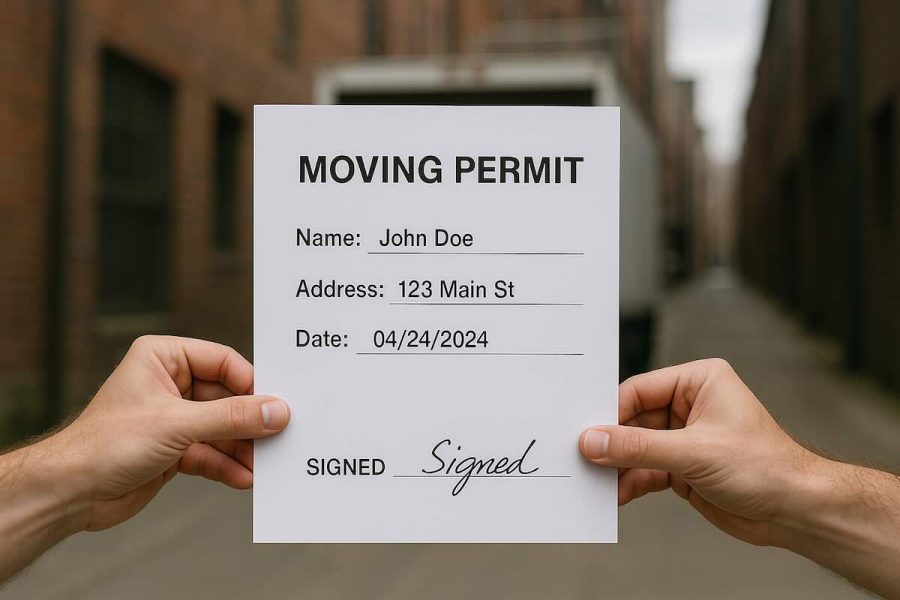
A moving permit commonly refers to permission to reserve curb space for a truck. Some cities require a public-space permit for a moving truck using the street; others offer a voluntary parking reservation or expect trucks to follow ordinary commercial loading rules. Before applying, find out whether the carrier can use a private driveway, designated loading area or legal curb space at the address.
The distinction matters for a long-distance move. A carrier may arrive with a vehicle too large to fit the available curb space, and the nearest legal stopping point might be around the corner. That distance can add carrying work, especially if the building also has stairs or a fixed elevator window. Send the street’s posted restrictions and photographs of the proposed loading area to the person arranging the move.
How City Rules Differ
| City | What the official guidance says |
|---|---|
| Boston, MA | A moving-truck parking permit is optional. The city offers reservations for legal curb spaces; online applications must be made at least 15 days ahead. |
| Washington, DC | A public-space permit is required for the use of public space, and DDOT has a reserved-parking permit process for moving trucks. |
| New York City, NY | NYC DOT does not offer a general permit to reserve curb space for ordinary commercial pickup and delivery. Trucks must follow the city’s commercial parking and loading rules. |
| Seattle, WA | Ordinary moving trucks do not require a blanket street-use permit. A restricted parking arrangement can call for a Temporary No Parking Zone and the appropriate truck parking permit. |
For current rules, see the City of Boston’s moving-truck permit instructions, DDOT’s public-space permit portal, NYC DOT truck guidance and Seattle’s Temporary No Parking rules. Check the actual block and date rather than assuming that one city’s practice applies nationwide.
New York City’s rules also distinguish ordinary moving-truck parking from permits for oversized vehicles. A special vehicle permit, where one is required, concerns the vehicle and route. The carrier operating the truck needs to address those restrictions; a household moving its furniture does not automatically need to apply for that permit.
Do You Need a Permit for a PODS or Moving Container?
A portable moving container may sit outside your home for several days, which can change the type of permission required. In Seattle, a storage container placed in the public right-of-way requires a Street Use permit. The city has separate requirements for reserving curb space for that container. Its container-permit guidance explains the placement rules and application process.
A container placed entirely on private property can raise a different question. The city may have fewer street-use concerns, while a landlord or HOA may prohibit containers in driveways or shared parking areas, limit how long they can remain or require prior approval. Confirm the exact location before scheduling delivery of a container; the company bringing it may ask you to secure the site permissions.
Do You Need HOA Approval Before Moving?
If your home belongs to a homeowners association or sits inside a gated community, request the current moving rules from the association or its management company. Some communities require residents to register a moving date, identify the carrier, obtain a gate pass or submit proof of insurance. Others allow moves during specified hours without a separate written application.
Check the route the truck must use. A security gate can be tall enough for a passenger car but too low for a moving truck; a private road may have weight or length restrictions that affect delivery. If a large truck cannot reach the house, the assigned carrier may need a smaller shuttle vehicle or a longer carry. These details belong in the moving plan before the carrier arrives.
Ask whether the association requires a deposit, limits moves on weekends or needs the driver’s details in advance. A gate approval is specific to that community. It does not authorize a truck to park illegally on a public street outside the entrance.
Do Apartments and Condos Require Moving Permits?
Managed apartments and condominiums may require a move-in or move-out form, a scheduled arrival window or approval from the property manager. You may hear that paperwork called a moving permit, although it is issued by the building rather than a government agency. Your lease, resident handbook or management office should establish the actual requirement.
Ask for written instructions from both the building you are leaving and the one receiving your belongings. A confirmation from the new building does nothing for the old building’s freight elevator, and a landlord’s approval may still leave the carrier without access to the loading dock.
Elevator and Loading-Dock Reservations
A high-rise may allow moves only during reserved freight-elevator hours. Management may hold the elevator for one apartment at a time and ask crews to use a service entrance instead of the main lobby. Check the reservation’s start and end times, whether setup and cleanup are included, and where the truck may wait while the elevator is in use.
A loading-dock booking does not reserve a city parking space. If the truck must stand on the street because the dock cannot take its size, the carrier still has to follow local curb rules. The truck’s height and length are worth checking before the reservation is confirmed.
Does an Apartment Stairwell Need a Permit?
There is no general U.S. government permit for carrying furniture up an apartment stairwell. A building may nevertheless restrict which staircase the crew can use, require padding on corners or floors, and prohibit blocking fire exits or shared hallways. Some managers want an inspection or refundable damage deposit before allowing large furniture through common areas.
Measure narrow landings and turns if you are moving a sofa, sectional or large dresser. Send photos that show the stairs, entrance, railings and any tight corners. If the furniture cannot be carried safely through the approved route, the carrier will need to discuss another way to handle it.
Is a Certificate of Insurance Required for Moving?
Some apartment buildings, condominium associations and gated communities require a Certificate of Insurance before admitting the crew. The certificate normally comes from the assigned moving carrier’s insurance provider and shows the coverage the property manager wants to verify. Management may have its own certificate-holder wording, coverage limits or submission deadline.
Ask the building for its written COI instructions and pass them along before the moving date. If the assigned carrier is not yet known, find out how close to the move management will accept the completed paperwork. A resident cannot usually substitute a personal insurance policy for a carrier’s certificate when the building specifically requires the latter.
Keep the COI separate from the valuation coverage for your belongings. The Federal Motor Carrier Safety Administration explains that interstate carriers must offer Full Value Protection and Released Value as two levels of liability for household goods. The building’s COI request addresses its insurance requirements; it does not select your shipment’s valuation coverage. For the paperwork itself, see our guide to moving Certificates of Insurance.
Who Gets the Moving Permits and Approvals?
There is no single person responsible for every document. A city may accept a curb-reservation application from the resident or another eligible applicant. A building generally expects its resident to arrange elevator time and obtain permission to move, while the carrier supplies insurance information and details about the vehicle it will operate.
On an interstate move arranged through us, we coordinate transportation with an authorized motor carrier and communicate the access information you provide. The assigned carrier performs the move and must confirm that its truck and crew can comply with the restrictions. Ask us what documentation the carrier can provide and which city or building applications you must submit yourself. Do not assume that booking transportation automatically reserves parking or approves a building move.
For a move across state lines, collect the requirements at the pickup and delivery addresses separately. A condo in Boston and a home in Washington, DC can have unrelated permit authorities, different application deadlines and different rules for where a truck can stop.
How Early Should You Apply for a Moving Permit?
Start checking as soon as you know the addresses and likely move dates. City processing and sign-posting requirements vary. Boston accepts a standard online reservation when the move is at least 15 days away, while Seattle’s temporary no-parking system has its own permit and advance-notice requirements. A building may require management approval before it will even let you book an elevator.
Once you have the actual city or building instructions, work backward from the move date. Allow for city processing, delivery or printing of official signs, management review of insurance paperwork and the time needed to tell the assigned carrier where it may unload. Moving dates that cover several days of interstate pickup or delivery should be discussed with the property manager before reserving a narrow access window.
If you are arranging a short-notice move, contact the relevant city or building office directly to find out what it can still approve. A late application does not make a loading restriction disappear.
What to Have Ready Before Calling for a Moving Quote
Tell us about access restrictions while the estimate is being prepared. A truck that has to park farther away, use a smaller shuttle or wait for an elevator may require services that were not included in an estimate based on ordinary door-to-truck access. FMCSA specifically identifies stairs, elevators and required parking permits among the circumstances that can affect interstate moving estimates.
- Both addresses: Include apartment or unit numbers, floor levels, and the correct entrance for moving trucks.
- City parking details: Tell us whether the truck will use a driveway, loading dock or street. Include any confirmed permit, restricted hours or posted loading rules.
- Building and HOA rules: Have the management contact, move-in instructions, approved moving hours and any deadlines for submitting forms.
- Elevator and stair access: Confirm whether a freight elevator is available, the reservation window, the number of flights of stairs and any restrictions on common areas.
- COI requirements: Request the property’s exact insurance instructions and the email address where the carrier’s documentation must go.
- Photos to send us: Photograph the curb or loading dock, truck entrance, street signs, gate, stairwell, elevator and any tight turns. Include enough of the surroundings to show how a truck or large piece of furniture would pass through.
- Inventory: List large furniture, fragile pieces and unusually heavy items, and have photos of items that may need special handling.
- Written confirmations: Keep permit numbers, approval emails, reserved access times and the name of the person who approved the move.
You can begin discussing your move before every approval is issued. Let us know what is still pending, and send the building instructions and photographs as soon as they are available. If the property restricts trucks or requires special handling, those facts need to reach the assigned carrier before pickup or delivery.
Planning a Move With Restricted Access
For an interstate move, give us the pickup and delivery addresses, your inventory and any city or building restrictions you already know. We can discuss the carrier-arranged services required for those addresses and identify access questions that still need answers before the moving date. Request a moving estimate once you have the addresses and a working inventory.
Sources
- City of Boston: moving-truck parking reservations and application rules.
- District Department of Transportation: public-space permits and reserved parking for moving trucks.
- New York City DOT: commercial truck parking rules and permit limitations.
- Seattle Department of Transportation: temporary no-parking arrangements and street-use requirements for containers.
- Federal Motor Carrier Safety Administration: interstate moving estimates and access-related charges.