
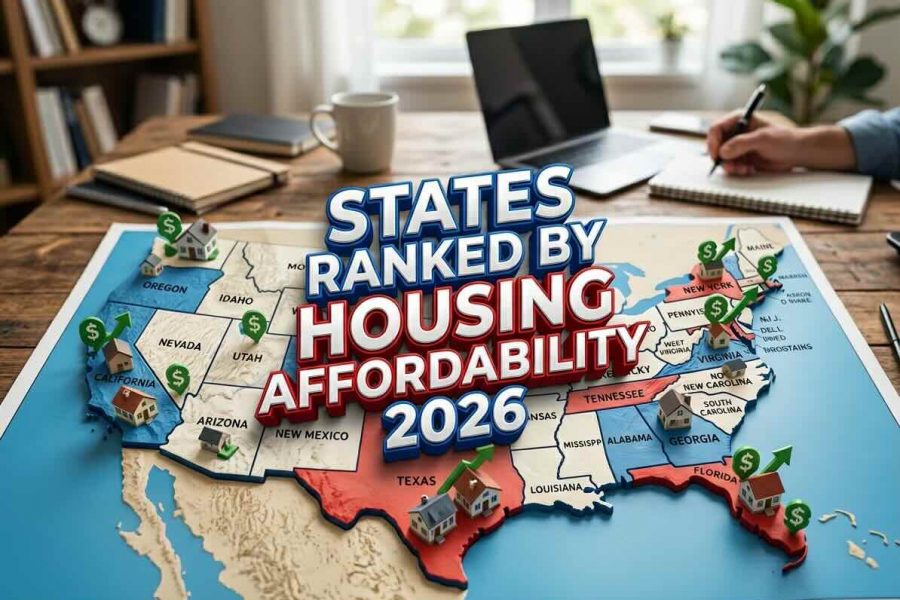
When states are ranked by housing affordability, the term ‘best‘ is ambiguous, as it can refer to different factors, such as lowest median price, lowest price-to-income ratio, or lowest overall cost of living. Some lists score only median home prices, while others blend purchase costs with property taxes, utilities, and renter expenses. Below you’ll find the states that lead housing affordability right now, how those results compare with price-to-income ratios and cost-of-living indices, and the common factors that affordable housing markets share.
Key Points (2026)
- Lowest home prices: West Virginia leads with the cheapest homes at a $146,578 median price, followed by Mississippi, Louisiana, Kentucky, and Arkansas, where all median prices stay under $212,000.
- Cost of living leaders: Oklahoma ranks number one for overall affordability with an 85.5 cost of living index, followed by Mississippi, Alabama, Missouri, and West Virginia.
- Best price-to-income ratios: West Virginia shows a 2.9 ratio, Iowa comes in at 3.0, and Kansas sits at 3.2, offering the most balanced housing costs relative to local incomes. On the opposite end, Hawaii at 8.8 and California at 8.2 represent the least affordable markets in the nation.
- Performance context: The most affordable states cluster in the South, Southwest, and Midwest where land remains abundant, property taxes stay lower, and population density runs lighter. However, job opportunities and amenities may differ significantly from high-cost coastal regions.
Most Affordable States for Housing (Median Home Prices)
States with the lowest median home prices offer significant savings for homebuyers, though housing costs represent just one piece of the total affordability picture. Here are the 10 states with the lowest average home prices in 2025 and what makes them stand out.
| Rank | State | Median Home Price | Why It Stands Out |
|---|---|---|---|
| 1 | West Virginia | $146,578 | The state’s rural character keeps property values low, while property taxes stay modest at 0.59 percent and a low state income tax helps residents keep more of their earnings. The price-to-income ratio of 2.9 means homeownership remains accessible to most middle-income families. |
| 2 | Mississippi | $179,182 | Housing costs run remarkably low with the lowest housing index at 66 and a 3.3 price-to-income ratio, making it affordable across virtually all metrics families care about. |
| 3 | Louisiana | $196,112 | Property taxes stay low at just 0.62 percent, and the 3.4 price-to-income ratio follows the broader Southern affordability pattern where housing remains within reach. |
| 4 | Arkansas | $207,284 | The combination of low taxes and rising industry presence creates opportunity alongside affordability. With a 3.5 price-to-income ratio and 90.5 cost of living index, Arkansas balances housing costs with growing economic prospects. |
| 5 | Oklahoma | $204,861 | Oklahoma claims the lowest cost of living index nationwide at 85.5, with median homes around $260,700, cheap utilities, and a 3.3 price-to-income ratio that makes the math work for buyers. |
| 6 | Kentucky | $211,465 | The state offers balanced affordability with property taxes at 0.89 percent and a 3.5 price-to-income ratio that keeps homeownership accessible to working families. |
| 7 | Iowa | $216,891 | Iowa shows one of the best price-to-income ratios in the nation at 3.0, supported by a stable agriculture economy and an 89.6 cost of living index that keeps overall expenses manageable. |
| 8 | Alabama | $225,539 | Growing aerospace and automotive industries bring jobs without the housing price surges typical of coastal metros. The 87.6 cost of living index and 3.6 price-to-income ratio create favorable conditions for buyers. |
| 9 | Kansas | $227,854 | Kansas delivers an excellent 3.2 price-to-income ratio with median homes at $242,044. The state has no income tax, and the 89.7 cost of living index means your dollar stretches further on everyday expenses. |
| 10 | Ohio | $228,988 | Ohio’s diverse metro areas from Columbus to Cincinnati offer a strong 3.4 price-to-income ratio, though property taxes run higher at 1.57 percent compared to some neighboring states. |
Sources: Raleigh Realty Average House Prices By State 2025; Construction Coverage price-to-income ratio analysis; Freedom for All Americans Cost of Living Index 2025.
Least Affordable States for Housing
At the opposite end of the spectrum, several states present significant housing affordability challenges where median home prices far exceed what local incomes can reasonably support. Understanding these markets helps buyers set realistic expectations about what homeownership will actually cost.
| State | Median Home Price | Price-to-Income Ratio | Affordability Challenge |
|---|---|---|---|
| Hawaii | $973,555 | 8.8 | Hawaii faces the highest price-to-income ratio nationwide, where limited land availability and strong demand create exceptional home prices that stretch far beyond what typical incomes can comfortably afford. |
| California | $809,227 | 8.2 | California shows the second-worst affordability in the nation, with five of the six most expensive large cities located within its borders. Los Angeles pushes the ratio even higher at 12.2, making homeownership exceptionally challenging. |
| Massachusetts | $685,886 | 6.3 | Despite offering excellent quality of life, healthcare, and education, Massachusetts faces high housing costs driven largely by the Boston metro area where demand consistently outpaces supply. |
| Washington | $595,732 | 6.3 | Seattle and the broader tech economy drive strong demand, but housing supply remains constrained by geography and development limits, creating a challenging market even for well-paid professionals. |
| Montana | Data varies | 6.4 | Montana experienced a rapid 56 percent price increase since 2020, creating an affordability crisis driven by recent migration patterns and limited inventory that can’t keep pace with demand. |
| Idaho | Data varies | 6.1 | Home prices jumped over 56 percent in just five years as migration from California and other expensive markets strained affordability for longtime residents whose wages haven’t kept pace. |
| Colorado | Data varies | 5.9 | The Denver metro area drives high costs statewide as the outdoor lifestyle and strong economy attract buyers faster than housing supply can expand to meet demand. |
Sources: World Population Review Median Home Price by State 2025; Construction Coverage price-to-income ratio data 2025.
Beyond Home Prices: Total Cost of Living, Cheapest States to Live in
Home prices tell only part of the affordability story that families experience when they actually live somewhere. Property taxes, utilities, groceries, healthcare costs, and local wages all combine to determine whether housing remains manageable over the long term. The cost of living index captures this broader picture, with 100 representing the national average and anything below that number indicating savings relative to typical American expenses.
| Rank | State | Cost of Living Index | Key Factors |
|---|---|---|---|
| 1 | Oklahoma | 85.5 | Oklahoma offers low housing costs with median prices around $260,700, combined with particularly cheap utilities and balanced affordability across multiple expense categories. |
| 2 | Mississippi | 87.3 | The state shows the lowest housing index at 66 with median homes around $262,000, creating affordability that extends across virtually every metric families track. |
| 3 | Alabama | 87.6 | Affordable homes combine with growing aerospace and automotive industries to create economic opportunity alongside low living costs. WalletHub ranks Alabama first overall for affordability. |
| 4 | Missouri | 88.0 | Missouri delivers inexpensive groceries and housing while offering good access to mid-sized cities like St. Louis and Kansas City that provide employment and cultural amenities. |
| 5 | West Virginia | 88.6 | Low housing and utility bills create significant savings, though higher healthcare costs in some areas offset part of the financial advantage. |
| 6 | Iowa | 89.6 | A stable agriculture economy supports affordable homes and an excellent 3.0 price-to-income ratio that makes homeownership accessible to working families. |
| 7 | Kansas | 89.7 | The absence of state income tax helps residents keep more earnings, while low housing at a $242,044 median and a 3.2 price-to-income ratio keep the total cost picture favorable. |
| 8 | Michigan | 89.8 | Reasonable housing costs prevail across much of the state, though some areas face higher utility costs. A diverse economy from manufacturing to healthcare provides employment options. |
| 9 | Tennessee | 90.0 | Tennessee levies no state income tax, and living costs stay cheaper outside the Nashville and Memphis metros where prices have risen more sharply in recent years. |
| 10 | Arkansas | 90.5 | Low taxes and home prices combine with rising industry presence that improves the job market, creating a balanced environment for families seeking affordability with opportunity. |
Source: MERIC Cost of Living Index via Freedom for All Americans 2025 rankings.
Price-to-Income Ratios: The True Affordability Test
The price-to-income ratio measures how many years of household income it would take to purchase a median-priced home, offering perhaps the clearest picture of whether housing remains truly accessible to the people who actually live and work in a given area. The national ratio currently stands at 4.6, meaning the typical home costs 4.6 times the median household income across the United States.
States with ratios below 3.5 offer exceptional affordability where homeownership remains genuinely accessible even for middle-income families without significant wealth or high-paying jobs. West Virginia leads the nation at 2.9, followed closely by Iowa at 3.0 and Kansas at 3.2. These states manage to combine low home prices with reasonable local wages, making homeownership achievable for a broad range of residents rather than just the most affluent.
long distance moves
as low as $1748
Long-distance moving all across the United States. Experienced and insured, residential and commercial.
4.9/5 AVERAGE RATING
Conversely, states with ratios above 6.0 present severe affordability challenges where typical families face nearly impossible math when trying to purchase homes. Hawaii tops the list at 8.8 and California follows at 8.2, meaning homes in these states cost over eight times what the median household earns annually. Montana and Idaho, both showing ratios above 6.0, experienced rapid price growth exceeding 56 percent since 2020 as migration from expensive coastal markets drove demand far faster than housing supply could respond. Massachusetts and Washington both sit at 6.3, where even strong job markets and relatively high wages still cannot keep pace with escalating housing costs.
At the city level, affordability challenges intensify even further beyond state averages. Los Angeles shows a staggering 12.2 ratio, San Jose reaches 11.0, and Long Beach hits 10.4, making homeownership nearly unattainable for anyone without substantial wealth or dual high incomes. Five of the six most unaffordable large cities in America sit within California’s borders. New York City and Miami follow with ratios of 10.0 and 8.5 respectively, creating similar barriers to homeownership.
Property Taxes: The Hidden Affordability Factor
Property taxes vary dramatically from state to state and significantly impact the total cost of homeownership over time in ways that median home prices alone don’t reveal. A lower purchase price combined with high property taxes can actually negate the affordability advantages you thought you were getting, while low property tax states help your housing budget stretch considerably further over the years you own the home.
| Category | States | Property Tax Rate | Impact on Affordability |
|---|---|---|---|
| Lowest Property Taxes | Hawaii | 0.29% | Hawaii shows the lowest property tax rate in the nation, but the highest home prices create an interesting paradox. The low tax helps somewhat but cannot offset the extraordinarily high purchase costs. |
| Alabama | 0.41% | Alabama combines low home prices with low property taxes to create excellent total affordability where both the purchase and ongoing costs remain manageable. | |
| Colorado | 0.52% | Colorado keeps property taxes low even though home prices run high. The tax relief helps reduce ongoing costs but overall affordability remains challenging due to purchase prices. | |
| West Virginia | 0.59% | Low property taxes amplify the state’s already low home prices, creating a strong affordability combination where both upfront and ongoing housing costs stay modest. | |
| Highest Property Taxes | New Jersey | 2.46% | New Jersey carries the highest property tax rate nationwide, which combines with already high home prices to create severe ongoing costs that add up significantly over time. |
| Illinois | 2.29% | High property taxes offset what would otherwise be moderate home prices in many areas, reducing long-term affordability even when purchase prices seem reasonable. | |
| Connecticut | 2.16% | Connecticut residents face high property taxes on top of high home prices, creating a double burden where both purchase and ownership costs strain budgets. | |
| New Hampshire | 2.09% | The state levies high property taxes but no state income tax, creating a different tax structure where residents face a trade-off between property and income taxation. | |
| Texas | 1.90% | Texas has no state income tax but compensates with high property taxes, so ongoing housing costs add up considerably despite moderate home prices in many areas including Dallas and Phoenix. |
Source: Maptive Property Taxes by State 2025; data reflects 2024 rates.
Property taxes rose nationally by 4.1 percent for single-family homes in 2023, with Northeast states showing the highest rates while Midwest and Southern states generally remain more moderate. States like New Jersey, with a 2.46 percent rate, can add over $10,000 annually to your housing costs on a median-priced home, which compounds to hundreds of thousands of dollars over a typical 30-year ownership period. Conversely, Alabama at just 0.41 percent adds under $1,000 annually, preserving the affordability advantage and keeping homeownership sustainable long term.
What Affordable Housing States Share
Across different affordability metrics, common patterns emerge among the states that consistently rank as most affordable. These states typically feature abundant land combined with lower population density, which keeps housing supply ahead of demand and prevents the bidding wars that drive up prices in constrained markets. Property taxes remain moderate to low in most affordable states, reducing the ongoing costs of homeownership that can strain budgets year after year. Many of these states feature no state income tax, including Tennessee, Texas (though it counters with higher property taxes), and Florida, allowing residents to keep more of their income available for housing expenses and other needs.
Geographic location matters significantly in these patterns, with Southern, Southwest, and Midwest states dominating the affordability rankings year after year. These regions historically show more land availability and lower construction costs than coastal markets where geography constrains development and demand consistently outpaces what builders can deliver. Economic diversification also plays an important role, with states like Alabama seeing aerospace and automotive industry growth that creates good jobs without triggering the explosive housing price surges typical of tech hubs like San Francisco or Seattle.
However, lower housing costs often come with trade-offs that families need to consider carefully before relocating. Job markets in affordable states may offer fewer opportunities in high-paying sectors like technology, finance, and specialized professional services, which is actually why the price-to-income ratios remain favorable. Cultural amenities, dining options, and entertainment venues may be less extensive than in expensive metropolitan areas, which matters more to some families than others depending on lifestyle priorities. Healthcare access can vary significantly, particularly in rural areas that may have fewer specialists and major medical facilities. Public transportation remains limited or nonexistent in most affordable states, making car ownership essentially mandatory. School quality varies widely even within affordable states, requiring careful research at the district level rather than relying on state averages.
States Where Affordability Changed Rapidly
Some states experienced dramatic affordability shifts in recent years, driven largely by migration patterns and remote work adoption. Understanding these rapid changes helps buyers anticipate where affordability challenges might emerge unexpectedly.
- Montana and Idaho: Rapid Affordability LossMontana and Idaho exemplify the pattern of rapid affordability loss. Both states saw median home prices surge over 56 percent between 2020 and 2025. Montana’s price-to-income ratio jumped to 6.4, while Idaho reached 6.1, transforming both states into severely stretched markets. Local wages did not keep pace, effectively pricing out many longtime residents.
- Florida: A Mixed PatternFlorida shows a more mixed pattern. Miami became exceptionally expensive, yet the state overall maintains middle-tier affordability depending on the area. Areas outside major metros remain more accessible, though rising insurance costs driven by hurricane exposure and increasing property taxes increasingly impact the total housing expense picture.
- North Dakota: Opposite TrendNorth Dakota presents the opposite trend from states like Montana and Idaho. Housing costs remain quite low, with CNBC noting that three out of five homeowners and renters pay less than 30 percent of their income for housing, a benchmark that indicates sustainable costs. The state offers exceptional childcare access and low crime rates.
Methodology & Definitions for Housing Affordability
Different affordability measures answer fundamentally different questions about housing costs. When comparing states, understanding these distinctions helps you focus on the metrics that matter most for your specific situation:
- Median home price:The middle point of all home sale prices in a state. Useful for purchase planning but doesn’t tell you whether locals can actually afford these prices.
- Price-to-income ratio:Calculated by dividing median home price by median household income. Ratios below 3.5 indicate strong affordability, while ratios above 6.0 signal severe challenges.
- Cost of living index:A composite measure capturing housing, utilities, groceries, healthcare, and transportation costs. 100 represents the national average.
- Property tax rate:Annual tax expressed as a percentage of home value, representing an ongoing cost that significantly impacts long-term affordability.
- Housing cost burden:The percentage of gross income spent on housing. Spending over 30 percent signals housing stress.
A 90-Second Comparison Recipe (State & Community)
- Start by picking 3 states using median home price rankings to understand purchase costs, then cross-reference those with price-to-income ratios to make sure local wages can actually support the housing costs you’ll face.
- Calculate your total monthly costs for each state using online mortgage calculators that include property taxes, insurance premiums, HOA fees if applicable, and utility estimates based on local climate and rates.
- Within each state, research 2 to 3 specific communities where you might actually want to live, since affordability can vary dramatically between expensive metros and more affordable rural areas even within the same state.
- Check the job market strength in your particular field using local employment data and salary surveys, because housing affordability means nothing if you can’t find work or have to accept a significant pay cut.
- Assess the trade-offs carefully by researching school quality in specific districts, healthcare facility locations and specialties, typical commute times, and the cultural amenities or outdoor recreation that matter to your family’s lifestyle.
Regional Snapshots (Why Some Regions Stay Affordable)
Housing affordability clusters geographically in clear patterns, with distinct regional characteristics that help explain why some areas remain accessible while others have become prohibitively expensive. Here’s how affordability typically looks across different regions of the country:
South
Southern states dominate affordability rankings thanks to abundant land, relatively low property taxes, and lighter regulatory burdens that keep construction costs down. States like Alabama, Mississippi, Arkansas, and Louisiana offer median home prices under $230,000, making homeownership accessible to working families. Many Southern states feature no state income tax, including Tennessee and Texas, though Texas counters that advantage with higher property taxes that add to ongoing costs. Growing industries in aerospace, automotive, and logistics bring employment opportunities without triggering the explosive housing price surges typical of coastal tech hubs.
Midwest
The Midwest combines housing affordability with generally stronger infrastructure and education systems compared to some Southern states, creating a different value proposition for families. Iowa shows an exceptional 3.0 price-to-income ratio, Kansas comes in at 3.2, and Ohio delivers 3.4, offering genuine value where housing costs remain proportional to local earnings. Stable agriculture economies, diverse manufacturing bases, and growing technology sectors in cities like Columbus provide employment across different skill levels and industries. Harsh winters and population loss in some areas keep housing demand moderate, which preserves affordability but can also mean fewer economic opportunities compared to booming Sun Belt markets.
Mountain West
The Mountain West was formerly affordable but has changed rapidly in ways that caught many by surprise. Montana and Idaho both experienced over 56 percent price growth since 2020, pushing ratios above 6.0 and transforming them from destinations people moved to for affordability into expensive markets themselves. Migration from California and Washington drove demand far faster than supply could respond, with remote workers bringing coastal salaries into markets built around much lower local wages. Colorado faces similar pressure with Denver metro costs running high despite lower property taxes that offer some relief. Wyoming and New Mexico maintain somewhat better affordability but offer fewer job opportunities, particularly in high-paying professional sectors.
Coastal Regions
Coastal regions remain consistently unaffordable due to limited land availability, strong job markets that attract workers, and persistent high demand that supply simply cannot match. California shows an 8.2 ratio and Hawaii reaches 8.8, making homeownership nearly impossible for anyone without substantial wealth or very high dual incomes. Massachusetts at 6.3 and Washington at 6.3 demonstrate similar patterns where even high wages in technology, finance, and professional services cannot keep pace with escalating housing costs. Property taxes add significant burden in the Northeast, with New Jersey at 2.46 percent, Connecticut at 2.16 percent, and New Hampshire at 2.09 percent, turning ongoing ownership costs into a substantial expense that compounds over the years.
Affordability Trade-Offs: What Lower Costs Mean
Moving to an affordable housing market delivers real financial benefits that can transform your budget and quality of life, but it’s important to understand the trade-offs that come with lower costs and how they might impact your daily experience and long-term prospects.
Job market and wages represent perhaps the most significant consideration. Many affordable states offer fewer opportunities in high-paying sectors like technology, finance, and specialized professional services that drive salaries in expensive markets. Median household incomes typically run considerably lower in affordable states, which is actually why price-to-income ratios remain favorable in the first place. Remote work has partially addressed this challenge by allowing some workers to earn coastal salaries while living in affordable markets, though an increasing number of employers have started adjusting compensation based on employee location.
Healthcare access varies significantly, particularly in rural areas of affordable states. You may find fewer medical specialists, longer travel times to major hospitals with advanced capabilities, and limited mental health services compared to what’s available in expensive metropolitan areas. West Virginia ranks 42nd in WalletHub’s overall state rankings partly due to healthcare challenges that persist despite the state leading national affordability metrics.
long distance moves
as low as $1748
Long-distance moving all across the United States. Experienced and insured, residential and commercial.
4.9/5 AVERAGE RATING
Public services often reflect the lower tax revenue that affordable states collect, which can impact road maintenance quality, public transportation options (which are often extremely limited or nonexistent), park systems, libraries, and other government-provided services. Most affordable states require car ownership because public transit infrastructure doesn’t exist outside of a few downtown cores in larger cities.
Data Glossary
- Median home price: the middle point of all home sales where half sell for more and half sell for less. This measure is more stable than average price, which can be skewed significantly by a small number of luxury sales at the high end.
- Price-to-income ratio: calculated by dividing median home price by median household income, this shows housing affordability relative to what local residents actually earn. The national average currently sits at 4.6, meaning homes cost 4.6 times typical household income.
- Cost of living index: a composite measure where 100 equals the national average. A score of 85 means living costs run 15 percent below the national norm, while 115 indicates costs that are 15 percent above average.
- Property tax rate: the annual tax expressed as a percentage of a home’s assessed value, representing an ongoing cost that compounds over the many years you’ll own the property and can total hundreds of thousands of dollars.
- Housing cost burden: the percentage of gross household income spent on housing costs. Spending over 30 percent indicates cost burden that strains budgets, while over 50 percent signals severe burden that leaves little for other necessities.
- Affordability index: measures whether a median-income household can reasonably afford to purchase a median-priced home. Scores below 100 indicate that housing has become unaffordable for typical local residents.
Planning Checklist for Housing Affordability Research
State Level
- Compare median home prices, price-to-income ratios, and cost of living indices for 3 to 5 candidate states that match your budget and lifestyle priorities.
- Look up property tax rates for each state and calculate what you’d pay annually on a home at your target price point to understand ongoing costs.
- Research job market strength in your specific field using state employment data, salary surveys, and job posting volumes on major sites.
Community Level
- Narrow your search to 2 or 3 specific cities or counties within your top states, recognizing that metro versus rural location makes an enormous difference in both costs and lifestyle.
- Check local median home prices and rent levels for specific neighborhoods you’re actually considering, since these can vary dramatically from state averages.
- Research school ratings using sites like GreatSchools, locate nearby healthcare facilities and specialists, and map commute times to likely employment centers during actual rush hours.
Financial Calculation
- Use detailed mortgage calculators that include local property tax rates, homeowners insurance estimates for that specific area, and HOA fees if you’re considering communities that charge them.
- Calculate your total monthly housing cost including principal, interest, taxes, insurance, and utilities, then divide by your expected monthly gross income and aim to stay under 30 percent.
- Factor in utility costs carefully, which can vary by hundreds of dollars monthly depending on climate and home energy efficiency between heating-heavy northern states and cooling-intensive southern markets.
Why Affordability Rankings Differ
Different affordability measures produce notably different state rankings because they capture distinct aspects of what housing actually costs and who can afford it. Looking at median home price alone naturally favors West Virginia, Mississippi, and Louisiana where purchase prices remain lowest. But when you shift to price-to-income ratio, the list changes to highlight Iowa, Kansas, and West Virginia because this metric accounts for local earning power rather than just sticker prices. When you examine cost of living index instead, Oklahoma rises to the top by including utilities, groceries, and other living expenses that extend beyond housing alone.
WalletHub’s overall affordability ranking, which places Alabama first and California last, blends housing costs with broader living expenses, tax burden, and economic opportunity factors. This more comprehensive view helps explain why Alabama ranks first for overall affordability despite West Virginia showing lower median home prices. Alabama manages to combine low housing costs with a growing economy driven by aerospace and automotive industries, plus lower expenses across multiple categories that families actually experience.
U.S. News affordability rankings show Arkansas first, Mississippi second, and West Virginia third, using a methodology that weights housing costs most heavily while still incorporating healthcare expenses and other living costs into the final calculation. The variance you see between these rankings highlights how important it is to choose the affordability metric that best matches your own priorities and financial situation.
For buyers focused purely on minimizing purchase price, median home price rankings matter most and will guide you toward states with the lowest entry costs. For those concerned about long-term sustainability and whether you can realistically afford homes based on local job prospects, property tax rates and price-to-income ratios prove more relevant to your decision. Families evaluating a complete relocation who need to understand total living expenses should prioritize the cost of living index that captures how far your money will actually stretch across housing, food, healthcare, and other necessities.
Planning a Move to an Affordable State?
If relocating to a more affordable housing market is on the table for your family, it makes sense to pair your affordability research with a practical relocation plan that addresses the logistics of actually making the move happen. Our long-distance moving guide walks through how delivery windows and valuation coverage work on interstate routes, and our packing services overview explains how partial packing options can keep your week on track while you transition to your new, more affordable home.
How to Use Affordability Rankings Without Missing Hidden Costs
The smartest approach is to use statewide affordability rankings as an initial filter to narrow your options, then drill down into specific communities where you would actually consider living. A state’s median price matters far less than what homes cost in the particular neighborhoods that offer good schools, reasonable commutes, and the safety and amenities your family needs. Property taxes deserve careful attention at the county level rather than just state averages, since rates can vary dramatically within states depending on local school funding needs and municipal services. Research homeowners insurance costs specific to your target area, which can shock buyers in states prone to hurricanes, tornadoes, wildfires, or other natural disasters that drive premiums far higher than you might expect. Factor in climate-related utility costs carefully, recognizing that heating expenses in cold northern states and air conditioning costs in hot southern markets can add several hundred dollars to your monthly budget. Finally, calculate the true affordability picture by considering your likely income in the new location rather than assuming you’ll maintain your current salary, since wage levels often correlate directly with housing costs in ways that affect the actual math families face.
If you are interested we also prepared articles for States Ranked by Healthcare in 2025, States Ranked by Quality of Life in 2025, States Ranked By Highest Number of People Leaving 2025, States Ranked by Safety 2025, and States Ranked by Education in 2025
FAQ
Which state has the most affordable housing in 2025?
West Virginia leads the nation with the lowest median home price at $146,578 and the best price-to-income ratio at 2.9, making homeownership genuinely accessible to middle-income families. Oklahoma ranks first when you look at overall cost of living index at 85.5, capturing expenses beyond just housing.
What is a good price-to-income ratio for housing affordability?
Ratios below 3.5 indicate strong affordability where homeownership remains accessible to typical middle-income families without requiring exceptional wealth or dual high incomes. The national average currently sits at 4.6, while ratios above 6.0 signal severe affordability challenges where only high earners can reasonably manage the costs.
Which states have the worst housing affordability?
Hawaii ranks as the least affordable state with an 8.8 price-to-income ratio and $973,555 median home price that puts homeownership out of reach for most residents. California follows closely at an 8.2 ratio and $809,227 median price. Montana, Massachusetts, and Washington all show ratios exceeding 6.0, indicating severe affordability strain.
Do property taxes significantly impact housing affordability?
Property taxes make a huge difference over time. New Jersey’s 2.46 percent property tax rate adds over $10,000 annually to a median-priced home, while Alabama’s 0.41 percent rate adds under $1,000 for the same value. Over a typical 30-year ownership period, that difference compounds to well over $300,000 in additional costs.
Which affordable states offer the best job markets?
Alabama combines housing affordability with growing aerospace and automotive industries that provide good employment opportunities. Iowa and Kansas balance low housing costs with stable agriculture economies and expanding manufacturing sectors. Ohio offers affordability alongside diverse metropolitan areas like Columbus that are seeing technology sector growth. Tennessee provides no state income tax along with strong logistics and healthcare employment sectors.
Are rapidly growing states like Idaho and Montana still affordable?
Not anymore. Both states experienced median home price surges exceeding 56 percent between 2020 and 2025, pushing their price-to-income ratios above 6.0. Migration from expensive coastal markets drove prices up far faster than local wages increased, transforming both states from affordable destinations into severely stretched housing markets that price out many longtime residents and middle-income workers.
long distance moves
as low as $1748
Long-distance moving all across the United States. Experienced and insured, residential and commercial.
4.9/5 AVERAGE RATING
References
- Raleigh Realty Average House Prices By State in 2025.
- Construction Coverage Cities With the Highest Home Price-to-Income Ratios 2025.
- World Population Review Housing Costs by State 2025.
- World Population Review Median Home Price by State 2025.
- Maptive Property Taxes by State in 2025.
- Freedom for All Americans Top 10 US States Ranked by Cost of Living in 2025.
- CNBC These are America’s cheapest states to live in for 2025.