Key Population Facts (2025 – 2026)
- Total U.S. population: approximately 341,784,857 (U.S. Census Bureau estimate, July 1, 2025)
- Most populous state: California at 39,355,309 (2025 estimate); projected 39,896,400 in 2026
- Least populous state: Wyoming at 584,057 California has 67 times more residents
- States with over 10 million residents: 10 states: California, Texas, Florida, New York, Pennsylvania, Illinois, Ohio, Georgia, North Carolina, and Michigan
- States with under 1 million residents: 7 states: Montana, Rhode Island, Delaware, South Dakota, North Dakota, Alaska, Vermont, and Wyoming
- Fastest-growing states by trend: Texas and Florida are adding residents at the fastest absolute pace; Texas is projected to surpass 32.4 million in 2026 and is on a long-term trajectory to challenge California’s top ranking within the next two to three decades
- Population loss states: New York, Illinois, and West Virginia have experienced consistent net population decline driven by out-migration outpacing births and immigration
All 50 States Ranked by Population (2025)
The table below ranks all 50 states and the District of Columbia by their 2025 U.S. Census Bureau population estimates. Where 2026 projection data is available for the largest states, it is included alongside the 2025 figure to show the current growth trajectory. States are ranked from most to least populous.
U.S. State Population Rankings: 2025 Data, 2026 Estimates, and Density
| Rank | State | Population (2025) | 2026 Estimate | Land Area (Sq Mi) | Density (Per Sq Mi) |
|---|---|---|---|---|---|
| 1 | California | 39,355,309 | ~39,896,400 | 155,779 | 252.6 |
| 2 | Texas | 30,503,301 | ~32,416,700 | 261,232 | 116.8 |
| 3 | Florida | 22,610,726 | ~24,306,900 | 53,625 | 421.6 |
| 4 | New York | 19,571,216 | ~20,127,000 | 47,126 | 415.3 |
| 5 | Pennsylvania | 12,961,683 | ~13,200,800 | 44,743 | 289.7 |
| 6 | Illinois | 12,549,689 | ~12,846,000 | 55,519 | 226.0 |
| 7 | Ohio | 11,785,935 | ~12,001,800 | 40,861 | 288.4 |
| 8 | Georgia | 11,029,227 | Pending | 57,513 | 191.8 |
| 9 | North Carolina | 10,835,491 | Pending | 48,618 | 222.9 |
| 10 | Michigan | 10,037,261 | Pending | 56,539 | 177.5 |
| 11 | New Jersey | 9,290,841 | Pending | 7,354 | 1,263.4 |
| 12 | Virginia | 8,715,698 | Pending | 39,490 | 220.7 |
| 13 | Washington | 7,812,880 | Pending | 66,456 | 117.6 |
| 14 | Arizona | 7,431,344 | Pending | 113,594 | 65.4 |
| 15 | Tennessee | 7,126,489 | Pending | 41,235 | 172.8 |
| 16 | Massachusetts | 7,001,399 | Pending | 7,800 | 897.6 |
| 17 | Indiana | 6,862,199 | Pending | 35,826 | 191.5 |
| 18 | Missouri | 6,196,156 | Pending | 68,742 | 90.1 |
| 19 | Maryland | 6,180,253 | Pending | 9,707 | 636.7 |
| 20 | Wisconsin | 5,910,955 | Pending | 54,158 | 109.1 |
| None | District of Columbia | 678,972 | Pending | 61 | 11,130.7 |
| 50 | Wyoming | 584,057 | Pending | 97,093 | 6.0 |
Sources: U.S. Census Bureau 2025; World Population Review February 2026. Note: Land area measured in square miles. Density calculated as persons per square mile.
The Top 10 Most Populous States
The ten most populous states together account for approximately 190 million people, or roughly 55 percent of the entire U.S. population. They dominate American politics, economics, and culture in ways disproportionate even to their large share of the population, because wealth, GDP, corporate headquarters, and cultural output are even more concentrated in these states than raw population numbers suggest. Here is what makes each one distinct beyond the headline figure.
Population is just one piece of the puzzle. To see how these largest states by population impact your wallet, check out our guide to States Ranked by Cost of Living.
1. California – 39,355,309
California is the most populous state by a significant margin and has held the top position since surpassing New York in the 1960s. Its population spans an extraordinary geographic range from the Oregon border to Baja California and concentrates most heavily in the Los Angeles metro area (approximately 13 million), the San Francisco Bay Area (about 7.7 million), and the San Diego metro (about 3.3 million). California is the world’s fifth-largest economy by GDP, and its technology, entertainment, agriculture, and international trade sectors give it an economic footprint that exceeds most countries. Despite its dominance, California has experienced net domestic out-migration in recent years as high costs push residents to Texas, Arizona, Nevada, and the Carolinas, though international immigration and natural births have kept total population largely stable rather than declining.
2. Texas – 30,503,301
Texas is the second most populous state and the fastest-growing large state in the country, adding residents at a pace that has narrowed the gap with California from roughly 14 million people in 2010 to under 9 million in 2025. The Dallas-Fort Worth metroplex at approximately 8 million, Houston at approximately 7.5 million, San Antonio at about 2.7 million, and Austin at approximately 2.3 million anchor an economy of enormous breadth and resilience. No state income tax, abundant land, a pro-business regulatory environment, and corporate relocations from California and other high-cost states have sustained Texas population growth at rates that most demographers project will eventually bring it to parity with California within the next 20 to 30 years if current trajectories hold.
3. Florida – 22,610,726
Florida passed New York in 2014 to become the third most populous state and has continued widening that gap in the decade since. Its growth is driven by the most consistent retiree in-migration of any state, sustained domestic migration from the Northeast and Midwest by working-age households seeking warmer climate and lower taxes, and significant international immigration concentrated in the Miami metro area. Florida’s 2026 projection of approximately 24.3 million represents one of the fastest absolute growth rates of any large state and reflects the continued appeal of its no-income-tax structure and year-round outdoor lifestyle despite rising housing and insurance costs.
4. New York – 19,571,216
New York reached its population peak around 2020 and has experienced measurable net out-migration since, driven by high taxes, housing costs, and the pandemic-era shift toward remote work that reduced the premium of proximity to New York City. New York City’s five boroughs still account for approximately 8 million of the state’s total, making it by far the most densely populated concentration in the country. The state retains strong immigration inflows that partially offset domestic out-migration, and its finance, media, healthcare, and education sectors keep it the dominant economic hub of the Northeast. Without continued international immigration, New York would be declining faster than current estimates reflect.
5. Pennsylvania – 12,961,683
Pennsylvania’s population has been largely stable for decades, growing slowly through immigration to the Philadelphia metro while rural and former industrial communities in the central and western parts of the state have seen long-term population decline. The Philadelphia metro and Pittsburgh metro together account for roughly half the state’s population. Pennsylvania’s large population in a geographically competitive Electoral College position gives it a political significance well beyond what its population growth trajectory might suggest in purely demographic terms.
6. Illinois – 12,549,689
Illinois is notable among large states for having experienced consistent net out-migration for over a decade, driven by one of the highest combined state and local tax burdens in the country, fiscal stress in state government, Chicago’s public safety challenges in certain neighborhoods, and the broader migration trend from Rust Belt states toward Sun Belt destinations. Chicago still accounts for roughly 2.7 million of the state’s total and remains one of America’s most significant cities for finance, logistics, and healthcare, but population in Chicago and its surrounding metro has declined from its late-1990s peak, with suburban DuPage and Will counties absorbing some of the urban-to-suburban shift.
7. Ohio – 11,785,935
Ohio crossed 11 million residents and has maintained moderate population stability despite the broader Rust Belt population loss narrative. Columbus has grown into one of the most dynamic mid-sized metros in the Midwest, driven by Ohio State University, a growing technology and financial services sector, and housing costs dramatically below coastal alternatives that have attracted remote workers and young professionals. Cleveland and Cincinnati are stable to modestly declining, while the southeastern and northeastern industrial corridor continues to see population loss from manufacturing sector contraction that has characterized the region for 40 years.
8. Georgia – 11,029,227
Georgia has been one of the South’s most consistent population growth stories, driven almost entirely by the Atlanta metro, which accounts for approximately 6.3 million of the state’s 11 million people. Corporate relocations, a growing technology and film production economy, and internal migration from the Northeast and Midwest have fueled continuous growth that shows no sign of slowing in 2026. Georgia recently crossed 11 million residents for the first time, a milestone that reflects a generational transformation from a state that was comparable in population to Ohio or Pennsylvania in 1960 to one that now trails the Rust Belt giants by shrinking margins each decade.
9. North Carolina – 10,835,491
North Carolina’s population growth has been driven by the Research Triangle region around Raleigh, Durham, and Chapel Hill, which has emerged as one of the country’s most watched technology and life sciences clusters, and by Charlotte’s continued expansion as a banking, logistics, and corporate headquarters city. The state has grown by nearly 2 million people since 2000 and now approaches 11 million, overtaking states like Michigan that were substantially larger a generation ago. North Carolina’s combination of a diversified economy, affordable housing relative to coastal alternatives, and geographic variety from the Appalachians to the Atlantic Coast continues to drive above-average population inflows.
10. Michigan – 10,037,261
Michigan barely maintains its position in the top 10, having been overtaken by Georgia and closely followed by North Carolina in recent census cycles. The state’s population peaked in the late 1990s and declined through the 2000s as automotive industry contraction drove significant out-migration from Detroit and the broader southeastern Michigan corridor. The Detroit metro has stabilized somewhat as the auto industry adapted and diversified into electric vehicle components and technology, but Michigan’s total population has grown by only a few hundred thousand people over the entire 25 years since 2000 while states like Georgia and North Carolina added millions over the same period.
Finding a home in the largest states by population can be a challenge. See where your real estate budget goes furthest in our report on States Ranked by Housing Affordability 2025.
2025-2026 U.S. Population by Region: State Lists and Growth Trends
| Region | States Included | Approx. Total Population | Population Trend |
|---|---|---|---|
| South | TX, FL, GA, NC, VA, TN, MD, SC, AL, LA, KY, OK, AR, MS, WV, DE | 128,450,000 | Fastest growing; gains from Northeast, Midwest, and West Coast migration |
| West | CA, WA, AZ, CO, OR, UT, NV, NM, ID, MT, HI, AK, WY | 82,100,000 | Mixed; CA flat; AZ, UT, ID, NV growing fast; WA growing steadily |
| Midwest | IL, OH, MI, IN, MO, WI, MN, IA, KS, NE, ND, SD | 69,200,000 | Largely stable to slow decline; Columbus and Minneapolis bucking regional trend |
| Northeast | NY, PA, NJ, MA, CT, NH, ME, RI, VT | 57,350,000 | Declining through domestic out-migration; sustained by international immigration |
Source: U.S. Census Bureau population estimates July 1, 2025; World Population Review U.S. States 2026.
Population Milestone Breakdowns
Looking at population thresholds gives a clearer picture of how lopsided the U.S. population distribution is across states of vastly different sizes, economies, and political weights.
U.S. Population Milestones: State Count by Population Bracket
| Population Bracket | Number of States | % of Total States | States |
|---|---|---|---|
| Over 20 million | 3 | 6% | California, Texas, Florida |
| 10 million to 20 million | 7 | 14% | New York, Pennsylvania, Illinois, Ohio, Georgia, North Carolina, Michigan |
| 5 million to 10 million | 13 | 26% | New Jersey, Virginia, Washington, Arizona, Tennessee, Massachusetts, Indiana, Missouri, Maryland, Wisconsin, Colorado, Minnesota, South Carolina |
| 1 million to 5 million | 20 | 40% | Alabama, Louisiana, Kentucky, Oregon, Oklahoma, Connecticut, Utah, Iowa, Nevada, Arkansas, Kansas, Mississippi, New Mexico, Nebraska, Idaho, West Virginia, Hawaii, New Hampshire, Maine, Montana (and Rhode Island, Delaware crossing just over 1M) |
| Under 1 million | 7 | 14% | South Dakota, North Dakota, Alaska, Vermont, Wyoming (plus DC at 678,972) |
Source: U.S. Census Bureau population estimates July 1, 2025. Data reflects historical trends and official 2026 projections.
Fastest-Growing and Shrinking States
Raw population size tells only part of the story. The growth trajectory of each state reveals the direction of migration, economic confidence, and demographic momentum that will reshape the ranked list over the coming decades. Texas and Florida are the two states adding the most residents in absolute numbers each year, powered by domestic migration from high-cost states and sustained international immigration to their major metros. Texas is projected to add roughly 1.9 million residents between the 2025 estimate and the 2026 World Population Review projection, a pace that if sustained would see it approach California’s population within approximately 20 years.
The other end of the growth spectrum is equally important for understanding where population is leaving. New York, Illinois, and California have all experienced sustained net domestic out-migration, meaning more Americans are choosing to leave these states for other states than are choosing to move into them from other states. The total population of these states has remained stable or grown modestly only because international immigration and natural births more than offset domestic losses. West Virginia is the clearest case of genuine population decline across all demographic categories, having shed population in nearly every census estimate since 2010 as coal industry contraction and limited economic diversification have reduced both employment and birth rates in the state.
2026 U.S. State Population Growth Trends: Winners, Losers, and Migration Drivers
| State | Trend | Net Growth/Loss (Est) | Primary Driver |
|---|---|---|---|
| Texas | Fastest growing (absolute) | +475,000 | Domestic migration from CA, IL, NY; corporate relocations; no income tax |
| Florida | 2nd fastest growing (absolute) | +365,000 | Retirees; Northeast/Midwest migration; no income tax; warm climate |
| Georgia | Fastest growing mid-size state | +115,000 | Atlanta corporate growth; tech and film industry; cost relative to Northeast |
| North Carolina | Fast-growing; near 11M milestone | +140,000 | Research Triangle; Charlotte growth; climate and affordability vs. Northeast |
| Idaho / Utah / Arizona | Fastest % growth among smaller states | +1.5% to +2.1% | California spillover; affordability; outdoor lifestyle; remote worker migration |
| West Virginia | Fastest shrinking state | (0.5%) | Coal industry contraction; limited economic diversification; aging population |
| Illinois | Consistent net out-migration | (85,000) | High taxes; fiscal instability; Chicago population loss; Sun Belt competition |
| New York | Net domestic out-migration | (102,000) | Housing costs; tax burden; post-pandemic remote work flexibility enabling exits |
| Louisiana / Mississippi | Slow or flat growth | Static | Economic stagnation; hurricane vulnerability; limited economic diversification |
Sources: World Population Review U.S. States 2026; U.S. Census Bureau estimates July 2025. Parentheses indicate negative growth.
Top 5 Reasons for Migration to the Sun Belt: 2026 Analysis
- ✓Tax Advantages and Fiscal Policy: Many Sun Belt states, most notably Texas and Florida, do not levy a state income tax. This provides a significant “automatic raise” for households relocating from high-tax states like New York, California, or Illinois.
- ✓Lower Cost of Housing: While prices have risen nationwide, the Sun Belt generally offers more “house for the dollar.” In many Southern and Western interior markets, buyers can find newer builds and larger lots at lower price points.
- ✓Corporate Relocations and Job Growth: Major tech, finance, and manufacturing hubs have shifted to cities like Austin, Charlotte, Phoenix, and Atlanta. As corporations move headquarters to business-friendly environments, the workforce follows.
- ✓Climate and Lifestyle Preferences: The shift toward year-round outdoor living continues to be a major draw for both retirees and young professionals. The warm climate of the South and proximity to national parks are significant pull factors.
- ✓Remote Work Flexibility: The permanence of hybrid and remote work models has decoupled income from geography. Workers previously tethered to expensive coastal offices are choosing states with higher quality of life.
Why Population Rankings Matter
U.S. state population figures are not merely trivia: they directly determine political power, federal resource allocation, and economic opportunity in ways that shape everyday American life. The U.S. House of Representatives apportions its 435 seats based on each state’s population as measured by the decennial census, meaning that population growth in Texas and Florida translated directly into additional Congressional seats after the 2020 census while New York, Illinois, California, and Pennsylvania lost seats. Electoral College votes follow the same formula, making states gaining population more influential in presidential elections over time and states losing population less so.
If you are moving with your household, largest states by population density often changes the local school and safety landscape. See which states are top-tier in our list of the Best States to Raise a Family.
Federal funding allocation across hundreds of programs, from Medicaid and highway construction to education and housing assistance, also incorporates population figures as a primary distribution variable. A state that grows faster than national projections expected gains federal dollars that more slowly growing states lose. For businesses, state population rankings signal market size, labor force depth, and the density of consumer spending that determines where to open facilities, establish headquarters, and invest in infrastructure. The ongoing Sun Belt migration documented in current population data is already reshaping corporate America’s geographic footprint in ways that will continue compounding for decades.
2026 Comparison: Taxes, Home Prices, and Cost of Living in Top Migration States
| State | Income Tax Rate (2026) | Cost Of Living Index (US Avg = 100) | Avg Home Price (Est) |
|---|---|---|---|
| Texas | 0.00% | 92.1 | $294,800 |
| Florida | 0.00% | 101.4 | $405,000 |
| Tennessee | 0.00% | 90.3 | $310,500 |
| Georgia | 5.19% (Flat) | 92.2 | $245,900 |
| North Carolina | 4.25% (Flat) | 97.8 | $330,000 |
| Arizona | 2.50% (Flat) | 110.7 | $435,000 |
Sources: Tax Foundation 2026; Zillow Home Value Index; World Population Review Cost of Living 2026. Note: Home prices reflect estimated state-wide medians and can vary significantly by metro area.
Planning a Move to a High-Population State?
From the busy streets of Miami to the sprawling suburbs of Dallas, we specialize in the long-haul logistics required for moves to the country’s most populated regions. Let us handle the heavy lifting while you focus on your new start.
Call our team today: 888-316-8329
FAQ
What is the largest state by population in the United States?
California is the most populous U.S. state with approximately 39,355,309 residents as of July 1, 2025, projected to reach roughly 39,896,400 in 2026. California has held the top position since surpassing New York in the 1960 census and contains more people than the 21 least populous states combined. Its population is concentrated primarily in the Los Angeles metro area, the San Francisco Bay Area, and the San Diego metro.
What is the least populous state in the United States?
Wyoming is the least populous U.S. state with 584,057 residents as of July 2025, roughly 67 times fewer residents than California. Wyoming’s vast land area makes it the 10th largest state by geographic size, meaning it also has the lowest population density of any contiguous U.S. state. Vermont (647,464) and Alaska (733,406) are the next least populous states.
What are the top 5 most populous states?
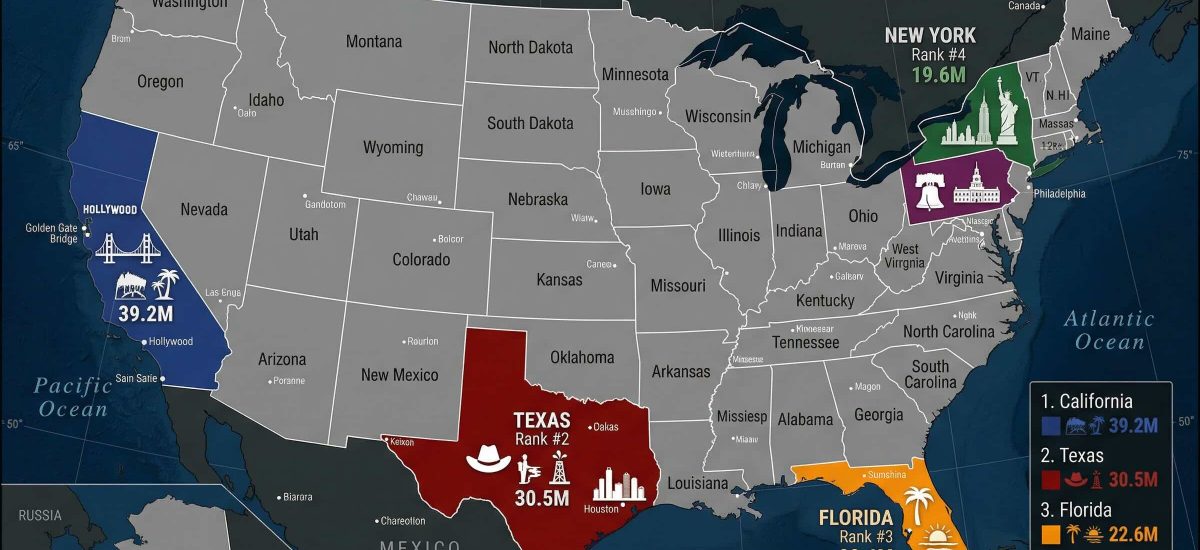
The five most populous U.S. states as of July 2025 are California (39,355,309), Texas (30,503,301), Florida (22,610,726), New York (19,571,216), and Pennsylvania (12,961,683). These five states alone account for approximately 124 million people, or roughly 36 percent of the entire U.S. population. Three of the five have experienced net domestic out-migration in recent years, sustained by international immigration and natural population growth.
Is Texas going to overtake California in population?
Texas has been closing the gap with California steadily for decades. In 2000, Texas had about 20.8 million people compared to California’s 33.9 million, a difference of 13.1 million. By 2025, Texas reached 30.5 million while California sits at 39.4 million, a gap of approximately 8.9 million. If current growth rate differentials hold, demographers project Texas could approach California’s population within 20 to 30 years, though the trajectory assumes sustained domestic migration, continued corporate relocations, and international immigration to Texas at current rates.
How many states have over 10 million people?
Ten states have populations above 10 million as of July 2025: California, Texas, Florida, New York, Pennsylvania, Illinois, Ohio, Georgia, North Carolina, and Michigan. Georgia and North Carolina are recent additions to this tier, having crossed the 10 million threshold in recent census cycles as their growth outpaced the plateau or decline of older industrial states like Michigan and Illinois that were far ahead of them in population just two decades ago.
Which region of the United States has the most people?
The South is the most populous U.S. region, with approximately 128 million residents across its 16 states plus Washington D.C. The South also has the fastest growing population of any region, driven by Texas and Florida’s massive absolute additions and by continued growth in Georgia, North Carolina, Tennessee, South Carolina, and Virginia. The Northeast is the least populous region despite containing some of the country’s most economically significant cities, and it is the only region currently experiencing sustained net domestic out-migration as a whole.
References
- Enchanted Learning / U.S. Census Bureau: State Populations as of July 1, 2025
- World Population Review: U.S. States – Ranking by Population 2026, updated February 24, 2026
- StatsAmerica / U.S. Census Bureau: Population Estimate Rank List 2025
- Wikipedia: List of U.S. States and Territories by Population
- Britannica: U.S. States Ranked by Population – Which Is Largest?