

Key Points: Washington State Living in 2026
- No personal state income tax. Washington is one of nine states with no personal income tax, delivering a meaningful take-home pay advantage for tech and professional workers. A capital gains tax applies to gains above $250,000 on certain asset sales, but earned wages are fully exempt.
- Statewide median home price is $646,100, with the Eastside tech corridor (Bellevue, Redmond, Kirkland) commanding $1.3M to $1.45M and Eastern Washington cities like Spokane and Walla Walla running $363,000 to $380,000. The 2026 market offers a buyer’s window with inventory up 9% and sellers negotiating on price and terms.
- Return-to-office mandates have reshuffled priorities. Amazon’s 5-day mandate and Microsoft’s 3-day-per-week requirement for employees within 50 miles have re-elevated commute proximity as a home value driver in 2026. Homes within 15 minutes of major tech campuses command 5 to 8 percent premiums over equivalent homes further out.
- The cost of living statewide runs 17% above the national average, driven almost entirely by housing at 31% above the national average. Utilities run 5% below the national average. Eastern Washington cities like Spokane and Yakima run 13 to 17% below the statewide average cost of living, making them among the most affordable major cities in the Pacific Northwest.
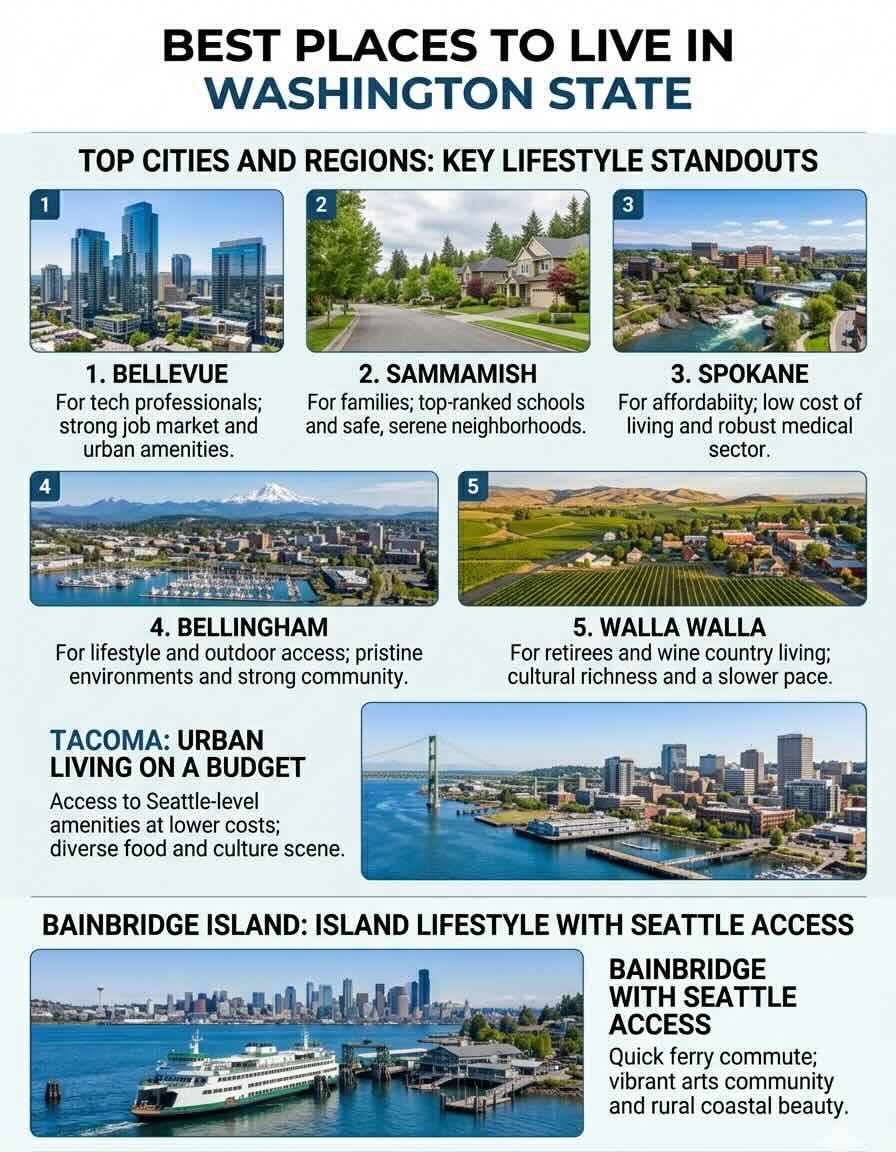
- Best city overall by category: Bellevue for tech professionals; Sammamish for families; Spokane for affordability; Bellingham for lifestyle and outdoor access; Walla Walla for retirees and wine country living; Tacoma for urban living on a budget; Bainbridge Island for island lifestyle with Seattle access.
Washington State at a Glance
Washington divides naturally into two very different regions separated by the Cascade Range. West of the Cascades, the Puget Sound region anchors the state’s dominant economic engine with Seattle, Bellevue, and the technology and aerospace corridor that has made the region one of the highest income per capita areas in the country. The climate is mild, rainy from October through April, and genuinely beautiful from May through September with warm dry summers, access to the mountains within an hour, and saltwater views from much of the region. Traffic is the primary quality-of-life friction point, and housing costs reflect years of strong demand and constrained land supply in a geography bounded by water on one side and mountains on the other.
East of the Cascades, Washington feels like a different state. Spokane is the second largest city and the anchor of the Inland Northwest, with a healthcare, education, and growing technology economy that runs at a fraction of Seattle’s cost. The Tri-Cities, Walla Walla, Yakima, and smaller agricultural communities provide affordable housing, wine country access, warm dry summers with over 300 days of sunshine per year, and a lifestyle pace that stands in sharp contrast to the competitive pressure of the Puget Sound region. The tradeoff is fewer employer options for professional career advancement and winters that are colder and snowier than Seattle’s consistently mild temperature.
Washington State Cost of Living & Economic Overview (2026)
| Key Category | Washington State Stats (2026) |
|---|---|
| State Income Tax | None (0%) on personal income. Note: 7% Capital Gains tax applies only to gains above $250k. |
| Median Home Price | ~$646,100 (Statewide Average as of Jan 2026) |
| Cost of Living (COL) | 117.0 (17% above national avg). Housing is 31% higher; Utilities are 5% lower. |
| Regional Contrast | Seattle Index: 152.8 (Global Top 15 Most Expensive) Spokane Index: 96.5 (Pacific NW Affordability Zone) |
| Average 2BR Rent | $1,800 – $2,200/month (Higher along I-5 / Sound transit corridors) |
| Economic Anchors | Technology (Amazon/Microsoft), Aerospace (Boeing), Healthcare, and Green Energy. |
| Western Climate | Mild/Rainy (Oct–Apr); Dry/Temperate (May–Sep). Rarely experiences extreme cold. |
| Eastern Climate | High Desert/Semi-arid; 300+ sunny days; True four seasons with snow in winter. |
Sources: Maggie Sun Real Estate 2026; RentCafe Washington Cost Data 2026; Numbeo Global Index 2026; Houzeo WA Affordability Study 2026.
Eastside Tech Corridor: Premium Cities for High Earners
The Eastside cities east of Lake Washington represent Washington’s most expensive and most in-demand residential real estate, driven by proximity to Microsoft, Amazon, Google, Meta, and the hundreds of companies clustered in the region’s technology belt. Return-to-office mandates from major employers in 2025 and 2026 have re-established commute distance as a primary home value driver, with properties within a 15-minute transit radius of major campuses commanding 5 to 8 percent premiums over comparable homes further out. These cities consistently dominate state rankings for school quality, safety, and investment performance, but they require incomes or equity levels that make them inaccessible for the majority of buyers without a significant California or New York home sale backstory or a senior technology industry compensation package.
Bellevue – Best Overall for Tech Professionals
Bellevue earns its position as Washington’s top-ranked city for high-income tech professionals in 2026 by combining the state’s best urban infrastructure, elite schools, and minimal commute times to the major Eastside employer campuses. The Bellevue School District remains a top-five national performer with schools like Newport and Interlake posting college-readiness scores near 100 percent. The East Link Light Rail expansion has meaningfully reduced transit times to Seattle and Redmond. Downtown Bellevue’s “Grand Connection” project is transforming the urban core into a pedestrian green corridor projected to further lift property values in the 98004 zip code. The median home price sits at $1,445,800, down a slight 1.1 percent year over year, and the market in West Bellevue’s premium zip codes still sees three to five offers on turnkey properties within a week while homes needing updates are sitting 40 percent longer than in the peak era. Over 40 percent of residents are foreign-born, creating a genuinely international cosmopolitan community unlike anything else in the state.
Redmond – Best for Microsoft Employees and STEM Families
Redmond’s identity is inseparable from Microsoft, whose campus expansion continues to be the single largest driver of residential demand in the city. The Lake Washington School District, which serves Redmond, is highly rated with particular strength in STEM programs through Tesla STEM High School. The median home price sits at $1,390,000, up 0.7 percent year over year, and new listings were down 12 percent year over year in late 2025 and early 2026, leading to a resurgence of escalation clauses in competitive segments despite higher interest rates. Microsoft’s February 2026 mandate requiring three days per week in office for employees within 50 miles has made the Redmond Technology Station the regional commute epicenter, reinforcing the city’s position as a high-demand residential market driven by inventory scarcity rather than speculative enthusiasm. Marymoor Park’s 640 acres and the city’s reputation as the Pacific Northwest’s bicycle capital reinforce its appeal to the outdoor-active tech professional demographic.
Kirkland – Best for Walkable Waterfront Living
Kirkland is the only Eastside city with a genuine waterfront downtown, combining Lake Washington access, boutique retail, and a walkable restaurant scene that gives it a character distinct from the more suburban feel of its Eastside neighbors. The median home price sits at $1,349,000, and 32 percent of Kirkland’s waterfront transactions in early 2026 were all-cash, reflecting the city’s position as a preferred wealth preservation asset among high-net-worth households rotating out of volatile tech equity positions. Google’s Kirkland campus makes the city an RTO powerhouse, and the Cross Kirkland Corridor’s 5.7-mile rail-trail provides a bicycle commute option that bypasses I-405 congestion entirely for workers heading to Eastside employers.
Premium Washington Communities: Price, Schools & Safety (2026)
| City | Median Home Price | School Quality | Safety Score | Best For |
|---|---|---|---|---|
| Bellevue | $1,445,800 | 10/10 | 9/10 | High-income tech (Amazon/Meta); Urban-suburban mix. |
| Mercer Island | $2,173,500 | 10/10 | 10/10 | Elite education; privacy; ultra-low crime rates. |
| Redmond | $1,390,000 | 9/10 | 9/10 | Microsoft hub; STEM-focused families; outdoor lifestyle. |
| Kirkland | $1,349,000 | 9/10 | 8/10 | Waterfront walkability; Google campus proximity; luxury buyers. |
| Woodinville | $1,193,000 | 9/10 | 9/10 | Acreage and privacy; wine country; executive estates. |
Source: Maggie Sun Real Estate Group: 10 Best Cities to Live in Washington State (Updated Jan 2026).
Best Suburbs for Families
Families represent the largest segment of Washington’s internal migration between cities, and the suburbs east and northeast of Seattle consistently dominate state and national family ranking metrics. The combination of top-tier public school districts, low crime, substantial lot sizes, and access to outdoor recreation within 30 minutes creates a category of community that California, Texas, or Florida equivalents struggle to match at the same price point relative to household income. The tradeoff in all of these communities is a commute to Seattle or the Eastside core that can run 30 to 50 minutes under normal conditions and substantially longer during peak hours or incidents on the limited highway corridors.
Sammamish – Safest City in Washington and Top National Family Destination
Sammamish ranks as the safest city in Washington State and among the top 25 in the country for quality of life in the 2025-2026 rankings, and it earns that position through the combination of essentially no violent crime, a school system served by both the Lake Washington and Issaquah districts (both gold-standard performers in state rankings), and a residential environment built around Pine Lake, Beaver Lake, and the forested trails that run through the city’s developed neighborhoods. The median home price sits at $1,300,000, and the city is experiencing a buyer’s shift from the 2021 bidding war environment: sellers are now accepting credits for mortgage rate buy-downs, and bidding wars are rare outside the most desirable streets. Niche rates it the second-best suburb for families in Washington, and Extra Space Storage’s 2026 analysis calls it an ideal Seattle suburb for families specifically for its safety ratings and school access.
Issaquah – Best for Families Who Prioritize Nature and School Quality
Issaquah sits at the base of the “Issaquah Alps,” the trio of Tiger, Cougar, and Squak Mountains that provide world-class hiking, trail running, and paragliding access within minutes of residential neighborhoods. The Issaquah School District is a consistent top performer and the primary driver of family demand in the city, and the “Central Issaquah Plan” is transforming the valley floor into a more walkable urban center that reduces the car dependency typical of Eastside suburbs. The median home price has risen dramatically to $942,500, up 25.7 percent year over year, reflecting the market’s recognition of Issaquah as no longer a hidden alternative to the core Eastside but a primary family destination in its own right. The East Link bus-rapid transit mitigates the I-90 commute sufficiently for hybrid three-day-per-week workers headed to Bellevue or Seattle.
Bothell – Best Entry Point for Families Moving to the Eastside
Bothell offers a 15 to 20 percent price discount compared to Kirkland or Bellevue for similar-sized homes, a median of $1,030,000, while sharing access to the acclaimed Northshore School District, which is particularly recognized for its specialized academies and innovative programming. The city’s biotech corridor expansion is bringing high-paying jobs directly to Bothell rather than requiring the 20 to 30 minute commute to Bellevue, which makes it attractive for households where one partner works locally and one commutes into the Eastside core. Downtown Bothell’s revitalization, anchored by McMenamins Anderson School and a cluster of new craft breweries and restaurants along the Sammamish River, has given the city a walkable evening scene it did not have five years ago. First-time buyer activity surged 20 percent in early 2026 as mortgage rates dipped from their late 2024 peak.
Best Places to Live in Washington State: 2026 Guide to Housing Costs and School Quality
| City / Area | Lifestyle Highlights | Median Home Price | Safety & Schools |
|---|---|---|---|
| Seattle (SLU, Queen Anne, Ballard) |
Global tech hub; premier arts, culture, and nightlife. | $850,000+ | ●●●●● Good |
| Bellevue & Redmond | Top-tier school districts; major HQ job growth (Microsoft). | $900K – $1M | ●●●●● Excellent |
| Sammamish | Elite family-friendly suburbs with private lake access. | $1.1M | ●●●●● Excellent |
| Spokane | Best value for families; massive outdoor recreation access. | $375,000 | ●●●●● Good |
| Bellingham | Waterfront university town; blend of nature and academics. | $620,000 | ●●●●● Good |
| Walla Walla | World-class wine country; historic downtown charm. | $400,000 | ●●●●● Very Good |
| Pullman & Liberty Lake | Safe tech/research corridors; high affordability. | $320K – $450K | ●●●●● Excellent |
| Mercer Island | Premium luxury community; top-ranked schools nationally. | $1.5M+ | ●●●●● Excellent |
Sources: Washington RE Analytics 2026; Niche Best Places to Live 2025-2026.
Seattle – Best for Urban Living and Career Mobility
Seattle remains the cultural, employment, and transit center of Washington State, and for households that want genuine urban density, walkable neighborhoods, professional sports, world-class dining, and career mobility across multiple industries, it is the only city in the state that delivers all of those things simultaneously. Amazon’s headquarters in South Lake Union, the return-to-office mandate that has revitalized that neighborhood’s foot traffic by 15 percent since implementation, and a technology sector that extends well beyond Amazon and Boeing into biotech, gaming, logistics technology, and professional services gives the city’s job market a depth that none of its suburban neighbors can match. The citywide median home price sits at $832,800, with a range that spans Downtown First Hill condos at more accessible price points to single-family homes in Ballard, Magnolia, and Capitol Hill commanding significant premiums. New 2025-2026 ADU zoning laws that allow backyard cottages on single-family lots have created forced appreciation opportunities for buyers who purchase properties and add rental units.
Seattle’s livability picture is nuanced by neighborhood in ways that most statewide comparison articles oversimplify. Ballard offers a Scandinavian-heritage neighborhood with a thriving food and bar scene, waterway access, and a population of young professionals and established families that gives it one of the best neighborhood quality scores in the city. Capitol Hill’s density and walkability score among the highest in the Pacific Northwest, with a cultural energy and independent retail base that has survived and partially recovered from the disruptions of 2020. Magnolia is quiet, residential, and family-oriented with Discovery Park and Puget Sound views. Downtown condos saw 5 to 8 percent price adjustments in 2026, creating high-yield rental investment opportunities for buyers who can withstand short-term volatility for long-term urban appreciation driven by the Waterfront Seattle park project nearing completion along Elliott Bay.
Affordable Western Washington: Tacoma, Renton, and Vancouver
Not every Western Washington city requires a technology salary to afford. Tacoma, Renton, and Vancouver offer access to the Puget Sound region’s job market and lifestyle at price points meaningfully below Seattle and the Eastside core, making them the primary landing zones for households priced out of the premium markets but unwilling to relocate to Eastern Washington and give up proximity to Seattle’s economic opportunity and Puget Sound’s physical environment.
Tacoma – Best Budget-Friendly Urban Option in Western Washington
Tacoma’s cost of living index sits at 118.5, elevated above the national average but meaningfully below Seattle’s 152.8, with average rent running approximately $1,650 per month compared to Seattle’s $2,200. The city has undergone sustained revitalization over the past decade, transforming old warehouses into loft apartments and craft restaurant spaces, developing a waterfront promenade at Point Ruston with Puget Sound views, and building out a cultural infrastructure that includes the Tacoma Art Museum, Museum of Glass, and Washington State History Museum. The city’s arts scene and lower housing costs attract the creative professional demographic that Seattle absorbed in the 2000s but has increasingly priced out since. The Sounder commuter rail connects Tacoma to Seattle in roughly an hour, making it a viable Seattle employment commute for households comfortable with a train-based commute lifestyle.
Renton – Best Value Play in King County
Renton’s median home price of $685,000 makes it the most affordable entry point into King County’s job core, and its strategic position at the intersection of I-5, I-405, and SR-167 gives workers efficient road access to Boeing’s main production facilities, Sea-Tac Airport’s employment hub, and the broader Eastside technology corridor. The city’s Southport on Lake Washington development is adding a major tech and office campus that is already being compared to Bellevue’s Spring District in terms of job creation potential for the south end. Gene Coulon Memorial Beach Park provides waterfront recreation that larger premium cities charge multiple hundreds of thousands of dollars more in home price to live near. Investor activity in the Renton Highlands reflects market confidence: properties purchased for $550,000 in 2024 are selling for $750,000 after renovation in early 2026 as the “Bellevue Spillover” effect compresses further into the surrounding communities.
Vancouver – Best for Oregon Access and Suburban Lifestyle
Vancouver, Washington sits on the north bank of the Columbia River directly across from Portland, Oregon, giving residents access to Portland’s cultural and dining infrastructure while living in a state with no personal income tax rather than Oregon’s income tax structure, which creates a genuine financial advantage for households that earn income in Washington but want the Portland metro lifestyle. Major employers including PeaceHealth and HP anchor the local economy, and the technology and healthcare sectors have grown substantially, reducing Vancouver’s historical dependence on Portland as the primary employment destination. The Fort Vancouver National Historic Site, waterfront development along the Columbia River, and easy access to hiking around Mount St. Helens and the Columbia River Gorge provide an outdoor recreation context that rivals anything available from within Portland proper.
Eastern Washington: Affordable Living, Sunshine, and Small City Quality
Eastern Washington is the part of the state that most out-of-state articles about Washington living underweight, and it deserves detailed attention for the combination of genuine affordability, a dry sunny climate that offers a completely different quality of life from the Puget Sound’s grey winters, and small-to-mid city communities that provide a strong sense of place and established local identity. The financial case for Eastern Washington is straightforward: Spokane runs 17 percent below the statewide cost of living average at a cost of living index of 96.5, below the national average. Walla Walla runs 11 percent below statewide average. The Tri-Cities run 13 percent below statewide average. All of these communities retain Washington’s no-income-tax benefit while delivering housing costs that are 50 to 75 percent below the Puget Sound markets.
Spokane – Best Overall for Affordable Large City Living
Spokane is Washington’s second-largest city and the anchor of the Inland Northwest, offering a fully developed large city infrastructure at a cost that undercuts the Puget Sound region dramatically. The median home price sits at $380,000, rent averages $1,393 per month, and the cost of living index runs 96.5, below the national average and 17 percent below Washington’s statewide average. Providence Health Care, MultiCare Health Systems, Gonzaga University, Eastern Washington University, and Washington State University’s Spokane campus provide the institutional employment base that stabilizes the local economy independent of technology sector cycles. Riverfront Park, the Centennial Trail that runs 40 miles along the Spokane River, and the annual Lilac Bloomsday Run and Hoopfest basketball tournament reflect a city that takes its outdoor identity and community culture seriously. Winters are colder and snowier than Seattle’s, with genuine cold weather from November through March that requires adjustment for people arriving from the Puget Sound side of the state, but summers in Spokane are warm, sunny, and genuinely excellent.
Walla Walla – Best for Retirees and Wine Country Living
Walla Walla is one of the most distinctive small cities in the entire Pacific Northwest, anchored by over 120 wineries and tasting rooms in a nationally recognized wine region, a beautifully preserved historic downtown with farm-to-table dining that has received national food media coverage, and Whitman College, which gives the city an intellectual depth and cultural activity density unusual for a community of 35,000 people. The median home price sits at $363,000, rent averages $1,495 per month, and the cost of living runs 11 percent below the statewide average. Retirement resources list Walla Walla consistently as one of the most appealing affordable retirement destinations in the Northwest, combining mild relative to Spokane winters, 300-plus days of sunshine, access to the Blue Mountains for hiking and outdoor activities, and a community pace that rewards engagement rather than demanding the intensity of a larger city.
Tri-Cities (Richland, Pasco, Kennewick) – Best for Families Wanting Eastern Washington Value
The Tri-Cities metro sits at the confluence of the Yakima, Snake, and Columbia Rivers in southeastern Washington, combining a cost of living 13 percent below the statewide average with growing wine industry employment, a technology sector expansion rooted in Richland’s Pacific Northwest National Laboratory, and a warm and sunny climate that averages over 300 days of sunshine annually. Pasco is among the most affordable of the three cities at a median of $423,000 with rent around $1,499 per month, and the Columbia Basin College and Washington State University Tri-Cities campus provide higher education anchors that feed local employer pipelines and stabilize residential demand. The waterfront lifestyle along the Columbia River, accessible boat launches, and easy access to eastern Oregon wine country give the Tri-Cities a recreational depth that smaller cities of equivalent cost rarely provide.
Affordable Eastern Washington at a Glance: 2026 Data
| City | Median Price | Avg Monthly Rent | Cost vs State Avg | Best For |
|---|---|---|---|---|
| Spokane | $380,000 | $1,393 | -17% Below Avg | Healthcare, education, and large city amenities. |
| Walla Walla | $363,000 | $1,495 | -11% Below Avg | Retirees; wine country and cultural dining. |
| Kennewick / Pasco | $423,000 | $1,499 | -13% Below Avg | Families; sunny climate; waterfront recreation. |
| Yakima | $360,500 | $1,104 | -13% Below Avg | Agriculture industry; budget homeownership. |
| Moses Lake | $352,500 | $1,600 | -14% Below Avg | Data center workers; outdoor lake lifestyle. |
| Cheney | $373,000 | $1,421 | -15% Below Avg | College town (EWU); budget-conscious buyers. |
Source: Houzeo: 10 Most Affordable Places in Washington (Feb 2026).
Best Lifestyle Cities: Bellingham, Olympia, and Bainbridge Island
Washington’s lifestyle cities are the communities that attract people who weight outdoor access, community character, and environmental quality as highly as career proximity or financial optimization. They are not the cheapest cities in the state and they are not the highest-earning markets, but they consistently rank at the top of quality-of-life surveys among people who have lived in both the Puget Sound premium markets and these smaller communities.
Bellingham – Best College Town and Outdoor Gateway
Bellingham sits in the northwest corner of Washington State between the Cascades and Bellingham Bay, 90 miles north of Seattle and 56 miles south of the Canadian border, in what amounts to one of the most scenic positions of any mid-sized city in the Pacific Northwest. Western Washington University (WWU) anchors the city’s intellectual and cultural energy with events, lectures, and a youthful population that keeps the food, music, and creative scene vibrant in ways that larger but less university-centered cities often lack. Whatcom Falls Park, Chuckanut Drive, the Bellingham Bay waterfront trail network, and the accessibility of the North Cascades for serious mountain recreation give the city an outdoor lifestyle depth that justifies the housing premium above Eastern Washington alternatives. Travel and Leisure included Bellingham in its February 2026 list of the best places to live in Washington, citing its natural beauty, community feel, and Pacific Northwest authenticity.
Olympia – Best for Government Workers and Nature Access
Olympia’s identity as Washington’s state capital makes it the primary destination for state government employees, public policy professionals, and people who want a mid-sized city with genuine outdoor access at the southern tip of Puget Sound without the full cost burden of Seattle. The State of Washington, Providence St. Peter Hospital, and local school districts anchor stable public sector employment, and Evergreen State College adds a progressive academic energy unusual for a capital city. The Olympia Farmers Market and Lakefair summer festival give the city a strong community event calendar. Proximity to the Capitol State Forest, Mount Rainier, and the Olympic Peninsula means that within 30 to 60 minutes of downtown Olympia, residents can reach some of the most dramatic wilderness in the contiguous United States.
Bainbridge Island – Best for Island Lifestyle with Seattle Access
Bainbridge Island provides one of the genuinely distinctive living arrangements in the Pacific Northwest: island community character, deep natural beauty, and a thriving local arts and dining scene, connected to downtown Seattle by a 35-minute ferry crossing that turns the commute into a daily buffer between professional life and residential tranquility. Niche rates it among the top 15 best suburbs for families in Washington, and Travel and Leisure highlighted it as one of the best places to live in Washington in its January 2026 expert roundup. The island’s natural setting, waterfront access, Luther Burbank-equivalent parks, and boutique local economy attract a community of remote workers, commuters in senior professional roles who value the decompression of the ferry commute, and families who have consciously chosen to exit the Eastside suburban competitive environment for a lifestyle that trades square footage premiums and bidding wars for genuine island quality of life.
Washington State Cities: The 2026 Rent & Living Comparison
| City | Median Home Price | Avg Rent | Best For | Key Drawback |
|---|---|---|---|---|
| Bellevue | $1,445,800 | ~$2,400 | High-earning tech professionals. | Extreme entry costs. |
| Mercer Island | $2,173,500 | ~$2,800+ | Wealth preservation & top schools. | Lowest inventory in state. |
| Redmond | $1,390,000 | ~$2,300 | Microsoft hub; STEM education. | Corporate single-economy. |
| Kirkland | $1,349,000 | ~$2,200 | Waterfront lifestyle; Google. | Heavy I-405 congestion. |
| Sammamish | $1,300,000 | ~$2,200 | Safest city; family focus. | Remote; poor transit access. |
| Woodinville | $1,193,000 | ~$2,000 | Privacy; Wine country lifestyle. | Commute distance to Seattle. |
| Bothell | $1,030,000 | ~$1,950 | Biotech corridor; Young families. | Variable I-405 traffic. |
| Issaquah | $942,500 | ~$1,900 | Outdoor access; Sub-$1M entry. | Dense morning I-90 traffic. |
| Bainbridge Island | ~$900,000 | ~$2,000 | Island arts & nature lovers. | Ferry dependency. |
| Seattle | $832,800 | ~$2,200 | Career mobility; arts/culture. | General cost of living. |
| Renton | $685,000 | ~$1,700 | Boeing hub; King Co. value play. | Schools are mid-tier. |
| Bellingham | ~$500,000 | ~$1,600 | WWU; proximity to Canada. | Limited local job market. |
| Vancouver | ~$450,000 | ~$1,700 | Portland access; No income tax. | Portland bridge traffic. |
| Tacoma | ~$420,000 | $1,650 | Affordable Sound lifestyle. | Commute distance to Seattle. |
| Spokane | $380,000 | $1,393 | Healthcare; high-affordability. | Harsh snowy winters. |
| Walla Walla | $363,000 | $1,495 | Retirees; Wine culture. | Isolated geography. |
Sources: Maggie Sun Real Estate 2026; iBuyer.com Best Places 2026; RentCafe WA 2026; Travel + Leisure Jan 2026.
FAQ
What is the best city to live in Washington State?
The best city in Washington State depends entirely on your priorities. Bellevue is the top overall city for high-income technology professionals seeking elite schools, safety, and investment stability. Sammamish is the best city for families prioritizing safety and school quality above all else, ranking as the safest city in Washington and among the top 25 in the country for quality of life in 2025-2026. Spokane is the best overall for affordability and large city quality of life at below-national-average cost. Walla Walla is the best for retirement and wine country lifestyle. Seattle is the best for urban living, career diversity, and cultural depth.
Is Washington State expensive to live in?
Washington’s statewide cost of living runs 17 percent above the national average, driven primarily by housing at 31 percent above the national average. The Puget Sound region, including Seattle and the Eastside tech corridor, is significantly more expensive than that average, with Seattle’s cost of living index sitting at 152.8, placing it among the twelve most expensive cities globally. Eastern Washington cities like Spokane (96.5 index), Yakima (13 percent below state average), and Walla Walla (11 percent below state average) run at or below the national average and represent some of the best large-city affordability in the Pacific Northwest. Washington has no personal state income tax, which meaningfully improves net take-home pay compared to California, Oregon, and other competing states.
Which Washington cities are best for families?
Sammamish, Issaquah, Bothell, and the suburbs of Bellevue and Redmond consistently dominate family rankings across school quality, safety, and community amenity metrics. Sammamish ranks #1 in Washington for safety and #2 best suburb for families per Niche. Issaquah earns top marks from families who prioritize outdoor access alongside school excellence. Bothell serves families who want top-tier schools and biotech corridor employment at the entry level of the Eastside premium market. In Eastern Washington, Spokane’s school system and community culture make it the top family destination for households choosing affordability over Puget Sound proximity.
Where in Washington can I live affordably?
Eastern Washington provides the most affordable living options in the state. Sunnyside is the single most affordable community in Washington with a median home price of $269,000 and rent under $1,100 per month, running 16 percent below the statewide cost average. Spokane at $380,000 median and $1,393 average rent is the most affordable large city at 17 percent below statewide average. In Western Washington, Renton at $685,000 is the most affordable King County entry point, Tacoma at approximately $420,000 with $1,650 rent is the most affordable major Puget Sound city, and Puyallup provides suburban Pierce County living at below-Seattle prices with Mount Rainier as a neighbor.
Does Washington State have income tax?
Washington State has no personal income tax, making it one of nine states in the country that does not tax earned wages at the state level. This represents a significant take-home pay advantage over neighboring Oregon, which has income tax rates up to 9.9 percent, and California, which taxes top earners at 13.3 percent. Washington does have a capital gains tax on gains above $250,000 from the sale of certain assets like stocks and bonds, though the sale of real property is specifically exempt. No personal income tax on wages combined with Washington’s strong technology sector salaries makes the state particularly attractive for high-income professionals comparing relocation options within the Pacific Northwest or against California alternatives.
What is the weather like in Washington State?
Washington’s climate divides sharply at the Cascade Range. Western Washington, including Seattle, Bellevue, Tacoma, Bellingham, and Olympia, experiences a marine climate with mild year-round temperatures, significant rainfall from October through April (Seattle averages about 38 inches of rain annually), and genuinely beautiful dry warm summers from May through September where temperatures typically stay between 65 and 85 degrees Fahrenheit. Snow in Seattle’s lowlands is rare and usually light. Eastern Washington experiences a high desert continental climate with warm to hot dry summers often exceeding 90 degrees Fahrenheit, more than 300 sunny days per year in much of the region, and cold winters with regular snowfall and temperatures that drop below freezing from November through February. Neither side of the Cascades matches the extreme summer heat of Texas or the extreme winter cold of the Midwest, and the climate is a primary driver of Washington’s continued population growth from states with less comfortable year-round outdoor living conditions.
Is 2026 a good time to buy a home in Washington State?
Most analysts and local real estate professionals characterize 2026 as a better buying environment than 2025, with inventory up nearly 9 percent year over year and mortgage rates stabilized in the low 6 percent range after their late 2023 and 2024 peaks. The competitive bidding war conditions of 2021 and 2022 have subsided in most markets, and sellers are accepting contingencies, price negotiations, and mortgage rate buy-down credits from buyers who were not available as options during the peak period. The Eastside tech corridor is seeing “price separation,” where turnkey homes in premium locations still attract multiple offers while homes needing updates are sitting significantly longer, creating opportunities for buyers willing to take on renovation projects. Renton, South Seattle, and outer suburban markets show the best current conditions for rental yield investors under Washington’s expanded 2026 ADU zoning laws.
References
- Maggie Sun Real Estate Group: 10 Best Cities to Live in Washington State 2026, updated January 28, 2026
- iBuyer.com: The 11 Best Places to Live in Washington State in 2026
- Houzeo: 10 Most Affordable Places to Live in Washington in 2026, updated February 20, 2026
- reAlpha: Cheapest Places to Live in Washington State 2026, updated February 12, 2026
- Travel and Leisure: 8 Best Places to Live in Washington According to Real Estate Experts, January 2026
- U.S. News Real Estate: 28 Best Places to Live in Washington 2025-2026
- Niche: Best Suburbs to Raise a Family in Washington 2025
- Extra Space Storage: 5 Best Suburbs of Seattle in 2026, updated January 5, 2026
- RentCafe: Cost of Living in Washington 2026
- Cost of Living USA: Best Places to Live in Washington — Full 2026 Rankings
- DFW Urban Realty reference for comparative metro benchmarking, 2026