
South Carolina has become the top destination state for relocation in 2026, and the reasons are consistent across every demographic making the move: a cost of living index of 95.5 against the national average of 100, housing that runs 18 to 21 percent below the national average, no state income tax on Social Security, year-round mild weather, and a geographic range that puts Atlantic beaches, Blue Ridge Mountain foothills, and a historically significant coastline all within the same state boundary.
The Palmetto State is not a single lifestyle proposition. It is ten different ones depending on where you land. Choosing the right city or town makes the difference between a move that works for your situation and one that requires a second move eighteen months later. This guide covers the best places to live in South Carolina in 2026 with current housing data, honest trade-offs, and the specific types of residents each location actually suits.
Key Points: Best Places to Live in South Carolina 2026
- South Carolina is the #1 relocation destination state in 2026, driven by housing affordability, job growth, mild climate, and favorable tax treatment for retirees and working professionals alike
- Tega Cay ranks #1 on Niche’s 2026 Best Places to Live in South Carolina list, earning an A+ overall grade for schools, safety, and family-friendliness; it consistently outperforms much larger cities in quality-of-life rankings
- Mount Pleasant holds the top spot on US News’s 2025–2026 rankings for the state, combining top-tier public schools with coastal access and strong household income metrics
- Columbia is the most affordable major city with a median home price around $245,000, a stable government and healthcare job market, and lake access to Murray that most residents underestimate until they live there
- Greenville has the strongest job market in the Upstate, anchored by BMW, Michelin, and GE with median home prices around $340,000; it ranked in Travel + Leisure’s top three best places to live in South Carolina in 2026
- South Carolina’s statewide cost of living sits at 95.5 on the MERIC index, meaning residents pay about 5 percent less than the national average overall and 18 to 21 percent less on housing specifically
- No state income tax on Social Security and relatively low property taxes make South Carolina one of the most tax-friendly destinations in the Southeast for retirees and those on fixed or investment income
- The state’s geographic range is genuinely unusual: you can be on the Atlantic coast in one hour and in the Blue Ridge Mountain foothills in two from most Upstate cities, giving residents access to both ecosystems without living in either extreme
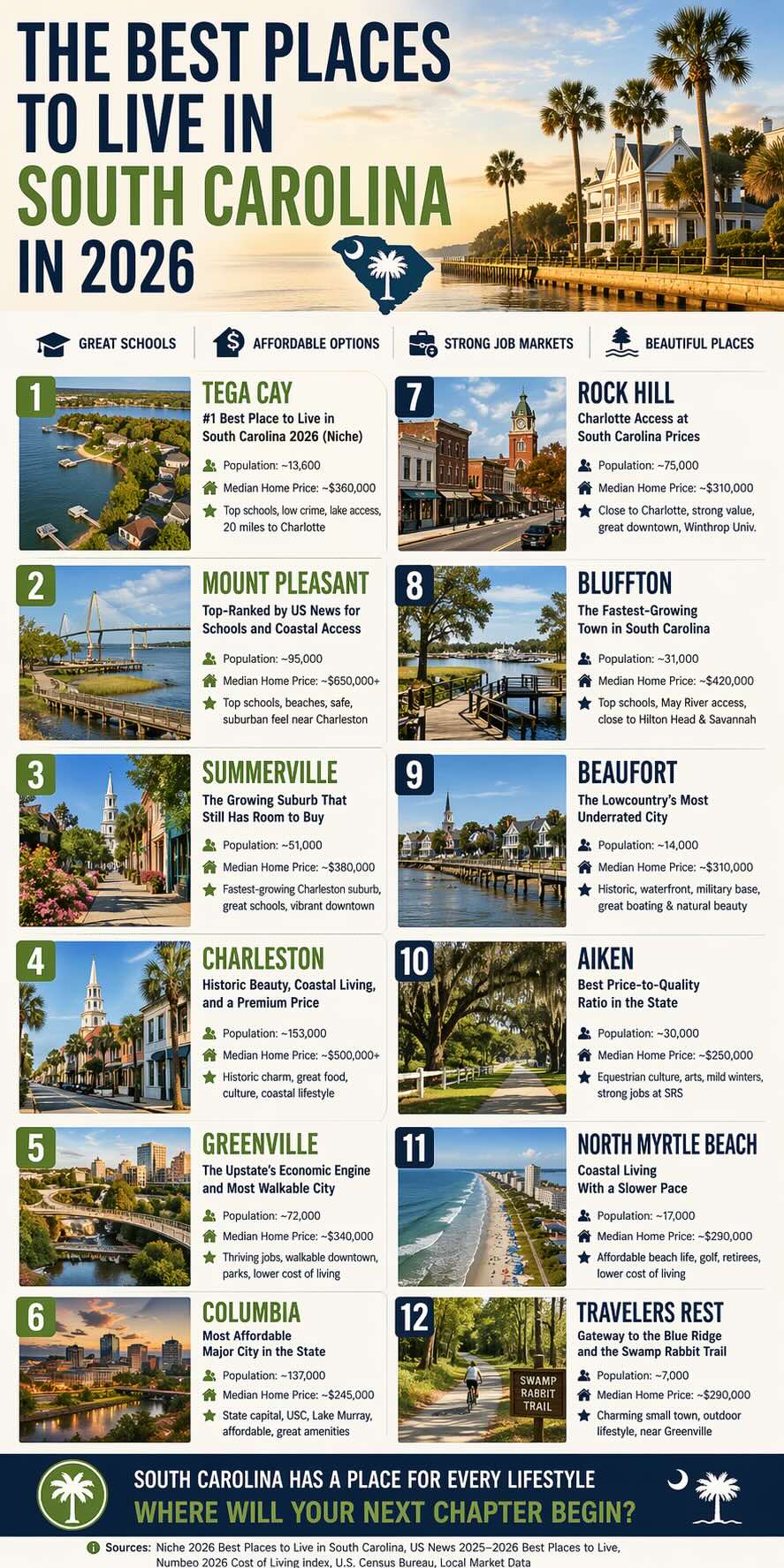
South Carolina’s Best Cities at a Glance
| City / Town | Median Home Price | Region | Best For | 2026 Ranking Highlight |
|---|---|---|---|---|
| Tega Cay | ~$360,000 | Charlotte Metro Border | Families, schools, lake access | #1 Niche 2026, A+ overall |
| Mount Pleasant | ~$650,000+ | Charleston Metro | Professionals, coastal families | #1 US News 2025–2026 |
| Greenville | ~$340,000 | Upstate SC | Professionals, creatives, families | #2 US News; T+L Top 3 |
| Summerville | ~$380,000 | Charleston Metro | Families, first-time buyers | Fastest-growing Charleston suburb |
| Charleston | $500,000+ | Lowcountry Coast | Culture, retirees, professionals | #4 US News; T+L Top 3 |
| Columbia | ~$245,000 | Central SC | Affordability, government, university | #1 T+L; #6 US News |
| Rock Hill | ~$310,000 | Charlotte Metro Border | Charlotte commuters, young families | #5 US News 2025–2026 |
| Bluffton | ~$420,000 | Lowcountry / Hilton Head | Retirees, families near Hilton Head | Fastest-growing town in SC |
| Beaufort | ~$310,000 | Lowcountry Coast | Retirees, artists, boaters | Historic district, coastal gem |
| Aiken | ~$250,000 | Western SC | Retirees, equestrians, affordability | Lowest price-to-quality ratio in state |
| North Myrtle Beach | ~$290,000 | Grand Strand Coast | Retirees, seasonal, second homes | Avg rent ~$1,075/mo; 9 mi shoreline |
| Travelers Rest | ~$280,000 | Upstate SC | Outdoor lifestyle, active adults | Swamp Rabbit Trail gateway; Blue Ridge access |
Sources: Niche 2026; US News 2025–2026; Travel + Leisure 2026; Zillow; ConsumerAffairs 2026.
1. Tega Cay: #1 Best Place to Live in South Carolina 2026
Tega Cay sits on a peninsula surrounded by Lake Wylie just south of the North Carolina border, and it holds the number one spot on Niche’s 2026 Best Places to Live in South Carolina rankings with an A+ overall grade. It is a small city of roughly 13,600 residents, but what it offers per capita is exceptional: consistently top-ranked public schools, very low crime rates, direct lake access with marina facilities and waterfront parks, and the professional job market of Charlotte just 20 miles north without the Charlotte cost of living.
Median home prices sit around $360,000, which is higher than most other South Carolina suburbs of comparable size but competitive relative to the quality of the school district and the access to Lake Wylie. The housing stock skews newer, and many properties are waterfront or water-view lots that would carry a significant premium in coastal Carolina markets. Residents who work in Charlotte can access the city in 30 to 40 minutes via I-77, making Tega Cay one of the most economically efficient locations in the state for dual-income households with children in school.
The primary trade-off is density of local amenities. Tega Cay itself is primarily residential; most dining, retail, and entertainment requires a short drive to Fort Mill, Rock Hill, or Charlotte. For households that prioritize school quality, safety, and recreational access over walkability and urban density, Niche’s top ranking reflects the genuine strength of what the city offers.
2. Mount Pleasant: Top-Ranked by US News for Schools and Coastal Access
Mount Pleasant holds the top spot on the US News 2025–2026 Best Places to Live in South Carolina rankings and has become one of the most desirable suburban communities in the entire Southeast. Located across the Arthur Ravenel Jr. Bridge from Charleston, it offers direct access to Sullivan’s Island and Isle of Palms beaches, some of the best public schools in the state, and a suburban infrastructure that has grown sophisticated enough to feel urban in several corridors without the density of Charleston proper.
The housing market is significantly more expensive than the rest of the state, with median prices starting around $650,000 and waterfront or beach-access properties pushing well above $1 million. That premium reflects the combination of school quality, beach proximity, safety, and the strong household income profile of existing residents that reinforces property values over time. For families relocating from expensive Northeast or West Coast markets, Mount Pleasant’s price levels are familiar; for buyers coming from inland South Carolina or lower-cost states, the sticker shock is real.
The Shem Creek waterfront district, with its cluster of restaurants and marinas, and the growing retail corridor along Highway 17 give Mount Pleasant a functional self-contained character. It is the right choice for households that want Charleston-area coastal living with top public schools and are prepared to pay the corresponding premium.
3. Summerville: The Growing Suburb That Still Has Room to Buy
Summerville sits 25 miles northwest of downtown Charleston and has become the most actively growing suburb in the Charleston metro, drawing buyers who want the cultural and economic energy of the Charleston region without paying the prices that come with Charleston proper or Mount Pleasant. The town is known for its azalea-lined streets, a revitalized downtown district along Central Avenue, strong school options, and the Flowertown Festival, the largest arts and crafts show in South Carolina that draws over 200,000 attendees each spring.
Median home prices are around $380,000, with new developments in surrounding areas like Nexton and Cane Bay offering modern single-family homes and townhomes in the $300,000 to $450,000 range. The trade-off for the affordability relative to Mount Pleasant and Charleston is commute time: getting into downtown Charleston at peak hours takes 45 to 60 minutes, and the I-26 corridor is one of the most congested stretches in the metro. Buyers who work remotely or in the Summerville area itself are less affected by this, and Summerville’s own commercial infrastructure has expanded enough that many residents rarely need to drive to Charleston for daily needs.
Summerville is the right entry point for first-time buyers and growing families who want Charleston-area lifestyle access at prices that still allow genuine financial breathing room.
4. Charleston: Historic Beauty, Coastal Living, and a Premium Price
Charleston is one of the most consistently lauded cities in the country for livability, tourism, and quality of life, and the national attention is deserved. The historic district with its antebellum architecture, cobblestone streets, and waterfront Battery delivers an urban experience unlike anything else on the East Coast. The food scene is nationally recognized, with Charleston chefs winning James Beard Awards and the restaurant-per-block ratio of the Peninsula rivaling any mid-sized American city. The hospital system includes MUSC, a nationally ranked academic medical center that draws healthcare professionals from across the country.
The pricing reflects the reputation. Median home prices have surpassed $500,000 citywide, and the most desirable neighborhoods on the Charleston Peninsula, in the French Quarter, and on the barrier islands push significantly higher. Neighborhoods like West Ashley and James Island offer more accessible options in the $350,000 to $450,000 range with reasonable access to downtown, and both have developed their own commercial strips and community identities over the last decade.
The 2026 Numbeo Cost of Living Index named Charleston the 8th most expensive city in America, which should temper expectations for buyers coming from lower-cost markets. Charleston works best as a destination for professionals with strong household incomes, retirees with substantial assets, and buyers who have researched the trade-off between price and the specific lifestyle benefits the city provides.
5. Greenville: The Upstate’s Economic Engine and Most Walkable City
Greenville has spent the last fifteen years building a downtown district that is now used as a case study in mid-sized city urban revitalization. Falls Park on the Reedy, a 32-acre urban park bisected by the Reedy River waterfall and the Liberty Bridge pedestrian suspension span, is the anchor of a walkable Main Street corridor that has attracted independent restaurants, breweries, art galleries, and boutiques at a density that surprises most visitors expecting a sleepy Upstate city.
The job market is the state’s most diversified in manufacturing and technology outside of the Charleston aerospace sector. BMW’s only US production plant in Spartanburg anchors a German automotive supply chain that runs through the Greenville-Spartanburg metro, employing tens of thousands directly and through suppliers. Michelin’s North American headquarters is in Greenville. GE’s power division has a major presence. The tech sector has grown steadily, and Greenville’s lower cost of living relative to Charlotte and Atlanta has attracted remote workers from both markets.
Median home prices around $340,000 remain genuinely affordable relative to what the metro’s job market supports. Suburbs like Simpsonville, Greer, and Mauldin offer family-oriented communities with strong schools and short commutes into Greenville proper in the $270,000 to $380,000 range. Travelers Rest to the north is discussed separately because its character is distinct enough from the core metro to warrant its own profile. Greenville is the right answer for anyone who wants a real city with real career infrastructure at South Carolina prices.
6. Columbia: Most Affordable Major City in the State
Columbia sits at the geographic center of South Carolina and at the bottom of the state’s major-city price range with a median home price of around $245,000. As the state capital and the home of the University of South Carolina, the University of South Carolina School of Medicine, and several large hospital systems, it maintains a job market anchored in government, healthcare, education, and military employment at Fort Jackson, the largest US Army initial entry training post in the country. That base of stable, recession-resistant employment gives Columbia a consistency that tourism-dependent coastal markets do not have.
Lake Murray, a 50,000-acre reservoir roughly 20 minutes west of the city, gives residents access to boating, fishing, and waterfront living at prices that bear no resemblance to what coastal lake access costs in neighboring states. Neighborhoods within Columbia like Shandon, Elmwood Park, and Forest Acres offer historic bungalows and mature streetscapes at prices that feel undervalued relative to the quality of the housing stock. Suburbs including Lexington and Irmo consistently appear on family-friendliness rankings and are among the more affordable family destinations in the state.
Travel + Leisure named Columbia its #1 Best Place to Live in South Carolina for 2026, reflecting the city’s combination of affordability, cultural amenities through the university, and quality-of-life infrastructure that larger cities take decades to build. The food scene in the Vista district, the Five Points commercial corridor, and the Main Street renovation have given Columbia a livability that its affordability-first reputation sometimes undersells.
7. Rock Hill: Charlotte Access at South Carolina Prices
Rock Hill sits directly south of Charlotte on I-77 and operates in the economic orbit of one of the fastest-growing metros in the country while maintaining South Carolina’s significantly lower property taxes and cost of living. The median home price of around $310,000 compares favorably to comparable Charlotte suburbs north of the state line that run $380,000 to $450,000 for similar product. Winthrop University anchors a cultural and intellectual presence in the city, and the downtown revitalization effort along Main Street has added dining, retail, and event space that gives Rock Hill a more genuine urban feel than its size might suggest.
US News ranked Rock Hill 5th on its 2025–2026 Best Places to Live in South Carolina list, reflecting the city’s strong value proposition for Charlotte-area workers and families who want more house for the money and a lower total cost of living without sacrificing access to the Charlotte job market. The commute to Charlotte’s Uptown from Rock Hill runs 30 to 45 minutes without traffic; the I-77 corridor northbound during morning rush can push that to 60 minutes on congested days, which is worth factoring realistically into any decision to live in Rock Hill and work in Charlotte.
8. Bluffton: The Fastest-Growing Town in South Carolina
Bluffton has been the fastest-growing incorporated town in South Carolina for several consecutive years, driven by its position between Hilton Head Island and Savannah, Georgia, its top-rated school district, access to the May River, and a historic Old Town district that has preserved a small-town character while the surrounding areas have grown rapidly. The May River waterway creates genuine outdoor access for kayaking, fishing, and paddleboarding within the town itself, which is unusual for a community that is also building significant new residential development.
Median home prices average around $420,000, with a mix of older stock in the historic Old Town area and newer planned communities in surrounding corridors that offer resort-style amenities. The distinction between Bluffton and Hilton Head Island is worth understanding for buyers: Bluffton offers significantly more affordable housing than Hilton Head while providing comparable access to its beaches and golf courses, making it the practical choice for families and working-age residents who want the Hilton Head lifestyle without the island’s price premium and property insurance complexity.
Bluffton draws both retirees and young families, which gives it a more demographically diverse character than most Lowcountry destinations. The school district consistently ranks among the best in the state.
9. Beaufort: The Lowcountry’s Most Underrated City
Beaufort is the kind of city that people who have been there consistently recommend to people who have not, while remaining genuinely less discovered than Charleston or Hilton Head. Its antebellum architecture, waterfront setting on Port Royal Sound, and access to ACE Basin, one of the largest undeveloped estuaries on the East Coast, give it a natural and historic character that has made it a recurring film location and a consistent presence in national livability lists without the accompanying influx that has priced out Charleston.
Median home prices around $310,000 make it significantly more accessible than Charleston or Bluffton for coastal Lowcountry living. The historic district is walkable, the waterfront park is excellent, and the Marine Corps Air Station Beaufort and the Marine Corps Recruit Depot at Parris Island create a stable military economic base that supports local employment and keeps the housing market more stable than purely tourism-driven coastal markets.
Beaufort is the right answer for retirees, artists, writers, and outdoor-focused households who want authentic Lowcountry coastal living without paying Charleston prices or competing with the seasonal crowd that dominates Hilton Head. The Intracoastal Waterway access makes it one of the best boating bases on the East Coast at any price point.
10. Aiken: Best Price-to-Quality Ratio in the State
Aiken is the outlier on any South Carolina best-cities list because it offers a quality of life that its price point should not be able to support. Median home prices around $250,000 buy well-maintained homes in a walkable downtown context with genuine cultural infrastructure: the Aiken Symphony Orchestra, the Aiken Center for the Arts, the Hitchcock Woods equestrian preserve, and a collection of historic homes and hotels that reflect the city’s late-19th-century status as a winter resort for Northeastern elite.
The equestrian culture is genuine and active, not just heritage tourism. Polo matches, steeplechase racing, and competitive trail riding operate out of Aiken’s extensive network of horse-accessible paths and facilities year-round. For households with horses or an interest in equestrian sport, Aiken is the most accessible equestrian community in the Southeast by a significant margin.
The Savannah River Site, a Department of Energy nuclear facility that employs thousands in high-paying technical and engineering roles, provides a stable professional employment base that makes Aiken more economically robust than its small-town pace implies. For retirees, remote workers, and households whose careers do not require a major metro job market, Aiken’s combination of cultural richness, affordability, and mild winters is one of the most compelling propositions in the state.
11. North Myrtle Beach: Coastal Living With a Slower Pace
North Myrtle Beach offers the beach lifestyle that draws millions of visitors to the Grand Strand each year, but its residential character is quieter and more sustainable than the entertainment-heavy strip of Myrtle Beach proper to the south. With nearly nine miles of shoreline, lower density, and a more local-oriented commercial infrastructure, it functions as a genuine year-round residential community rather than just a resort.
Average rent sits around $1,075 per month, and housing prices around $290,000 median make it one of the most affordable coastal communities in the Southeast. The area has seen consistent population growth among residents over 55, drawn by the combination of beach access, golf courses, healthcare infrastructure along the Strand, and living costs that are significantly lower than comparable coastal communities in Florida. For retirees and buyers seeking a second home or investment property, the value proposition relative to Florida’s Gulf or Atlantic coast markets is significant.
The honest trade-off is seasonality: North Myrtle Beach’s commercial infrastructure is sized for tourist season, which means some services and dining options are reduced or closed during the off-season, and traffic during summer peaks reflects the area’s primary identity as a vacation destination. Year-round residents who have thought through that cycle beforehand generally find the off-season quieter and more pleasant than the alternatives. Year-round residents who have not thought through it find the summer crowds genuinely disruptive.
12. Travelers Rest: Gateway to the Blue Ridge and the Swamp Rabbit Trail
Travelers Rest sits at the northern edge of the Greenville metro where the Upstate’s suburban development gives way to the foothills of the Blue Ridge Mountains, and it has developed into one of the most charming small towns in South Carolina without losing the accessibility that makes it practical as a place to live rather than just visit. The Swamp Rabbit Trail, a 22-mile multi-use rail trail running from Greenville north through Travelers Rest, anchors an outdoor culture that has drawn cyclists, runners, and active households in significant numbers over the last decade.
Main Street functions as a genuine neighborhood commercial district with independent restaurants, coffee shops, and weekend farmers markets rather than the chain-dominated retail that surrounds most suburban towns. Home prices have risen with demand but remain in a range accessible to first-time buyers and downsizing retirees, generally running from the low $200,000s for older stock to $350,000 or above for newer builds with mountain views.
For remote workers and active adults who want Greenville-area access without living in the city, and who prioritize outdoor recreation, a tight community character, and the visual reward of Blue Ridge scenery in daily life, Travelers Rest is worth serious consideration as a primary residence rather than a weekend destination.
Why South Carolina Keeps Growing: The Core Advantages
The state’s population growth is not a coincidence of one or two favorable factors; it is the product of several advantages that are hard to find combined in the same state anywhere else in the country.
Cost of Living and Tax Environment
South Carolina’s MERIC cost of living score of 95.5 means residents pay about 5 percent below the national average overall, with housing running 18 to 21 percent below the national average across the state. The statewide median rent of $1,476.95 sits below the national median of $1,529. The tax picture adds further advantage: Social Security income is exempt from state income tax, and property tax rates are among the lowest in the Southeast. The combination produces a financial environment where households arriving from California, New York, New Jersey, or Illinois frequently find that their existing income goes further than they planned.
Geographic Diversity Within State Boundaries
South Carolina’s geography covers coastal barrier islands and salt marshes in the Lowcountry, the Midlands Sandhills and Lake Murray watershed in the center, and the Blue Ridge Mountain foothills in the Upstate, all within a state that is under 250 miles wide. That range means residents can choose a climate and landscape profile without having to choose a different state, and can access the other landscapes as day or weekend trips regardless of where they settle.
Job Market Across Multiple Sectors
South Carolina’s economy has diversified significantly over the last twenty years. BMW, Michelin, Boeing, Volvo, and Mercedes-Benz Vans all operate major manufacturing facilities in the state. The Port of Charleston is one of the largest and fastest-growing container ports on the East Coast, supporting a logistics and distribution sector that employs tens of thousands. Healthcare, higher education, aerospace, and government employment anchor the Columbia and Charleston metros. The breadth of the job market means that the state’s growth is not dependent on any single industry’s cycle.
Moving to South Carolina?
Coastal Moving Services has helped hundreds of families relocate to South Carolina’s cities and coastal communities with licensed, insured crews and binding estimates that do not change at the truck. Whether you are moving to the Charleston metro, Greenville, Columbia, or anywhere in the Lowcountry, we handle packing, transport, and delivery with flat-rate pricing based on your certified shipment weight. Call us at +1-334-659-1878 or get a free quote below.
Frequently Asked Questions: Living in South Carolina 2026
What is the best place to live in South Carolina in 2026?
It depends on your priorities. Tega Cay ranks first on Niche’s 2026 list for families and school quality. Mount Pleasant leads the US News 2025–2026 rankings for overall livability and coastal access. Travel + Leisure named Columbia the #1 Best Place to Live in South Carolina for 2026 based on affordability and urban amenities. Greenville is the strongest choice for career-focused professionals in manufacturing, technology, or healthcare. There is no single best answer because the state’s geographic and demographic range means different cities serve genuinely different priorities.
Is South Carolina affordable to live in?
Yes, relative to national averages. The MERIC cost of living index scores South Carolina at 95.5, about 5 percent below the national average of 100. Housing costs run 18 to 21 percent below the national average. The statewide median rent of $1,476.95 sits below the national median. Social Security is exempt from state income tax, and property taxes are low relative to the Southeast. The state is not uniformly cheap; Charleston and Mount Pleasant carry prices that are competitive with expensive coastal markets nationally. But the overall value proposition is strong, and even the most expensive South Carolina markets cost less than comparable coastal cities in Florida, Virginia, or the Northeast.
What part of South Carolina is best for retirees?
Several areas make strong cases for different retirement priorities. Hilton Head Island and Bluffton offer resort-quality amenities with beach and waterway access at prices significantly below comparable Florida markets, and both have healthcare infrastructure suited to retirees. Beaufort offers quieter coastal living with historic character and lower prices than Bluffton. Aiken is the best choice for retirees who want affordability, mild winters, and a culturally rich small-city environment without beach or mountain geography. North Myrtle Beach is the strongest option for retirees who prioritize beach access and low cost simultaneously. All five are meaningfully better tax environments for retirees than most Northern states, given South Carolina’s Social Security income tax exemption.
Is Greenville or Charleston better to live in?
They serve different priorities. Charleston offers coastal access, historic urban character, a nationally recognized food and arts scene, and proximity to some of the best beaches on the East Coast, at prices starting above $500,000 for median homes. Greenville offers a walkable downtown that rivals Charleston for vibrancy at significantly lower prices (around $340,000 median), a stronger manufacturing and technology job market, and access to Blue Ridge Mountain outdoor recreation within an hour. For households whose careers are in energy, manufacturing, technology, or healthcare, Greenville’s job market and price point make a compelling practical case. For households who prioritize coastal living, cultural depth, and are prepared to pay the premium, Charleston is worth every dollar it costs.
How much does it cost to move to South Carolina from out of state?
A long-distance full-service move to South Carolina from a major out-of-state market typically runs $4,500 to $9,500 for a two- to three-bedroom household, depending on origin distance and shipment weight. Moving from the Northeast (New York, New Jersey, Massachusetts) runs $5,000 to $8,500. Moving from the Midwest runs $4,500 to $7,500. Moving from California runs $6,500 to $11,000 depending on home size. Booking eight to twelve weeks ahead for summer moves and getting binding estimates from at least three FMCSA-licensed carriers before signing anything are the two most important steps in managing that cost.
What are the fastest-growing areas in South Carolina?
Bluffton is the fastest-growing incorporated town in South Carolina. The Summerville and surrounding Cane Bay and Nexton communities are the fastest-growing corridors in the Charleston metro. Fort Mill and Tega Cay in York County are the fastest-growing communities on the Charlotte metro border. Greer and Simpsonville in the Greenville metro have both seen consistent growth driven by the area’s manufacturing and technology employment base. All five areas have active new construction in the $290,000 to $480,000 range as of 2026.
References
- Niche 2026 Best Places to Live in South Carolina (Updated 2026)
- US News and World Report — Best Places to Live in South Carolina 2025–2026
- The State Best Places to Live in South Carolina 2026 (April 2026)
- ConsumerAffairs — South Carolina Cost of Living 2026
- RentCafe Cost of Living in South Carolina vs. National Average
- MERIC — Cost of Living Data Series: South Carolina Index
- reAlpha Cheapest Places to Live in South Carolina 2026 (April 2026)
- SoFi Cost of Living in South Carolina: Full Guide
- Livability — South Carolina City Rankings
- Coastal Moving Services Top Cities People Are Moving to in 2025