

Key Points: How to Use Moving Blankets
- What they are: Thick, quilted fabric pads (typically 72″ × 80″) made from woven polyester, cotton, or a blend, designed to absorb impact, prevent scratches, and stop furniture from shifting during transport
- Primary uses: Wrapping furniture, protecting appliances, lining truck walls and floors, padding between stacked items, covering corners and edges of doors and walls during loading and unloading
- Best securing method: Mover’s stretch wrap (plastic stretch film), sticks to itself without leaving residue on furniture; preferred over tape for wood, leather, and painted finishes
- Tape rule: Never apply tape directly to furniture surfaces; tape only touches the blanket, never the furniture itself
- Overlap rule: Overlap blanket seams by at least 6 inches when using multiple blankets on one item; gaps at seams are where damage happens
- Corner and edge priority: Corners and edges cause and receive the most damage; always double-layer at corners and secure them first before wrapping the flat surfaces
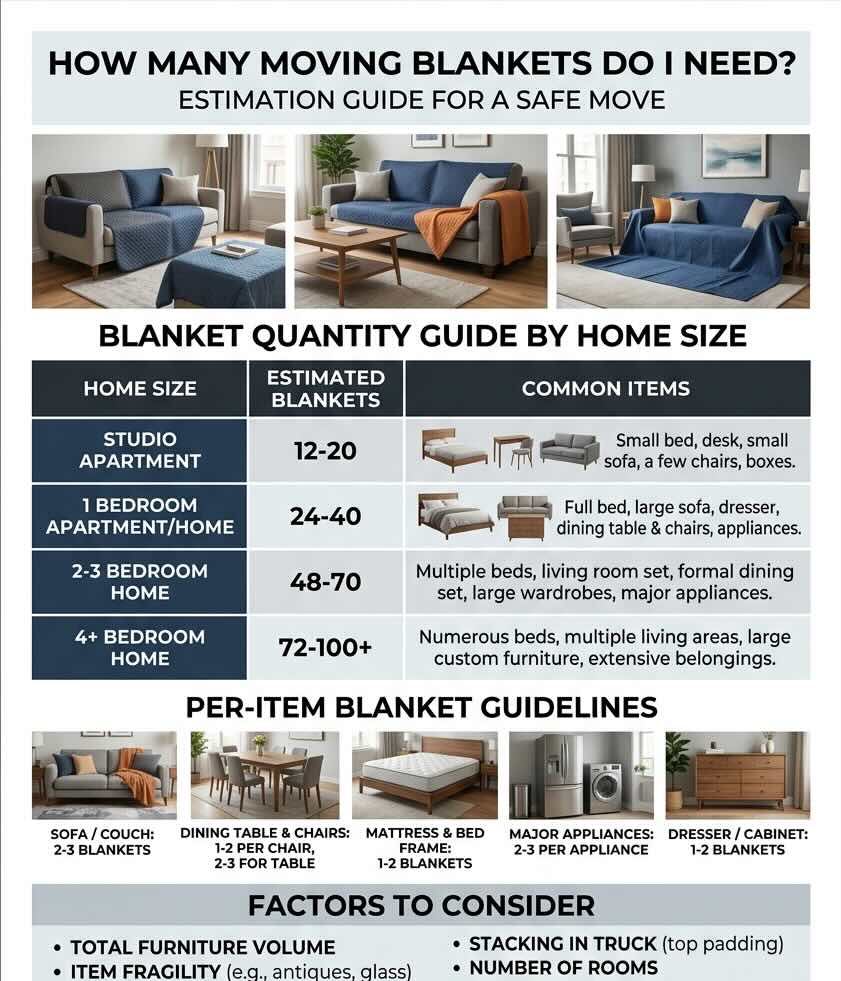
- How many you need: Industry standard is 1 blanket per major furniture piece as a starting point; large sofas require 2 to 3; a standard 2-bedroom move typically uses 12 to 24 blankets
- Wood and leather warning: Do not use stretch wrap directly against bare wood or leather in hot weather, it can trap heat and moisture; use the blanket as a barrier between the wrap and the furniture surface
- Truck loading: Line truck walls with hanging blankets, place blankets on the truck floor under heavy items, and stuff folded blankets into gaps between furniture to stop shifting during transit
- Standard blanket dimensions: 72″ × 80″ is the professional standard; some economy blankets are 54″ × 72″ (smaller, thinner, less protection); always verify dimensions before renting or purchasing
- Rental vs. buy: Renting from U-Haul or your moving company costs approximately $5 to $10 per blanket per day; purchasing a 12-pack of professional-grade blankets costs $80 to $150; buying makes economic sense if you move more than once in 5 years or plan to use them for storage
What Are Moving Blankets?
A moving blanket is a thick, quilted protective pad used by professional movers and DIY movers to shield furniture and household goods from scratches, dents, chips, and impact damage during loading, transport, and unloading. The standard professional moving blanket measures 72 inches by 80 inches and is constructed with a quilted face fabric, a dense interior fill, and a woven backing that together create a pad thick enough to absorb the kind of impact, vibration, and friction that furniture encounters during a normal move. The quilted construction distributes force across a wider surface area than a single-layer fabric pad, which is why genuine moving blankets outperform old bedding, towels, and regular household blankets for furniture protection despite looking superficially similar.
Moving blankets serve two distinct protection functions that work together: surface protection and impact cushioning. Surface protection prevents the kind of scratching, scuffing, and finish damage that happens when furniture surfaces contact each other, contact the metal walls of a moving truck, or slide against rough concrete driveways and loading dock surfaces. Impact cushioning absorbs the vibration and jarring forces that occur during driving, road imperfections, stops, starts, turns, and the low-frequency vibrations of engine and tire contact that can work loose joints in wood furniture, rattle glass panels out of cabinet doors, and shift the internal components of appliances. A furniture piece that is blanket-wrapped and secured inside a moving truck experiences a fundamentally different transit environment than one that is simply set in the truck unprotected, and the difference in arrival condition consistently reflects that.
Types of Moving Blankets
Not all moving blankets are the same. Choosing the wrong type for your furniture’s value is a common mistake. The three primary categories differ in weight, fill density, and protective capacity.
| Blanket Grade | Weight (Ea.) | Best For | Not Ideal For | 2026 Price (12-Pk) |
|---|---|---|---|---|
| Economy / Utility | 3 – 4 lbs | Light items, short city moves, and garage storage. | Heavy furniture, appliances, or long-distance hauls. | $45 – $65 |
| Standard / Pro-Lite | 5 – 6 lbs | Typical residential moves; what most pro movers use. | High-value antiques or grand pianos. | $85 – $125 |
| Premium / Heavy-Duty | 7 – 9 lbs | Long-distance moves, pianos, and high-end wood. | Short moves where extra weight is a hassle. | $130 – $210 |
Sources: 2026 Textile & Logistics Pricing Report; U-Haul Moving Standards (Feb 2026); Tarp Supply Jan 2026 Analysis.
Standard vs. Economy Blankets: The Weight Difference Matters
The weight difference between an economy blanket at 3 to 4 pounds and a professional blanket at 7 to 8 pounds is not about the size of the blanket which both are typically 72″ × 80″. The difference is entirely in fill density: professional blankets have a significantly denser quilted interior that absorbs more impact force per square inch and holds its protective shape across multiple uses. Economy blankets compress flat under light pressure, which means that when a sofa is wrapped in an economy blanket and pressed against the truck wall, the blanket provides minimal padding between the sofa’s frame and the wall. A professional blanket maintains more of its cushioning even under compression. For a single local apartment move of modest furniture, economy blankets are adequate. For anything of value, anything fragile, or any long-distance move where vibration accumulates over hours of driving, the standard or professional grade is the correct choice.
How Many Moving Blankets Do You Need?
The standard professional calculation is one blanket per major furniture piece as a minimum starting point, with adjustments for item size, shape, and fragility. The table below gives specific estimates for common household moves.
| Move Size | Recommended Blankets | Notes |
|---|---|---|
| Studio or 1-bedroom apartment | 6 to 12 | Typical pieces: bed frame, dresser, desk, sofa, dining table, chairs, TV stand |
| 2-bedroom home or apartment | 12 to 24 | Adds second bedroom set, more kitchen appliances, additional living room seating |
| 3-bedroom home | 24 to 36 | Adds washer, dryer, refrigerator, more bedroom sets, larger furniture volume overall |
| 4+ bedroom home / large move | 36 to 48+ | Plan for extra blankets to fill truck gaps and line walls; oversized or antique items need 2 to 3 blankets each |
Per-Item Blanket Estimates
- Sofa (standard 3-seat): 2 to 3 blankets to achieve full coverage including cushion backs and base
- Sectional sofa: 4 to 6 blankets; wrap each section separately before loading
- Queen or king bed frame: 2 to 3 blankets; headboard requires 1 to 2 separately
- Dresser or chest of drawers: 1 to 2 blankets; secure drawers with stretch wrap before blanket application
- Dining table: 1 blanket for the top; wrap legs individually or as a group depending on style
- Dining chairs: 1 blanket per 2 chairs when stacked; pad between each chair face with a folded section
- Refrigerator: 2 blankets; one for the front face and door, one for the sides and back where scratching from the truck wall occurs
- Washing machine or dryer: 1 full blanket; secure lid or door with stretch wrap before blanketing
- Large mirror or artwork: 1 blanket per piece minimum; consider corner protectors under the blanket at all four corners before blanketing
- TV (flat screen): Original box is always preferred; if no box, 1 to 2 blankets with cardboard backing on screen face before blanket application
- Bookshelf or wardrobe: 1 to 2 blankets; remove and wrap shelving separately
The professional rule of thumb: when in doubt, bring more blankets than you think you need. Unused blankets cost nothing when rented and fold flat for storage when purchased. Running out of blankets mid-move means the last few pieces go unprotected, and those are always the ones that get damaged because the crew is tired and less careful in the final loading phase.
Supplies You Need Alongside Moving Blankets
Moving blankets work best as part of a system that includes complementary materials. Using only the blanket without the right securing materials is one of the most common reasons blanketed moves still result in damage with an unsecured blanket slips off furniture during loading and transit, eliminating the protection it was supposed to provide.
- Mover’s stretch wrap / plastic stretch film: This is the most important companion material to moving blankets. Stretch wrap is a plastic film similar to saran wrap but manufactured for commercial moving use, wound tightly around blanket-wrapped furniture to hold the blanket firmly in place from top to bottom. It clings to itself without adhesive, which means no sticky residue on your furniture when it is removed. Professional movers use stretch wrap almost exclusively to secure blankets. Purchase a 20-inch wide roll rated for moving use; avoid kitchen plastic wrap which is too narrow and too thin to secure furniture effectively.
- Packing tape (heavy-duty): Acceptable for securing blanket edges when stretch wrap is unavailable, with one critical rule: tape touches only the blanket fabric, never the furniture surface itself. Tape applied directly to wood, painted surfaces, leather, or vinyl can pull off finish, stain leather, or leave permanent adhesive residue. Mark a mental “tape-free zone” around all exposed furniture surfaces and apply tape only to blanket-over-blanket or blanket-to-blanket contact points.
- Corner protectors: Foam or cardboard corner protectors applied to furniture corners before the blanket goes on add a rigid structural layer between the furniture’s most vulnerable point and the moving environment. This is especially valuable for tables, mirrors, picture frames, glass-fronted cabinets, and any piece with sharp corners that could punch through a blanket under pressure.
- Moving straps and ratchet straps: Used inside the truck to secure large blanket-wrapped items to the truck walls or to anchor points built into the truck floor and walls. Straps are the load-securing mechanism for the truck; stretch wrap is the blanket-securing mechanism for the furniture. Both are needed for complete protection.
- Rubber bands (large): Useful for securing blankets on furniture types where stretch wrap might cause damage when rubber bands hold blanket folds in place on smaller wood pieces, lamp bases, and items with delicate painted surfaces without the heat-trapping effect that stretch wrap can produce in warm moving trucks.
- Bubble wrap: Wrap truly fragile items such as dishes, electronics, glass surfaces, and decorative objects individually in bubble wrap before applying the moving blanket as an outer protective layer. Blankets alone are not appropriate first-layer protection for items that would be damaged by surface-to-surface contact with the blanket’s woven texture.
Basic Wrapping Technique: Step-by-Step
The fundamental moving blanket wrapping sequence applies to most furniture pieces with minor adjustments for shape and size. Master this base technique and you can adapt it to anything in your home.
- Prepare the item before the blanket goes on. Remove all loose elements first: drawer handles that protrude, removable shelves from bookcases, cushions from sofas, legs from tables if they detach cleanly, and any items stored inside the furniture. Secure drawers and doors with stretch wrap so they cannot open during the move. Clean the furniture surface lightly with a dry cloth where any grit or debris trapped under a moving blanket against a wood surface can scratch during vibration, defeating the blanket’s purpose.
- Apply corner protectors to all exposed corners before the blanket. Place foam or cardboard corner protectors on all four corners of tables, dresser tops, headboards, and any piece with a defined corner that projects outward. These create a rigid buffer at the most damage-prone point and prevent the corner from punching through the blanket under impact.
- Lay the blanket flat and position the furniture in the center (for smaller items) or drape the blanket over the top (for larger items). For items small enough to manage with chairs, nightstands, small dressers, ottomans that lay the blanket flat on the floor, center the item on the blanket, then bring the edges up and over the furniture, folding them like a present. For large items like sofas and refrigerators, drape the unfolded blanket over the top of the item and work it down the sides evenly so it hangs with approximately equal coverage on all sides.
- Ensure full coverage with no gaps, with special attention to corners and edges. Tuck the blanket into any recesses, the junction between sofa cushion backs and armrests, the underside of table aprons, the gap between a dresser’s base and the floor. Edges and corners are where damage occurs; they require the tightest, most secure coverage. If the blanket is too small to cover everything without gaps, add a second blanket overlapping the first by at least 6 inches at any seam.
- Secure the blanket with stretch wrap, starting from the top and working down. Begin wrapping stretch wrap at the top of the item and wind it continuously downward in overlapping loops, maintaining tension to keep the blanket pressed firmly against the furniture surface. Each loop of stretch wrap should overlap the previous one by approximately 30 to 40 percent to create a continuous layer without gaps. Make at least two to three full passes around the item to build a secure layer. The blanket should not be able to shift or pull away from the furniture surface when you tug it after wrapping.
- Test for security before moving the item. Once wrapped, attempt to shift the blanket on the item by pulling on it from multiple directions. A properly secured blanket should feel like part of the furniture with no slippage, no loosening, no exposed furniture surface visible through gaps. If the blanket shifts, add another pass of stretch wrap at the point where movement is occurring.
How to Wrap Specific Furniture and Items
Sofas and Sectionals
Remove all loose cushions and wrap them individually in plastic bags or small blankets to keep them clean. For a standard three-seat sofa, start by draping a full blanket over the back of the sofa from top to floor, covering the sofa back completely. Bring a second blanket over the seat cushion top and front face, tucking it under the base of the sofa. Overlap the two blankets by at least 6 inches where they meet along the sofa’s side panels. A third blanket may be needed to cover the armrests and any exposed side panels on wider sofas. Secure the entire assembly with stretch wrap at the base, middle, and top, making multiple full passes at each height. For sectionals, separate the sections if they come apart cleanly and wrap each section individually using the same technique. Wrapping a sectional as one piece produces gaps at the join points that leave those areas unprotected.
Beds and Headboards
Disassemble the bed frame if possible with rails, headboard, footboard, and center support as separate pieces. Wrap the headboard and footboard individually, applying corner protectors to all four corners before the blanket. For upholstered headboards, the blanket protects the fabric from soiling and puncture during transport. For wood headboards, the blanket is protecting a finished surface that scratches very easily, especially on edges. Bed rails can typically be bundled and wrapped together with a single blanket. The box spring and mattress require mattress bags or dedicated mattress boxes rather than moving blankets; blankets do not provide adequate protection for mattress cleanliness or against the sharp metal and wood protrusions of other furniture items in the truck.
Dressers and Chests of Drawers
Secure all drawers closed with stretch wrap before applying the blanket. Wrap the stretch wrap around the entire dresser body two to three times at the middle height to hold all drawers closed, then remove the stretch wrap after the blanket is in place and re-secure the blanket over the top. Do not leave items inside dresser drawers unless the drawers are secured so firmly that they cannot open under any circumstances when the weight of items inside unsecured drawers can cause them to slide open during transit, which can break the drawer face or damage the items inside. Drape one full blanket over the top of the dresser and work it evenly down all four sides, tucking the bottom edge underneath or securing it with stretch wrap. A second blanket may be needed for dressers wider than 48 inches.
Dining Tables
Wrap the table top first: lay one blanket flat, flip the table top-down onto the blanket center, and bring the edges up over the table legs before flipping back right-side up. For tables with glass tops, remove the glass top entirely, sandwich it between two pieces of moving blanket, and transport it separately and vertically (never flat) to prevent breakage. Once the main blanket is on the table, apply corner protectors to all four table corners on top of the blanket for an additional layer of corner protection, then wrap with stretch wrap. If the table has removable legs, remove them, wrap each leg individually with a section of folded blanket, bundle the legs together, and wrap the bundle with stretch wrap for consolidated transport.
Chairs
Standard dining chairs can be efficiently wrapped in pairs: position two chairs facing each other with seat faces together, drape a full blanket over the pair, tuck the blanket into all gaps, and secure with stretch wrap. This technique reduces blanket consumption and keeps chairs organized as matched pairs during loading. For upholstered chairs or armchairs, wrap individually: drape the blanket over the back, bring the sides in around the arms, tuck the bottom under the seat, and secure with stretch wrap. For office chairs, remove the base and wheels (store them in a sealed bag secured to the chair body with tape), then wrap the chair body and transport the disassembled base separately.
Refrigerators and Large Appliances
Refrigerators have large flat door faces that scratch easily against other surfaces in a truck and large flat sides that contact the truck wall directly during transport which both require blanket coverage. Secure the refrigerator door closed with a rubber band or moving strap before blanketing (tape applied to a refrigerator door seal will damage the rubber gasket). Apply one full blanket to the front face and door, bringing it around the corners and down the sides. Apply a second blanket to cover the sides and back. Secure both with stretch wrap, which is safe for appliance exteriors when applied over the blanket as a barrier. Washers and dryers: secure the drum with a washing machine transit bolt if available (or pack the drum with a moving blanket to prevent drum damage during the move), wrap the exterior with a single blanket, and secure with stretch wrap.
Large Mirrors and Framed Artwork
Mirrors and framed artwork with glass are the items most frequently broken during moves, and they require a specific technique rather than the standard furniture wrap. Apply corner protectors to all four corners first. Cut two pieces of cardboard to approximately the same size as the mirror face and tape one to each side to create a rigid sandwich that protects the glass from flexing pressure. Place the cardboard-sandwiched mirror vertically (never flat) on a moving blanket laid on the floor, bring the blanket edges up around the frame, and secure with stretch wrap. Transport all mirrors and framed artwork in an upright vertical position inside the truck when never laid flat on a horizontal surface. Lay a blanketed mirror flat and stack anything on top of it and the glass will almost certainly break under load in transit.
Flat Screen TVs
A television’s original box provides the best protection available, keep it if you still have it. If the original box is gone, the process requires more care than for most furniture pieces because a TV screen is both extremely fragile and extremely expensive to repair. Cut a piece of cardboard to the exact size of the screen face and tape it flat against the screen surface before touching anything else, this prevents any object from directly contacting the screen. Apply bubble wrap around the screen body over the cardboard. Drape one moving blanket over the front and wrap the sides in a second blanket. Secure with stretch wrap and transport the TV upright in the truck, never on its face or back. Position it between two padded vertical surfaces or secure it with a strap to the truck wall to prevent toppling during transit.
Oddly Shaped Items and Bicycles
For irregularly shaped items, bicycles, exercise equipment, lamps, garden tools, floor mirrors, use the blanket as a drape rather than attempting a wrapped enclosure that the shape will not support. Drape the blanket over the item, tuck it into recesses and around protrusions as thoroughly as possible, and secure any loose sections of blanket with rubber bands or gentle stretch wrap loops. The goal is to cover exposed surfaces and prevent the item from contacting other objects or truck surfaces directly. For bicycles, remove the pedals and turn the handlebars parallel to the frame before blanketing to reduce the footprint and eliminate protruding elements that would compromise coverage.
Using Moving Blankets Inside the Truck
Moving blankets do more than wrap furniture, they transform the inside of the moving truck from a metal box into a padded environment where furniture is protected from every direction simultaneously. Professional movers use blankets on the truck itself in three specific ways that most DIY movers skip entirely, and the difference in arrival condition between a professionally loaded and amateur-loaded truck is largely explained by these three practices.
Line the Truck Walls
Hang moving blankets on the interior metal walls of the moving truck before loading any furniture. Most moving trucks have hooks, rails, or wooden slat walls with gaps that blankets can be tucked into or hung from. Wall-lining creates a padded buffer that prevents the hard metal wall from contacting furniture directly during transit. This is especially important on the driver’s side wall, which experiences the most lateral force during turns. Blankets that are not being used to wrap specific pieces of furniture should always be hung on the truck walls as padding, a blanket doing nothing on the truck floor is a wasted protective resource.
Pad the Truck Floor
Lay folded moving blankets on the truck floor in the areas where heavy items will be placed. The truck floor is a hard metal surface with ridges that can mark and dent the base of wooden furniture, scratch appliance feet, and damage any soft-bottomed item placed directly on it. Blankets on the floor also reduce vibration transmission from the road surface to the furniture above, which is particularly valuable for wood furniture with glued joints that can be stressed by sustained vibration over a long drive.
Fill Gaps Between Items
Empty space inside a moving truck is the enemy of a damage-free move. When furniture items are loaded with gaps between them, those items can shift, slide, and collide during every turn and stop throughout the trip. Fold spare moving blankets and stuff them into the gaps between loaded furniture items to fill the space and prevent movement. The tighter and more completely filled the truck load, the less opportunity any individual piece has to shift during transit. Professional movers call this principle “tight loading,” and it is as important to damage prevention as the wrapping itself. A perfectly wrapped sofa that slides three feet across an empty truck floor and collides with a refrigerator will be damaged despite the wrapping.
Layer Between Stacked Items
When loading items vertically, stacking boxes on dressers, placing chairs on tables, positioning lighter items on top of heavier base pieces, always place a folded moving blanket between each horizontal layer. The blanket absorbs the weight distribution from the item above and prevents surface contact between stacked pieces. Never stack heavy items on top of lighter wrapped furniture without an intervening blanket layer regardless of how well both pieces are individually wrapped.
How to Secure Moving Blankets: Method Comparison
| Securing Method | Best For | Avoid On | 2026 Pro Notes |
|---|---|---|---|
| Mover’s Stretch Wrap ⭐ Industry Standard | All furniture types; wood, leather, painted surfaces, and appliances. | Direct contact with bare leather/wood in high-heat transit. | Clings to itself with zero residue. 2026 tip: Always use a blanket as a buffer to prevent “sweating” on finished surfaces. |
| Packing Tape | Securing blanket-to-blanket seams; reinforcing corners. | Never apply directly to furniture, leather, or finished wood. | Tape should only touch the blanket. Residue from 2026 high-tack tapes can permanently mar furniture finishes if misplaced. |
| Large Mover Bands | Small items, lamp bases, and delicate antique finishes. | Heavy items or long-distance moves where shifting is likely. | Reusable and fast. Zero residue risk; ideal for securing folded blanket edges on fragile legs. |
| Straps / Rope | Oversized pieces, pianos, and securing loads to truck walls. | Soft surfaces without heavy-duty blanket padding underneath. | Essential for structural support. Use ratchet straps for heavy appliances but verify blanket thickness to prevent “bite” marks. |
Sources: 2026 Mover’s Best Practices Guide; FMCSA Furniture Transit Safety Standards (Updated Feb 2026).
Common Moving Blanket Mistakes to Avoid
- Leaving corners and edges uncovered. The most damage-prone points on any piece of furniture are its corners and edges, they are the first surfaces to contact anything during a collision and they concentrate impact force at a single point rather than distributing it. Gaps in blanket coverage at corners are the leading cause of chip and dent damage on blanketed furniture. Always double-check corner coverage and add corner protectors under the blanket for high-value items.
- Applying tape directly to furniture surfaces. This is probably the single most common moving blanket mistake made by first-time DIY movers. Tape applied to wood pulls off stain and finish. Tape applied to leather lifts color and embeds adhesive into the surface. Tape applied to painted surfaces strips paint. The rule is absolute: tape touches only the blanket, never the furniture.
- Not using enough stretch wrap. A single loop of stretch wrap around a large sofa is not adequate. The wrap needs multiple full passes from top to bottom to create a continuous holding layer. Movers who use two loops and call it done often arrive at the destination to find the blanket partially off the furniture and the previously covered surface now exposed and potentially damaged.
- Leaving gaps at seams when using multiple blankets. When two blankets are used to cover a large item, the seam where they meet is the most vulnerable point. Overlap the blankets by at least 6 inches at every seam and cover the seam with stretch wrap to hold both blankets together. A seam with minimal overlap creates a narrow exposure channel that scratches surfaces on contact with other objects or the truck wall.
- Wrapping leather furniture in plastic stretch wrap without a blanket barrier in hot weather. Stretch wrap traps heat and moisture against surfaces. In a hot moving truck (interior temperatures can exceed 120°F in summer), stretch wrap applied directly against leather or fine wood can leave impressions in the leather surface, cause wood to sweat moisture under the wrap, and in extreme cases, bond the wrap material to the furniture finish. Always use the blanket as the first layer against the furniture surface and the stretch wrap over the blanket.
- Moving the wrapped item before the securing is complete. A blanket draped over furniture but not yet secured with stretch wrap can shift and slide off during the carry from the room to the truck. Complete the full wrapping and securing process before the item is lifted or moved. This is especially important for tall items like armoires and bookcases where a shifting blanket during a carry can change the weight distribution and compromise the grip of the movers.
- Not securing dresser drawers and cabinet doors before blanketing. Drawers that open during transit will likely be damaged, will damage their contents, and may damage adjacent items in the truck. Cabinet doors that swing open can break off hinges or crack door faces. Apply stretch wrap around the body of the dresser or cabinet specifically to hold drawers and doors closed before the outer blanket goes on.
- Leaving blankets loose inside the truck without securing the load. Wrapped furniture inside a truck that is not anchored to the walls or floor with straps will still shift during transit regardless of how well the blankets are applied. The blankets protect surfaces from damage when contact occurs; the straps prevent the contact from occurring in the first place. Both are necessary.
- Using too few blankets to save money and then needing repairs. The cost-benefit calculation always favors more blankets over fewer. If you are on the fence between 12 and 18 blankets for a 2-bedroom move, rent or buy 18. The extra 6 blankets cost approximately $3 to $6 in rental fees or $10 in purchase price. A single furniture repair from a scratch or dent that a 13th blanket would have prevented costs $150 to $600.
Other Uses for Moving Blankets
Moving blankets are versatile tools that earn their cost beyond a single move day when repurposed for other protective applications.
- Furniture storage protection: Moving blankets are the standard padding material in climate-controlled and standard storage units. Wrap furniture in blankets before placing it in storage to prevent dust, moisture, and surface damage from stacking pressure over long storage periods. The woven textile allows the furniture to breathe, which is an advantage over plastic wrapping for extended storage durations.
- Protecting floors during renovations: Lay moving blankets over hardwood or tile floors in rooms where contractors are working to protect the floor surface from tool drops, foot traffic, and construction debris. The thick padding of professional-grade blankets provides significantly better protection than paper floor protection or drop cloths.
- Soundproofing applications: Moving blankets have documented noise-dampening properties that make them a popular DIY soundproofing solution for music practice spaces, podcasting rooms, and home recording setups. Hanging blankets on walls absorbs mid-range frequencies and reduces echo in a room at a fraction of the cost of acoustic foam panels.
- Vehicle and equipment transport protection: Moving blankets are used in automotive shipping and equipment transport to protect paint finishes, windshields, and polished surfaces from contact damage during loading and transit. They are standard equipment in professional auto transport operations for exactly the same reasons they are standard equipment in furniture moving.
- Workshop and garage surface protection: Lay blankets on workbenches and garage floors when working on vehicles, motorcycles, bicycles, or furniture refinishing projects to protect the object’s surface and the floor from drops, spills, and abrasion.
- Outdoor furniture winter storage: Cover patio furniture, grills, and outdoor equipment with moving blankets as an under-layer before applying waterproof covers for winter storage. The blanket layer provides additional insulation against freeze-thaw cycles and prevents condensation from building up directly against metal and fabric surfaces.
Lighten the Load Before You Wrap
Moving blankets are essential for protection, but the fewer items you have to wrap, the faster your move will go. Learn the most effective ways to declutter and simplify your relocation with our expert downsizing strategies and checklists:
How to Downsize When Moving – Tips for a Streamlined Relocation.
How to Fold and Store Moving Blankets
Properly folded moving blankets stack cleanly, take up minimal storage space, and are easier to deploy on the next move because they open flat without being tangled. The standard professional fold used by moving companies results in a compact rectangle approximately 20 inches by 36 inches that stacks stably and stores in a standard closet or storage bin.
The Professional Fold (Most Efficient)
- Lay the blanket flat on a clean floor or large table surface. Standard blankets are 72″ × 80″, you need adequate floor space to lay it completely flat.
- Fold the blanket in half along its long dimension (72″ becomes 36″), bringing the two 80-inch edges together. Smooth out any wrinkles as you make the fold.
- Fold the blanket in half again along its long dimension (36″ becomes 18″), bringing the two folded edges together. You now have a long, narrow rectangle approximately 18″ × 80″.
- Fold the blanket in half across its width (80″ becomes 40″), bringing the two short ends together. You now have a compact rectangle approximately 18″ × 40″.
- Fold one more time across the width (40″ becomes 20″) for the standard professional size of approximately 18″ to 20″ × 20″. This size stacks stably and stores in standard shelving without tipping.
- Fold all blankets the same way in the same direction so the stack remains uniform and stable. A mixed stack of differently-oriented folds topples easily and takes up more space.
Storage and Care
- Dry completely before folding for long-term storage. Moving blankets that are folded and stored while damp will develop mold and mildew in the interior fill that is difficult to remove and creates odors that transfer to furniture in subsequent use. If blankets are damp from a move in rain or humidity, hang them over a railing, door, or fence until fully dry before folding.
- Store in a sealed plastic bin or bag if storing long-term. Open storage on a shelf allows dust, insects, and moisture to accumulate in the blanket fill over time. A sealed container maintains cleanliness and extends the blanket’s useful life significantly.
- Washing instructions: Most standard moving blankets can be machine washed on a cold or warm gentle cycle and air-dried or tumble-dried on low heat. Check the specific product tag before washing. Avoid high heat dryer settings, which can shrink the fill and distort the quilted pattern. Professional-grade heavy blankets may require a commercial washer due to their weight when wet, a 7-pound dry blanket can be 12 to 15 pounds wet, which overloads a residential washer when multiple blankets are washed together.
- Inspect blankets after each move. Check for tears in the face fabric, exposed fill from damaged seams, and any areas where the quilting has separated. Blankets with significant structural damage provide less protection and should be replaced before the next use. Small tears can be temporarily repaired with duct tape on the exterior of the blanket body, not against the furniture contact face, to prevent the tear from extending during use.
Should You Buy or Rent Moving Blankets?
The buy-versus-rent decision depends on how often you move and whether you have secondary uses for the blankets after the move. The math is straightforward.
| Moving Situation | Recommendation | 2026 Cost & Logistics Logic |
|---|---|---|
| One-time move; no storage needed. | RENT | Current rental rates are $6–$12 per dozen. Best for minimal logistics; return them with the truck to avoid clutter. |
| Moving twice within 36 months. | BUY | Ownership pays for itself by the second move. Professional-grade 2026 packs (12-count) average $85–$110. |
| Furniture going into a storage unit. | BUY | Rentals cannot be kept in storage. Buying ensures long-term protection against dust, moisture, and pests while in the unit. |
| Home renovation planned post-move. | BUY | Highly versatile for 2026 DIY projects. Use them as high-durability floor runners or to wrap appliances during kitchen remodels. |
| Using full-service movers. | INCLUDED | Most 2026 professional quotes include blanket wrapping as a standard service. Always verify the “Inventory Protection” clause in your contract. |
Source: 2026 Coastal Moving Services Pricing Guide. Prices are national averages; local retail and rental rates may vary by 15-20%.
Where to buy moving blankets: U-Haul (in-store and online; standard and premium grades); Home Depot and Lowe’s (economy through mid-weight); Amazon (widest range of brands, weights, and 12-pack bulk options); Harbor Freight (economy price point; acceptable for single moves); uBoxes.com (professional-grade blankets sold individually and in bulk to both movers and consumers).
Don’t Struggle With the Heavy Lifting Alone
Properly wrapping furniture with blankets and navigating tight corners is physically exhausting and risky for your belongings. Skip the DIY stress. Let Coastal Moving Services handle the full-service logistics, professional packing, and safe transport for you.
Call for a custom moving plan: 888-316-8329
FAQ
Can I use regular household blankets instead of moving blankets?
Regular household blankets can serve as a substitute for moving blankets in a limited capacity, but they perform significantly worse at every measurable function. They are thinner, which means less impact cushioning. They are softer and less structured, which means they shift off furniture more easily during a carry. They are typically smaller than the standard 72″ × 80″ moving blanket, meaning coverage gaps are more likely. Most importantly, they have personal value, a household blanket that absorbs a furniture edge impact hard enough to leave a mark during the move is a damaged household blanket you now have to replace or live with. If moving blankets are unavailable and you must improvise, old comforters, sleeping bags, and thick bath towels used in combination are the closest household substitutes, secured with rubber bands rather than tape to avoid damaging them.
Do moving blankets prevent all damage?
Moving blankets prevent surface damage, scratches, scuffs, dents, chips, that occur from contact between the wrapped item and other objects or surfaces. They do not prevent structural damage from mishandling, such as dropping a piece of furniture from height, dropping a heavy box directly onto a wrapped item, or stress damage to wood joints from improper carrying technique. They also do not substitute for proper load securing inside the truck, a well-wrapped but unsecured item will still be damaged if it shifts far enough to experience a significant collision with another item or the truck wall. Blankets are one component of a complete damage-prevention system, not a standalone solution.
How do I secure moving blankets without stretch wrap?
If stretch wrap is unavailable, use large rubber bands for smaller items, moving rope or bungee cords for medium items, and ratchet straps for large furniture and appliances. Packing tape applied exclusively to blanket-to-blanket contact points (never to furniture surfaces) can supplement these methods for specific problem spots where a corner or edge refuses to stay covered. Avoid relying solely on tape as the primary securing method for large items, the adhesive is not strong enough to hold a blanket against the forces that occur during loading and transport.
How many moving blankets come in a typical rental truck?
U-Haul typically includes 12 furniture pads at no extra charge with truck rentals; additional pads rent for approximately $5 to $10 per pad per day. Penske and Budget truck rentals offer blankets as add-ons at similar rates. If you are renting a truck and relying on the included blankets, count them at pickup and confirm the quantity matches your estimate for the move. Professional full-service moving companies typically bring their own blanket inventory as part of the move and include blanket use in the move cost, confirm this during the quoting process rather than assuming.
Can moving blankets be used for soundproofing?
Yes, and this is one of their most popular secondary uses. Moving blankets hung on walls absorb mid-range sound frequencies and reduce echo in a room meaningfully. They are not a substitute for professional acoustic treatment for studio-quality recording, but for home podcast setups, music practice rooms, and spaces where basic echo reduction is the goal, a wall of moving blankets delivers measurable acoustic improvement at a cost of $80 to $150 for a 12-pack versus $400 to $800 for comparable coverage in acoustic foam panels.
References
- MovingPlace: How to Use Moving Blankets and Furniture Pads
- U-Haul: Moving Blankets 101
- Last Stop Moving: How to Properly Use Moving Blankets
- Tarp Supply: How to Properly Wrap and Secure Furniture with Moving Blankets
- Tarp Supply: How to Wrap and Store Large Appliances with Moving Blankets
- My Good Movers: How to Protect Furniture When Moving
- Rent a Mover: Moving Blankets – The Must-Have Tool for Safe Relocation
- This Old House: How to Use Moving Blankets