

States ranked by quality of life articles rarely tell the whole story; they are a composite of competing factors that must be weighed carefully.. Some lists score only healthcare and safety; others blend economic opportunity, education, environmental quality, and affordability. Below you’ll find the states that lead overall quality of life right now, how those results compare across different ranking methodologies, and the common factors strong quality-of-life states share.
Key Points (2026)
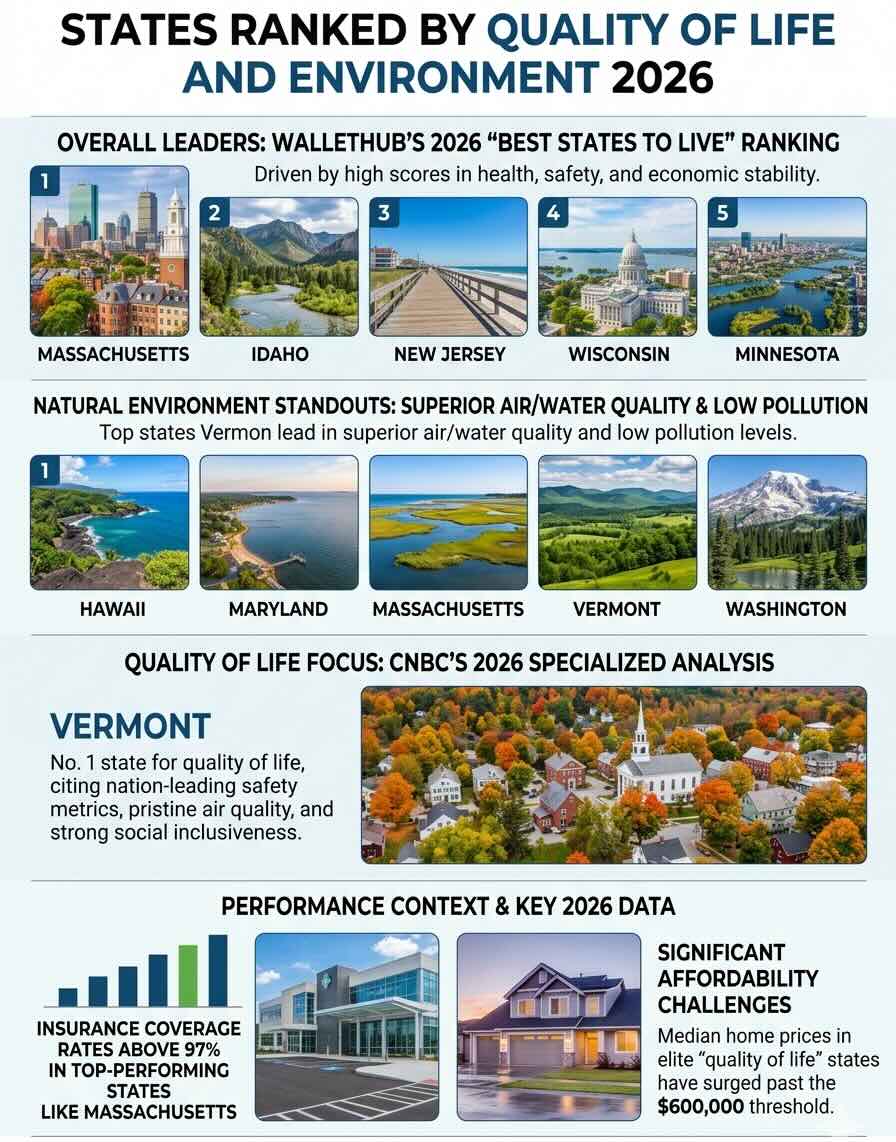
- Overall leaders: WalletHub’s 2026 “Best States to Live” ranking continues to place Massachusetts at No. 1, followed by Idaho, New Jersey, Wisconsin, and Minnesota, driven by high scores in health, safety, and economic stability.
- Natural environment standouts: In 2026, Hawaii maintains its No. 1 rank for natural environment, with Maryland, Massachusetts, Vermont, and Washington rounding out the top five for superior air/water quality and low pollution levels.
- Quality of life focus: CNBC’s 2026 specialized analysis maintains Vermont as the No. 1 state for quality of life, citing its nation-leading safety metrics, pristine air quality, and strong social inclusiveness.
- Performance context: 2026 data shows that top-performing states like Massachusetts maintain insurance coverage rates above 97%, but face significant affordability challenges as median home prices in elite “quality of life” states have surged past the $600,000 threshold.
Best States for Quality of Life (Overall)
WalletHub’s 2026 evaluation references 51 indicators across five pillars: affordability, economy, education/health, quality of life, and safety. Below are the top 10 performers.
| Rank | State | Why It Stands Out | Strategic Metric |
|---|---|---|---|
| 1 | Massachusetts | National leader in health (97.5% coverage) and #1 for public education; maintains the lowest premature death rate in the U.S. | #1 Education & Health |
| 2 | Idaho | Explosive income growth and low taxes; remains a top choice for safety and economic momentum despite rising costs. | #4 Public Safety |
| 3 | New Jersey | Strongest public safety metrics and high median household income; top-tier environmental protection policies. | #1 Public Safety |
| 4 | Wisconsin | High marks for social well-being and affordability; strong k-12 school performance and healthcare access. | #9 Health Quality |
| 5 | Minnesota | Low poverty rate and high primary care physician density; ranks top 10 for both quality of life and health infrastructure. | #5 Healthcare Access |
| 6 | Florida | Best-in-nation restaurant density and #3 in income growth; no state income tax remains a major draw for professionals. | #4 Quality of Life |
| 7 | New Hampshire | Consistently the lowest crime state; high health outcomes and strong economic opportunity in the Northeast corridor. | #3 Economy Rank |
| 8 | Utah | Ranked #1 for Fiscal Stability; unmatched access to national parks and a booming tech-driven job market. | #1 Fiscal Stability |
| 9 | New York | Leader in cultural amenities and public transit access; holds the highest score for the “Quality of Life” subcategory. | #1 Quality of Life |
| 10 | Pennsylvania | Offers a “middle ground” of high safety metrics, affordable homeownership, and solid health infrastructure. | #5 Quality of Life |
Source: WalletHub, “Best States to Live In (2026).” Indicators include 51 weighted measures across affordability, economy, education, health, quality of life, and safety.
Natural Environment Leaders: Clean Air, Water & Outdoor Access
Environmental quality including parks, walking paths, clean rivers, and air quality significantly impacts daily quality of life. U.S. News ranks states specifically on natural environment factors, revealing which states offer the cleanest, most accessible outdoor living.

2026 Environmental Quality & Sustainability Index
| Rank | State | Environmental Strengths (2026 Update) | Key 2026 Metric |
|---|---|---|---|
| 1 | Hawaii | Maintains the nation’s best air quality due to consistent trade winds; holds the 2026 record for the fewest drinking water violations per capita. | #1 Air Quality |
| 2 | Maryland | Aggressive Chesapeake Bay restoration and renewable energy mandates; top-tier 2026 marks for pollution reduction and climate-health policy. | #2 Natural Env. |
| 3 | Vermont | Ranked the “Greenest State” in 2026 for its carbon-neutral initiatives, organic farm density, and pristine air-water synergy. | #1 Greenest Overall |
| 4 | Massachusetts | Leader in energy efficiency and LEED-certified infrastructure; provides exceptional accessibility to state-protected conservation land. | #3 Health-Env. Link |
| 5 | Washington | Top 5 for industrial pollution control; remains a national hub for “Outdoor Activity Access” with diverse mountain and coastal ecosystems. | #1 Outdoor Access |
| 6 | Maine | Boasts 51 designated Ecological Reserves; leading the East Coast in 2026 for “wildland” preservation and low industrial impact. | #2 Clean Water |
| 7 | Minnesota | Exceptional freshwater preservation across 10,000+ lakes; high 2026 score for public recycling and community-led conservation efforts. | #3 Eco-Behavior |
Sources: U.S. News Best States “Natural Environment” 2026; WalletHub “Greenest States” 2026; SmileHub “Outdoor Recreation Index” 2026.
Quality of Life Leaders: CNBC’s Specialized Ranking
CNBC’s 2025 analysis specifically measures quality of life through crime rates, air quality, healthcare access, childcare availability, worker protections, and inclusiveness. This narrower focus reveals different leaders than comprehensive rankings, with environmental factors playing a central role.
Vermont tops this specialized list with its combination of exceptionally low crime rates, clean air, preserved outdoor spaces, and strong community protections. The state’s Vermont Outdoor Recreation Economic Collaborative supports trails, parks, and outdoor recreation infrastructure that encourages connection with nature and community interaction. Maine follows closely with similar environmental quality and safety profiles, maintaining 51 Ecological Reserves specifically to protect natural ecosystems. New Jersey ranks third thanks to its ninth-lowest violent crime rate nationally and its 2023 record for fewest murders in over 40 years, combined with strong environmental protections. Minnesota benefits from the esteemed Mayo Clinic and ranks seventh in primary care physicians per capita, while its extensive lake systems and eco-friendly culture contribute to top-10 cleanest state status. Connecticut rounds out the top five with the fourth-lowest crime rate in the nation and extensive worker protections.
What Top Quality-of-Life States Share
Across methodologies, the same patterns emerge repeatedly. States that rank near the top usually combine accessible healthcare infrastructure, safe communities with low violent crime rates, exceptional environmental quality including clean air and water, accessible parks and outdoor recreation, economic stability with diverse job markets, and strong protections against discrimination.
Healthcare access proves especially critical with states showing high densities of primary care physicians, low uninsured rates, and strong hospital systems consistently outperforming peers. The Commonwealth Fund’s 2025 Scorecard confirms this pattern, with Massachusetts, Hawaii, New Hampshire, Rhode Island, and the District of Columbia leading health system performance based on 50 measures including access, affordability, and outcomes. Meanwhile, the lowest-ranked states like Mississippi, Texas, Oklahoma, Arkansas, and West Virginia lag significantly in these same healthcare metrics.
Environmental quality matters just as much for daily living. States with pristine air quality, protected water sources, extensive park systems, and accessible walking trails report higher resident satisfaction and better health outcomes. Vermont’s outdoor recreation economy demonstrates this connection, where open spaces invite nature connection and community interaction, supporting local businesses and encouraging neighborly bonds.
Why Rankings Disagree: Comprehensive vs. Focused Approaches
WalletHub measures overall livability across five broad dimensions, while CNBC’s quality-of-life metric focuses specifically on day-to-day living conditions. U.S. News emphasizes healthcare and education, also mentioned with a high point in our article States Ranked by Education in 2025, most heavily in its overall state rankings, with a separate natural environment category. A state can rank high on environmental quality but lower overall if affordability drags down its composite score or vice versa.
2026 State Rankings Comparison: Quality of Life, Environment, and Economic Stability
| State | WalletHub 2026 Overall | U.S. News Environment | CNBC Quality of Life | Strategic Why |
|---|---|---|---|---|
| Massachusetts | #1 Best Overall | 3rd Environment | Top Tier | Elite healthcare and education metrics; the most consistent high-performer across all 2026 data. |
| Utah | #8 Overall | Mid Tier | #1 Best State | Ranked #1 Overall by U.S. News in 2026 due to explosive job growth and fiscal stability. |
| Vermont | #21 Overall | 1st (Air/Water) | #1 Quality of Life | Top marks for safety and environment; lower economic rankings keep it mid-tier for “overall” liveability. |
| Hawaii | #35 Overall | 1st (Natural) | Top Tier | Unrivaled environment; however, $820k median home price and cost of living drag down its overall rank. |
| New Jersey | #3 Overall | Top Tier | #3 Quality of Life | High education and safety scores (#1 in Safety) offset its higher tax burden. |
| Idaho | #2 Overall | 10th Environment | Mid Tier | Exceptional economy and safety ranks boost it to the top of “liveability” lists despite lower health care scores. |
Sources: WalletHub “Best States to Live In (2026)”; U.S. News “Best States Rankings 2026”; CNBC “Quality of Life Analysis (2025/2026)”.
How Environment Affects Daily Quality of Life
Environmental quality touches daily life in tangible ways that rankings capture through multiple indicators. Clean air means lower respiratory illness rates and fewer asthma triggers, particularly important for families with children. Hawaii demonstrates this with trade winds that continuously clear pollution, resulting in some of the nation’s lowest asthma hospitalization rates.
Accessible parks and walking trails promote physical activity, with studies showing residents of high-environment states exercise more frequently. Vermont’s extensive trail system, supported by the Vermont Outdoor Recreation Economic Collaborative, encourages regular outdoor activity that supports both physical and mental health. Protected water sources ensure safe drinking water and recreational opportunities, with Maine’s 51 Ecological Reserves specifically monitoring water quality and ecosystem health.
Natural spaces also boost mental health by providing stress relief and opportunities for social connection. States ranking high in environmental quality typically show better mental health outcomes and higher resident life satisfaction scores. Minnesota exemplifies this with its “Land of 10,000 Lakes” offering year-round outdoor recreation that strengthens community bonds.
Dig Deeper: Health System Performance by State
The Commonwealth Fund’s 2025 Scorecard provides detailed state-by-state health system data across access, affordability, prevention, treatment, and outcomes. Massachusetts leads with the lowest avoidable mortality rate, while West Virginia’s rate exceeds twice that level. Uninsured rates fell to record lows in all states by 2023, narrowing differences in health coverage between states thanks to Affordable Care Act expansions and state Medicaid expansions. However, childhood vaccination rates declined in most states between 2019 and 2023, with Nebraska and Minnesota seeing drops exceeding 10 percent. You can find more related on States Ranked by Healthcare in 2025
How to Select a State Ranked by Quality of Life
Different lists answer different questions. A comprehensive “best states” ranking evaluates overall livability across economic, educational, healthcare, safety, and affordability dimensions. A focused “quality of life” metric isolates daily living conditions like crime, air quality, healthcare access, and community protections. A natural environment ranking specifically measures air and water purity, pollution levels, and environmental protections. When comparing states, keep these distinctions in view:
- Healthcare access & quality: primary care physicians per capita, hospital quality ratings, life expectancy, uninsured rates, and health outcomes.
- Safety & crime: violent crime rates, property crime rates, FBI statistics, and community safety indicators.
- Environmental quality: air quality measurements, water purity, pollution levels, industrial toxins, protected natural spaces, and park accessibility.
- Outdoor recreation: state and national park systems, trail networks, walking paths, clean rivers and lakes, and recreational facility access.
- Affordability: housing costs, cost of living indices, median home prices, and overall expenses relative to income.
- Economic factors: job market strength, unemployment rates, median household income, and economic opportunity.
A 90-Second Comparison Recipe (State & Community)
- Pick 3 states using both a comprehensive ranking and a quality-of-life-focused list, plus checking natural environment scores to balance all factors.
- Within each state, check 2 to 3 specific communities using local crime statistics, healthcare facility locations, and nearby park or trail access.
- Review affordability metrics including median home prices, property taxes, and overall cost of living for your target areas.
- Assess healthcare access: locate nearby hospitals, primary care physicians, and emergency services within reasonable distance.
- Check environmental factors: air quality indices for your specific county, water quality reports, natural disaster risks, nearby parks and trails, and climate considerations for your health needs.
Regional Snapshots (Why Some States Consistently Rank Well)
The same ingredients reappear in high performers across regions: strong healthcare infrastructure, low crime rates, exceptional environmental quality with accessible outdoor spaces, and community protections. Here’s how that often looks on the ground:
Northeast
States with established healthcare systems and strong universities produce top health outcomes and education access. Families find extensive cultural amenities, robust public transit, comprehensive worker protections, plus accessible state parks and conservation areas throughout Massachusetts, Vermont, and New Hampshire. Vermont’s trail systems and Maine’s Ecological Reserves exemplify regional commitment to environmental preservation, though housing costs run significantly higher than national averages.
Mid-Atlantic & South
A mix of growing metros and suburban communities with varying crime rates, healthcare access, and environmental quality. New Jersey combines strong environmental protections with low crime and high income. Florida exemplifies the trade-offs: strong economy and no state income tax, but rising housing costs and higher crime in some areas impact overall quality of life, with environmental challenges in some coastal regions.
Midwest
Notable affordability combined with strong healthcare systems, low crime, and abundant freshwater resources in many areas. Minnesota stands out with the Mayo Clinic, extensive discrimination protections, and eco-friendly lake culture, though harsh winters and childcare availability remain challenges. Wisconsin balances affordability with quality across multiple dimensions.
West
Dramatic variation between coastal and interior states. Hawaii and Washington offer exceptional air quality, pristine waters, and outdoor recreation but face high housing costs. Vermont ranks 4th for outdoor enthusiasts with extensive green space, while Idaho balances affordability with economic growth but shows more variable environmental and healthcare access by region. Utah provides access to national parks and outdoor recreation alongside strong economic opportunity.
The Affordability Trade-Off (What High Rankings Cost)
Several top-ranked states come with significant affordability challenges. Hawaii, despite ranking No. 1 for natural environment with exceptionally clean air and water, presents serious housing cost barriers with a median home price of $755,000. New Jersey’s high median household income comes with correspondingly high property taxes and housing costs. Connecticut and Massachusetts offer exceptional healthcare, education, and environmental quality but rank among the most expensive states for housing.
Conversely, more affordable states often require trade-offs in other areas. Idaho ranks second overall partly due to housing costs well below coastal states, but healthcare access and environmental protections vary significantly by region. Wisconsin balances affordability with strong quality metrics across healthcare, education, and safety, making it attractive for families prioritizing value. North Dakota offers exceptional childcare access and low crime but faces harsh winters and fewer cultural amenities.
Healthcare Performance: The Biggest Quality-of-Life Driver
Healthcare system strength separates top-tier from bottom-tier states more than any other single factor. Massachusetts leads the Commonwealth Fund’s 2025 health system rankings with comprehensive access, the lowest premature death rate, 97.4 percent health insurance coverage, and strong preventive care. Hawaii and New Hampshire follow with similarly robust systems.
The gap between best and worst states proves substantial with West Virginia’s avoidable mortality rate exceeding twice Massachusetts’ rate. Wide racial disparities persist, with 42 states and D.C. showing avoidable mortality for Black residents at least two times the rate for the group with the lowest rate. Infant mortality rates worsened in 20 states between 2018 and 2022, highlighting ongoing challenges. Minnesota’s position near the top stems partly from ranking seventh nationally in primary care physicians per capita and maintaining one of the lowest uninsured rates.
Data Glossary
- Avoidable mortality: premature deaths from conditions preventable with timely, effective healthcare; key indicator of health system performance.
- Quality of life score: composite measure across crime, healthcare access, air quality, childcare, inclusiveness, and worker protections.
- Natural environment ranking: measures air and water quality, pollution levels, industrial toxins, and environmental protections.
- Air quality index: measurement of pollutants including particulate matter, ozone, and industrial emissions that affect respiratory health.
- Violent crime rate: FBI-reported incidents of murder, rape, robbery, and aggravated assault per capita.
- Median household income: middle point of household earnings; indicator of economic opportunity and purchasing power.
- Uninsured rate: percentage of population lacking health insurance coverage; impacts healthcare access and outcomes.
Planning Checklist for Families Moving for Quality of Life
State Level (30 minutes)
- Compare comprehensive, quality-of-life-focused, and natural environment rankings; note 3 candidate states.
- Review Commonwealth Fund health system data for your shortlist states.
- Check state-level air and water quality reports.
Community Level (45 minutes)
- Pull local crime statistics, healthcare facility locations, and park or trail access for 2 to 3 target communities.
- Confirm median home prices and property taxes for specific neighborhoods.
- Check county-level air quality indices and water quality reports.
On-Site Visit (1 to 2 hours)
- Drive to nearest hospital, primary care facilities, and emergency services to assess actual travel time.
- Visit nearby parks, trails, or green spaces to evaluate accessibility and maintenance.
- Visit neighborhoods at different times; observe foot traffic, maintenance, and general atmosphere.
Appendix A: Overall vs. Quality of Life vs. Environment Crosswalk
This crosswalk identifies the divergence between different ranking methodologies. Use this guide to understand why a state may rank #1 for economy but fall behind in environmental health or social well-being.
| State | WalletHub Overall | CNBC Quality of Life | U.S. News Natural Env. | 2026 Interpretation |
|---|---|---|---|---|
| Massachusetts | No. 1 Overall | Top Tier | 3rd | High-performance synergy: Strong healthcare and education metrics align with elite environmental quality. |
| Hawaii | Mid Tier | High QoL | No. 1 | Exceptional health and air quality; median housing now exceeds $820,000, heavily dragging overall rank. |
| Vermont | Mid Tier | No. 1 QoL | 4th | Prioritizes safety and pristine outdoors; “Overall” rank is limited only by a smaller, less diverse job market. |
| Idaho | No. 2 Overall | Mid Tier | Mid Tier | Economic momentum and affordability drive the overall score, even with average social/medical scores. |
| New Jersey | No. 3 Overall | No. 3 QoL | Top Tier | Consistent leader in Public Safety and Education (#1 state ranks); highly stable across all frameworks. |
| Washington | Upper Tier | Mid-High | 5th | Elite environmental purity; ranks 4th for outdoor access, balancing its high-tech economic focus. |
| Florida | No. 6 Overall | Lower Tier | Lower Tier | Strong economic/job scores mask high living costs, surging insurance rates, and lower environmental scores. |
Tip: If rankings diverge, look for specialized strengths like “Environmental Quality” or “Fiscal Stability” as the primary driver.
How to Use Rankings Without Letting Them Drive the Whole Decision
Use statewide rankings as a filter, then evaluate the specific communities you might actually live in. Local crime statistics, hospital proximity, air quality measurements in your target neighborhood, park and trail accessibility, and actual housing costs in specific ZIP codes are the signals families feel day to day. A short visit to check commute times, healthcare facility access, nearby green spaces, and neighborhood atmosphere rounds out the picture better than any single composite score.
FAQ (2026 Edition)
Which states lead overall quality of life in 2026?
CNBC’s 2026 quality-of-life rankings place Vermont, Maine, New Jersey, Minnesota, and Connecticut as the top five. Vermont remains the gold standard, buoyed by the nation’s lowest violent crime rates and proactive environmental protections.
Which state has the best natural environment?
Hawaii continues to rank No. 1 for natural environment in 2026. Its unique trade winds provide the cleanest air nationwide, supported by a perfect record of zero public drinking water violations. Maryland, Vermont, Massachusetts, and Washington round out the top five.
Which state is No. 1 in WalletHub’s comprehensive 2026 ranking?
Massachusetts leads the overall “Best States to Live In” ranking for 2026. It boasts a 97.5% health insurance coverage rate and the lowest premature death rate in the country, followed closely by Idaho and New Jersey.
Where can I see detailed health system performance by state?
The Commonwealth Fund’s 2026 Scorecard is the primary source for state-level health data, tracking 50 measures including healthcare access, affordability, and equity in medical outcomes.
How much do environmental factors affect quality of life rankings?
Environmental factors are critical; they directly influence respiratory health, physical activity levels via trail access, and mental well-being through proximity to preserved natural spaces. In 2026, states with high environmental scores show a direct correlation with higher resident longevity and overall life satisfaction.
What’s the biggest trade-off in top-ranked states?
The primary hurdle remains affordability. In 2026, Hawaii’s median home price has climbed to roughly $820,000, while top-tier states like Massachusetts and New Jersey continue to see housing costs rise, requiring a higher income to access their elite healthcare and education systems.
References
- U.S. News Best States Rankings 2025.
- U.S. News Best States Natural Environment Rankings 2025.
- CNBC America’s 10 Best Places for Quality of Life 2025.
- WalletHub Best States to Live In 2025.
- The Commonwealth Fund 2025 Scorecard on State Health System Performance.
- World Population Review Greenest States 2025.
- SmileHub Best States for Outdoor Enthusiasts 2025.