
Key Points: Boston Moving Permits 2026
- Official permit portal: boston.gov/moving the only official City of Boston moving permit application system
- Base fee: $69 for a one-day permit covering two non-metered spaces, including two official “No Parking” signs
- Metered space surcharge: $40 additional per day if your reserved spot includes metered parking; total approximately $109 to $110 for a metered two-space permit
- Detailed fee formula (metered): $50 base + $1 per square foot per month (40 ft × 8 ft × 1 day) + $8 for two signs + $40 for two metered spaces = approximately $110
- Online application window: Between 2 weeks (14 days) and 8 weeks (56 days) before your move date
- In-person application deadline: At least 3 business days before your move; Parking Clerk’s Office, 2nd floor, Boston City Hall
- Sign posting requirement: Official “No Parking” signs must be posted 48 hours before your move date
- Permit hours: Standard permit valid 7:00 AM to 5:00 PM on the day of the move unless a different window is specified
- Maximum permit duration: Up to 2 days per permit; additional days require a new application
- Moving containers (PODS, etc.): Must apply in person; cannot use the online system
- Late application fee: $20 surcharge for applications submitted fewer than 3 business days before the move
- Payment methods: Visa, Mastercard, Discover, American Express, or pinless debit card; cash accepted in person at City Hall
- Who can apply: You, your moving company, or a third-party permit service on your behalf
- September 1st warning: September 1st is the single busiest moving day in Boston (driven by the academic calendar lease cycle). Permits for September 1st fill weeks in advance. Apply 6 to 8 weeks early for any move on or near this date.
What Is a Boston Moving Permit?
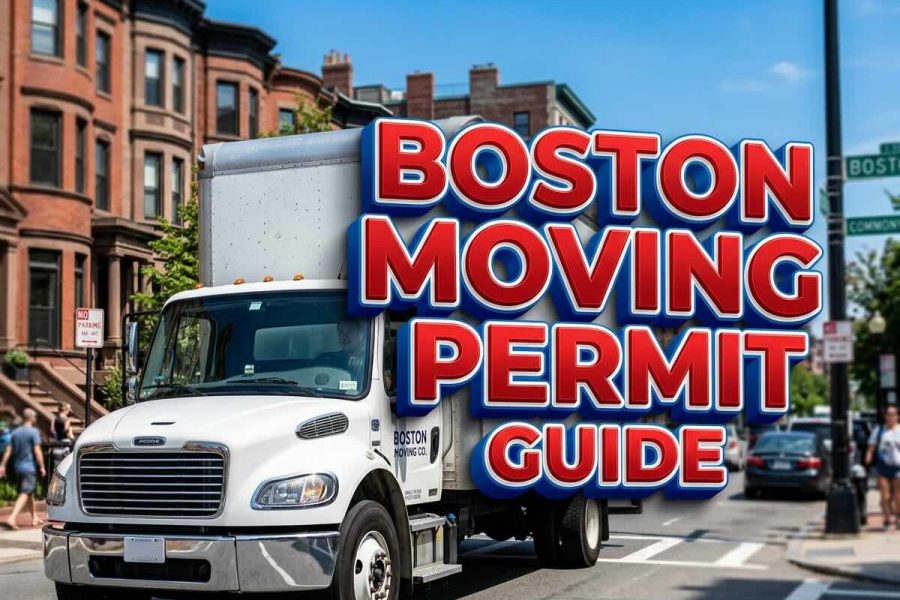
A Boston moving permit, formally called a Temporary Street Occupancy Permit, is a document issued by the City of Boston’s Parking Clerk’s Office that gives you the legal right to occupy a designated section of public street space with your moving truck for a specified time window. The permit reserves approximately 40 linear feet of curb space, the equivalent of two standard parallel parking spaces, directly adjacent to your move address. When the permit is issued, the City provides two official “No Parking” signs that you or your moving company must install on the street at least 48 hours before the permit’s start time. Any vehicle parked in the reserved zone after the signs are posted is subject to citation and towing at the vehicle owner’s expense, with the City of Boston empowered to clear the space based on the valid permit.
Moving permits are not optional in most Boston neighborhoods. The combination of dense on-street parking, narrow streets, and high vehicle ownership in neighborhoods like Beacon Hill, the South End, Jamaica Plain, Allston, Brighton, and Charlestown makes it physically impossible to park a full-size moving truck legally without a designated reserved space. Moving companies that operate in Boston regularly will tell you that unpermitted moves in dense neighborhoods routinely result in trucks double-parked on narrow streets, blocked loading zones, and confrontations with neighbors and parking enforcement officers that delay moves by hours. A permit eliminates all of those risks at a cost of $69, which is less than a single Boston parking ticket.
Types of Boston Moving Permits
The City of Boston issues three categories of temporary permits relevant to moves, each with different application procedures and fee structures. Understanding which type applies to your move before you begin the application prevents the most common initial mistake, which is starting an online application for a container move that requires an in-person visit.
1. Temporary Moving Truck Permit (Most Common)
This is the standard permit for any box truck, rental truck, U-Haul, or commercial moving van parking on a Boston street during a move. It is available through both the online system at boston.gov/moving and in person at the Parking Clerk’s Office. It covers up to two parking spaces (approximately 40 linear feet) for a single day, valid from 7:00 AM to 5:00 PM by default. The online system is the faster and preferred method when your move date is 14 to 56 days away. For move dates fewer than 14 days out, you must apply in person at City Hall at least three business days in advance.
2. Moving Container Permit (PODS, 1-800-PACK-RAT, U-Pack)
If you are using a portable storage container rather than a moving truck, the permit process is different and requires an in-person application at the Parking Clerk’s Office regardless of how far in advance you are applying. The online system does not support container permits. In addition to the standard permit information, container applications require the container company’s name, container dimensions, and planned placement duration. Container permits have the same sign-posting requirement: signs must be up 48 hours before the container arrives. Container rental periods that extend multiple days require renewed permits for each day the container occupies the street.
3. Multi-Day Permits
Single permits cover up to a maximum of two moving days. If your move requires more than two days of street occupancy, you will need to apply for additional permits. Multi-day situations arise most commonly with large households undergoing staged moves over multiple days, high-rise residential moves that require scheduled elevator windows, and commercial relocations. Multi-day permits beyond the standard two-day maximum must be handled in person at the Parking Clerk’s Office, which has discretion over approvals for extended occupancy in high-demand residential zones.
Complete Fee Breakdown 2026
The City of Boston’s fee structure for moving permits is built from several line items that combine into a total charge based on your specific moving situation. The table below breaks down every component so you can calculate your exact expected cost before submitting an application.
| Fee Component | Amount | Notes |
|---|---|---|
| Base application fee | $50 | Covers processing regardless of truck size; applies to all permit types |
| Space calculation fee | $1 per sq ft per month, prorated to daily | Standard 40 ft × 8 ft space for one day = approximately $11 (40 × 8 × 1/30 of monthly rate) |
| No Parking signs (standard 2) | $4 per sign; $8 for 2 signs | Minimum 2 signs required per permit; additional signs available at same rate for longer reserved zones |
| Metered space surcharge | $20 per metered space per day | Added only when reserved spaces include active parking meters; $40 total for the standard 2-space permit on a metered street |
| Late application surcharge | $20 flat | Applied when the application is submitted fewer than 3 business days before move date |
Total Cost Examples
| Scenario | Estimated Total |
|---|---|
| Standard 1-day permit, 2 non-metered spaces, applied on time | $69 |
| Standard 1-day permit, 2 metered spaces (e.g., Back Bay, Downtown), applied on time | ~$109 to $110 |
| Standard 1-day permit, 2 non-metered spaces, applied late (under 3 business days) | $89 |
| 2-day permit, 2 non-metered spaces | ~$130 to $140 |
| 1-day permit via third-party permit service (e.g., EasyMovingPermits.com) | ~$134 ($69 city fee + ~$65 service fee) |
Sources: City of Boston: Reserve a Parking Spot for Your Moving Truck (boston.gov); Anton’s Movers: Boston Parking Permit Guide (Dec 2024); 617 Boston Movers: Boston Moving Permits Complete Guide (Sept 2025); EasyMovingPermits.com: Boston MA (2026).
Moving Within or Out of the Hub?
Whether you are moving to a brownstone in Back Bay or relocating from the Greater Boston area, local expertise is non-negotiable. Explore our dedicated service page for Boston-specific relocation tips, logistics, and local resources:
Moving Companies Boston – Local & Long Distance Services.
How to Apply: Step-by-Step (Online and In-Person)
Online Application (Recommended for Moves 14 to 56 Days Out)
- Go to boston.gov/moving. This is the official City of Boston moving permit portal. Avoid third-party sites unless you specifically want a service to handle the application on your behalf, as third-party services charge an additional service fee of approximately $50 to $65 on top of the city fee. The City’s own portal charges only the city fee.
- Create or log in to your City of Boston account. You will need an account on the city’s online portal to submit an application. If you have applied for any other city permit previously (residential parking, street event, etc.), your existing account works for moving permits. New users can register in approximately two to three minutes with a valid email address.
- Confirm that you meet the online eligibility criteria before starting. The online system is only available if your move is a single-day permit, scheduled between 14 and 56 days from your application date, and you are able to post the required signs at least 48 hours before the move. If any of these conditions are not met, you must apply in person at City Hall.
- Enter your move address and parking location details precisely. The application requires the exact street address of the building you are moving out of or into, the side of the street on which the truck will park (even-numbered side or odd-numbered side), whether the spaces are metered or non-metered, and your preferred parking zone start point (typically the space directly in front of your entrance). Incorrect address details make the permit unenforceable, so verify every field before submission.
- Enter the move date and time window. The default permit window is 7:00 AM to 5:00 PM. If your move requires an earlier start or a later end, note this in the application. Requests outside standard hours are subject to approval and may not be available in all neighborhoods.
- Specify your vehicle type and size. Select moving truck, box truck, or commercial van as appropriate. The system uses this to confirm that the reserved 40-foot space is adequate for your vehicle. If you have an unusually long vehicle, note the length in the remarks field.
- Pay the permit fee. The application fee is charged immediately at submission. The city accepts Visa, Mastercard, Discover, American Express, and pinless debit cards online. No cash payment is accepted through the online system.
- Receive and handle your permit and signs. Once approved, the permit and official “No Parking” signs are mailed to you. Allow 7 to 10 business days for delivery. If your move date is within the 14 to 28-day window, submit early enough to receive materials before you need to post them. Signs must be posted at least 48 hours before your move start time.
- Post the signs 48 hours in advance. Place one “No Parking” sign at the beginning of your reserved zone and one at the end. Signs should be secured to a pole, sign post, or tree at approximately eye level. Do not attach signs to fire hydrants, parking meters, or in a way that obstructs pedestrian passage on the sidewalk.
In-Person Application at Boston City Hall
If your move is fewer than 14 days away, you are moving a container, your move requires more than two days, or you need to make any change to an existing permit, you must apply in person at the Parking Clerk’s Office.
- Location: Parking Clerk’s Office, 2nd Floor, Boston City Hall, 1 City Hall Square, Boston, MA 02201
- Hours: Monday through Friday, 8:00 AM to 4:00 PM (confirm current hours at boston.gov before visiting, as holiday and operational schedule changes apply)
- Deadline: Must apply at least 3 business days before your move date; applications received fewer than 3 business days before are subject to the $20 late fee and are processed at the office’s discretion
- What to bring: Photo ID; your move date, exact address, and parking details; vehicle type and size; payment (cash, Visa, Mastercard, Discover, American Express, or pinless debit card accepted in person)
- Signs at in-person pickup: You receive the permit and official signs at the time of application. You are responsible for posting them at least 48 hours before the move.
- Container applications: Bring your container company name, container dimensions, and the planned number of days the container will occupy the street in addition to the standard application information.
Why Risk a Parking Fine or Getting “Storrowed”?
Navigating Boston’s narrow streets and strict 48-hour sign-posting rules is a logistical nightmare. Don’t do this on your own. When you book your move with us, we take the stress out of the city’s red tape by handling the Boston Moving Permit process for you. We ensure your truck has a legal spot and the right clearance so your moving day stays on track.
Let us handle the permits: 888-316-8329
No Parking Sign Requirements
The official “No Parking” signs that come with your Boston moving permit are the enforcement mechanism for your reserved space. They are the only way to legally clear vehicles from your designated zone, and posting them correctly and on time is as important as obtaining the permit itself. A permit posted with signs at the wrong location, on the wrong side of the street, or without sufficient advance notice may not be enforceable if a vehicle challenges your reservation.
Posting Rules
- Time requirement: Signs must be posted a minimum of 48 hours before your move start time. If your move begins at 8:00 AM on a Saturday, signs must be posted no later than 8:00 AM on Thursday.
- Placement: Place one sign at the start of your reserved zone and one at the end, marking the full length of the approximately 40-foot reserved space. Position signs at approximately eye level for maximum visibility to drivers.
- Acceptable mounting locations: Street sign poles, utility poles, and trees are appropriate mounting points. Use rope, zip ties, or string, not tape on bare poles, which may not hold securely. Do not mount signs on fire hydrants, parking meters, or any structure in a way that blocks pedestrian movement on the sidewalk.
- What happens to vehicles already parked in your zone: Once your signs have been posted for 48 hours, any vehicle that remains in the reserved zone after the permit start time is in violation and subject to citation and towing by Boston parking enforcement. Call 617-635-4500 to report non-compliant vehicles in your reserved zone on your move day. Boston parking enforcement has authority to tow vehicles blocking a valid permitted space.
- Do not remove the signs early: Signs should remain posted for the full duration of the permit window. Removing signs before your permit expires could make your space available to other vehicles during your move. Remove and dispose of signs after your move is complete and the permit has expired.
Neighborhood-Specific Considerations
Boston’s neighborhoods vary significantly in street configuration, parking density, and permit complexity. The information below highlights the most commonly moved-to and moved-from neighborhoods with the specific permit considerations that distinguish each one from a standard application.
2026 Boston Neighborhood Moving Guide: Street Types, Permit Rules, and Application Lead Times
| Neighborhood | Street Type | Permit Notes | Lead Time Recommendation |
|---|---|---|---|
| Allston / Brighton | Mostly non-metered residential; dense student population | Highest permit volume in the city; September 1st moves require 6 to 8 weeks advance booking; expect heavy competition for street space | 6 to 8 weeks (Sept 1); 2 to 3 weeks otherwise |
| Beacon Hill | Very narrow cobblestone streets; mix of metered and non-metered | Some streets are too narrow for full-size trucks; confirm truck dimensions fit before booking movers; loading zone access may require coordinate with building management | 3 to 4 weeks |
| Back Bay | Primarily metered; grid layout; wide streets | Expect metered space surcharge ($40); higher total permit cost (~$109 to $110); most buildings have loading dock or rear alley access | 2 to 3 weeks |
| South End | Mix of metered and non-metered; brownstone density | High parking demand; double-parking common; permit sign posting strictly enforced by neighbors; allow extra time for sign enforcement on move day | 3 to 4 weeks |
| Jamaica Plain | Residential; non-metered; moderate density | Standard process; online application straightforward; Centre Street corridor has meters; confirm parking type at specific address | 2 weeks standard |
| Charlestown | Dense residential; narrow streets near Navy Yard | Old Charlestown area has colonial-era street widths; confirm truck size access; Navy Yard has separate building management protocols | 2 to 3 weeks |
| East Boston | Residential; non-metered majority; some narrow streets | Standard permit process; moderate demand; less competition for spots compared to Allston and South End | 2 weeks standard |
| South Boston (Southie) | Mix of residential and commercial; some metered | Waterfront Seaport area has building-managed loading access; traditional Southie residential streets follow standard permit process; high summer demand | 2 to 3 weeks |
| Fenway / Kenmore | Dense; many metered streets near Kenmore Square | Heavy student population; September volume nearly matches Allston; confirm metered vs. non-metered; game day restrictions apply on Red Sox home game dates | 4 to 6 weeks (Sept); 2 weeks otherwise |
| Roxbury / Dorchester | Mix of residential and commercial; mostly non-metered | Lower permit competition than downtown neighborhoods; standard process; wider streets in most sections allow larger truck access | 2 weeks standard |
Sources: Move and Care (Aug 2025); Stair Hoppers (July 2025); Lifetime Moving Co (Dec 2025); Boston Best Rate (Dec 2024).
Moving Permits for Cambridge, Somerville, and Brookline
Many Boston-area moves cross city lines between Boston and its immediate neighbors, each of which operates its own independent permit system. A City of Boston moving permit is not valid in Cambridge, Somerville, or Brookline. If either end of your move is in one of these cities, you need the appropriate permit from that city’s local authority in addition to any Boston permit you may require.
2026 Greater Boston Moving Permits: Fees and Rules for Cambridge, Somerville, and Brookline
| City | Typical Fee | Where to Apply | Key Rules |
|---|---|---|---|
| Cambridge | $40 to $50 city fee (plus local service fees if using third-party) | Cambridge Traffic, Parking, and Transportation Department; cambridgema.gov | Permit required for any moving truck on Cambridge residential streets; 48-hour sign notice required; Central Square and Harvard Square areas are metered and require surcharge |
| Somerville | $40 to $50 city fee | Somerville Traffic and Parking Division; somervillema.gov | Very narrow streets in Winter Hill, Union Square, and Powder House; confirm truck dimensions before booking; permit required 3 days in advance minimum |
| Brookline | $40 to $50 city fee | Brookline Transportation Division; brooklinema.gov | Separate permit required for Brookline addresses even when the move is otherwise entirely within the Boston metro; Coolidge Corner and Brookline Village areas have meters |
Sources: Move and Care: Guide to Boston Moving Permits and Parking Reservations (Aug 2025); Hingham Moving: Boston Moving Permit FAQs (Sept 2024).
Special Situations
September 1st Moves
September 1st is the single most concentrated moving day in the United States by volume, driven by Boston’s unique lease cycle in which the majority of the city’s rental leases expire simultaneously on August 31st. On September 1st, tens of thousands of households move simultaneously across Boston, Allston, Brighton, Fenway, Cambridge, and Somerville. The City of Boston’s permit system for September 1st fills weeks in advance, and permits for the most popular streets in Allston and Brighton are routinely exhausted by mid-July. If you are moving on or near September 1st, apply for your permit as early as possible, ideally 6 to 8 full weeks in advance, and confirm that the permit system is accepting applications for your specific date and address before finalizing your move date with your moving company. Your moving company may also need to be booked months in advance for a September 1st move, as Boston movers are fully allocated for this date by early summer.
High-Rise and Elevator Buildings
Moves into or out of high-rise residential buildings in Boston typically require coordination with building management in addition to the City’s street permit. Most high-rise buildings have a dedicated service elevator and a building-specific loading dock or loading zone policy. Building management typically requires advance scheduling of the service elevator, a separate building access deposit, and proof of your moving company’s insurance. Confirm these requirements with your building’s property manager before applying for the street permit, because building access constraints may affect your optimal move time window, which in turn affects what you specify on the street permit application.
Metered Parking Streets
If the street directly in front of your move address has active parking meters, your permit will include the metered space surcharge of $20 per meter per day, totaling $40 for the standard two-space permit. Back Bay, Kenmore Square, Downtown Crossing adjacent streets, and parts of the South End and South Boston waterfront are the most commonly encountered metered permit zones. When in doubt about whether your specific street is metered, search the address in the City of Boston’s parking meter map tool, available at boston.gov, before submitting your application. Applying for a non-metered permit on a metered street will result in an invalid permit that is not enforceable.
Moving During Events and Holidays
Boston’s event calendar creates permit complications that purely residential cities do not face. Marathon Monday (Patriots’ Day, third Monday in April) results in significant street closures across Back Bay, the South End, and downtown. Red Sox home games at Fenway Park affect parking enforcement and access in the Kenway-Fenway, Kenmore, and Audubon Circle neighborhoods. Boston Calling Music Festival in May and other major events in and around City Hall Plaza can affect downtown and Government Center adjacent addresses. Check the City of Boston events calendar at boston.gov/calendar before finalizing a move date, and contact the Parking Clerk’s Office if your move date coincides with a major event in your neighborhood to confirm that a permit is available and enforceable for that specific date.
What Happens If You Move Without a Permit
Moving without a permit in Boston is a common mistake, particularly among first-time movers who assume that briefly parking a truck in front of their building is informally acceptable. It is not. Boston Parking Enforcement is active throughout the city during business hours and regularly monitors moving activity in residential neighborhoods, particularly during September, June, and May when move volumes spike. An unpermitted moving truck on a Boston street is subject to all of the following enforcement actions:
- Parking citation: Moving trucks parked in a resident permit zone without a temporary occupancy permit are subject to parking tickets beginning at approximately $40 and scaling with the violation type. Double-parking a moving truck in a lane of traffic or blocking a fire hydrant carries substantially higher fines.
- Towing: A moving truck can be towed from any location where it is creating a traffic hazard or blocking access, including situations where the truck is obstructing a neighbor’s driveway, blocking a crosswalk, or obstructing a loading zone designated for another building. Recovering a towed moving truck from the Boston Transportation Department’s towing contractor costs approximately $200 to $350 in towing and storage fees, significantly more than the permit would have cost.
- Delayed move and additional labor costs: The practical cost of an unpermitted move is not just fines and potential towing but the labor cost of a moving crew that is unable to park and load efficiently. Professional movers who cannot park legally may spend 30 to 90 minutes repositioning, idling, and managing parking enforcement interactions during a move. At Boston mover rates of $80 to $150 per hour for a 3-person crew, those delays cost $40 to $225 in additional labor for a problem that a $69 permit would have prevented entirely.
- Neighbor and building management conflict: A moving truck blocking a neighbor’s vehicle, obstructing a shared driveway, or idling loudly in front of a building at 7:00 AM without a permit creates a poor first impression with new neighbors and can generate formal complaints to building management that affect your tenancy from its first day.
Pro Tips for a Smooth Boston Permit Move
- Apply online 4 to 6 weeks before your move date for maximum reliability. The window opens at 8 weeks out, and early applications get first choice of time windows and sign delivery timing. Applying in week six or seven is not risky for most dates but leaves less margin for any processing complications.
- Confirm whether your specific street is metered before applying. Use the Boston parking meter map at boston.gov, or call the Parking Clerk’s Office directly. Applying for the wrong permit type is a wasted fee with no refund.
- Ask your moving company if they handle permits. Experienced Boston movers deal with the permit system daily and many either handle the application as part of their service or can advise on the best application approach for your specific address. Some companies pass the permit fee through to the customer; others include it in the move quote. Clarify this during the quoting process to avoid paying for two permits for the same move.
- Post your signs at exactly the 48-hour mark, not later. Signs posted 24 hours before a move give vehicles already parked in the zone no legal obligation to move and leave you with no recourse against vehicles that park there during the 24 hours between posting and permit start. Signs at 48 hours give you two full days to identify and report any non-compliant vehicles before your move begins.
- Take a photo of your posted signs immediately after installation. A timestamped photo on your phone proves that signs were posted at the required time if you need to call parking enforcement on move day to report a non-compliant vehicle occupying your reserved space.
- Check the Boston events calendar before confirming your move date. A moving date that falls on Marathon Monday, a Red Sox playoff game, a major street festival, or a city-wide event can complicate permit enforcement and truck access in unexpected ways. Two minutes of calendar checking before booking can save a full day of stress.
- If you need only a few hours rather than a full day, note this on the application. The standard permit runs 7:00 AM to 5:00 PM. If your move will be complete by noon, you do not need to occupy the space for the full day, but noting your actual anticipated hours allows parking enforcement to understand the scope of your reservation if a dispute arises.
- For container moves, call the Parking Clerk’s Office before applying. Container dimensions, weight, and placement duration affect permit requirements in ways the standard online form does not fully accommodate. A five-minute phone call confirms exactly what you need to bring to the in-person application and prevents a wasted trip with incomplete documentation.
FAQ
Do I need a permit to move in Boston?
Yes, in nearly all cases. The City of Boston requires a temporary street occupancy permit for any moving truck parked on a public residential street, metered street, or other public roadway within city limits. The permit reserves your space, prevents citations, and gives you legal recourse if another vehicle blocks your loading zone. The only situations where a permit may not be required are moves entirely within a private parking lot, moves where the building has a private loading dock that does not require any street occupation, or very short loads where the truck is attended at all times and not left stationary in a parking space, but in practice, any unattended moving truck on a Boston street without a permit is at risk of citation.
How early should I apply for a Boston moving permit?
For most moves, applying 2 to 4 weeks in advance through the online system is adequate and allows sufficient time for mail delivery of your permit and signs. For moves near September 1st, apply 6 to 8 weeks in advance, the maximum the online system allows it because permit availability for this date is genuinely limited and demand from tens of thousands of simultaneous movers is the highest of any date in the city’s calendar. For moves with less than 14 days of lead time, go in person to the Parking Clerk’s Office at Boston City Hall at least 3 business days before your move date.
What if a car is parked in my reserved spot on moving day?
If your signs were posted at least 48 hours before your permit start time and a vehicle remains in your reserved zone, call Boston Parking Enforcement at 617-635-4500. Provide your permit number, move address, and the license plate of the non-compliant vehicle. Boston parking enforcement has authority to cite and tow vehicles blocking a validly permitted moving space. Having a timestamped photo of your signs at the time of posting strengthens your case and speeds the enforcement response.
Can my moving company apply for the permit on my behalf?
Yes we can. Coastal Moving Services, a family member, or a third-party permit service can apply for a Boston moving permit on your behalf using the same online system or in-person process. We handle the full application for approximately $65 to $70 above the city fee, which can be worth it if you are managing a complex out-of-state move remotely and want a professional to handle the paperwork and sign delivery logistics.
What is the fee for a Boston moving permit in 2026?
The base fee for a standard one-day moving permit covering two non-metered spaces is $69 in 2026, which includes two official “No Parking” signs. If your reserved spaces include active parking meters, an additional $40 metered space surcharge applies, bringing the total to approximately $109 to $110. Late applications submitted fewer than 3 business days before the move date incur a $20 surcharge. Third-party permit services charge the city fee plus a service fee of approximately $50 to $65, totaling approximately $120 to $135 for a non-metered one-day permit through a third-party provider.
Does a Boston moving permit guarantee a cleared space?
A permit gives you legal authority to have the space cleared and enforceable recourse against vehicles that remain after the 48-hour notice period. It does not physically guarantee that the space will be empty when you arrive. The 48-hour sign posting requirement exists precisely to give vehicles already in the space adequate advance notice to move. If a vehicle ignores the signs, Boston parking enforcement can remove it, but this enforcement action takes time on busy move days. Posting signs exactly 48 hours before your move start time and calling enforcement immediately if any vehicle is present at your start time minimizes delay.